AI Coding Assistant Statistics
Last updated on July 15, 2026

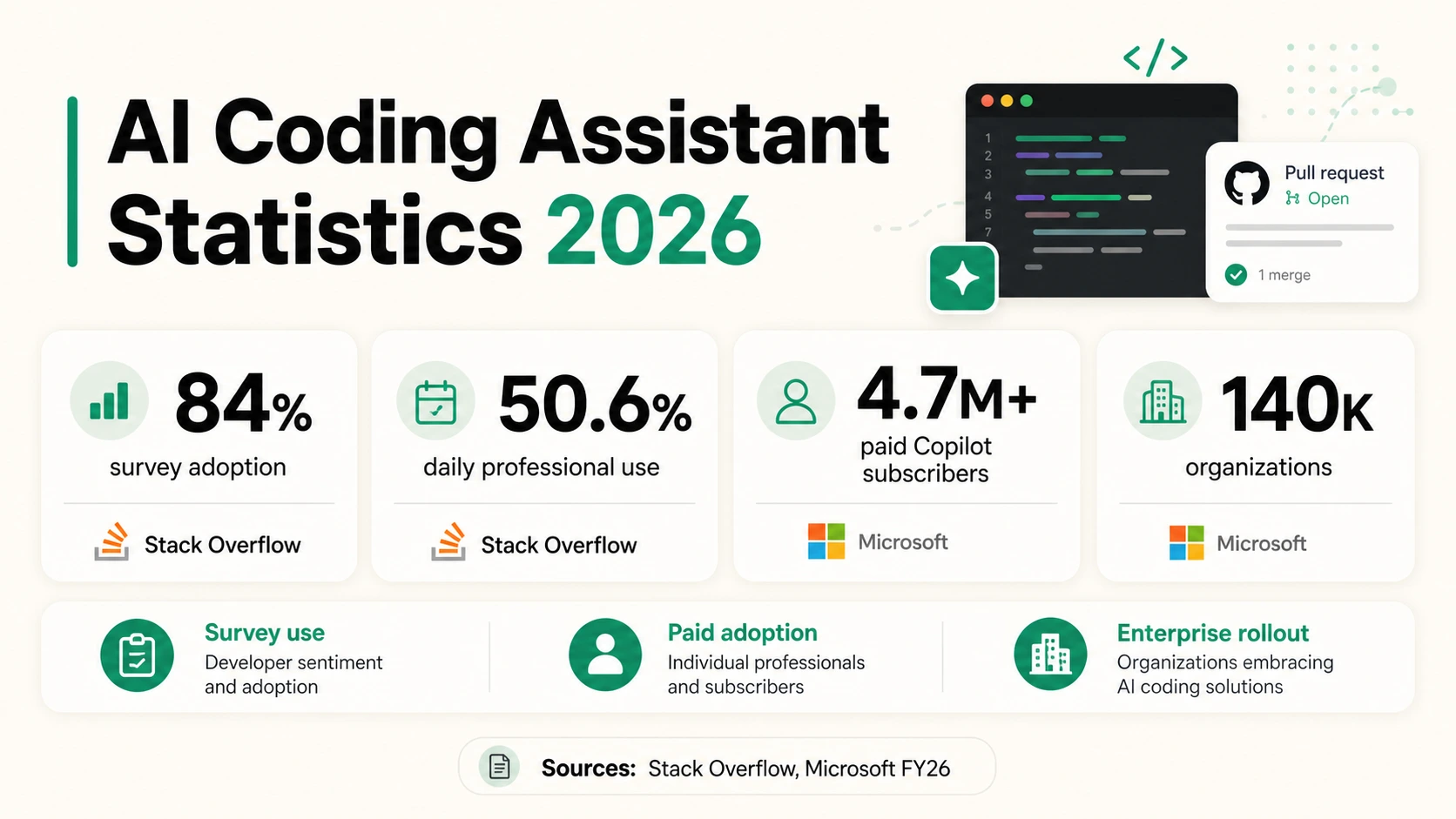
AI coding assistants are no longer a side experiment for curious developers. By 2026, the better question is what kind of adoption you mean: survey usage, daily habit, paid seats, enterprise rollout, accepted code suggestions, benchmark performance, or reviewed code that actually ships.
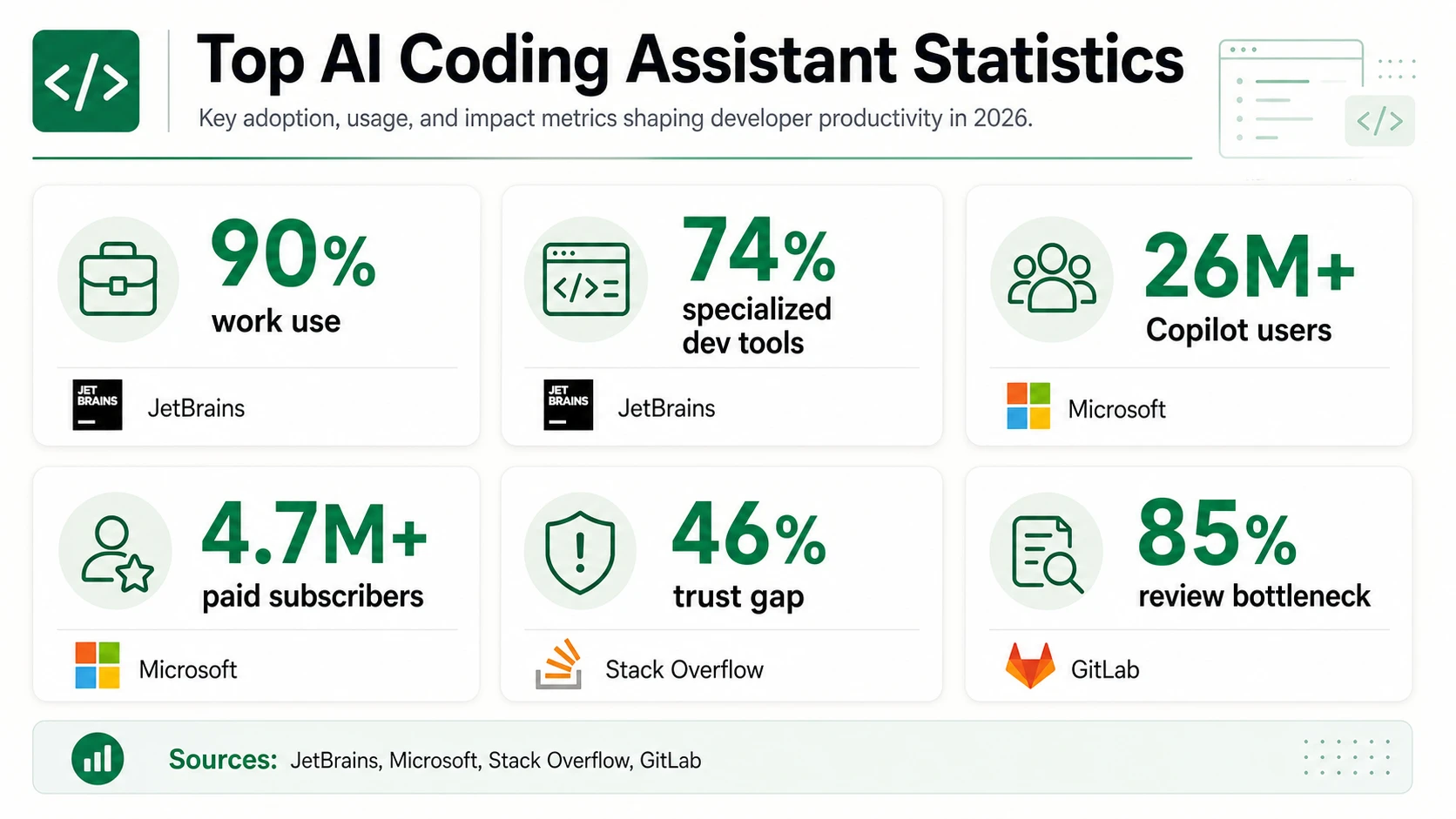
That distinction matters because the headline numbers are large. Stack Overflow says 84% of respondents use or plan to use AI tools in their development process, while 50.6% of professional developers use them daily. JetBrains says 90% of professional developers in its January 2026 AI Pulse survey regularly used at least one AI tool at work, and 74% had adopted specialized AI developer tools. Microsoft says GitHub Copilot has over 4.7 million paid subscribers and is used by nearly 140,000 organizations.
But big numbers can mislead when they are placed in the wrong bucket. A benchmark score is not a user count. A paid subscriber is not a daily active developer. A generated line of code is not reviewed, secure, deployed software. The real 2026 story is that AI coding tools are mainstream, commercial, and increasingly agentic, while the hard work has moved downstream into review, governance, traceability, and measuring whether teams ship better software.
AI Coding Assistants At A Glance
The headline numbers use different denominators, so read them as separate survey, commercial, capability, and governance signals rather than one figure.
Developer adoption (survey evidence)
Commercial scale, capability & governance
Read every number by its own denominator
AI coding assistant statistics answer different questions. Tap a metric category to see what it measures — and what it does not prove.
Stack Overflow, JetBrains, Microsoft, GitLab, SWE-benchReading The Adoption Numbers Carefully
The safest way to read AI coding assistant statistics is as a ladder. At the top are broad survey signals: whether developers have tried AI tools, use them daily, or plan to use them soon. Stack Overflow’s 84% “use or plan to use” figure is a strong adoption signal, but it is not the same metric as its 50.6% daily-use figure among professional developers.
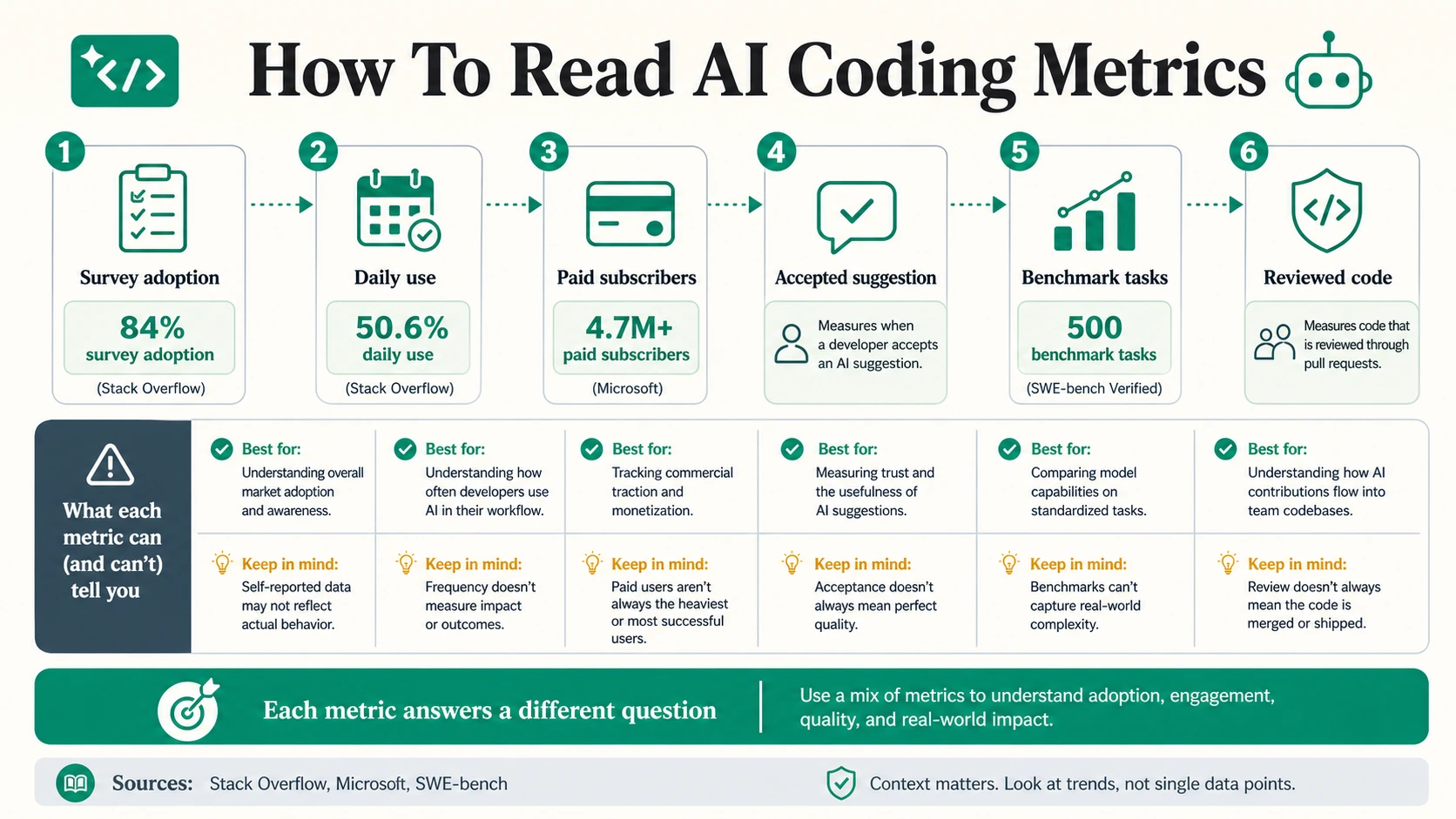
The next rung is work-specific usage. JetBrains’ January 2026 AI Pulse is helpful because it separates general AI tools from specialized developer tools. It reports 90% regular AI-tool use at work for coding and development, and 74% adoption of specialized AI developer tools. That is still survey evidence, but it is closer to professional workflow than a generic “developers like AI” poll.
Commercial scale is a different rung. Microsoft gives public numbers for GitHub Copilot users, paid subscribers, and organizations: over 26 million users, over 4.7 million paid subscribers, and nearly 140,000 organizations. These are among the strongest public indicators for a named AI coding assistant, but each answers a different question.
Below that are product-interaction metrics. GitHub’s own usage-metrics documentation defines an active Copilot user by user-initiated interaction count, and defines code-completion acceptance rate as accepted code activity divided by generation activity. Those definitions stop a common mistake: an accepted suggestion is not the same as a merged pull request, and a merged pull request is not the same as reliable production software.
Benchmarks sit on a separate branch. SWE-bench Verified’s 500 human-validated instances help compare coding agents on software-engineering tasks, and the broader SWE-bench family is useful for understanding capability progress. But benchmark pass rates are not user counts, customer counts, or enterprise ROI.
Developer Adoption: AI Has Become A Normal Part Of The Workflow
The strongest survey evidence points in the same direction: AI assistance is now normal in software development. Stack Overflow’s 2025 survey reports 47.1% daily AI-tool use among all respondents, 17.7% weekly, 13.7% monthly or infrequent, 5.3% planning to use soon, and 16.2% with no plan to use them. Among professional developers, the daily-use figure rises to 50.6%.
How often developers use AI tools
Stack Overflow 2025, all respondents. Daily use alone is larger than every other category combined — but 16.2% still report no plan to use AI tools, so adoption is deep, not universal.
Stack Overflow 2025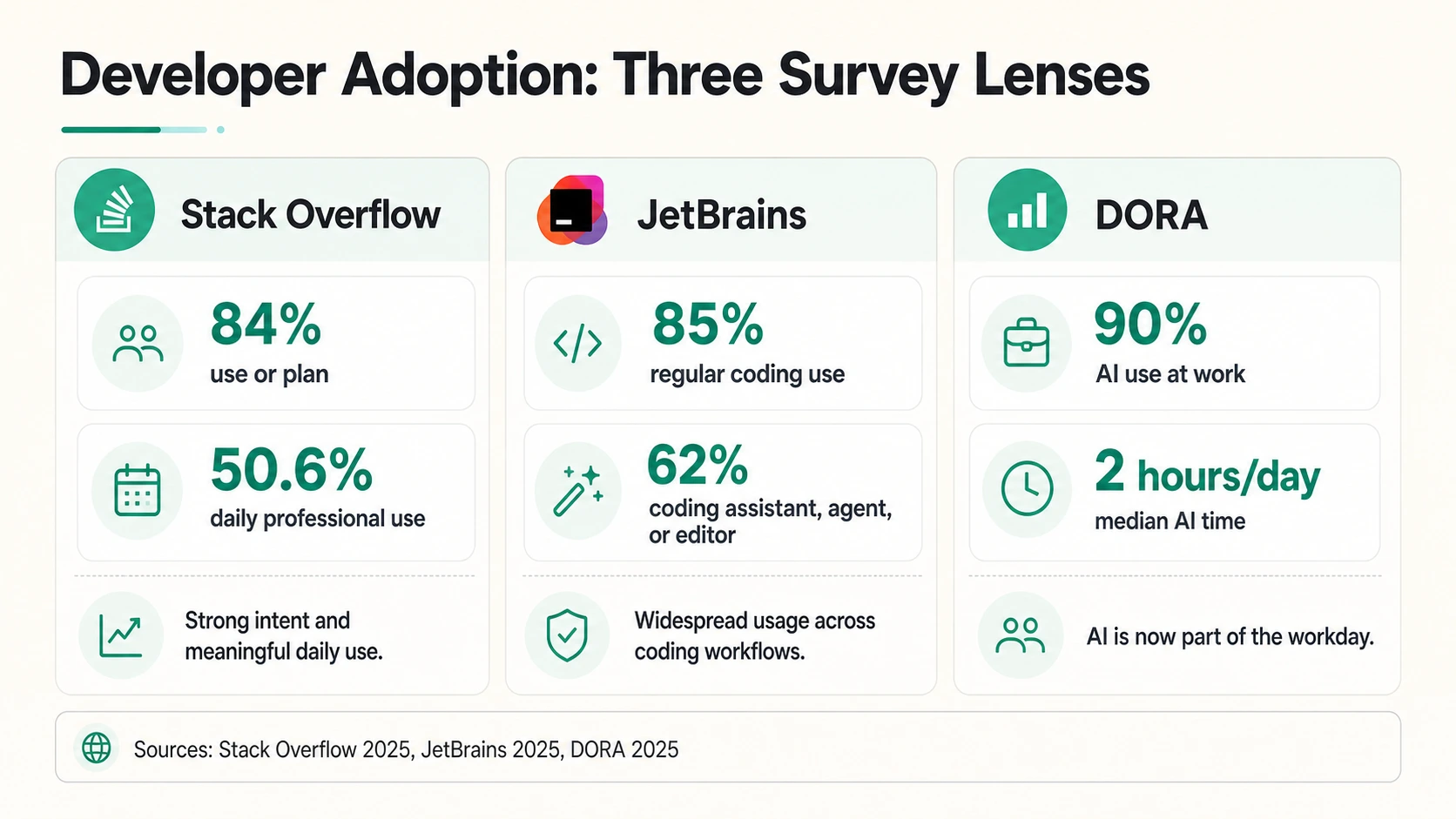
JetBrains tells a similar story with different survey design. Its 2025 Developer Ecosystem report is based on 24,534 developers after data cleaning, with weighting by geography, employment, languages, and product use, plus an explicit caveat that JetBrains users could be more likely to respond. Within that frame, JetBrains reports 85% regular AI use for coding and 62% reliance on at least one AI coding assistant, agent, or code editor.
The January 2026 AI Pulse update makes the market map more granular. It covered 10,000+ professional developers worldwide, localized into eight languages, weighted to align with Developer Ecosystem 2025 distributions. In that survey, 90% regularly used at least one AI tool at work, 74% had adopted specialized developer AI tools, GitHub Copilot was used at work by 29%, and Cursor and Claude Code were each used by 18%.
DORA adds a technology-organization lens. Google’s 2025 DORA summary says the report drew on nearly 5,000 technology professionals globally, with 90% reporting AI use at work and a median of two hours daily spent working with AI. DORA also says 65% heavily rely on AI for software development and more than 80% report productivity gains.
The caveat is that these are not identical populations. Stack Overflow surveys a broad developer community. JetBrains surveys developers and provides weighting details. DORA surveys technology professionals and studies team systems, not only coding assistants. The fact that all three point to high adoption is meaningful; the fact that they use different denominators is why they should not be collapsed into one number.
GitHub Copilot Is The Clearest Paid-Adoption Anchor
GitHub Copilot is not the entire AI coding assistant market, but it is the best-documented commercial anchor. Microsoft said in FY26 Q1 that GitHub Copilot was “now with over 26 million users” and that GitHub itself had over 180 million developers. The same call said 80% of new developers on GitHub start with Copilot within their first week and that more than 500 million pull requests had been merged over the previous year.
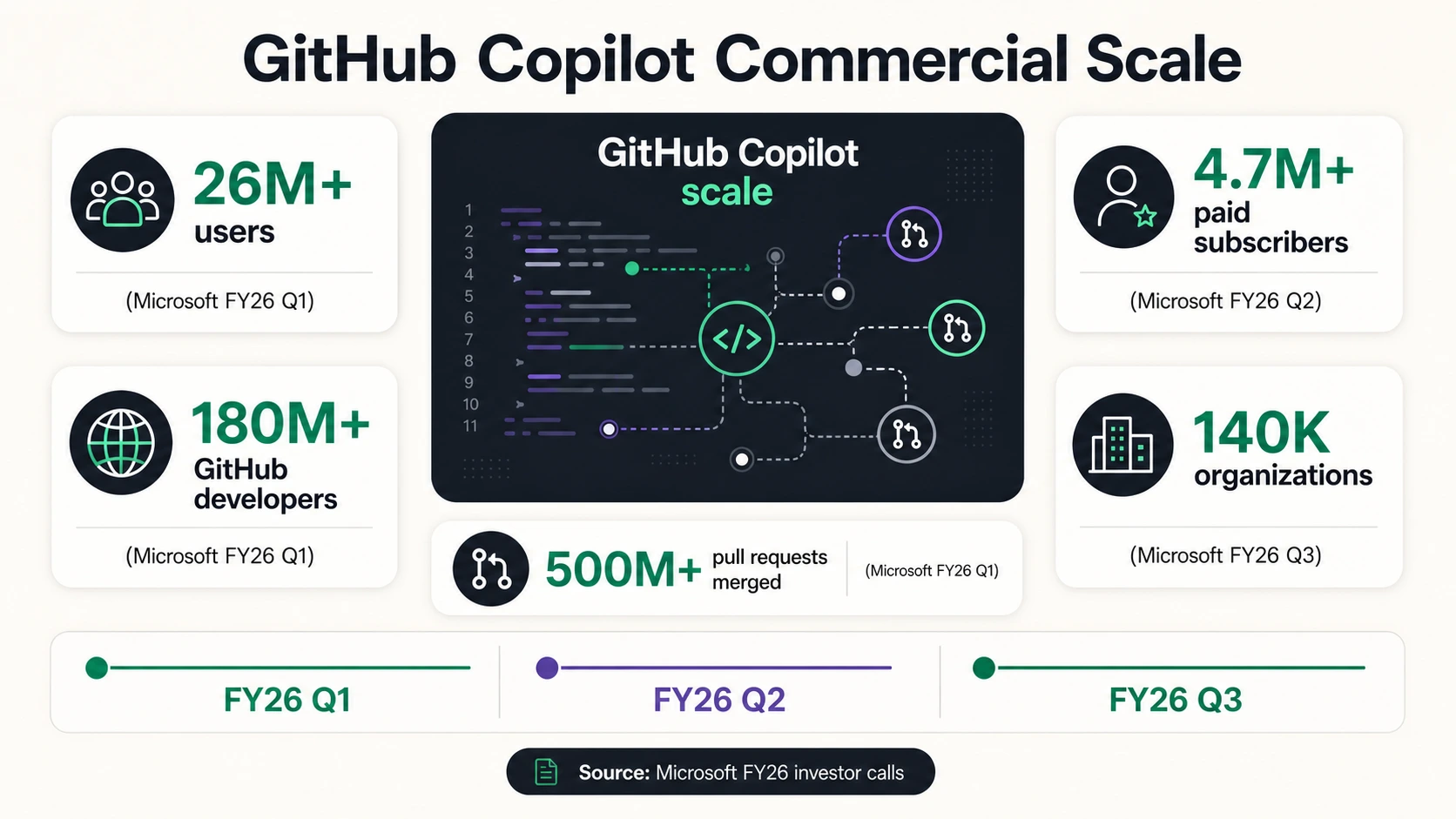
GitHub Copilot commercial scale (Microsoft investor calls)
The paid number is clearer than the user number. In FY26 Q2, Microsoft said Copilot had over 4.7 million paid subscribers, up 75% year over year, and that Copilot Pro+ subscriptions for individual developers increased 77% quarter over quarter. Microsoft also cited Siemens adopting GitHub broadly after a Copilot rollout to 30,000+ developers, a concrete enterprise example that should not be generalized to every customer.
By FY26 Q3, Microsoft said nearly 140,000 organizations use GitHub Copilot, enterprise subscribers had nearly tripled year over year, most users use multiple models, and Copilot CLI usage nearly doubled month over month. Microsoft also said it was moving Copilot toward usage-based pricing to align pricing with usage and costs.
The product itself is also changing. GitHub has moved beyond autocomplete and chat into a coding agent that works from issues and branches, and Agent HQ, which GitHub positions as an organizing layer for coding agents. It has also added model choice across OpenAI, Anthropic, and Google models. In 2026, “AI coding assistant” increasingly means an ecosystem of models, policies, agents, and review surfaces — not just one autocomplete box.
The Market Is Broader Than Copilot
The safest market map is by workflow surface, not by invented market share. GitHub Copilot is the largest publicly documented paid anchor, but JetBrains’ 2026 survey shows developers using a multi-tool stack: Copilot had 76% awareness and 29% work adoption; Cursor had 69% awareness and 18% adoption; Claude Code reached 18% adoption (24% in the US and Canada); OpenAI Codex had 27% awareness and 3% adoption within the survey window; and Google Antigravity reached 6% after launching in November.
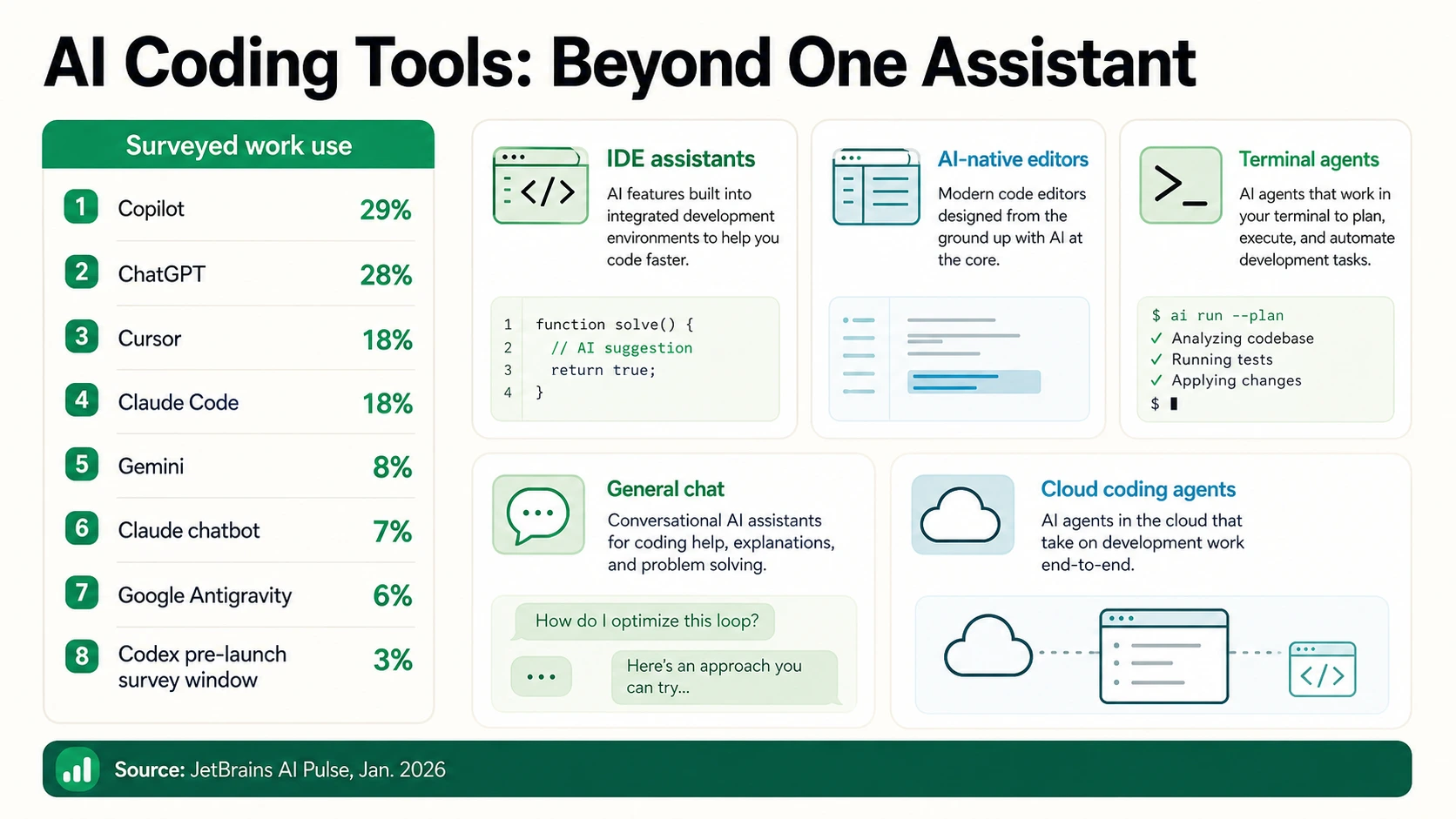
That survey also shows general chat interfaces still matter: 28% of developers use ChatGPT at work for coding, 8% use Gemini, and 7% use Claude’s chatbot. Stack Overflow’s agent-tool section similarly shows ChatGPT and GitHub Copilot as common out-of-the-box tools among respondents using or building agents, with Claude Code, Google Gemini, Microsoft Copilot, Replit, Tabnine, Amazon CodeWhisperer, Cody, and Devin in the long tail.
The market has layers, not one leaderboard
Completion and chat inside the editor you already use — GitHub Copilot, JetBrains AI Assistant, Tabnine, Sourcegraph Cody. Evaluate on IDE fit, repo context, and admin controls.
Editors and workspaces built around AI — Cursor and Replit. Cursor publishes funding and enterprise-positioning updates; Replit pushes AI-app-building and assistant workflows.
Agent products, not simple autocomplete — AWS Q Developer, Gemini Code Assist, OpenAI Codex, Claude Code. Evaluate on task delegation, execution environment, and review surface.
Still a major coding surface — ChatGPT, Gemini, and Claude’s chatbot are used at work for coding by 28%, 8%, and 7% of developers. Convenient, but outside the repo and review path.
AI coding tooling in 2026 spans several workflow surfaces. Tap a layer to see the products and what to evaluate there.
JetBrains 2026 AI Pulse, vendor product pagesFor founders, this map is more useful than a fake ranking. Selling “another coding assistant” is a weak position unless the product owns a specific layer: repo context, security review, test generation, migration, code search, codebase onboarding, terminal automation, cloud execution, policy, evals, billing, or agent orchestration.
Productivity: Faster Code Creation Is Real, But It Is Not Automatic ROI
The most cited positive productivity study is GitHub’s controlled Copilot task experiment. Developers using Copilot completed a JavaScript HTTP-server task 55% faster, averaging 1 hour 11 minutes versus 2 hours 41 minutes without Copilot. This is a real result, but it is one task setting — it supports “Copilot can speed certain coding tasks,” not “every developer is 55% faster.”
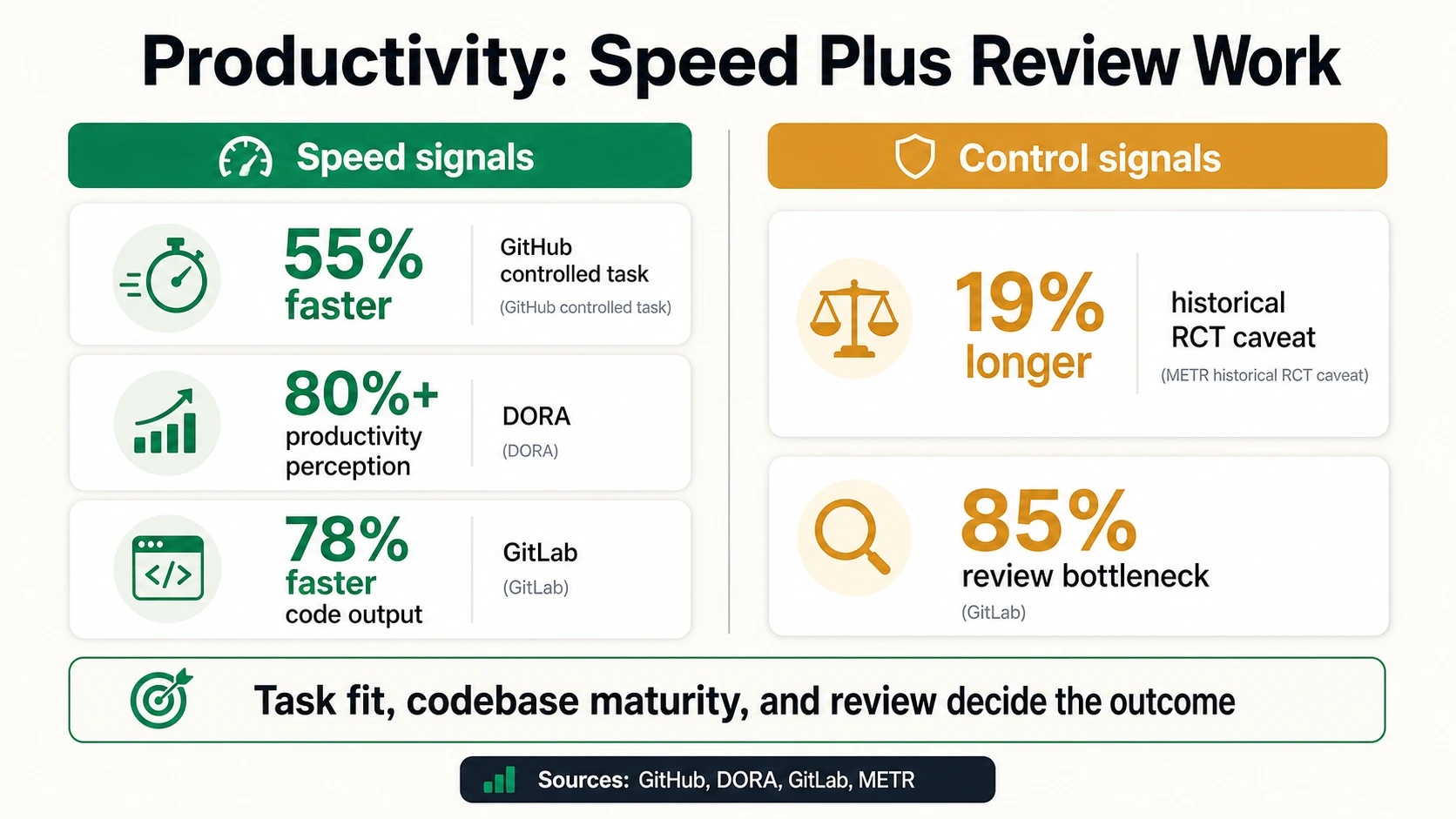
Survey evidence shows developers feel the benefit. JetBrains says nearly nine in ten developers who use AI for coding save at least one hour per week, and one in five saves eight hours or more. DORA says more than 80% believe AI increased productivity and 59% report positive influence on code quality. GitLab says 78% report faster code output and 73% say overall code quality improved since adopting AI coding tools.
The problem is not whether AI can make code appear faster. It can. The problem is whether faster code creation becomes faster, safer delivery. DORA’s 2025 announcement says AI adoption has a positive relationship with throughput and product performance, but a negative relationship with software-delivery stability. DORA’s broader framing is that AI amplifies the system a team already has: strong teams can benefit, while weak feedback loops and tightly coupled systems get exposed.
GitLab’s 2026 survey makes the downstream bottleneck concrete: 85% agree AI shifted the bottleneck from writing code to reviewing and validating it, 84% agree the biggest challenge is governing AI-generated code after it is created, and 82% say AI-generated code risks new technical debt their organization is not prepared to manage. GitLab’s earlier survey also said teams lose 7 hours per week per member to inefficient processes, 49% use more than five AI tools, and only 37% would trust AI to handle daily tasks without human review.
METR is the sharpest counterexample because it measured real tasks rather than self-report. In its early-2025 randomized controlled trial, 16 experienced open-source developers worked on 246 tasks in mature repositories. They expected AI to cut completion time by 24%, and afterward still believed AI had sped them up by 20% — but measured completion time was 19% longer when AI was allowed (METR arXiv).
That does not prove AI coding tools are bad. METR’s own page now warns the early-2025 result is out of date, and its 2026 update says newer data is difficult to interpret because developers increasingly opt out of AI-disallowed work, choose tasks differently, and use multiple agents concurrently. The right reading is nuanced: AI productivity depends on task type, codebase familiarity, quality bar, review burden, and how much of the workflow around code generation has been redesigned.
Code Supply, Pull Requests, And Benchmarks
AI coding assistants are changing the supply of code. Microsoft said tens of thousands of AMD developers use Copilot and accept hundreds of thousands of lines of code suggestions each month. GitHub’s usage-metrics docs define code-completion acceptance rate as accepted code activity divided by generated code activity. These are valuable for internal rollout dashboards, but they are still interaction metrics.
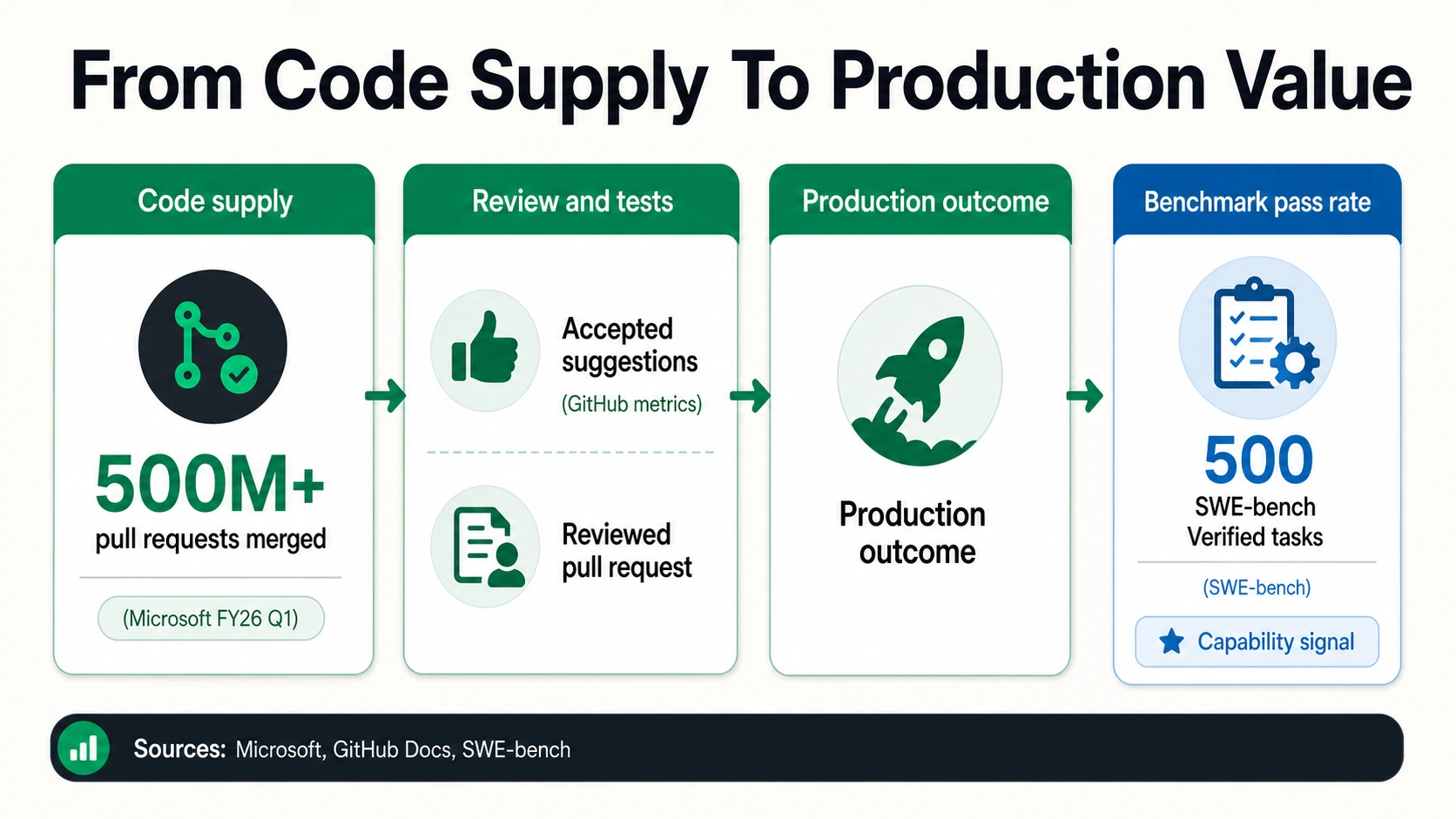
The next layer is pull-request workflow. Microsoft said more than 500 million pull requests were merged on GitHub over the prior year, in the same discussion of AI coding agents and Copilot adoption. GitHub has launched a Copilot coding agent that works from issues and branches, and Agent HQ for managing multiple coding agents. This moves AI assistance closer to the delivery system, but it does not remove review responsibility.
Accepted suggestion
A product-interaction metric — how much generated code a developer keeps. GitHub defines acceptance rate explicitly, but an accepted line is not a merged one.
Merged pull request
Microsoft cites 500M+ merged over the prior year. A merge shows the change entered the codebase, not that AI wrote it or that it was low-risk.
Reviewed, tested change
The stage where humans and CI catch defects. This is where GitLab says the bottleneck now sits after AI sped up generation.
Production outcome
The only metric that maps to value: did the change ship, stay stable, and improve the product without adding hidden risk?
Benchmarks show why everyone is investing in coding agents. SWE-bench Verified contains 500 human-validated instances, designed as a more reliable evaluation set for coding agents and language models. HumanEval remains important as an older code-generation benchmark, but it is a historical format, not a full proxy for enterprise software work. OpenAI’s note on no longer using SWE-bench Verified as a primary evaluation is a useful caution: benchmarks can saturate or lose discriminating power as models and scaffolds improve.
Trust, Security, And Governance Are The New Center Of The Market
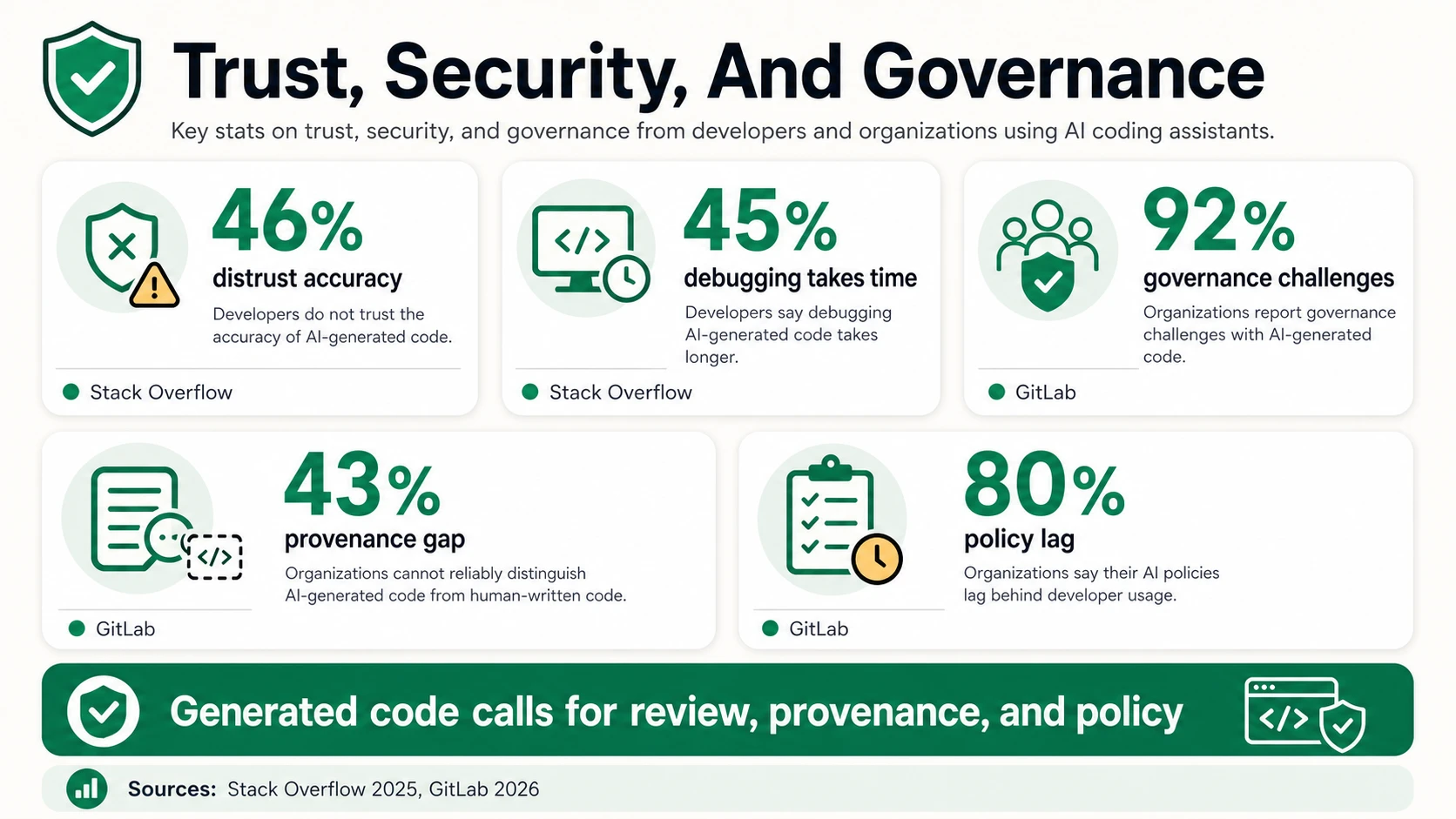
The adoption numbers are high, but trust is not. Stack Overflow’s 2025 press release says 46% of developers do not trust AI-output accuracy, up from 31% in 2024. The detailed survey says 66% cite AI solutions that are “almost right, but not quite,” and 45.2% cite debugging AI-generated code as time-consuming.
For AI agents, the concern is sharper. Stack Overflow says 87% are concerned about the accuracy of information from AI agents, and 81% have security and privacy concerns about data when using agents. DORA’s trust paradox points the same way: only 24% report a lot or great deal of trust in AI, while 30% report little or no trust.
Governance is where this becomes a business issue. GitLab’s 2026 survey says 43% cannot reliably distinguish AI-generated from human-written code in their own codebase, 92% report some governance challenge, and 80% agree their organization adopted AI tools faster than it developed policies. GitLab also says 87% are confident they could determine within 24 hours whether AI-generated code contributed to a production incident — but 34% of organizations that had an incident in the past year could not actually make that determination.
Security studies explain why review cannot disappear. “Asleep at the Keyboard?” is an older study of Copilot-style code generation risks. “Do Users Write More Insecure Code with AI Assistants?” is another important historical study of user behavior with AI coding assistance. More recent USENIX Security 2025 work continues to examine how AI-generated code changes the risk profile. The exact rates in older papers should not be applied blindly to 2026 tools, but the durable lesson holds: generated code needs provenance, review, tests, policy, and security scanning.
Vendors are responding by moving from pure generation to controls. GitHub is building metrics dashboards, enterprise controls, model choice, and Agent HQ. GitLab is positioning governance, traceability, and lifecycle integration as the next layer after code generation. JetBrains is positioning Air, Central, Junie, and open agentic infrastructure around orchestration, local context, and model choice.
What This Means For Engineering Leaders And Founders
For engineering leaders, the numbers point to a rollout funnel. Start with access: who can use which tools, with what data boundaries? Then measure regular use: daily and weekly active use, accepted suggestions, tasks delegated, agent workflows. Then move to delivery outcomes: pull-request cycle time, review time, test quality, escaped defects, incident rate, developer satisfaction, and whether AI changes the bottleneck.
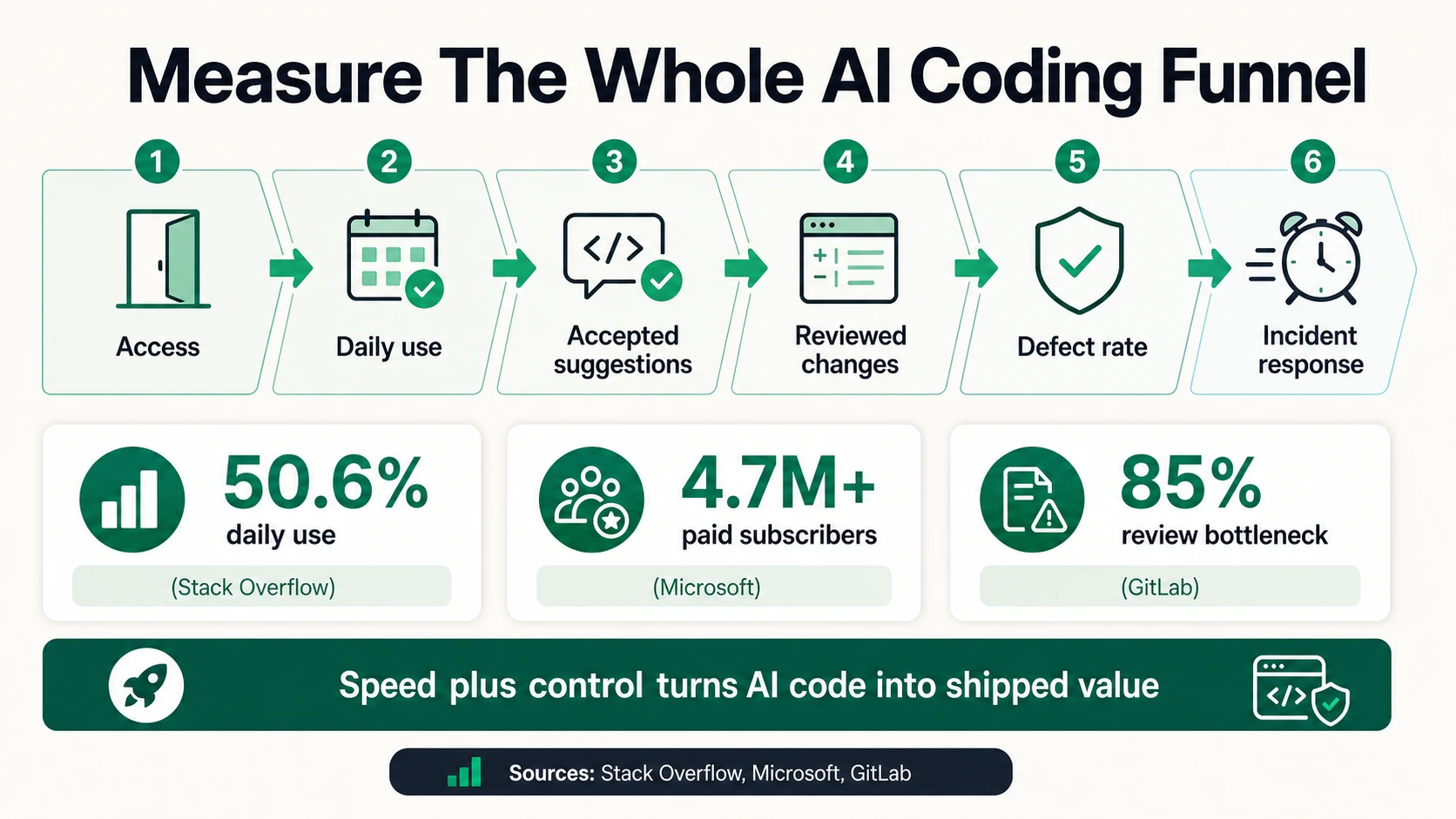
The wrong dashboard stops at code volume. GitLab’s 85% review-and-validation bottleneck statistic warns that faster generation can simply move work downstream. DORA’s “mirror and multiplier” framing is the strategic version: AI amplifies the system around it. METR’s measurement difficulty is the experimental version: developers can feel faster even when a controlled task says otherwise.
For founders, the market is clearly real, but generic positioning is weak. “Developers are using AI” is no longer differentiated. Stronger products attach to a specific bottleneck: codebase context, migration, testing, security review, dependency upgrades, knowledge retrieval, PR review, agent orchestration, evals, permissions, or cost control. Official product pages increasingly emphasize enterprise packaging and workflow — GitHub Copilot plans and metrics, AWS Q Developer, Gemini Code Assist for business, Claude Code costs, and JetBrains AI licensing — not just code completion.
For procurement teams, the data argues against a one-tool leaderboard. GitHub Copilot has the strongest disclosed paid-adoption anchor, but JetBrains shows a multi-tool environment, Stack Overflow shows broad AI-tool use rather than vendor-specific share, and GitLab shows organizations already dealing with tool sprawl. A realistic buying process compares IDE fit, repository access, model choice, policy controls, auditability, usage reporting, data retention, security review, and whether the tool supports the company’s existing code-review path. The adoption numbers say there is demand; they do not say every organization should standardize on the same interface.
Engineering-leader view
Measure the whole funnel
Access, regular use, accepted suggestions, review load, test pass rate, defect rate, incident impact, and time to merge — not code volume alone. GitLab shows the bottleneck moved downstream.
GitLab 2026Founder view
Own a specific bottleneck
Broad "AI coding" demand is table stakes. Durable differentiation comes from reducing the work that remains after generation — review, evals, migration, security, cost control.
Stack Overflow 2025Procurement view
Compare routes, not a ranking
IDE fit, repo access, model choice, policy controls, auditability, data retention, and review-path fit matter more than one leaderboard number.
JetBrains 2026 AI PulseSecurity & compliance view
Optimize for traceability
Record which tool created or modified code, require review for risky areas, scan generated changes, and match policy to repository sensitivity. Provenance beats a blanket verdict.
USENIX Security 2025The strongest programs treat adoption as a managed engineering change, not a software-seat rollout. A team can roll out licenses quickly and still fail to change delivery outcomes if developers use the tools only for isolated snippets. Start with low-risk tasks — documentation, test scaffolding, code explanation, simple refactors, internal tooling — then move toward higher-risk changes only when the team can observe acceptance rate, review load, security findings, and incident impact.
Turning These Numbers Into Decisions
Treat the strongest statistics as a set of lenses, each with its own scope:
Adoption & sentiment
Stack Overflow & JetBrains
Best for developer adoption, frequency, tool preference, and sentiment — but they are surveys with different populations, not market share.
Stack Overflow 2025Commercial scale
Microsoft investor calls
Best for GitHub Copilot commercial scale — but keep users, paid subscribers, organizations, and enterprise subscribers separate.
Microsoft FY26 Q2Delivery system
DORA
Best for the software-delivery view: adoption, productivity and code-quality perception, trust, throughput, and stability.
Google DORAGovernance
GitLab
Best for governance, tool sprawl, traceability, and the review bottleneck — with the caveat that it is vendor-sponsored survey evidence.
GitLab 2026Reality check
METR & academic work
Use to avoid overclaiming productivity: measured task outcomes can diverge sharply from developer perception.
METR 2025Capability
SWE-bench & model pages
Use for capability progress — not adoption, market share, or production reliability.
SWE-bench VerifiedThe durable 2026 conclusion is that AI coding assistants are mainstream, but the market is graduating from “can AI write code?” to “can teams manage AI-assisted software delivery?” The winners will not be the teams that generate the most code. They will be the teams that know which code came from where, why it changed, who reviewed it, what tests protect it, and whether it improved the product without increasing hidden risk.
Frequently Asked Questions
How many developers use AI coding tools in 2026?
Stack Overflow 2025 says 84% of respondents use or plan to use AI tools in their development process, and 50.6% of professional developers use them daily. JetBrains 2026 AI Pulse says 90% of professional developers regularly used at least one AI tool at work, and Google DORA says 90% of software professionals use AI at work. These are surveys of different populations, so they should not be merged into one figure.
How many people use GitHub Copilot?
Microsoft said GitHub Copilot had over 26 million users in FY26 Q1, over 4.7 million paid subscribers in FY26 Q2 (up 75% year over year), and nearly 140,000 organizations using it in FY26 Q3. A user count, a paid-subscriber count, and an organization count are three different metrics, and an earlier 20 million figure was clarified as all-time users.
Which AI coding tool has the most adoption?
In JetBrains 2026 AI Pulse, GitHub Copilot was used at work by 29% of developers, ChatGPT by 28%, Cursor and Claude Code by 18% each, Gemini by 8%, Claude chatbot by 7%, Google Antigravity by 6%, and OpenAI Codex by 3% within the survey window. This is a multi-tool market, not a single-product leaderboard.
Do AI coding assistants actually make developers more productive?
It depends on the setting. A GitHub controlled study found developers completed one JavaScript task 55% faster with Copilot, and DORA says more than 80% of respondents believe AI increased productivity. But METR's 2025 randomized controlled trial found experienced developers took 19% longer on real tasks in mature repositories even though they felt 20% faster, so productivity depends heavily on task type, codebase familiarity, and review burden.
Why do AI coding statistics differ so much between sources?
Because they measure different things. Survey adoption (Stack Overflow 84%), work use (JetBrains 90%), paid seats (Copilot 4.7M+), accepted-suggestion rates (GitHub Docs), and benchmark tasks (SWE-bench Verified 500) answer separate questions across separate populations. Averaging them into one number produces a fake market-share figure.
Do developers trust AI-generated code?
Trust lags adoption. Stack Overflow 2025 says 46% of developers do not trust AI-output accuracy, up from 31% in 2024, and 45% say debugging AI-generated code is time-consuming. DORA says only 24% report a lot or great deal of trust in AI while 30% report little or no trust.
What is the biggest challenge with AI-generated code?
Governance and review. GitLab 2026 says 85% of organizations agree AI shifted the bottleneck from writing code to reviewing and validating it, 92% report governance challenges, 43% cannot reliably distinguish AI-generated from human-written code, and 80% adopted AI faster than they developed policies to govern it.
Is a benchmark score like SWE-bench a measure of adoption?
No. SWE-bench Verified is a human-validated set of 500 software-engineering tasks used to compare coding agents and models, so it is a capability benchmark, not an adoption metric. A high pass rate shows agents are more capable, but not that developers use a tool daily, that companies pay for it, or that teams ship safer code.
Sources and Further Reading
Developer adoption & sentiment surveys
Commercial scale & GitHub Copilot
Productivity, governance & security research