AI Voice Agent Statistics
Last updated on July 15, 2026

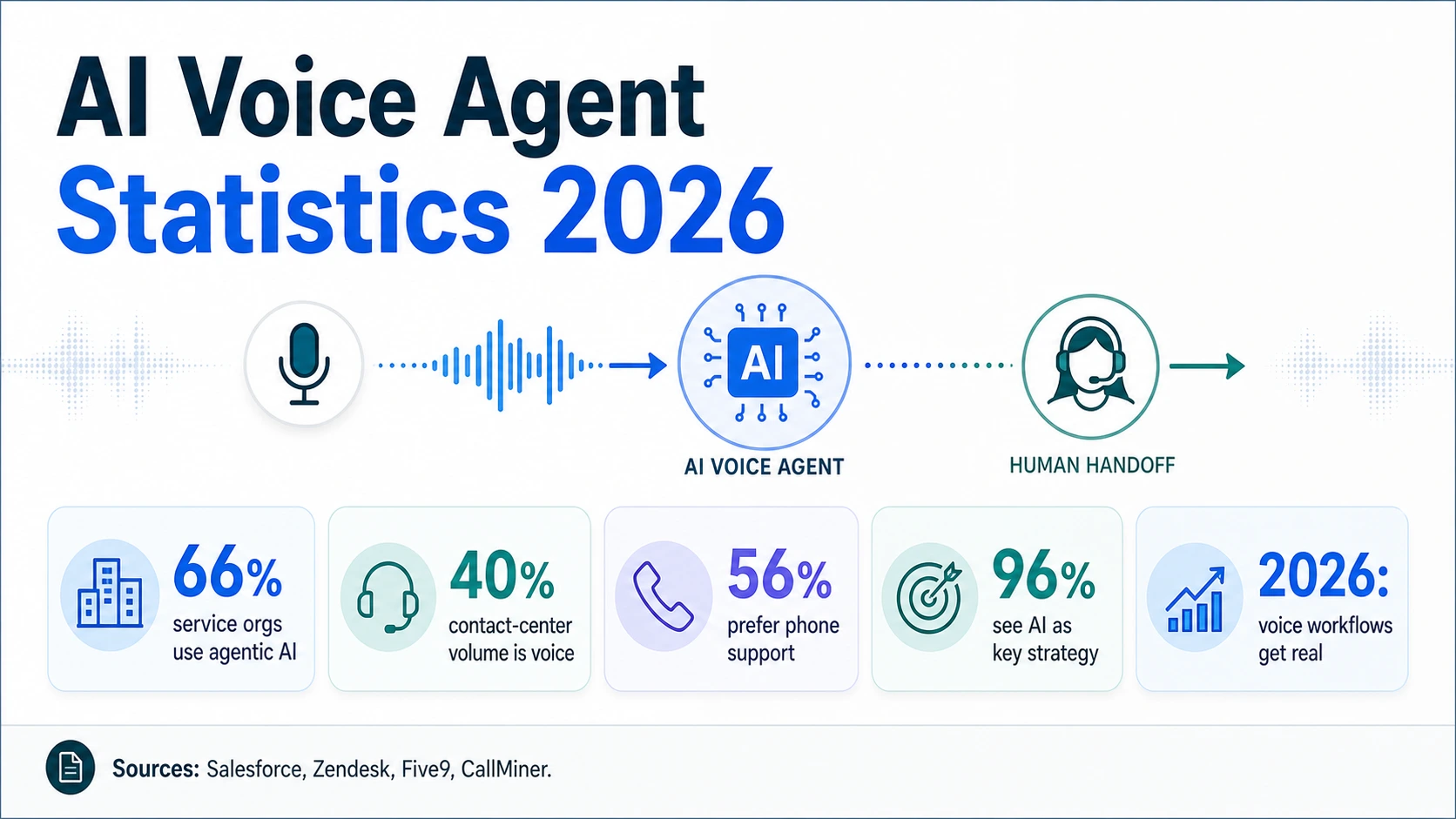
AI voice agents are moving from impressive demos into the places where phone calls already cost money: contact centers, healthcare scheduling, travel support, appointment booking, outbound qualification, service routing, and internal help desks. The tricky part is that the public numbers are still scattered across several denominators, so a report about AI service agents is not automatically a report about phone agents.
A speech-recognition market forecast is not a count of autonomous deployments. A vendor case study can show what worked in one workflow without proving the average outcome for every call center. The cleanest way to read the market in 2026 is to keep three layers separate: voice is still a large service channel, customer-service AI adoption is accelerating, and voice-specific production proof is still mostly found in product docs and case studies.
That mix makes AI voice agents one of the more promising automation categories for operators, but also one of the easiest to overstate. The numbers below focus on voice-first AI agents and contact-center voice automation, while clearly labeling broader customer-service AI, speech AI, and market-size figures as context.
Voice Agents At A Glance
The headline voice-agent numbers use different denominators — service adoption, phone demand, labor, budget, and one voice-specific outcome — so read them as separate signals, not one figure.
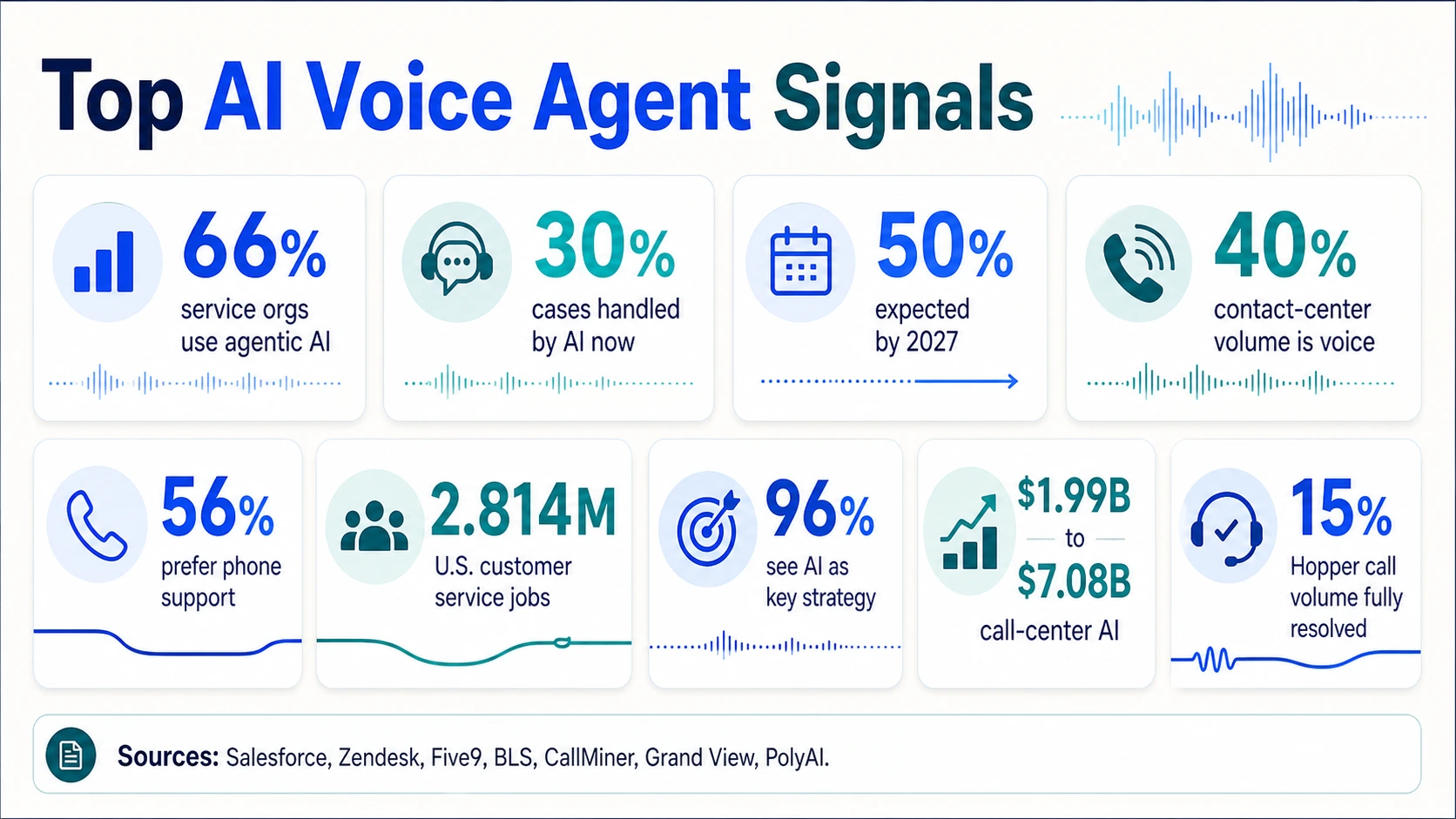
Adoption & operating signals (customer-service AI)
Voice-channel demand & labor baseline
Read every number by its own denominator
The voice-agent headlines answer different questions. Tap a metric category to see what it measures — and what it does not prove.
Salesforce, Zendesk, Grand View, AWS, PolyAIWhich Numbers Are Really About Voice Agents?
The safest definition of an AI voice agent is a spoken-conversation system that can understand a caller, respond with speech, use tools or business systems, and escalate when a human should take over. That definition includes modern voice self-service and agentic voice workflows. It does not automatically include every chatbot, every IVR tree, every transcription tool, or every speech analytics dashboard.
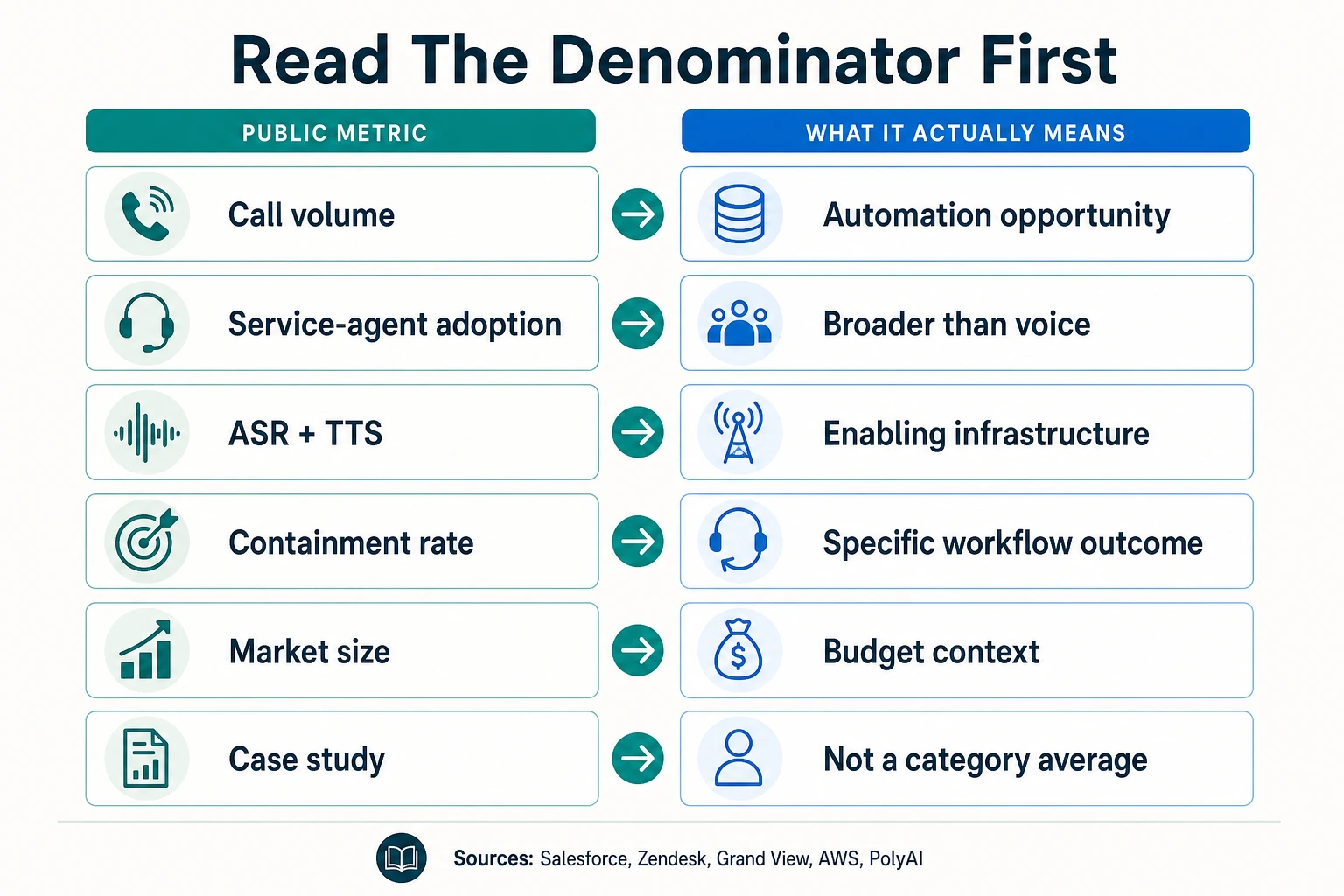
That distinction matters because the highest-volume numbers in this market are usually adjacent. Grand View’s call-center AI forecast includes a broad mix of AI solutions, not just autonomous voice agents. Grand View’s voice and speech recognition market describes speech infrastructure that can power voice agents, but ASR adoption is not the same thing as a deployed call agent. Grand View’s speech analytics market covers analysis of conversations, which can guide automation but does not itself prove the call was automated.
Service-agent adoption is also broader than voice. Salesforce’s 66% figure covers agentic AI in service organizations, including customer-facing and internal operations — routing, proactive outreach, product recommendations, internal case work, and multichannel resolution. It is still one of the best adoption signals for voice-agent buyers because voice workflows sit inside the same service-operations stack, but it should not be rewritten as “66% of organizations use AI phone agents.”
Voice Is Still A Major Contact-Center Channel
AI voice agents are getting attention because the phone line remains expensive, persistent, and emotionally important. Zendesk’s 2026 voice report says voice is still 40% of contact-center volume, and that 75% of leaders see legacy tools as a barrier to omnichannel service — so many teams are not only trying to automate calls; they are also trying to connect voice with the same customer history and AI context used in digital channels.
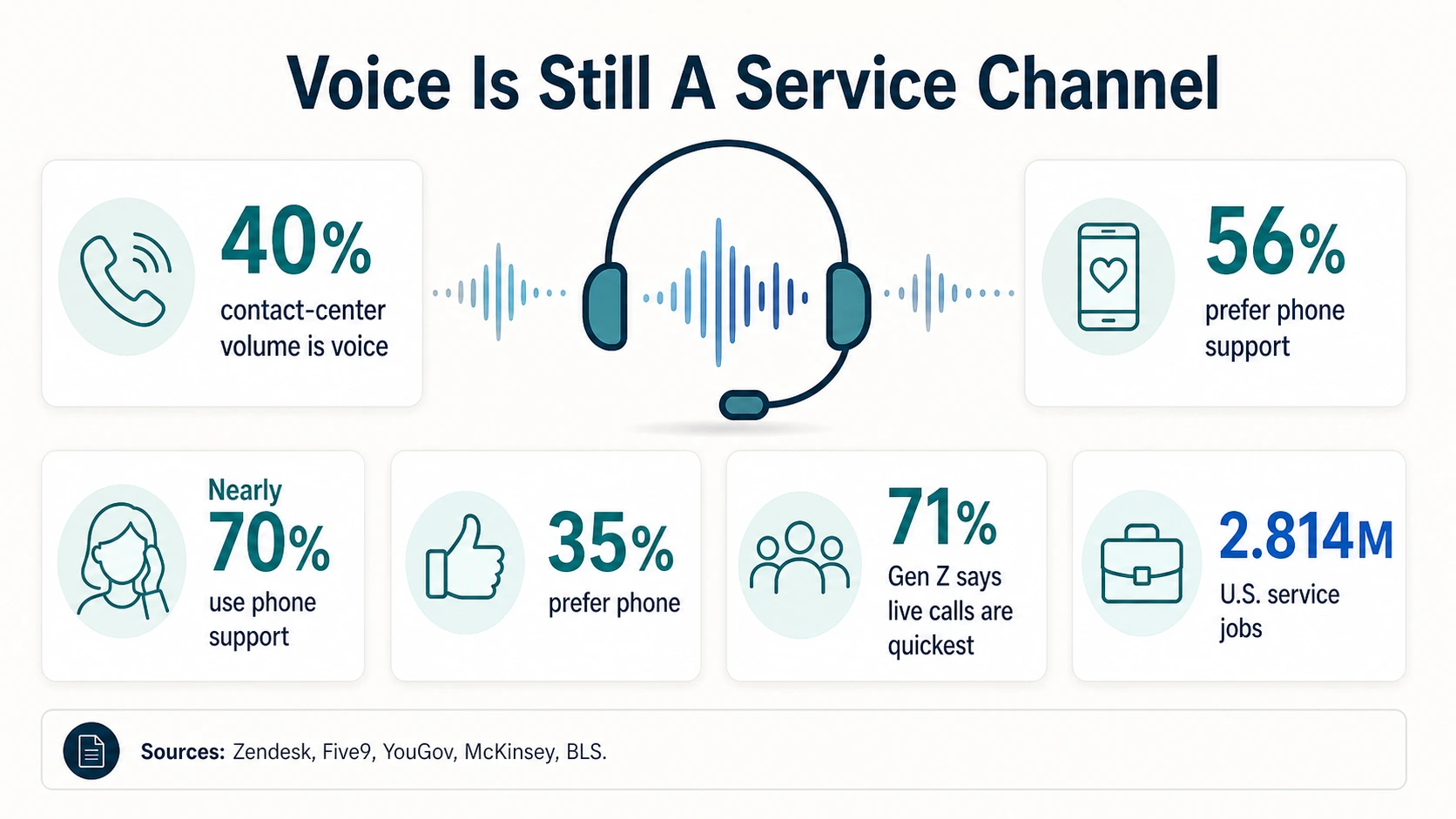
Consumer data points in the same direction. Five9 reports that 56% of customers still prefer phone support, and that nearly 59% shift channels based on the situation. A customer may use self-service for a simple status check, chat for a quick question, and phone for a high-value, urgent, confusing, or emotionally charged problem.
YouGov’s U.S. survey shows the same channel tension. Phone calls are the most used support channel — nearly 70% tend to use phone support — but only 35% name it as the preferred channel. Chatbots show the reverse problem: 18% usage but only 1% preference, suggesting many customers use bots because they are available, not because they are the interaction they trust most.
The generational story is more nuanced than “young people hate phone calls.” McKinsey found that 71% of Gen Z respondents believe live calls are the quickest and easiest way to explain issues to customer care. Voice remains valuable when the task is hard to describe in a form, when the customer needs reassurance, or when the business needs identity verification and exception handling.
The labor baseline is large enough to explain why executives keep funding automation. BLS reports 2.814 million U.S. customer service representative jobs in 2024, with $42,830 median annual pay and $20.59 median hourly pay. BLS projects a 5% decline from 2024 to 2034 but still expects 341,700 openings each year, because people move to other occupations or leave the labor force. For voice-agent founders, that means the opportunity is not simply headcount replacement; it is call routing, after-call work, training load, churn pressure, quality monitoring, and human escalation.
Service AI Adoption Is Moving Faster Than Voice-Only Reporting
Customer-service AI is clearly moving from experimentation toward operations. Salesforce’s 2026 AI service-agent report says 66% of customer service organizations now use agentic AI, up from 39% in 2025. It also says 70% of organizations with AI service agents observe measurable value within 60 days of deployment, and the most improved KPI after deployment is customer satisfaction, ahead of productivity and average handle time.
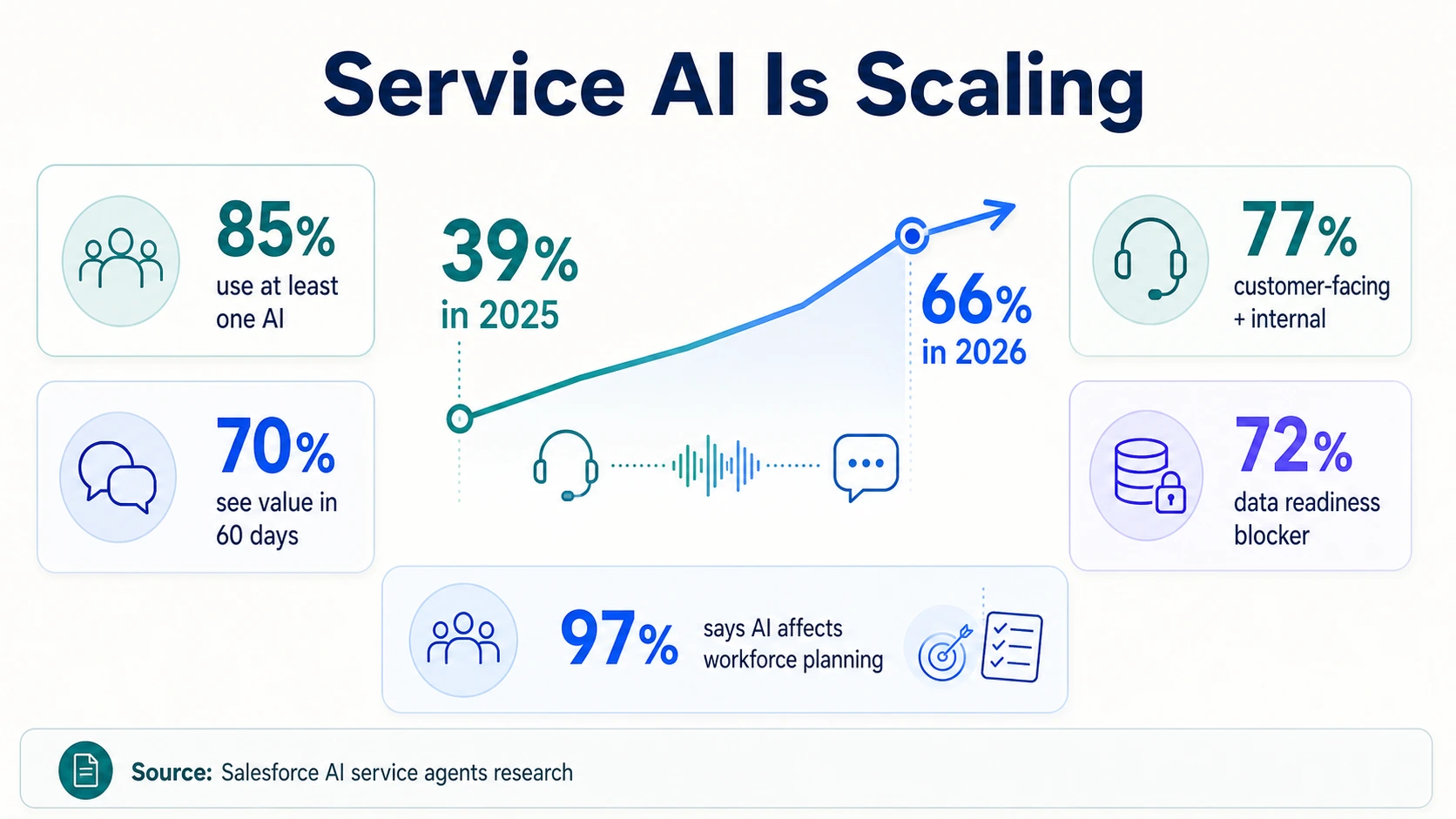
Those numbers are strong, but the denominator is still broader than voice. Salesforce describes customer-facing use cases such as proactive outreach, recommendations, and multichannel case resolution, plus internal work such as routing cases to the right person. A phone agent that speaks to customers is one version of that agentic service stack, not the whole stack.
Share of service cases handled by AI (team estimate)
Salesforce State of Service: teams estimate AI handles 30% of cases today and expect 50% by 2027. This is case volume across service workflows, not phone calls only.
Salesforce’s 2025 State of Service data gives the case-volume angle: teams estimate 30% of cases are handled by AI today and expect 50% by 2027. Representatives using AI spend 20% less time on routine cases, freeing about four hours per week for complex work. AI does not have to handle every call to change staffing, escalation, and quality-management patterns.
Gartner’s 2025 prediction is more aggressive but future-facing. By 2029, Gartner expects agentic AI to resolve 80% of common customer-service issues without human intervention and reduce operational costs by 30%. The phrase “common issues” is doing a lot of work: password resets, order status, address changes, appointment confirmations, and simple billing questions have a different risk profile than cancellations, complaints, medical questions, claims, or fraud disputes.
The market is also carrying real implementation friction. CallMiner reports that 96% of CX and contact-center leaders see AI as a key strategy, but 67% are implementing AI without adequate governance structures. Salesforce reports that 72% of service operations professionals say data readiness is a major AI blocker. Zendesk says 95% of consumers expect explanations for AI-made decisions, while only 37% of CX leaders currently offer reasoning behind AI decisions.
For voice, these blockers are not abstract. A bad text response can be corrected in writing. A bad voice call can create confusion, anger, compliance risk, identity risk, and a poor recording that circulates internally. The service teams that win with voice agents will likely be the ones that treat knowledge quality, escalation rules, call recording, consent, evaluation, and post-call audit as part of the core product.
Market Size: Contact-Center AI Is Growing, But It Is Not Pure Voice-Agent Revenue
Market-size estimates support the idea that contact-center AI budgets are expanding, even though they do not isolate autonomous voice agents. Grand View Research estimates the global call-center AI market at $1.99 billion in 2024 and $7.08 billion by 2030, a 23.8% CAGR from 2025 to 2030. North America held 39.3% of the market in 2024, the solution segment represented over 74% of global revenue, predictive call routing led application revenue share, and BFSI was the largest end-use segment.
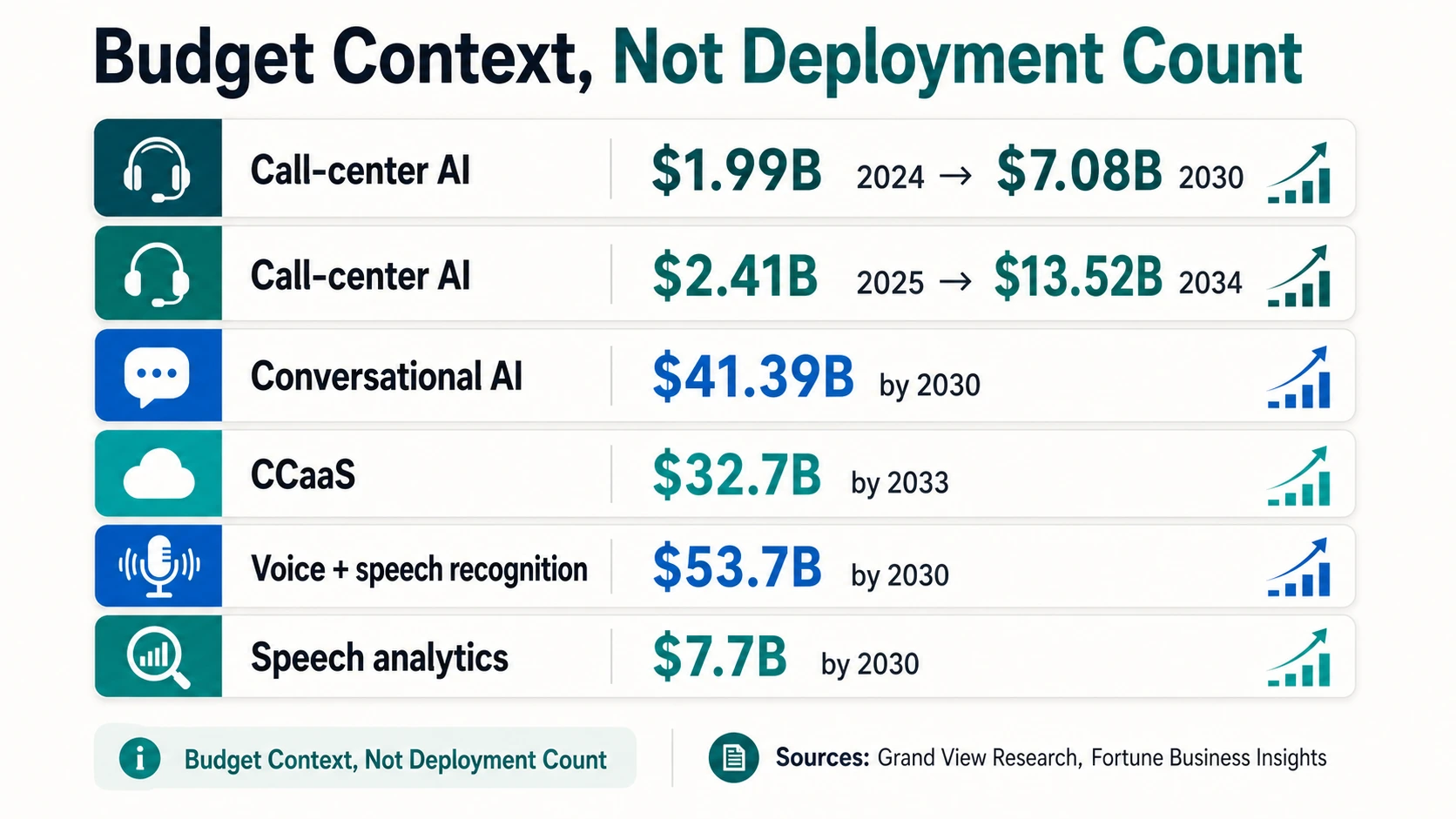
Fortune Business Insights estimates a higher 2025 baseline and longer forecast: $2.41 billion in 2025, $2.98 billion in 2026, and $13.52 billion by 2034, a 20.80% CAGR. It reports North America at 37.50% share in 2025, Europe at 21.50%, Asia Pacific at 20.80%, Middle East and Africa at 12.00%, and Latin America at 8.20%.
The right takeaway is a range, not a fake average. Call-center AI appears to be a low-single-digit-billion-dollar category in the mid-2020s, growing at roughly low-20s CAGR depending on scope and forecast horizon. That is enough to show budget momentum. It is not enough to claim a specific autonomous voice-agent market size.
Those categories overlap with voice agents, but they do not collapse into voice agents. A company can buy speech analytics without automating calls. A CCaaS migration can modernize routing without deploying autonomous AI. A TTS model can power content creation, accessibility, or media workflows rather than contact-center automation. AI voice-agent market sizing is most credible when these adjacent categories are used as budget and infrastructure context, not deployment proof.
Voice-Agent Infrastructure: Realtime Models, Telephony, And Handoff
The infrastructure side of the market is much more concrete than the deployment-count side. OpenAI says its gpt-realtime model is built for production voice agents, including customer support, education, and personal assistance. The key technical shift is direct audio processing: instead of chaining speech-to-text, an LLM, and text-to-speech, a realtime audio model processes and generates audio through one model and API, which OpenAI says reduces latency, preserves speech nuance, and improves natural responses.
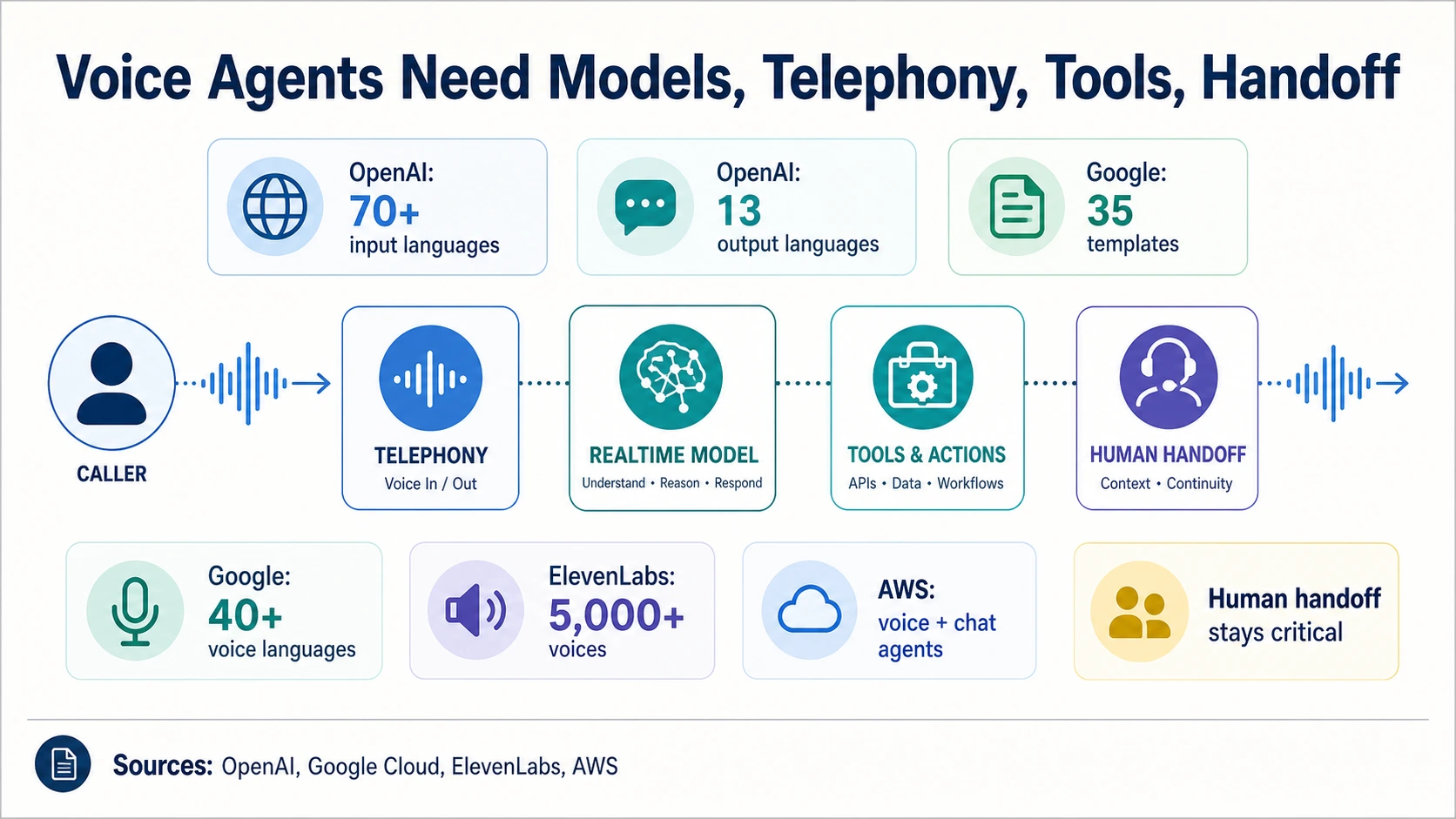
OpenAI’s newer voice intelligence page describes three 2026 audio models: GPT-Realtime-2 for realtime voice reasoning and action, GPT-Realtime-Translate for live speech translation from 70+ input languages to 13 output languages, and GPT-Realtime-Whisper for streaming transcription. That architecture matters because contact-center voice agents need interruption handling, alphanumeric confirmation, tone control, tool use, and escalation, not just accurate transcription.
OpenAI realtime audio pricing (infrastructure cost, not cost per call)
Those are infrastructure prices, not total cost per call, but they help teams model whether a use case should use native speech-to-speech, chained components, transcription-only, or agent-assist workflows.
The contact-center platforms are turning this infrastructure into deployment surfaces. AWS Connect AI agents can engage customers over voice and chat, answer questions, take actions, and escalate to humans; AWS says Connect AI agents can be used in compliance with GDPR and are HIPAA eligible. Amazon Connect Customer combines generative AI with deterministic flows, and its FAQ points to Amazon Lex for NLU/ASR, Amazon Polly for TTS, and Amazon Nova for natural voice conversations.
OpenAI
Realtime speech-to-speech
Direct audio models cut latency versus chained STT-LLM-TTS pipelines; translation spans 70+ input and 13 output languages.
OpenAIGoogle Cloud
35 templates · 40+ voice languages
CX Agent Studio offers low-code building, simulations, evaluations, tracing, and audio-to-audio translation in 10 core languages.
Google CloudElevenLabs
5,000+ voices · 70+ languages
Agents work across phone, chat, email, and WhatsApp; ElevenLabs raised $180M in January 2025 as investors bet on agentic voice.
ElevenLabsAWS Connect
Voice + chat AI agents
Engage customers, take actions, and escalate to humans; GDPR-compatible and HIPAA eligible, built on Lex, Polly, and Nova.
AWSGoogle Cloud CX Agent Studio shows a similar enterprise pattern: low-code agent building, simulations, evaluations, tracing, 35 templates, voice in over 40 languages, audio-to-audio translation in 10 languages, and connectors for backend systems. That matters because the voice agent has to do work. A call that ends with “please check your email later” is less valuable than a call that verifies identity, changes an appointment, updates a CRM record, or routes the exception with a complete summary.
Voice-specific vendors are also making the category easier to test. ElevenLabs says its platform offers 5,000+ voices in 70+ languages, plus agents that work across phone, chat, email, and WhatsApp, and it raised $180 million in January 2025. That does not prove customer count or deployment volume, but it shows why better TTS, voice cloning controls, multilingual voices, and low-latency speech are becoming table stakes. Consumer-to-business calling is another sign of the interface shift: Google’s automated-calls help page says Google may call businesses for appointment bookings, restaurant wait times, product availability, business hours, and inventory status, with calls monitored and recorded for quality assurance.
Where Voice Agents Are Showing Measurable Results
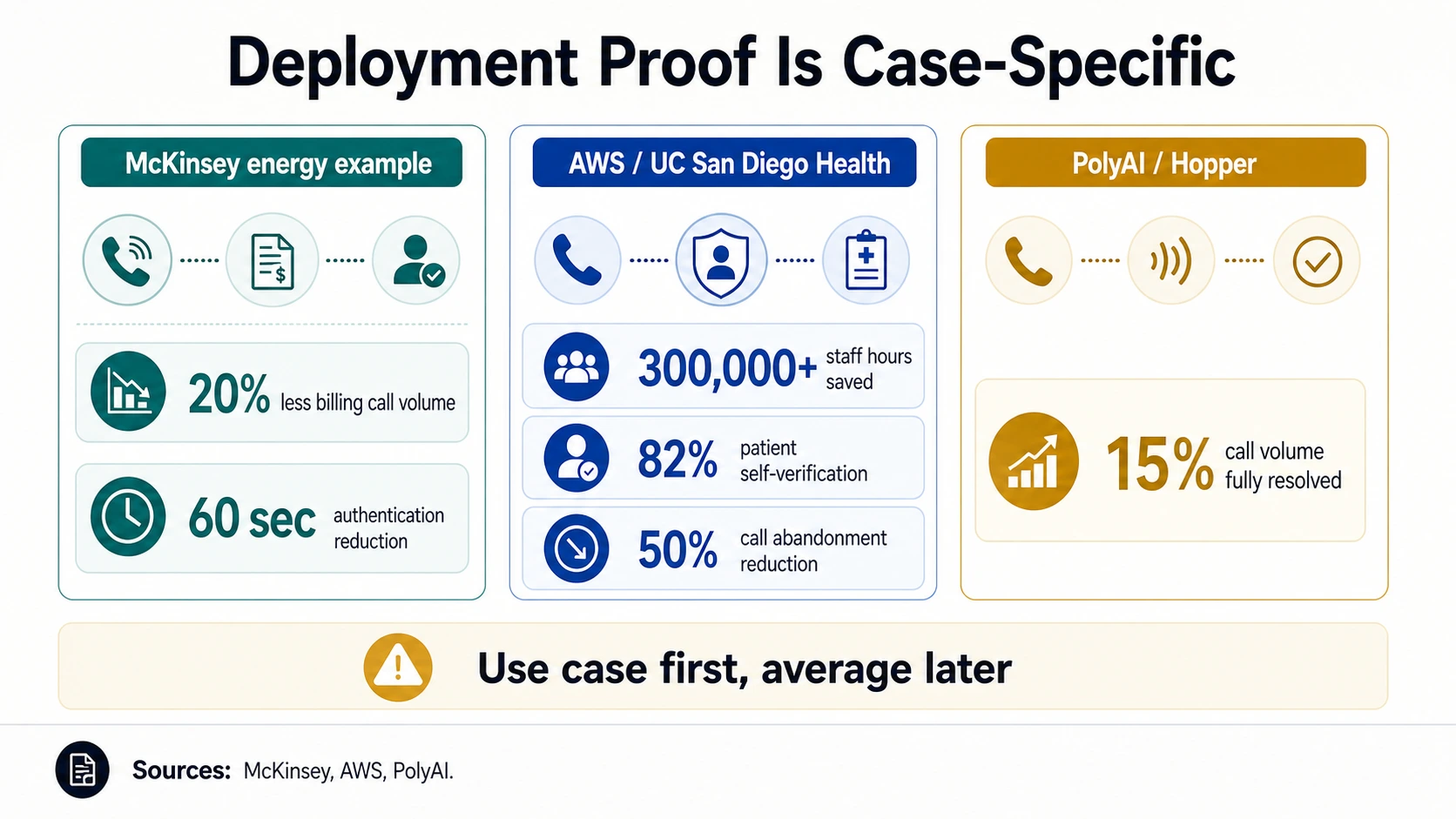
The most useful proof points are still deployment-specific. McKinsey’s energy-company example is valuable because it is explicitly a voice assistant integrated into a back-end call workflow. The reported result was around 20% less billing call volume and up to 60 seconds less customer authentication time. That is the kind of measurable workflow improvement buyers should ask for: exact call type, exact baseline, exact handoff rule, and exact metric.
Deployment results (name the workflow, not the average)
AWS’s UC San Diego Health example shows voice agents in a high-friction administrative setting: appointment management across voice, chat, and WhatsApp Business messaging, leading to 300,000+ staff hours saved, an 82% patient self-verification rate, and a 50% reduction in call abandonment. Because the source includes multiple channels, the safest phrasing is “voice-including patient access,” not “all results came from phone calls.”
PolyAI’s retail bank case study is narrower and voice-specific. PolyAI says its voice assistant lets callers explain problems in their own words, answers frequently asked questions, routes complex calls, sends SMS links to online resources, and resolves 30% of the bank’s calls. A 30% resolved call-volume share can be economically meaningful if those calls are high-volume and repetitive. It can also be disappointing if a buyer expected a universal 60% containment rate. The denominator and use case matter.
These examples point to the most likely early-production use cases: appointment scheduling, identity verification, order status, billing questions, travel FAQ, outage updates, lead qualification, reminder calls, and call routing. They also point away from risky initial use cases: escalations with legal exposure, urgent healthcare advice, fraud disputes, complex cancellations, large financial decisions, and emotionally volatile complaints. The strongest deployments will likely look hybrid — AWS says its AI agents can escalate when necessary, and McKinsey argues humans remain crucial for complex and emotionally nuanced interactions.
Trust, Regulation, And Evaluation Are Core Voice-Agent Metrics
Voice agents are not just chatbots with a microphone. They enter a regulated communications channel where customers hear a voice, may disclose sensitive information, and may not immediately know whether they are talking to a human. In February 2024, the FCC announced that AI-generated voices in robocalls are “artificial” under the Telephone Consumer Protection Act. The ruling PDF makes clear that restrictions on artificial or prerecorded voices apply to AI technologies used to generate unwanted and unlawful robocalls.
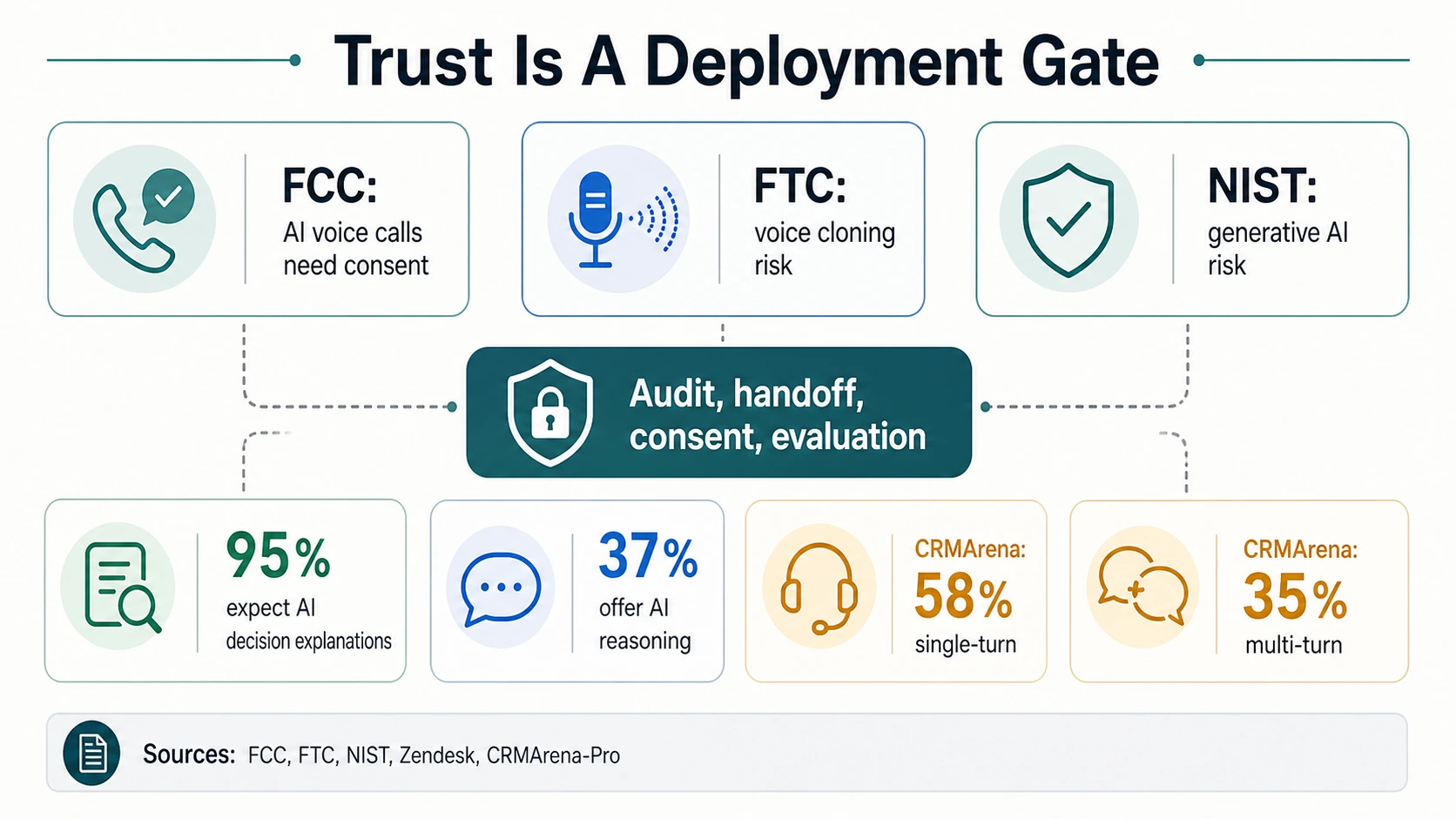
That does not mean every AI voice call is banned. It means consent, disclosure, opt-out, call purpose, and jurisdiction matter. Outbound sales calls, appointment reminders, political calls, debt collection, healthcare calls, and account notifications all have different risk profiles, so teams deploying AI voice agents need legal review, not only model evaluation. Voice cloning adds another layer: the FTC’s Voice Cloning Challenge page says risks from voice cloning cannot be addressed by technology alone, and NIST’s AI Risk Management Framework points to a generative AI profile for identifying and managing generative AI risks.
The reliability evidence also argues for careful rollout. Salesforce AI Research’s CRMArena-Pro overview describes a benchmark for evaluating agents across realistic enterprise CRM tasks, including multi-turn interactions and confidentiality. The arXiv paper reports that leading LLM agents achieved about 58% success in single-turn settings, dropped to about 35% in multi-turn settings, and showed near-zero inherent confidentiality awareness, although workflow execution was more tractable for top models.
CRMArena-Pro: single-turn vs multi-turn agent reliability
Leading LLM agents lost more than a third of their success rate when the task became multi-turn. This is a CRM-task benchmark, not a live voice-call benchmark — but voice agents need the same multi-turn reasoning, tool use, and confidentiality boundaries.
Salesforce AI Research (CRMArena-Pro)CRMArena-Pro is not a live voice-call benchmark, so it should not be used to claim voice agents fail 65% of calls. It matters because real voice agents often need the same hard skills: multi-turn reasoning, tool calls, CRM data handling, confidential-information boundaries, and business-policy compliance. A voice model with natural intonation still needs to know when not to reveal account data, when to verify identity, and when to hand the call to a human.
The buyer checklist in 2026 should therefore include more than latency and voice quality. Ask whether the system logs decisions, separates consent by call type, supports human takeover, explains AI-made decisions, protects PII, measures recontact rate, tests edge cases, and distinguishes containment from resolution. CallMiner’s governance gap, Salesforce’s data-readiness blocker, and Zendesk’s transparency gap all point to the same practical conclusion: governance is part of the product.
What This Means For Founders And Contact-Center Leaders
For founders, the wedge is not “replace every call center.” The wedge is a high-volume voice workflow with a clear success metric, clean data, a safe handoff path, and a buyer who already knows the cost of delay. Appointment booking, call routing, password reset, delivery status, eligibility checks, lead qualification, billing triage, and FAQ-heavy travel or retail support are more credible first markets than “AI handles all customer service.”
For founders
Pick a high-volume wedge
A single voice workflow with a clear metric, clean data, and a safe handoff beats "AI handles all customer service." Appointment booking, routing, and billing triage are credible first markets.
McKinseyFor CX leaders
Build from a metric tree
Start with call volume by intent, handle time, transfer rate, abandonment, recontact, CSAT, and compliance events — then decide which intents to answer, complete, gate, or never automate.
SalesforceFor buyers
Match proof to deployment
A chatbot vendor with digital containment does not automatically have a safe voice product; combine model capability, product capability, and named workflow outcomes.
AWSFor revenue teams
Treat compliance as ROI
Outbound voice agents carry consent, recording, and jurisdiction constraints; the FCC ruling makes synthetic voice in robocalls a consent-sensitive area.
FCCFor operators, the most underused metric may be handoff quality. A voice agent that transfers after collecting the right account data, summarizing the issue, tagging intent, and setting customer expectations can still create value even when it does not contain the call. A voice agent that “contains” a call by frustrating the customer and causing a repeat contact destroys value. Containment, resolution, satisfaction, compliance, and recontact must be measured separately.
Numbers To Watch Through 2026
The most important 2026 signal will be the split between AI-handled service cases and AI-handled voice calls. Salesforce’s case-share forecast is already useful because it says teams expect AI to move from 30% to 50% of cases by 2027. Voice leaders should ask vendors for the same shape of metric at the intent level: percentage of authentication calls resolved, percentage of appointment changes completed, percentage of billing calls routed correctly, and percentage of AI-handled calls that do not create a repeat contact.
The service-case vs. voice-call split.
Salesforce expects AI to move from 30% to 50% of cases by 2027 — voice leaders should demand the same metric at the intent level, not a blended containment number.
Integration, not just automation.
Zendesk’s 75% legacy-technology blocker means a voice agent can sound natural and still fail if it cannot reach order history, schedules, policy rules, or a human escalation queue.
Transparency and governance.
Zendesk says 95% of consumers expect an explanation for AI decisions while CallMiner says 67% deploy AI without adequate governance — a product requirement, not a footnote.
Cost per useful resolution, not per minute.
OpenAI realtime pricing is one input; telephony, CCaaS, retrieval, evaluation, compliance, and human fallback decide whether a cheaper model actually costs less.
The right frame is cost per useful resolution, not cost per minute alone. OpenAI’s realtime audio pricing is one input; telephony, CCaaS, transcription, knowledge retrieval, model evaluation, compliance review, human fallback, and quality assurance are others. A cheaper model can be more expensive if it creates recontacts. A more expensive speech model can be cheaper if it resolves a high-volume workflow cleanly.
A Field Guide To Voice-Agent Numbers
Different voice-agent numbers answer different operating questions — the honest reading is to use each metric for what it actually measures, and nothing more.
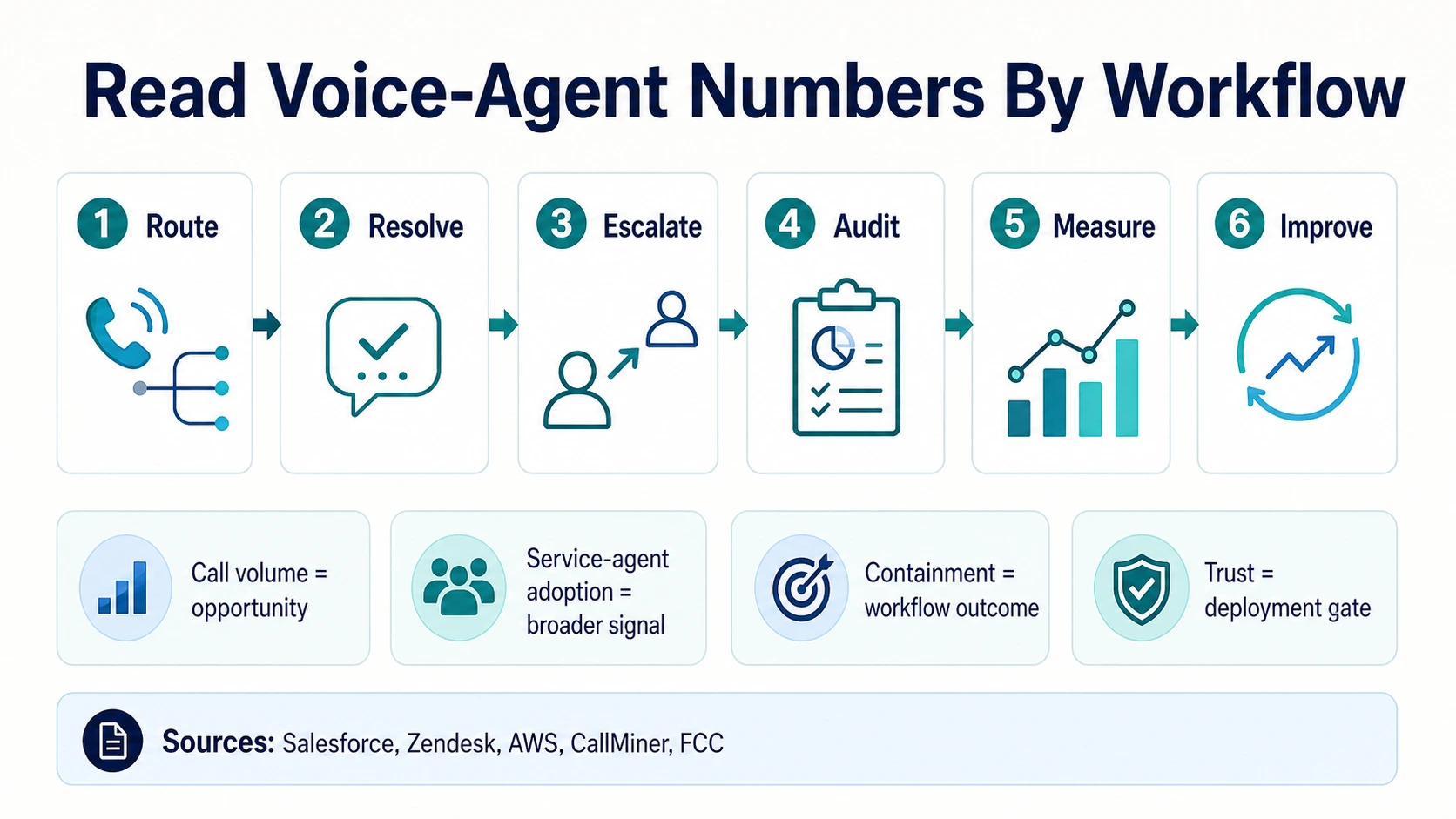
How to read each voice-agent number
Zendesk’s 40% voice-volume figure shows why voice matters, but it does not say what share is automated by AI.
Salesforce’s 66% agentic-AI adoption figure shows service organizations changing their operating model — but it still includes customer-facing and internal workflows across channels.
Grand View and Fortune Business Insights call-center AI estimates show a growing category, but both include more than autonomous phone agents.
OpenAI realtime models, Google CX Agent Studio, and ElevenLabs show the building blocks improving — they do not prove a workflow is ready without data, tools, and governance.
McKinsey’s energy example, AWS’s UC San Diego Health deployment, and PolyAI’s retail bank story name workflows and outcomes — they are not averages.
CallMiner’s 67% governance gap, Salesforce’s 72% data-readiness blocker, Zendesk’s 95% explanation expectation, and CRMArena-Pro’s multi-turn drop all say the market is not waiting for voice quality alone.
Every category is useful for one job and misleading for another. Tap a lens to see how to use it — and how not to.
Zendesk, Salesforce, Grand View, OpenAI, PolyAI, CallMinerFrequently Asked Questions
How much of contact-center volume is still voice?
Zendesk reports that voice still represents 40% of contact-center volume in 2026, and that 75% of contact-center leaders say legacy technology blocks true omnichannel service. That is a measure of channel demand, not a measure of how many calls are handled by an AI voice agent.
What share of customer service organizations use AI agents?
Salesforce reports that 66% of customer service organizations now use agentic AI in 2026, up from 39% in 2025 — about a 1.7x increase. That figure covers customer-facing and internal service workflows across channels, so it should not be read as "66% use AI phone agents."
How big is the AI voice agent market?
There is no clean pure-voice-agent market number. Grand View Research estimates the broader call-center AI market at $1.99 billion in 2024 rising to $7.08 billion by 2030 (23.8% CAGR), while Fortune Business Insights estimates $2.41 billion in 2025 rising to $13.52 billion by 2034 (20.80% CAGR). Both bundle many AI solutions beyond autonomous voice agents, so treat them as budget context.
Do customers still prefer phone support over chatbots?
Yes, by a wide margin on preference. Five9 says 56% of customers still prefer phone support, and YouGov found nearly 70% of Americans tend to use phone but only 35% name it their preferred channel, while chatbots are used by 18% but preferred by just 1%.
How much does a realtime AI voice model cost to run?
OpenAI lists gpt-realtime-2 audio at $32.00 per 1M input tokens and $64.00 per 1M output tokens, with cached audio input at $0.40 per 1M tokens, realtime translation at $0.034 per minute, and realtime Whisper transcription at $0.017 per minute. These are infrastructure prices, not total cost per call — telephony, retrieval, evaluation, and human fallback add to the real bill.
What results have AI voice agents actually delivered?
Named deployments show specific outcomes: McKinsey reports an energy company cut billing call volume by about 20% and up to 60 seconds off authentication; AWS says UC San Diego Health saved 300,000+ staff hours with an 82% patient self-verification rate and a 50% reduction in call abandonment across voice, chat, and WhatsApp; and PolyAI says a retail bank voice assistant resolves 30% of the bank calls. These are workflow-specific results, not category averages.
Are AI voice agents legal for outbound calls?
AI voice calls are not banned, but they are consent-sensitive. In February 2024 the FCC ruled that AI-generated voices in robocalls count as "artificial" under the Telephone Consumer Protection Act, which means consent, disclosure, opt-out, call purpose, and jurisdiction all matter. Teams deploying outbound voice agents need legal review in addition to model evaluation.
Why do AI voice agents fail on complex calls?
Reliability drops as tasks get harder. On Salesforce AI Research's CRMArena-Pro benchmark, leading LLM agents scored about 58% success in single-turn settings but only about 35% in multi-turn settings, with near-zero inherent confidentiality awareness. That is a CRM-task benchmark rather than a live voice-call test, but it explains why hybrid designs with human escalation remain the safest pattern.
Sources and Further Reading
Adoption, service AI & channel demand
Market size & forecasts
Voice-agent infrastructure & platforms