Anthropic Statistics
Last updated on July 14, 2026

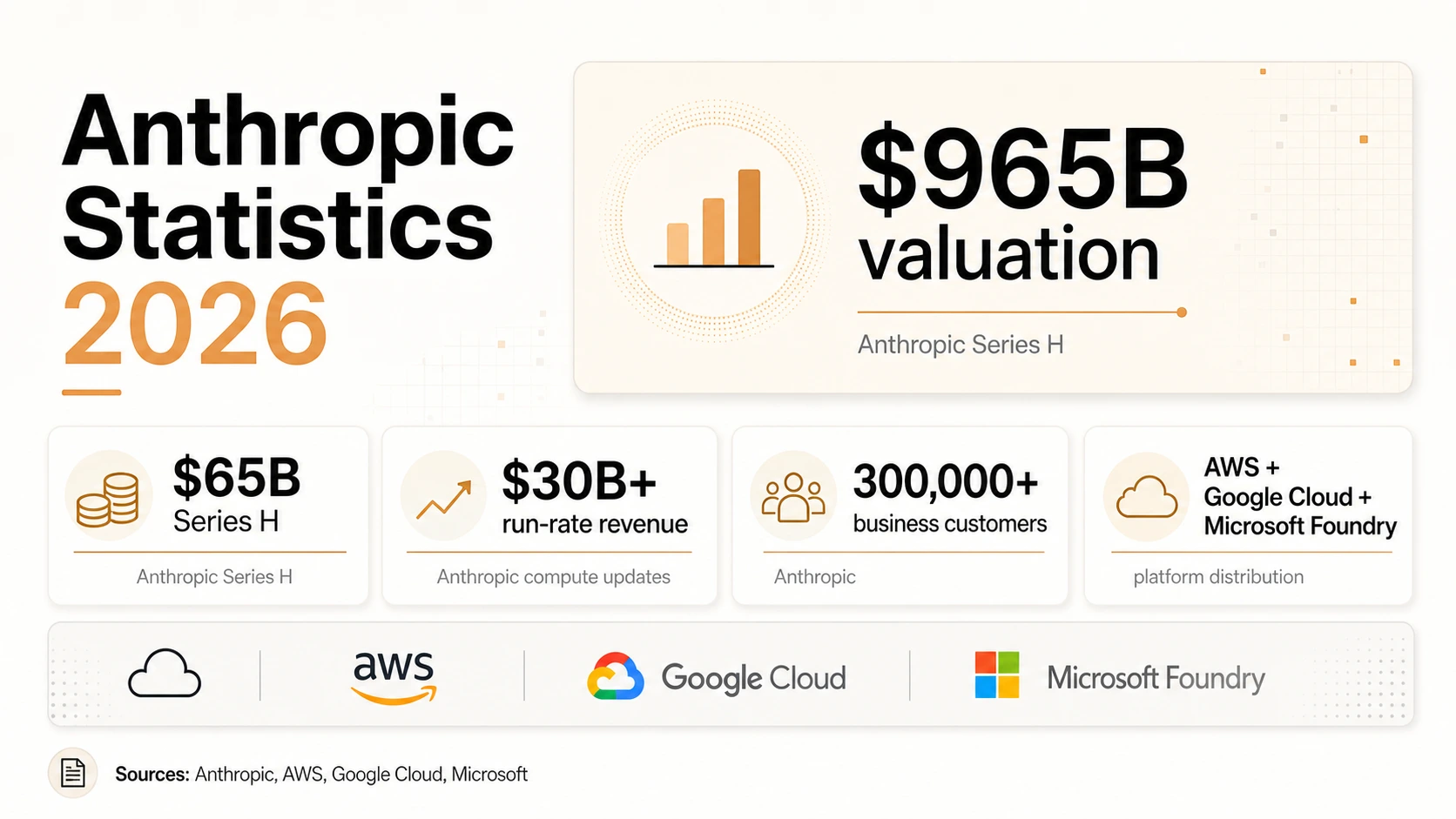
Anthropic is no longer just the company behind Claude. By mid-2026 it is a near-trillion-dollar private AI platform company with a direct API, enterprise subscriptions, agent products, cloud-marketplace routes, a large partner network, and a safety-governance stack that is part of its market positioning.
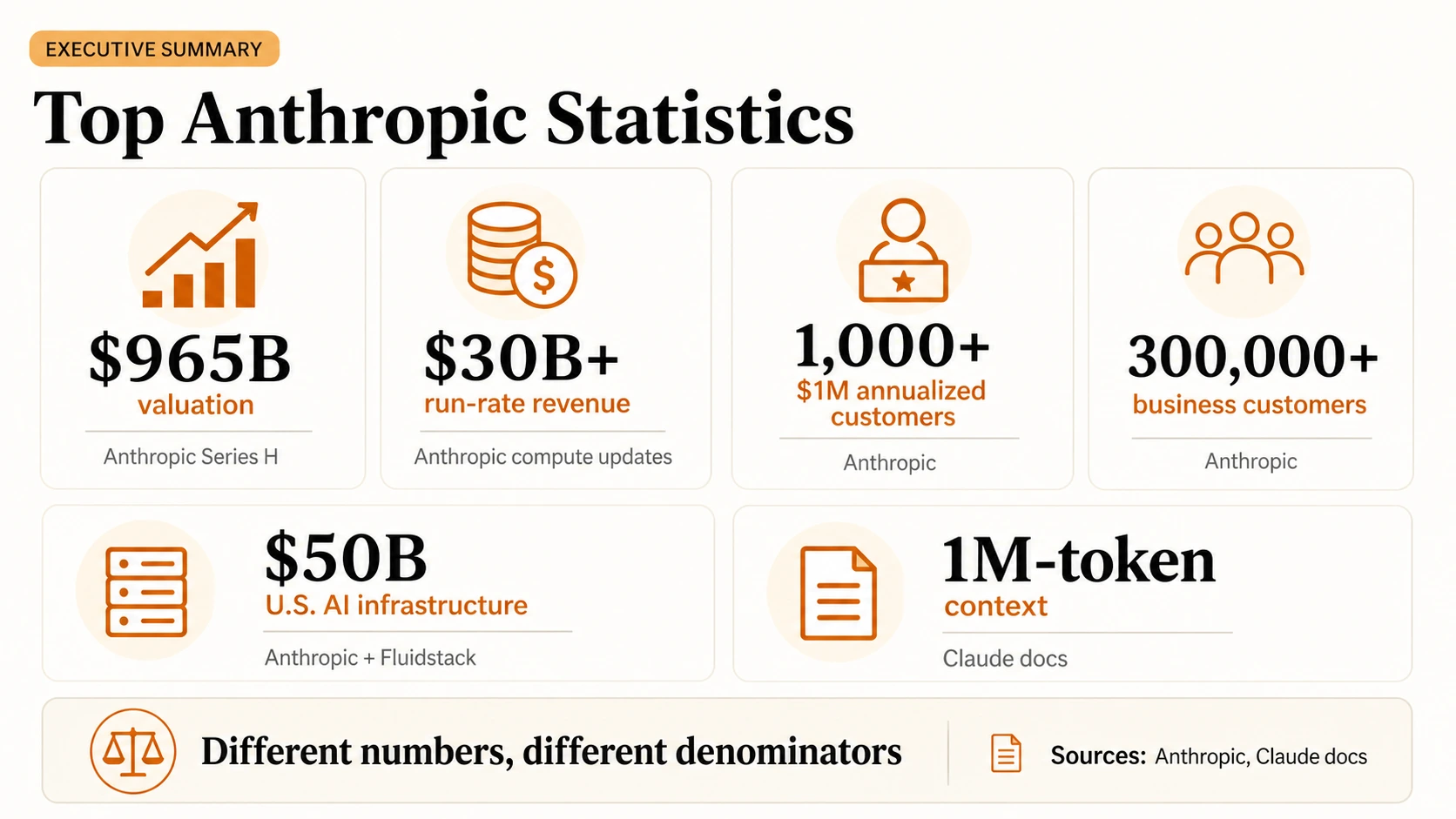
The numbers are impressive, but they are easy to misread. Anthropic’s $965 billion post-money valuation, $30 billion-plus revenue run-rate, 300,000-plus business customers, 1,000-plus $1 million annualized customers, AWS/Google/Microsoft distribution, 1M-token context windows, and Trust Center controls all measure different things. They should not be collapsed into one generic “Anthropic users” number.
Here is the clearest way to read Anthropic in 2026: funding and valuation show capital intensity, run-rate revenue and spend tiers show commercial traction, cloud availability shows distribution, model specs show platform capability, and safety and compliance artifacts show buyer due-diligence posture. None of those alone proves active usage, retention, profitability, or customer ROI.
Anthropic In 2026: The Key Figures
The headline Anthropic numbers use different denominators, so read them as separate company, customer, infrastructure, and model signals rather than one figure.
Funding & valuation (official announcements)
Commercial traction & infrastructure
Read every number by its own denominator
Anthropic's headline figures answer different questions. Tap a metric to see what it measures — and what it does not prove.
AnthropicCompany Scale: Funding, Valuation, Revenue, And Growth
Anthropic’s valuation arc is unusually steep even by AI-startup standards — it moved from a $61.5 billion Series E in 2025 to a $965 billion Series H in May 2026 in four rounds.
Post-money valuation — four rounds
Each point is an official Anthropic round on a linear axis, so the near-vertical rise into Series H is the story: valuation grew ~2.5× in under three months.
Anthropic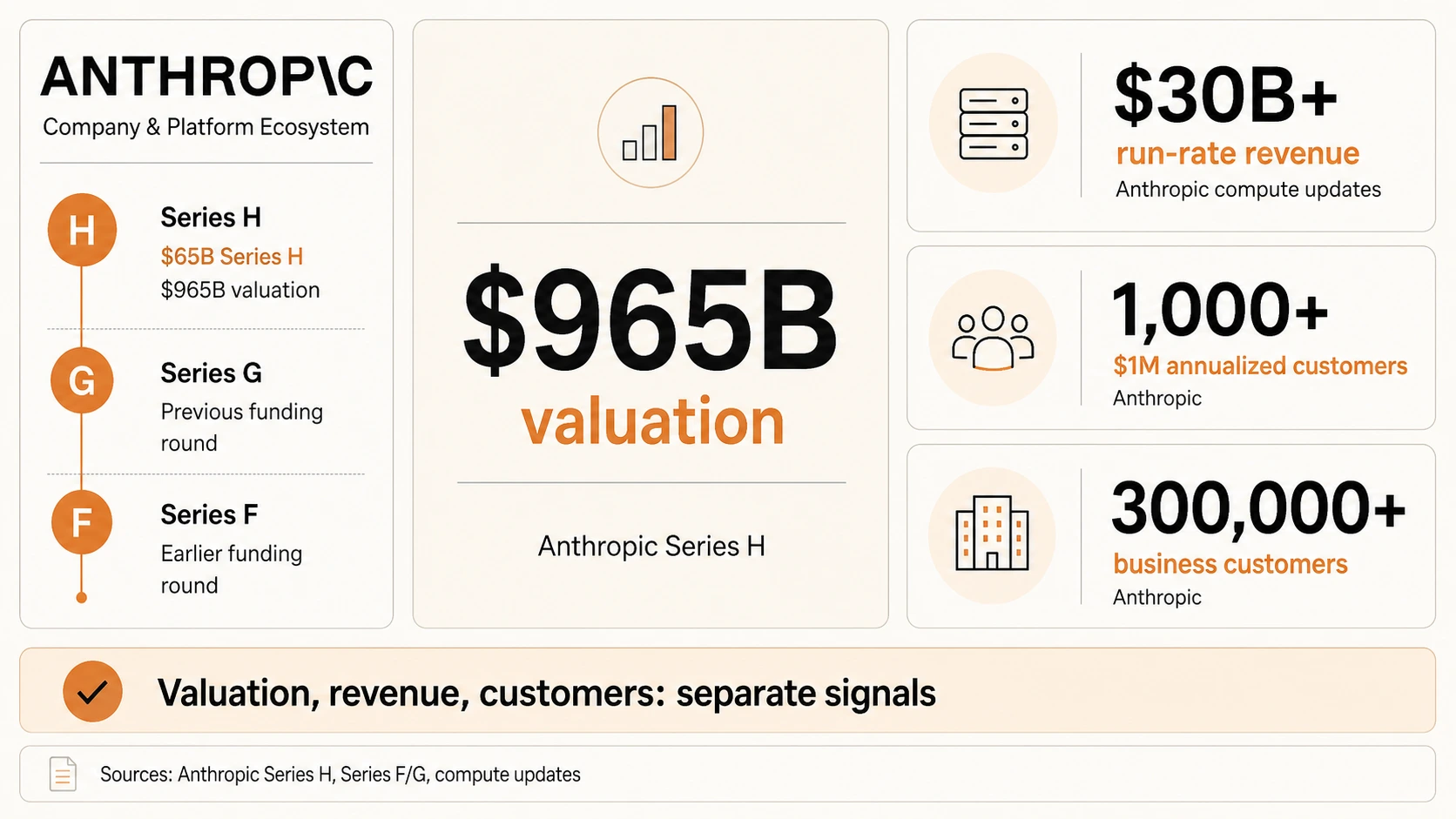
The revenue trajectory is just as important as the valuation. In August 2025, Anthropic said run-rate revenue had grown from $87 million at the start of 2024 to more than $5 billion in its international expansion announcement. By February 2026 it had reached $14 billion, and by April 2026 official compute posts said run-rate revenue had surpassed $30 billion, up from about $9 billion at the end of 2025 (Google/Broadcom update, Amazon compute update).
Run-rate revenue (annualized, company-reported)
Run-rate revenue is an annualized private-company metric, not audited GAAP revenue. Source: Anthropic announcements.
That does not mean Anthropic has published audited public-company revenue. “Run-rate revenue” is an annualized private-company metric. It is still a high-signal commercial indicator — especially because it appears repeatedly in official announcements — but it should not be treated as GAAP revenue, profitability, margin, or cash flow.
The spend tier has moved even faster at the top end. In February 2026, Anthropic said over 500 business customers were spending more than $1 million annualized and that eight of the Fortune 10 were Claude customers in its Series G announcement. In the later Google/Broadcom compute announcement the $1 million-plus customer count exceeded 1,000, doubling in less than two months.
Infrastructure And Compute Capacity
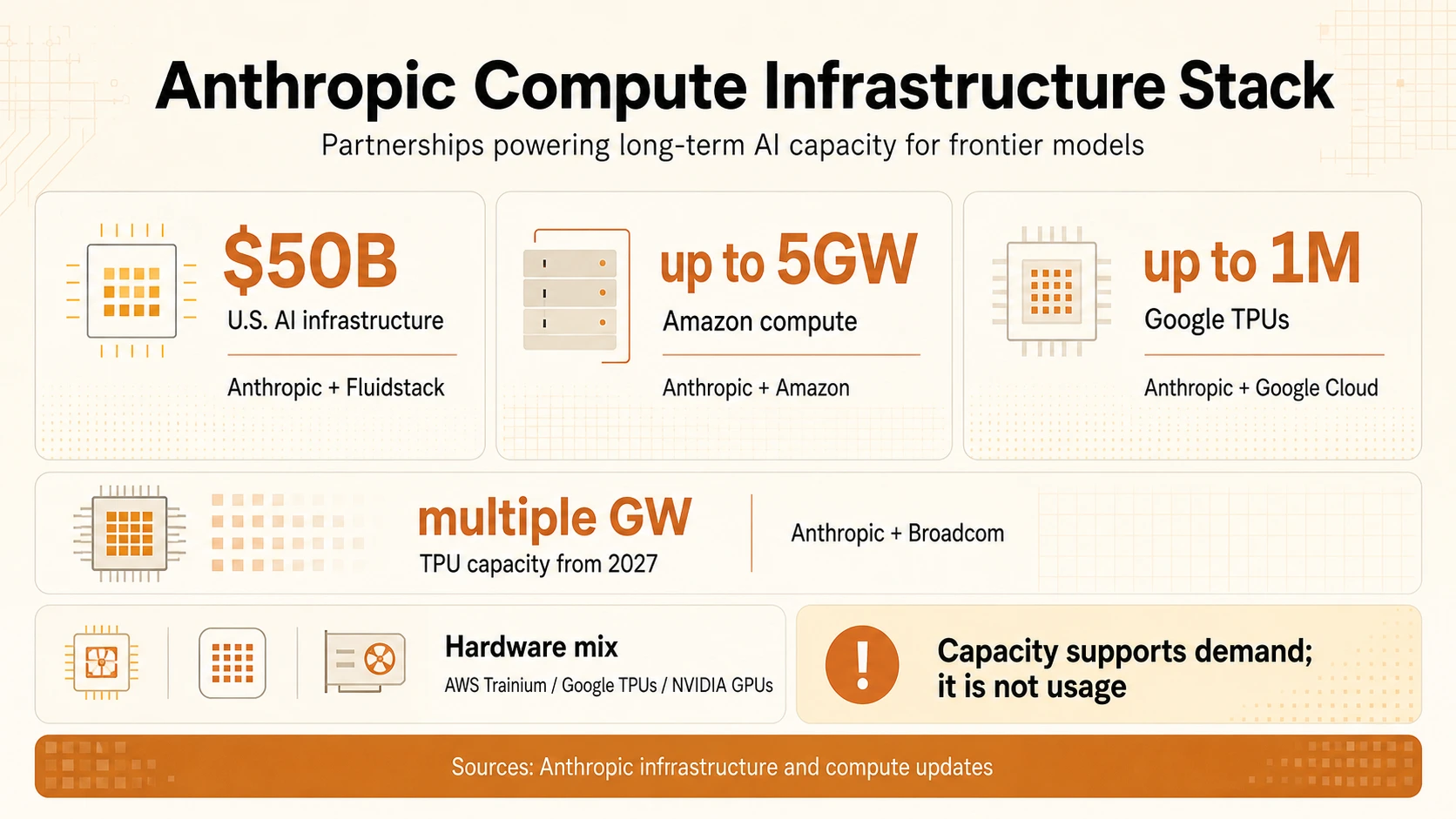
Anthropic’s infrastructure statistics explain why funding, valuation, and revenue are so tightly connected. Training and serving frontier models requires enormous capital outlays, and Anthropic now publishes compute commitments in gigawatts, billions of dollars, and partner-chip platforms.
Compute commitments (partnership announcements)
These are capacity and partnership statistics, not usage statistics. Compute capacity can support demand, but it is not the same as revenue, customer count, user count, or model quality. Anthropic’s best-supported compute story is diversification across AWS Trainium, Google TPUs, and NVIDIA GPUs, while keeping Amazon as its primary cloud provider and training partner.
Business Adoption: Customers, Large Accounts, And Partner Capacity
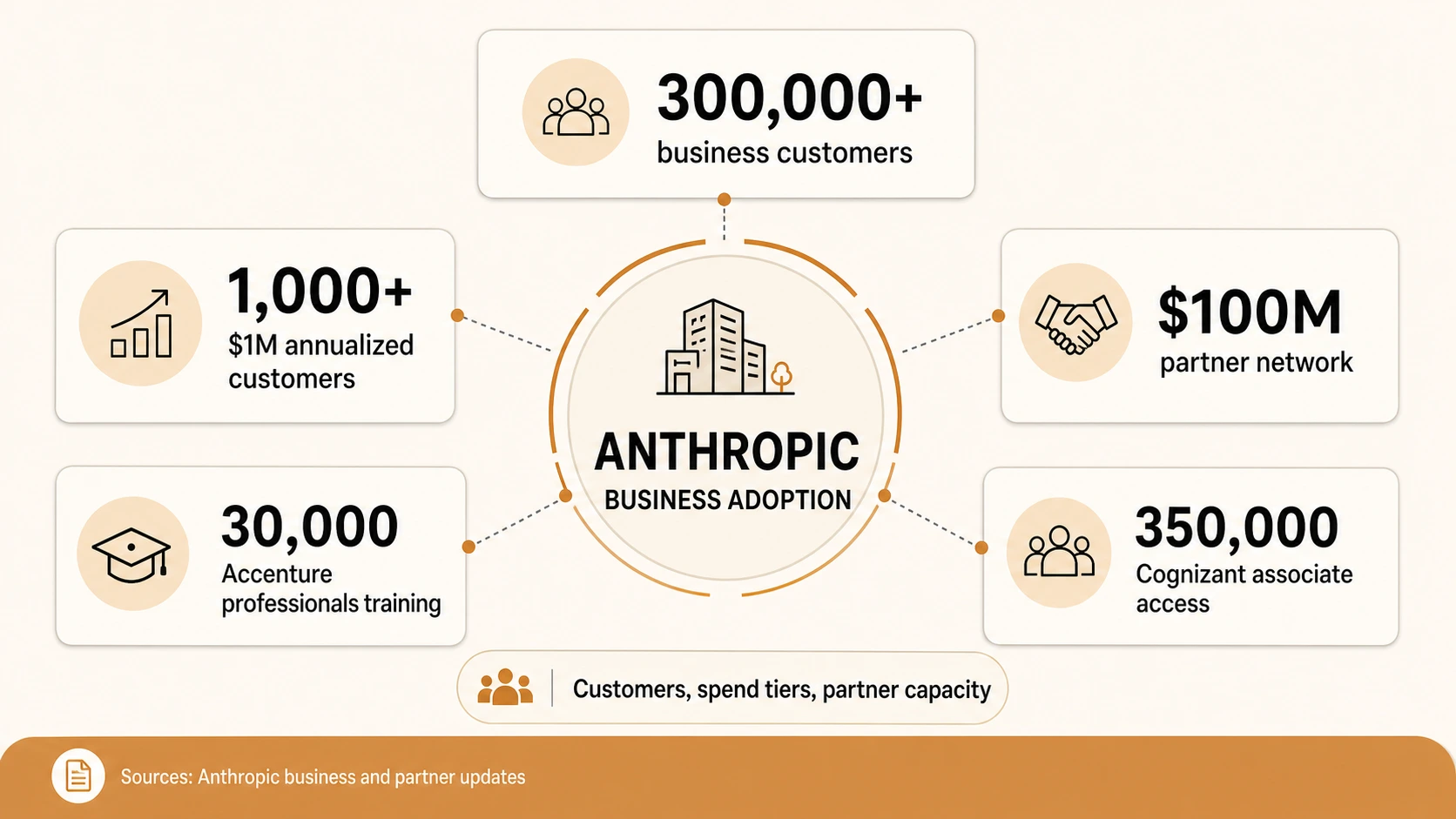
The cleanest Anthropic adoption number is 300,000-plus business customers, not a consumer-user count. Anthropic published that baseline in the Series F announcement, repeated it in the Google Cloud TPU expansion, and cited demand from hundreds of thousands of businesses in its $50 billion infrastructure announcement.
Customer breadth
300,000+ business customers
The cleanest adoption baseline, repeated across the Series F, Google Cloud TPU, and $50B infrastructure announcements.
AnthropicAccount depth
1,000+ at $1M annualized
Customers each spending more than $1 million annualized passed 1,000 in 2026, up from over 500 in February.
AnthropicPartner network
$100M partner commitment
The Claude Partner Network launched with an initial $100M 2026 investment and a fivefold expansion of the partner-facing team.
AnthropicImplementation capacity
30,000 + 350,000 trained
Accenture is training 30,000 professionals on Claude; Cognizant opened access across a workforce of about 350,000 associates.
AnthropicThose partner numbers should be read as implementation capacity, not deployments. Training 30,000 consultants or enabling access across a services workforce can accelerate customer adoption, but it does not prove how many end customers are in production. Industry-specific launches support the same enterprise-platform reading: 10 ready-to-run agent templates in financial services, HIPAA-ready tools connecting 600-plus vetted scientific tools in healthcare and life sciences, and 15 workflows plus 15 skills in Claude for Small Business.
Platform Distribution: API, AWS, Google Cloud, And Microsoft Foundry
Anthropic’s strongest platform statistic may be distribution. The company says Claude is available through the Claude API, Claude Platform on AWS, Amazon Bedrock, Google Cloud, and Microsoft Foundry in its models overview, and that Claude remains the only frontier AI model available to customers on AWS Bedrock, Google Cloud Vertex AI, and Microsoft Azure Foundry.
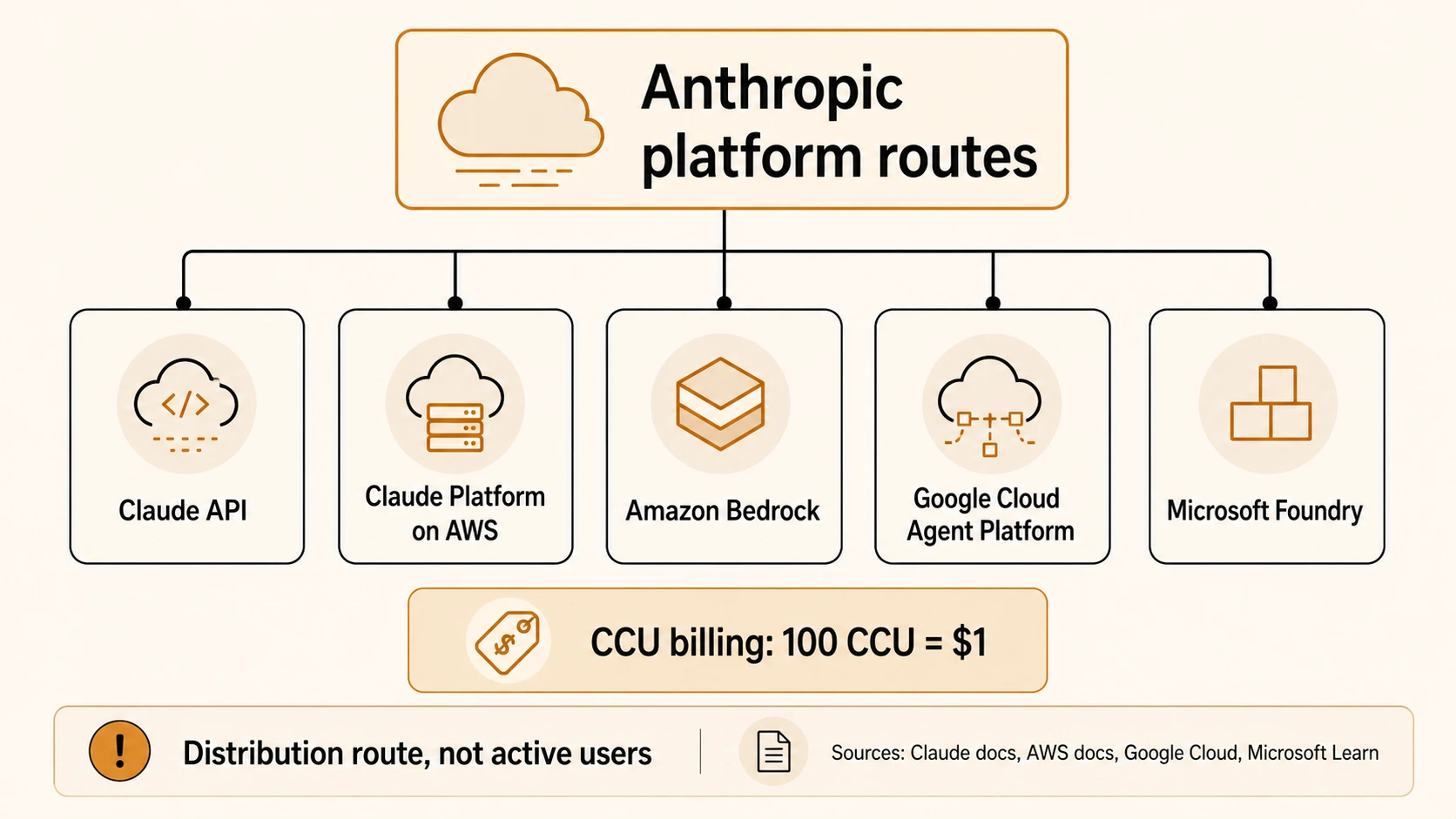
Five ways to deploy Claude
The direct developer route to Anthropic-hosted Claude models — first-party, usage-based.
AWS model cards list Claude Opus 4.8 (launched May 28, 2026) and Claude Sonnet 5 (June 30, 2026) as active on Bedrock.
Model IDs such as claude-opus-4-8 and claude-sonnet-5 are available on Google Cloud, region-dependent.
Claude models in Foundry can be hosted on Azure or on Anthropic infrastructure, under Azure Marketplace terms.
The marketplace billing unit for Claude on AWS and in Microsoft Foundry — a billing unit, not a usage metric.
Anthropic says Claude is the only frontier model available across AWS Bedrock, Google Cloud Vertex AI, and Microsoft Azure Foundry. Tap a route to see its specs.
Claude docsThe partner docs confirm real deployment routes: the AWS Bedrock documentation, Claude on Google Cloud docs, and Microsoft Foundry Claude models each spell out model IDs, context windows, deployment regions, and marketplace terms.
Models, Pricing, Context Windows, And Benchmarks
As of July 2026, Anthropic’s public lineup spans Claude Fable 5, Opus 4.8, Sonnet 5, and Haiku 4.5, with the frontier models at 1M context and 128K max output (models overview).
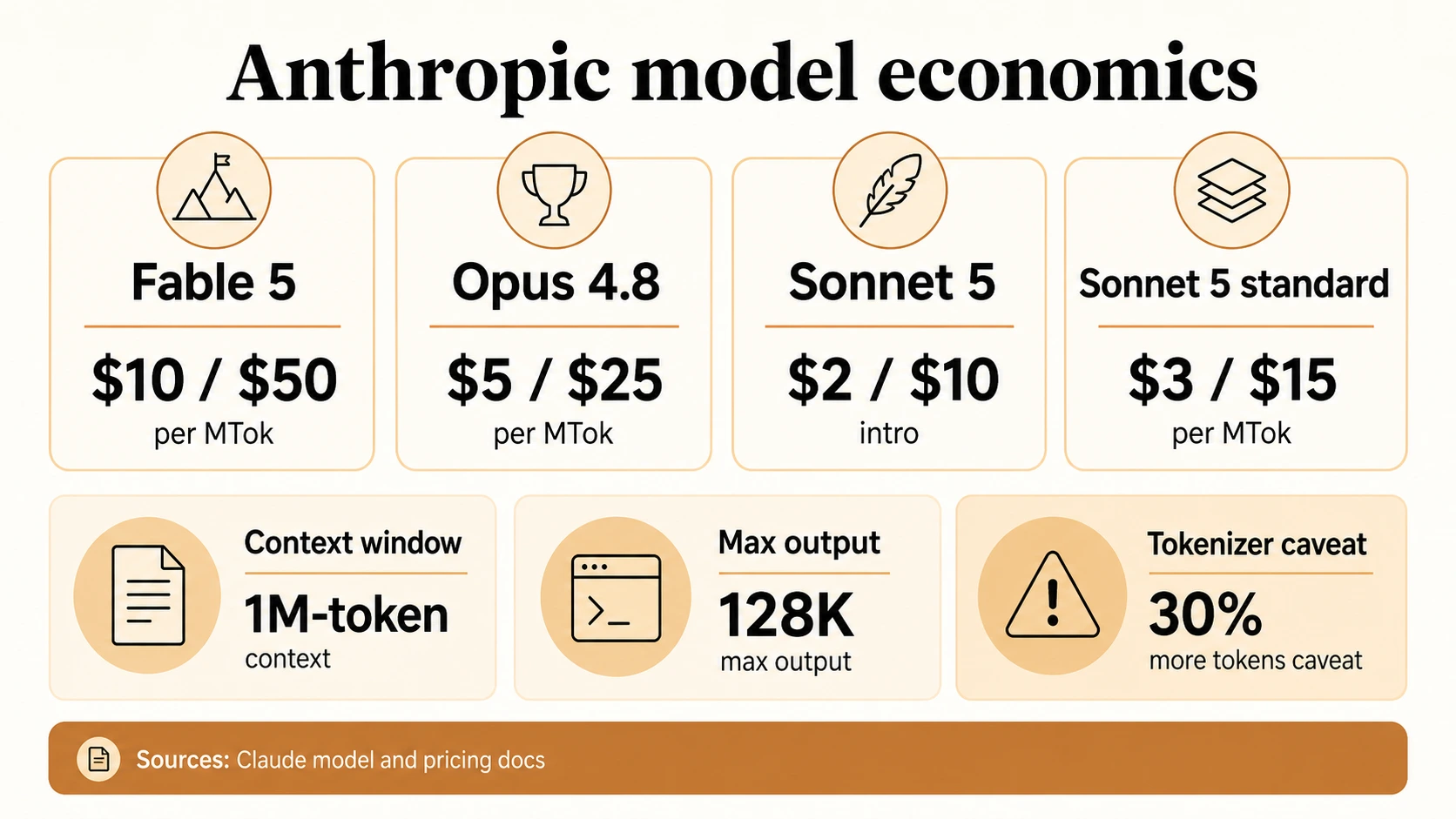
Claude model pricing (per million tokens, input / output)
Benchmarks should stay in their lane. A model score can show capability under a defined test harness; it does not prove average enterprise ROI, production reliability, or safety in every deployment. For buyers and builders, model specs, pricing, context windows, and partner availability are stronger planning signals than isolated benchmark anecdotes.
Claude Product Surface In Anthropic’s Platform
Anthropic’s platform has more product surface in 2026 than a simple chat app. Claude for Work, Claude Code, Claude Cowork, Claude Tag, Claude Design, Claude Science, financial-services agents, healthcare tools, small-business workflows, and cloud-deployed Claude models are all part of the platform map.
The other surfaces — Claude Tag, Claude Design, Claude for Small Business, healthcare and financial-services agents, and partner-led implementation — are best read as evidence of platform breadth rather than customer counts.
Trust, Safety, Compliance, And Governance
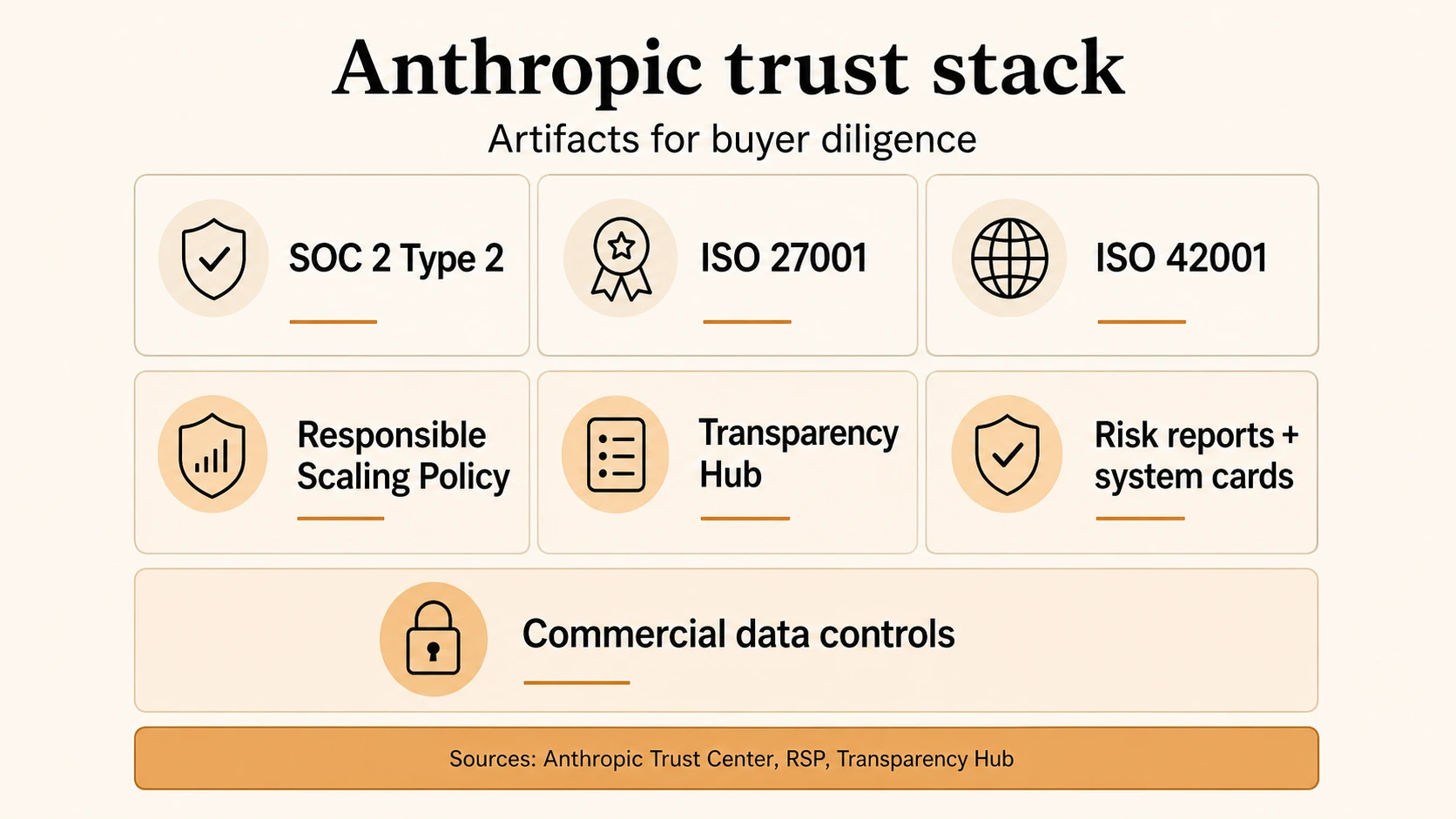
Anthropic’s safety and governance stack is part of its platform statistics because enterprise buyers evaluate models through risk, data, and compliance as much as benchmark performance.
Compliance artifacts
SOC 2 Type 2 · ISO 27001 · ISO 42001
The Trust Center is the main public compliance hub, listing these frameworks and CSA references — though certificate scope depends on the specific artifact and product boundary.
Trust CenterSafety policy
Responsible Scaling Policy v3
Released February 2026, with an ASL-3 activation report and a February 2026 risk report as evidence of process and reporting.
AnthropicTransparency
Transparency Hub & system cards
Public documentation buyers can inspect, though it does not prove that every deployment is low risk.
AnthropicData controls
Commercial vs consumer terms
Claude for Work, Government, Education, and third-party API use fall under Commercial Terms, with custom retention controls and no model training on Team/Enterprise code.
AnthropicMarket Context: Enterprise AI Is Growing, But Measurement Still Matters
Anthropic’s growth is easier to understand inside the broader AI market. The category is expanding fast, but market-wide adoption is not the same as Anthropic’s official market share.
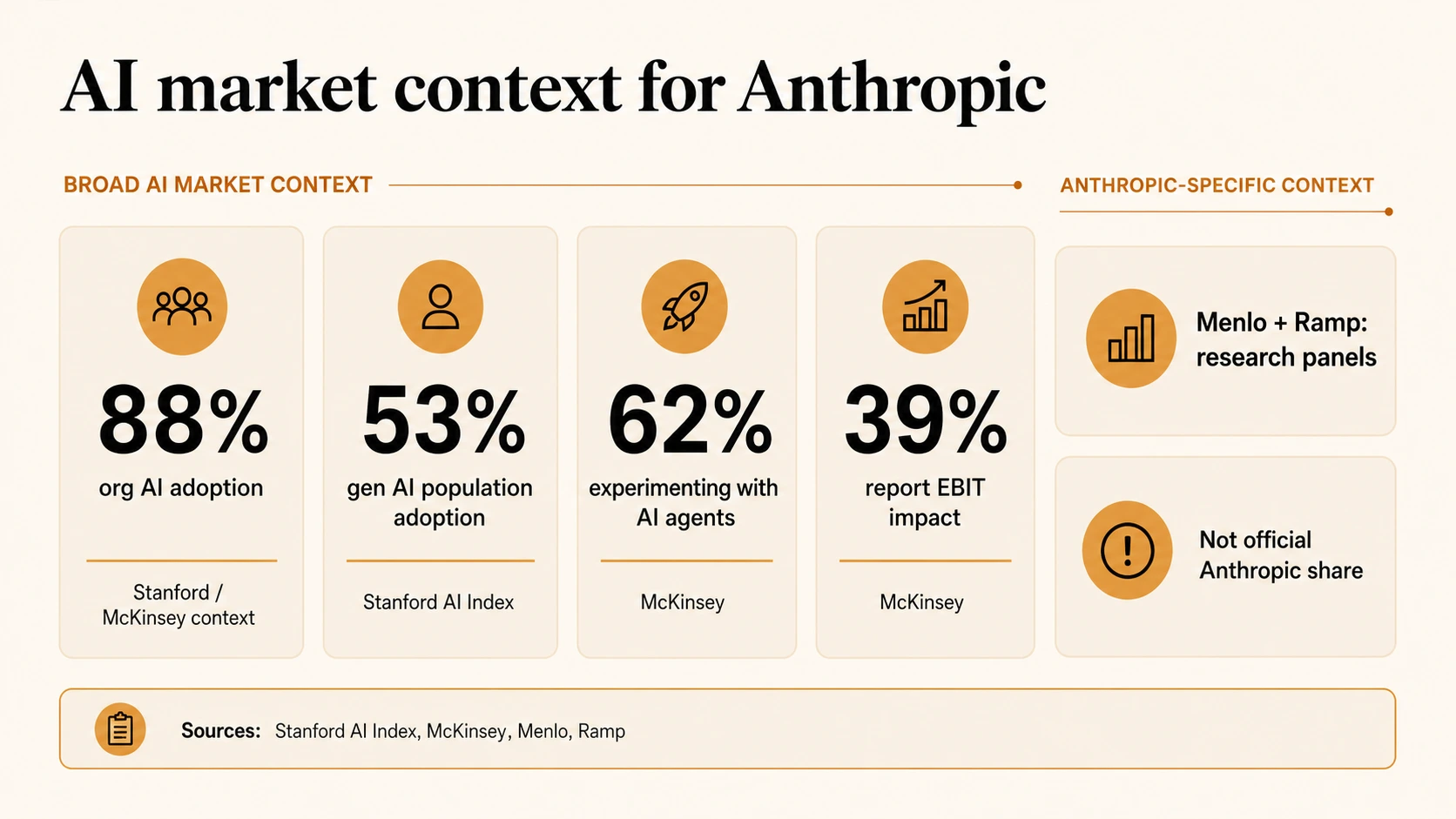
Stanford’s 2026 AI Index says organizational adoption reached 88%, generative AI reached 53% population adoption within three years, and global corporate AI investment hit $581.7 billion in 2025. Menlo Ventures estimates Anthropic captured 40% of enterprise LLM spend in 2025, up from 24% the prior year and 12% in 2023 — a useful investor-research estimate, not an official Anthropic disclosure. Ramp Economics Lab adds that Anthropic was winning roughly 70% of head-to-head matchups against OpenAI among first-time AI buyers in Ramp’s observed data, which is panel evidence from Ramp customers, not universal market share.
What Anthropic Does Not Publish
The missing numbers are as important as the published ones. Anthropic does not publish a single companywide monthly active user number, a clean active-user count for Claude.ai, an active developer count for the API, or a channel split showing how much revenue comes from direct API usage, subscriptions, cloud providers, Claude Code, industry products, and partner-led services.
A business-customer count shows breadth, not usage.
The 300,000-plus figure counts customers, not active seats, sessions, or monthly active users.
A spend tier shows account depth, not retention.
The $100,000 and $1 million annualized tiers do not reveal how many customers expanded, renewed, reduced spend, or churned after a pilot.
Run-rate revenue shows scale, not profitability.
It is an annualized private-company metric, not audited GAAP revenue, margin, or cash flow.
Compute capacity is a commitment, not live usage.
Gigawatts and dollar figures are partnership commitments; they can support demand but do not measure it.
A benchmark or case study is not average ROI.
Customer examples show what is possible in one workflow; they cannot prove the average ROI of Claude across all customers.
The largest blind spot is channel mix. A direct API customer, an Amazon Bedrock user, a Microsoft Foundry buyer, a Claude Team subscriber, and a consultancy-led implementation are not the same commercial object, and their economics differ. For operators, Anthropic statistics should be used as inputs to due diligence, not as a finished answer.
The Operator’s Read On Anthropic
The practical lesson is not simply that Anthropic is big. It is that different Anthropic numbers answer different operating questions.
Vendor-risk view
Start with company scale
The $965B valuation, $30B-plus run-rate revenue, 1,000-plus $1M customers, and multi-gigawatt compute commitments suggest commercial durability and capital depth — but not product-level margin, retention, or uptime by channel.
AnthropicBuild-route view
Start with deployment distribution
The Claude API, Google Cloud, AWS Bedrock, and Microsoft Foundry docs tell you which route fits your procurement, data, latency, and governance constraints — more actionable than one "best model" number.
Claude docsCost-forecast view
List pricing is only line one
Opus 4.8 at $5/$25, Sonnet 5 at $2/$10 introductory, context size, output limits, caching, routing premiums, and the ~30% tokenizer effect all shape the real bill.
Claude pricingCompetitor view
The opening is specificity
Not "Claude has no traction" — it clearly has traction. The opening is workflow integration, vertical data, reliability, cost control, governance, and implementation depth.
AnthropicReading Anthropic’s Numbers Honestly
Use official Anthropic announcements for funding, valuation, revenue run-rate, large-account growth, customer baselines, infrastructure commitments, and product launches. Use current docs for model and platform facts — pricing, context windows, endpoint support, data residency, and release status should be treated as current as of the access date. Use market research from Stanford, McKinsey, Menlo, and Ramp for category context, not as official Anthropic denominators.
Frequently Asked Questions
What is Anthropic worth in 2026?
Anthropic raised $65 billion in Series H funding at a $965 billion post-money valuation on May 28, 2026, up from a $380 billion valuation in its February 2026 Series G. This is a private post-money valuation set by investors, not a public-market capitalization.
How much revenue does Anthropic make?
Anthropic said its revenue run-rate had surpassed $30 billion in 2026, up from about $9 billion at the end of 2025 and $14 billion in February 2026. Run-rate revenue is an annualized private-company metric, not audited GAAP revenue, so it should not be read as profit, margin, or cash flow.
How many customers does Anthropic have?
Anthropic reports more than 300,000 business customers, with over 1,000 customers each spending more than $1 million on an annualized basis in 2026, up from more than 500 in February 2026. That is a business-customer count, not a consumer active-user number.
How much compute has Anthropic committed to?
Anthropic announced a $50 billion U.S. AI infrastructure investment with Fluidstack, up to 5 gigawatts of new Amazon compute, and up to one million Google Cloud TPUs, plus multiple gigawatts of Google/Broadcom TPU capacity from 2027. These are capacity and partnership commitments, not measures of live usage.
Where can you access Claude models?
Anthropic says Claude is available through the Claude API, Claude Platform on AWS, Amazon Bedrock, Google Cloud, and Microsoft Foundry, and that Claude is the only frontier model available across AWS Bedrock, Google Cloud Vertex AI, and Microsoft Azure Foundry. Availability, region, and pricing vary by route.
What share of enterprise AI spend does Anthropic have?
Menlo Ventures estimates Anthropic captured about 40% of enterprise LLM spend in 2025, up from 24% in 2024 and 12% in 2023. That is an investor-research estimate from a spend panel, not an official Anthropic disclosure or a universal market-share figure.
Does Anthropic publish a monthly active user number?
No. Anthropic does not publish a single companywide monthly active user number or a clean active-user count for Claude.ai or the API. Its public statistics are company, customer, revenue, model, partner, and trust metrics, each with its own denominator.
Sources and Further Reading
Official Anthropic funding, revenue & compute
Platform, model & pricing documentation
Partner network, industry products & trust