ChatGPT Statistics
Last updated on July 6, 2026

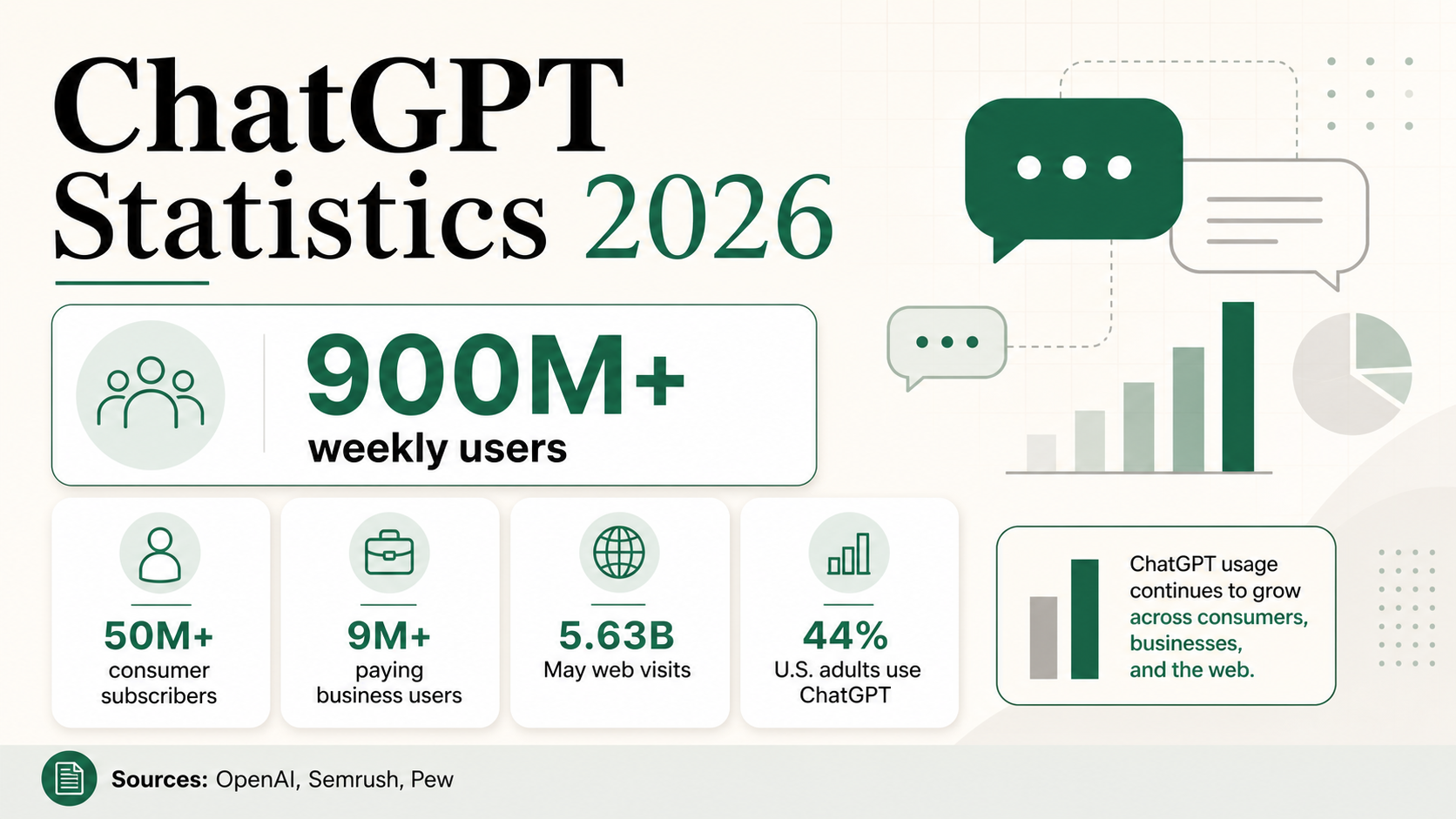
ChatGPT is now a mass-market AI product and a work platform at the same time. The cleanest current scale number is official: OpenAI says ChatGPT has more than 900 million weekly active users and more than 50 million consumer subscribers as of its 2026 scale update. That is the number to use when someone asks how big ChatGPT is.
But it is not the only number worth reading. ChatGPT also shows up in web visits, mobile app estimates, consumer surveys, enterprise seats, education use, pricing tiers, and feature rollouts. Those metrics are useful, but they answer different questions. A weekly active user count is not the same thing as a Semrush visit estimate, a Pew survey response, or a Sensor Tower app-market estimate reported by TechCrunch.
That distinction matters for founders and operators. If you are building around ChatGPT, selling to teams that use it, or trying to understand AI search and automation behavior, the question is not just “How many people use ChatGPT?” It is “Which ChatGPT metric tells me something reliable about demand, workflow adoption, monetization, or distribution?”
ChatGPT At Scale: The Headline Numbers
The headline ChatGPT numbers use different denominators, so read them as separate product, monetization, work, and demand signals rather than one figure.
Official OpenAI numbers (company statements)
Usage, research & third-party estimates
Read every number by its own denominator
ChatGPT's headline figures answer different questions. Tap a metric to see what it measures — and what it does not prove.
OpenAIWhich ChatGPT Metric Answers Which Question?
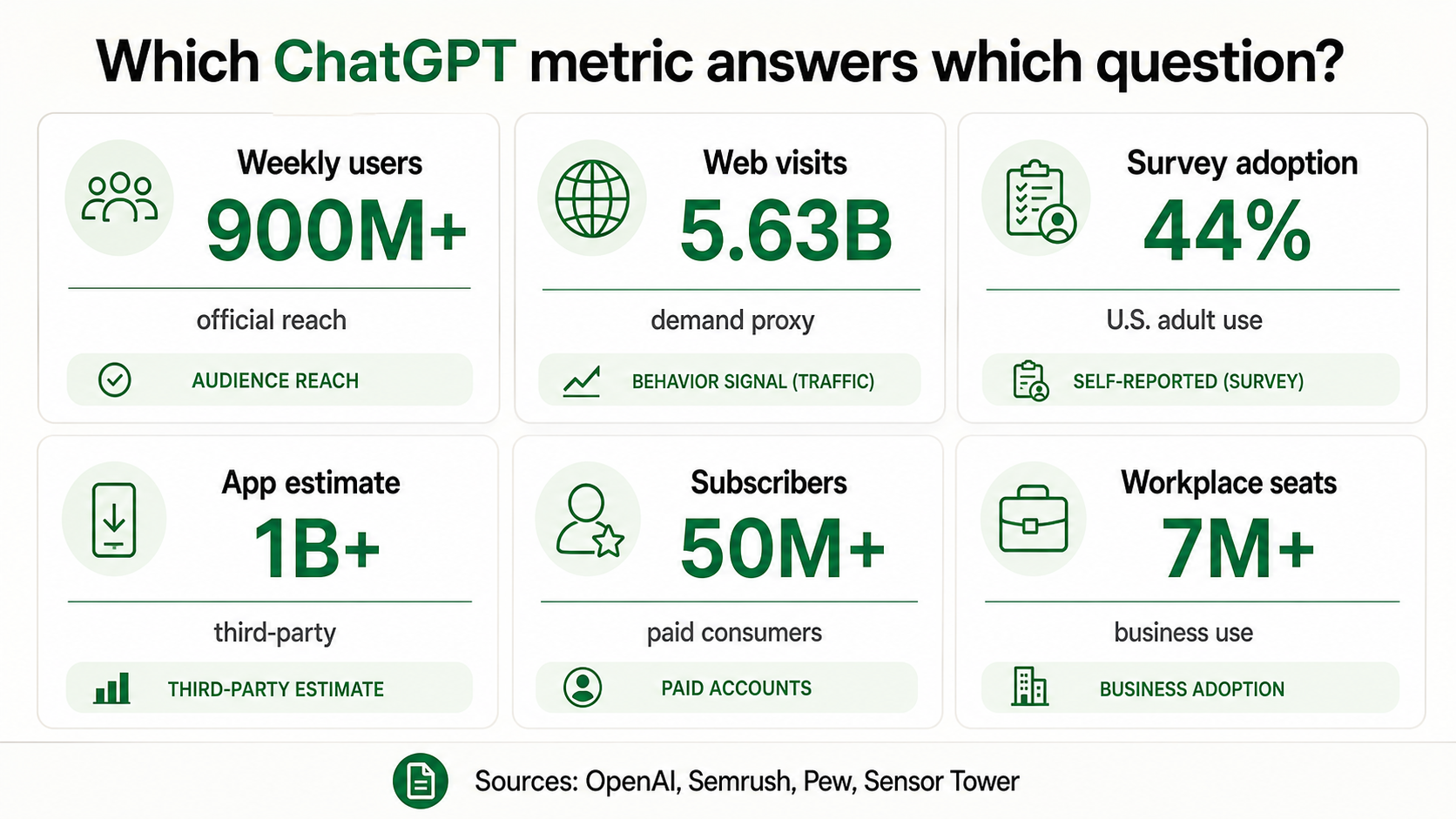
The simplest way to read ChatGPT statistics is to match each metric to the decision it can actually support. Weekly active users answer the product-scale question: how many people are using ChatGPT in a recent week, according to OpenAI’s definition. That is the right number for board decks, market sizing, and high-level market context.
Consumer subscribers answer a monetization question. OpenAI’s 50M+ consumer subscriber number tells you that paid consumer adoption is no longer a niche power-user behavior. It does not reveal how many subscribers are on Go, Plus, or Pro; it also does not reveal churn, upgrade paths, country mix, or how many paid users subscribe through app stores.
Paying business users and workplace seats answer a work-adoption question. OpenAI’s 9M+ paying business users and 7M+ ChatGPT workplace seats show that ChatGPT is sold and deployed inside organizations, not just used informally by employees. The additional Enterprise statistics, such as 8x weekly message growth and 19x Custom GPTs/Projects weekly-user growth, say more about depth of use than simple seat counts (OpenAI).
Product scale
Weekly active users
The right number for board decks and market sizing — how many people use ChatGPT in a recent week, on OpenAI’s definition.
OpenAIMonetization
Subscribers & business users
Paid adoption is no longer niche, but the counts hide plan mix, churn, ARPU, and consumer-versus-enterprise revenue share.
OpenAIIntensity
Messages per week
The 18B messages/week figure translates active users into actual usage volume, but it is a July 2025 historical baseline, not a 2026 estimate.
OpenAI / NBERDemand proxy
Web visits & app estimates
Semrush visits and Sensor Tower app estimates size attention and mobile competition; they are not interchangeable with weekly actives.
SemrushMessages per week answer an intensity question. The OpenAI/NBER paper’s 18B messages per week in July 2025 is useful because it translates active users into actual usage volume. Because it is a historical figure, it is safer to use it as a baseline for how large consumer use had become by mid-2025, not as a current 2026 message estimate.
Web visits answer an attention and channel question. Semrush’s 5.63B May 2026 visits and Similarweb’s category ranking are useful for SEO, traffic benchmarking, and competitive visibility. They do not answer how many unique people used ChatGPT, how many paid, or how often users returned inside the app. Survey adoption answers a social-penetration question: Pew’s 44% U.S. adult ever-use statistic shows how mainstream ChatGPT has become in the United States, and should be read alongside age, task, and frequency data. App-intelligence estimates answer a mobile-market question: Sensor Tower’s reported 1B+ monthly-user app milestone and 46.4% AI-assistant user share sit beside, not above, OpenAI’s weekly active user count.
The Official User Number: More Than 900 Million Weekly Active Users
The best current answer to “How many people use ChatGPT?” is OpenAI’s own weekly active user figure. OpenAI says ChatGPT has more than 900 million weekly active users. OpenAI repeats the 900 million weekly-user framing across other public materials, including its enterprise positioning, education commentary, and voice-infrastructure writing.
That consistency makes the 900M+ weekly number the strongest top-line statistic. It is still not a complete user model. It does not disclose exact monthly active users, total registered accounts, retention, prompt volume in 2026, free-versus-paid mix, geography, or average messages per user. A founder should treat it as the official current scale marker, then use other data classes to answer narrower questions.
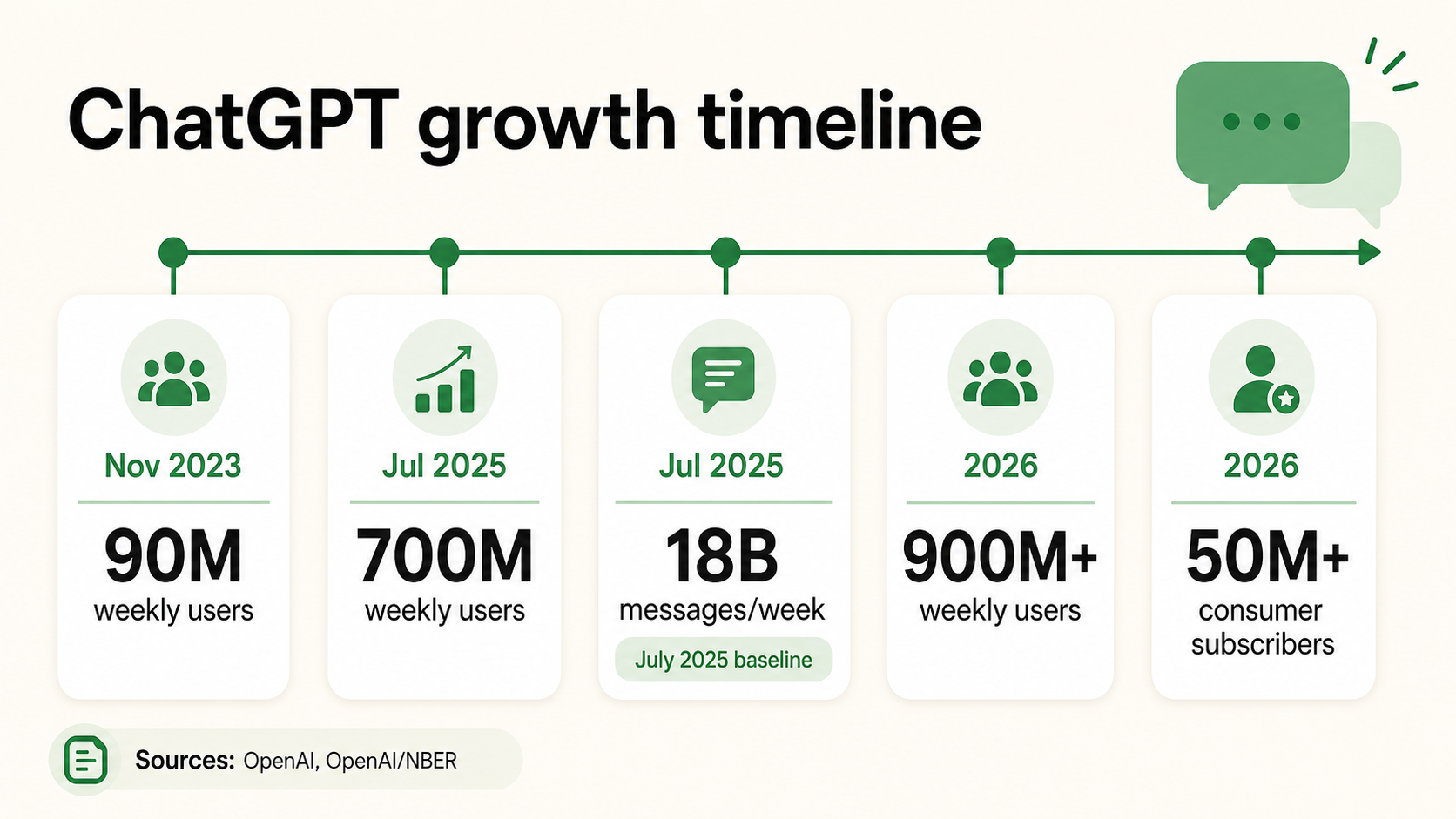
The history matters because ChatGPT’s scale has been moving quickly. OpenAI’s consumer usage study used 700 million weekly active users as its mid-2025 base and reported 18 billion messages per week by July 2025. OpenAI’s workplace report shows a charted progression from roughly 90 million weekly active users in November 2023 to nearly 680 million by July 2025. The 2026 900M+ figure extends that curve, but the safer path is to avoid inventing intermediate monthly numbers that OpenAI has not disclosed.
Weekly active users — three official milestones
Each point is an OpenAI-reported weekly-active-user milestone on a linear axis, so the steep climb is the story: roughly 10x in about two and a half years.
OpenAIOne practical way to read this: weekly active users tell you ChatGPT is a weekly habit for a huge population. They do not tell you whether a specific feature, plan, country, company segment, or use case has the same penetration.
What People Actually Do In ChatGPT
The most useful public evidence on ChatGPT behavior comes from the OpenAI/NBER study of consumer usage. OpenAI says the work drew on a privacy-preserving analysis of 1.5 million conversations and the NBER paper reports that by July 2025, 18 billion messages per week were being sent by 700 million users.
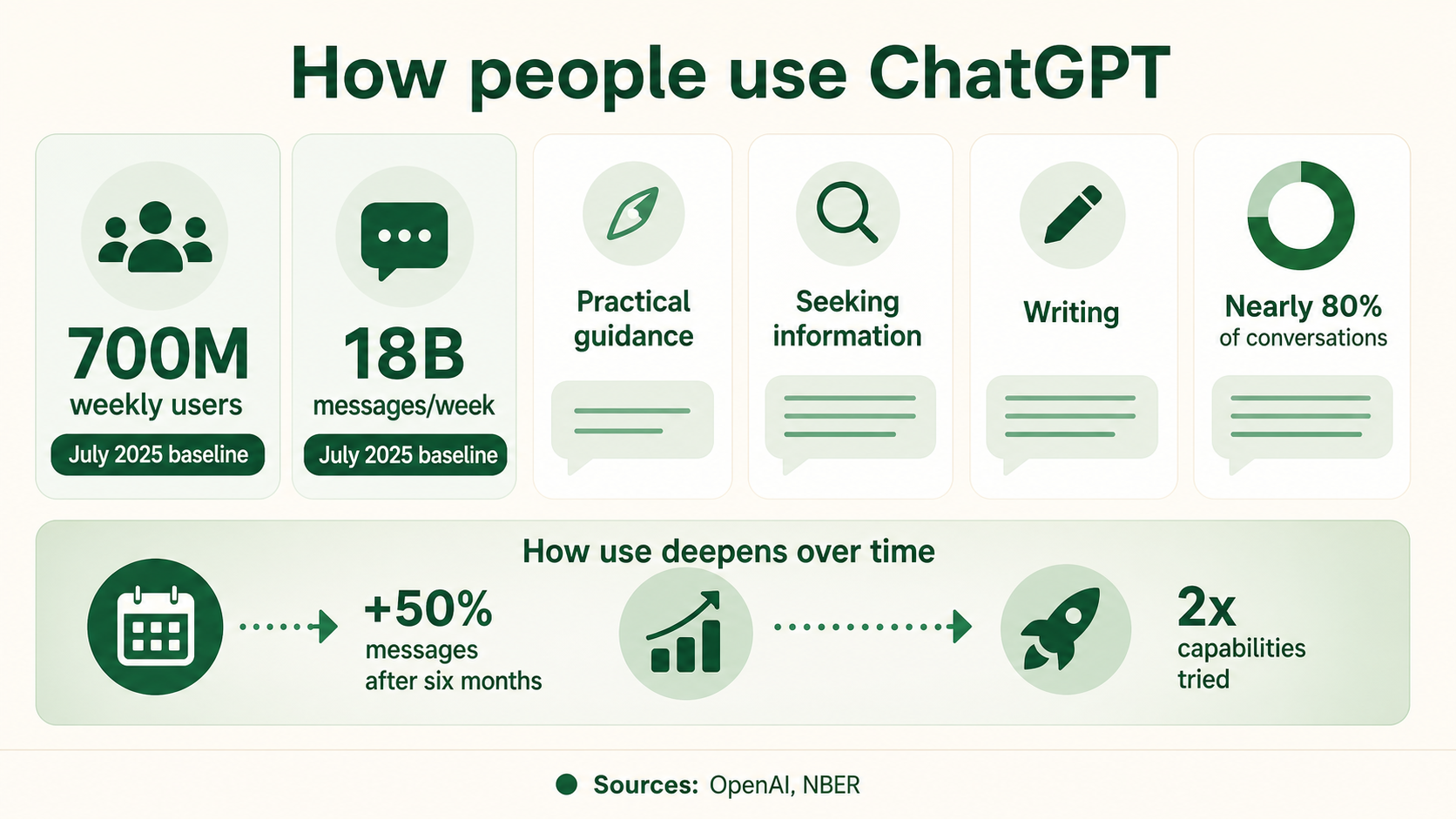
The most important finding is that ChatGPT is not only a coding tool or work bot. The NBER abstract says Practical Guidance, Seeking Information, and Writing are the three most common conversation topics and together account for nearly 80% of all conversations. For product builders, that says ChatGPT competes with search, docs, writing tools, coaching interfaces, and task-specific workflow software, not just other chatbots.
The study also changes how operators should think about “work use.” The report covers consumer plans, yet the value created spans personal and professional contexts. That means a user can learn a ChatGPT behavior at home, then bring it into work before procurement ever sees it. OpenAI’s workplace report makes that same point: consumer adoption makes enterprise rollout easier because employees already understand the product.
OpenAI’s 2026 adoption analysis adds a second layer: new users deepen and broaden their use over time. In a 0.1% sample of accounts created between October 15, 2025 and May 1, 2026, users sent 50% more messages per day six months after signup and tried twice as many distinct capabilities. That matters more than a one-time signup count. It suggests that continued use exposes people to more surfaces: search, files, images, voice, memory, Projects, data analysis, and apps.
The caveat is that OpenAI’s adoption sample excluded banned users, users under 18, and users who did not send messages for 28 days after account creation (OpenAI). That makes it a strong source for engaged-user behavior, not a universal retention number.
ChatGPT Is A Product Platform, Not One Chat Window
ChatGPT’s product surface in 2026 is much larger than the original chat interface OpenAI introduced in 2022. Current plan pages list Free, Go, Plus, Pro, Business, and Enterprise, with education-specific options also available (OpenAI pricing, ChatGPT pricing).
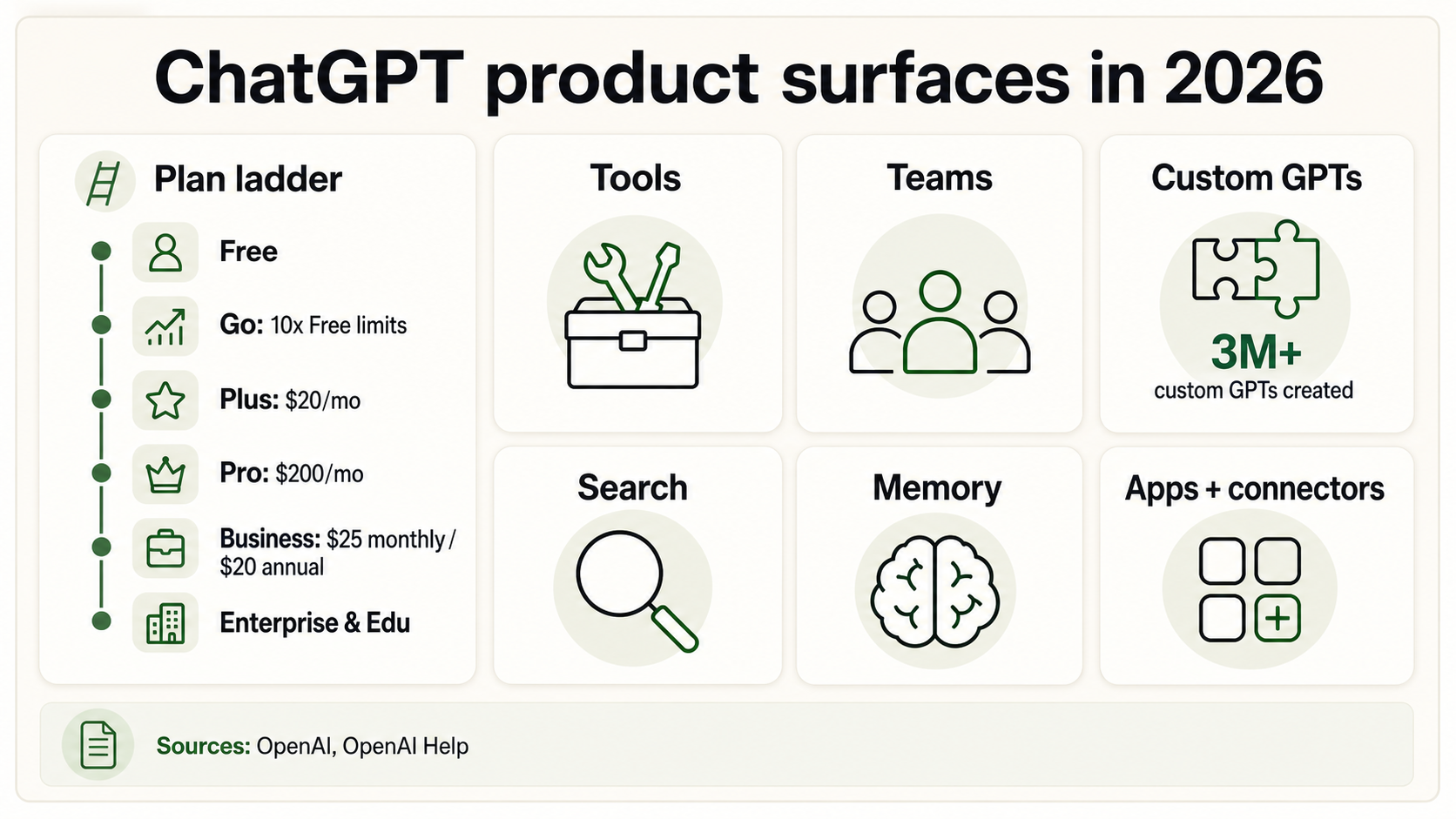
The individual plan ladder now matters for monetization. ChatGPT Plus remains the familiar $20/month subscription. ChatGPT Pro launched as a $200/month plan for heavy users of research-grade intelligence. ChatGPT Go was introduced as a lower-cost plan with 10x more messages, file uploads, and image creation than the free tier. For teams, ChatGPT Business pricing is listed by OpenAI Help at $25 per user per month if billed monthly and $20 per user per month if billed annually for most countries, with a minimum of two standard seats.
The ChatGPT plan ladder
Keeps ChatGPT broadly available. OpenAI says it is testing ads in Free and Go in the U.S. while paid tiers stay ad-free.
A lower-cost plan with 10x more messages, file uploads, and image creation than the free tier.
The familiar individual subscription, unchanged in price for years.
Launched for power users who want research-grade intelligence and higher limits.
Adds workspace administration, a minimum seat model, and business-data protections. ChatGPT Team was renamed ChatGPT Business on Aug 29, 2025.
Organization-level deployment, security, privacy, admin controls, and sales-led procurement; ChatGPT Edu adds university options.
Current plan pages list Free, Go, Plus, Pro, Business, and Enterprise. Tap a tier to see its price and who it is for. Prices are date-sensitive — check the live pricing page for the current tier.
OpenAIThe business plan name has also changed. OpenAI says ChatGPT Team was renamed ChatGPT Business on August 29, 2025, while features and pricing did not change in that announcement. That matters for anyone comparing older articles or procurement notes: “Team” and “Business” may refer to the same plan family depending on date.
Feature expansion is just as important as pricing. ChatGPT Search gives timely answers with links to web sources and was updated to be available broadly in supported regions by February 2025. Memory improvements reached free users in a lighter form and gave Plus/Pro users longer-term personalization. Shared Projects and connectors brought team memory and data access into Business, Enterprise, and Edu workspaces. Apps in ChatGPT and the Apps SDK made third-party services available inside conversations, with previews for Business, Enterprise, and Edu customers in late 2025.
For founders, the point is straightforward: ChatGPT’s distribution is not only its homepage. It is a bundle of plans, apps, model access, memory, connectors, search, files, images, voice, and team workspaces. This is why feature statistics should usually be written as launch and availability evidence. A product page can prove that a capability exists and who can access it. It cannot prove how many people use that capability unless OpenAI publishes a usage number for it.
ChatGPT At Work: Seats, Messages, And Enterprise Behavior
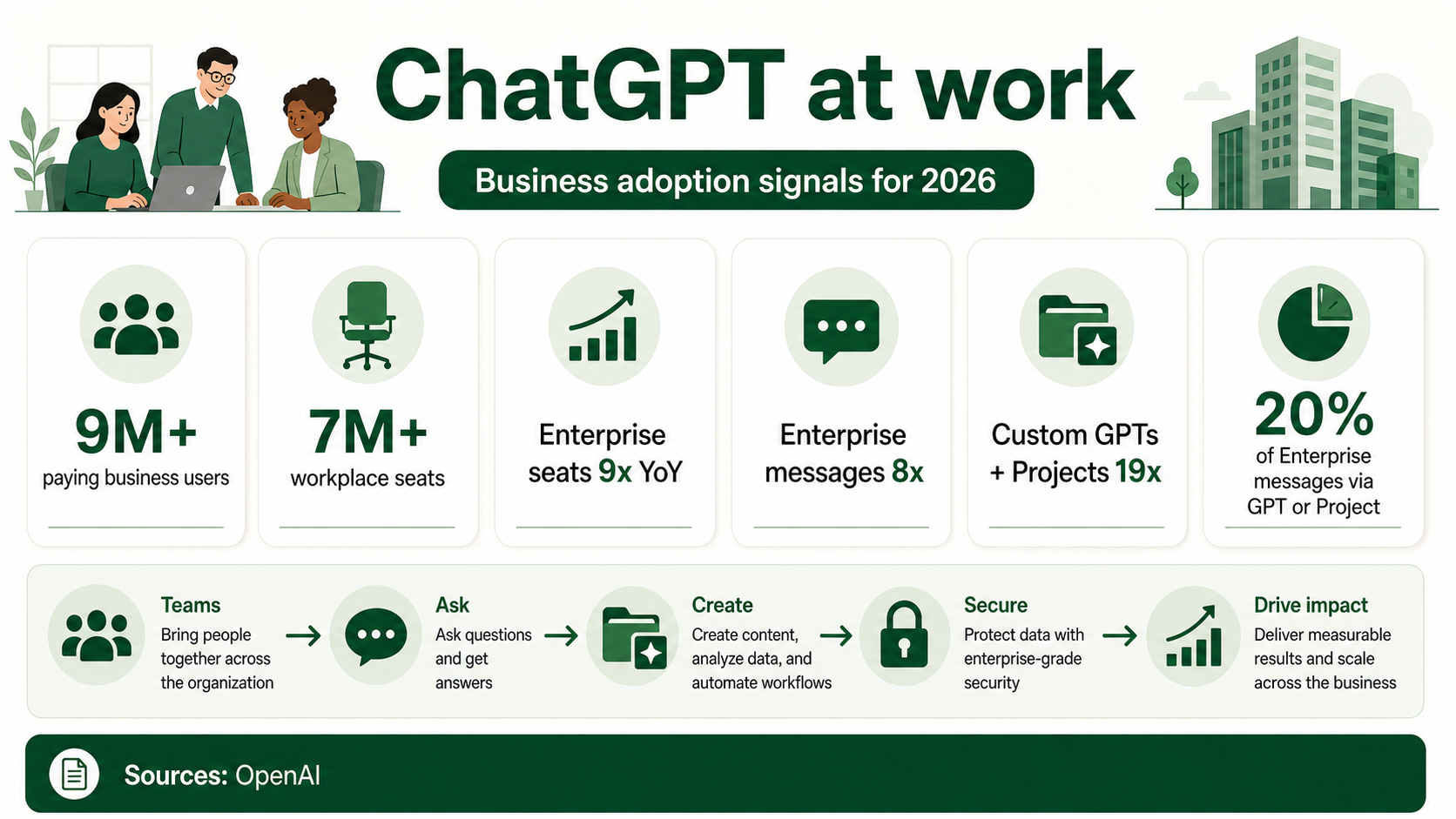
The strongest business-statistics story is that ChatGPT entered companies through both personal familiarity and formal seats. OpenAI says more than 9 million paying business users rely on ChatGPT for work. It also says there are more than 7 million ChatGPT for Work seats and that ChatGPT Enterprise seats grew 9x year over year.
Do not overstate the “1 million business customers” line. OpenAI defines it as all organizations actively paying OpenAI for business use, either through ChatGPT for Work or direct model consumption through the developer platform. That is a real business-platform number, but it is not a pure count of ChatGPT Enterprise customers.
OpenAI’s enterprise report gives more useful details for operators. It says OpenAI now serves more than 7 million ChatGPT workplace seats, ChatGPT Enterprise seats increased about 9x year over year, and weekly Enterprise messages grew about 8x since November 2024. It also says the average employee sent 30% more messages. This is where workflow adoption becomes visible: weekly users of Custom GPTs and Projects rose 19x year to date, and about 20% of all Enterprise messages were processed through a Custom GPT or Project. That is a stronger signal than a generic “AI adoption” quote because it points to repeatable work: internal assistants, shared project memory, organization-specific instructions, and persistent processes.
Employees also report measurable value, but the numbers come from OpenAI’s enterprise survey context. In the enterprise report, surveyed users attribute 40-60 minutes saved per active day to AI use, and staff in data science, engineering, and communications report 60-80 minutes saved per day. OpenAI also says 75% of surveyed employees report being able to complete tasks they previously could not perform, and coding-related messages outside engineering, IT, and research grew 36% over six months.
External research supports the broader pattern without proving ChatGPT-specific adoption. Gallup reports that U.S. employee AI use a few times per year or more nearly doubled from 21% to 40% over two years, while frequent use rose from 11% to 19% and daily use from 4% to 8%. McKinsey’s 2025 State of AI report says wider AI use is happening alongside the hard transition from pilots to scaled impact. Menlo Ventures estimates enterprise generative AI spend reached $37 billion in 2025, up 3.2x year over year, with $19 billion going to the application layer.
There is still a gap between active use and full organizational maturity. OpenAI’s enterprise report says even among monthly active ChatGPT Enterprise users, 19% had never used data analysis, 14% had never used reasoning, and 12% had never used search; among daily active users, those non-use shares fell to 3%, 1%, and 1% respectively. That is a useful operational signal: frequency of use and breadth of capabilities are linked. Companies do not get the full value of ChatGPT simply by buying seats; they need onboarding, task design, safe data access, and examples that move employees beyond basic prompting. Independent experiments help explain why those deployment details matter: BCG’s generative AI experiment with consultants used Enterprise ChatGPT on technical tasks and found that task design and tool fit, not seat counts, drive outcomes.
Public Adoption: Surveys Show Social Penetration, Not Active Users
Pew’s 2026 U.S. survey is one of the clearest public adoption sources. It reports that 44% of U.S. adults say they ever use ChatGPT, up from 34% in 2025, 23% in 2024, and 18% in 2023. That is a strong consumer-adoption statistic, but it is self-reported ever-use, not OpenAI active users.
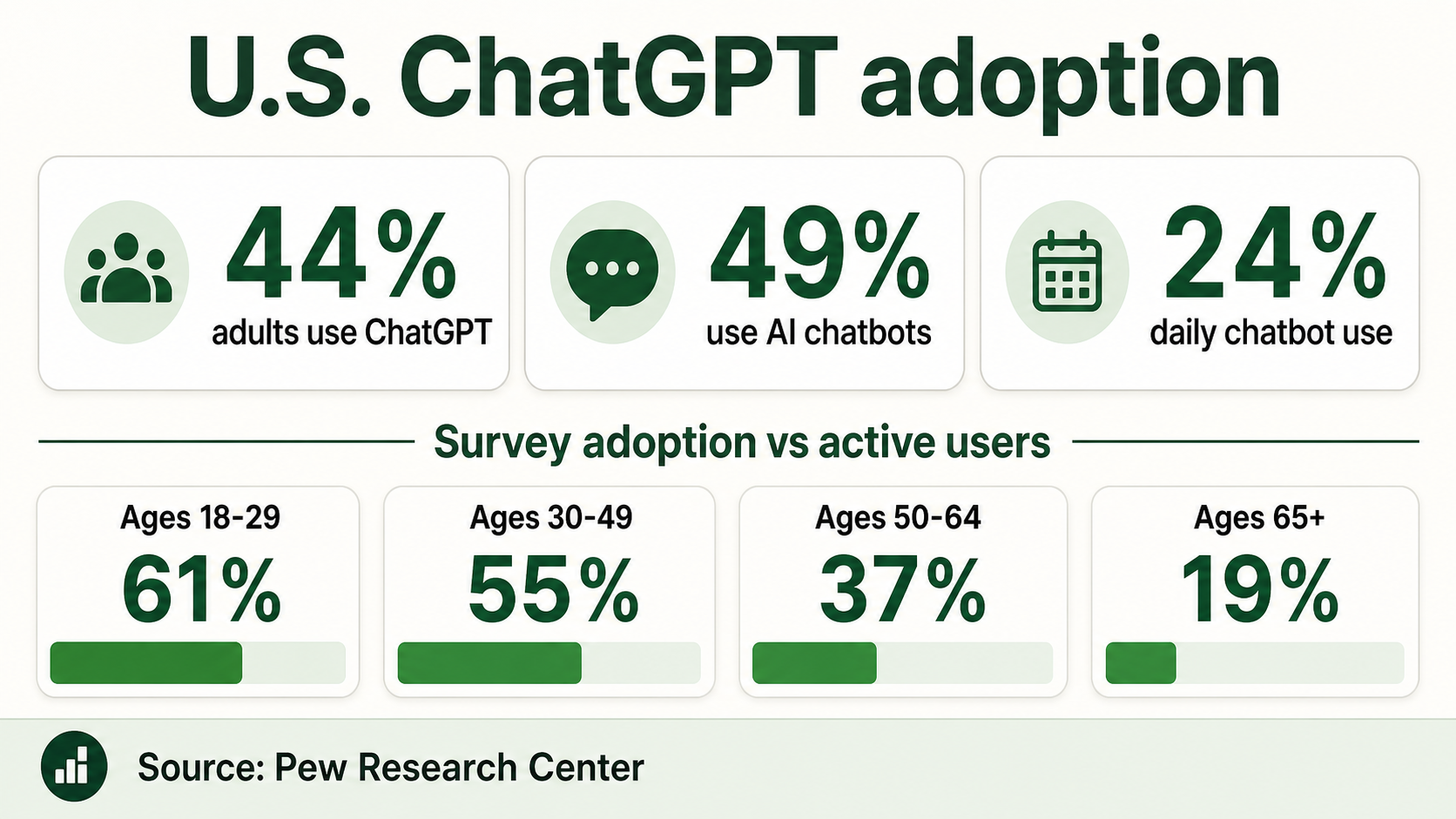
Pew also reports that 49% of U.S. adults use AI chatbots like ChatGPT, Gemini, or Copilot, and 24% use chatbots daily. The use cases are especially useful for product strategy: 42% of U.S. adults say they use chatbots to search for information, 38% of employed adults say they use them for work tasks, 25% for fun or entertainment, and 24% to create or edit images or videos.
ChatGPT is still the leading named chatbot in Pew’s 2026 survey. Pew reports 44% ever-use for ChatGPT, compared with 24% for Gemini, 17% for Copilot, 14% for Meta AI, 8% for Grok, 6% for Claude, and 3% for Character.ai (Pew Research Center). That is not a global market-share ranking. It is a U.S. adult survey question.
Age segmentation shows why ChatGPT’s consumer behavior can spill into work. Pew’s appendix reports that 61% of U.S. adults ages 18-29 and 55% of ages 30-49 say they ever use ChatGPT, compared with 37% for ages 50-64 and 19% for ages 65+.
Education is a separate surface. Pew found that 26% of U.S. teens ages 13-17 used ChatGPT for schoolwork in 2024, up from 13% in 2023. OpenAI has also launched ChatGPT Edu for universities and a free ChatGPT for Teachers plan for verified U.S. K-12 educators through June 2027.
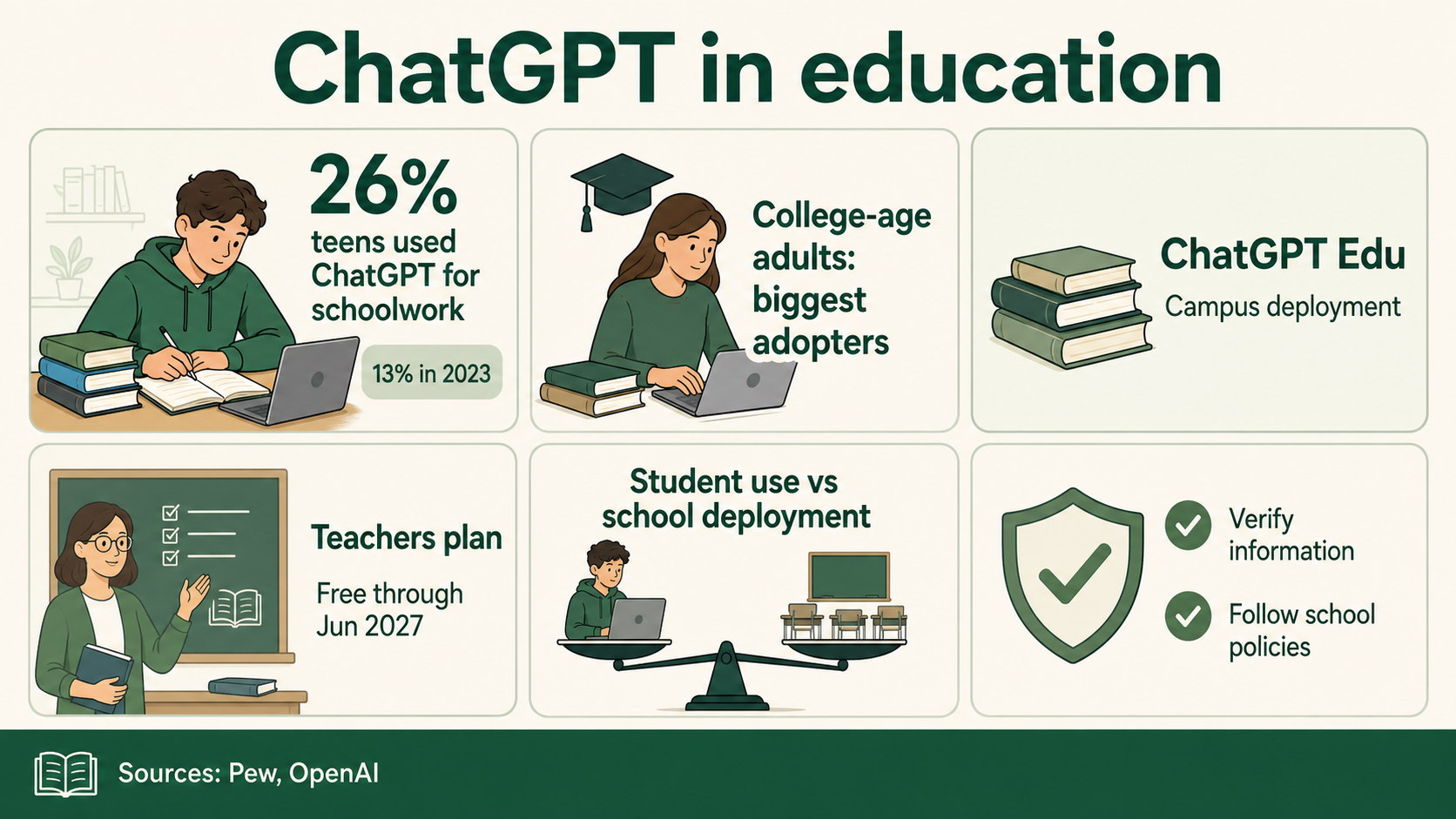
The correct interpretation is: surveys show social and demographic penetration. They are excellent for understanding awareness and self-reported behavior. They do not replace OpenAI’s active-user denominator.
Web, Mobile, Search, And App Metrics
Web traffic is one of the most visible ChatGPT demand signals. Semrush estimates chatgpt.com received 5.63 billion visits in May 2026, up 8.25% from April, with 4.06 pages per visit and a 12:46 average visit duration. Semrush’s global top-sites page also places chatgpt.com among the world’s largest web properties by visit volume.
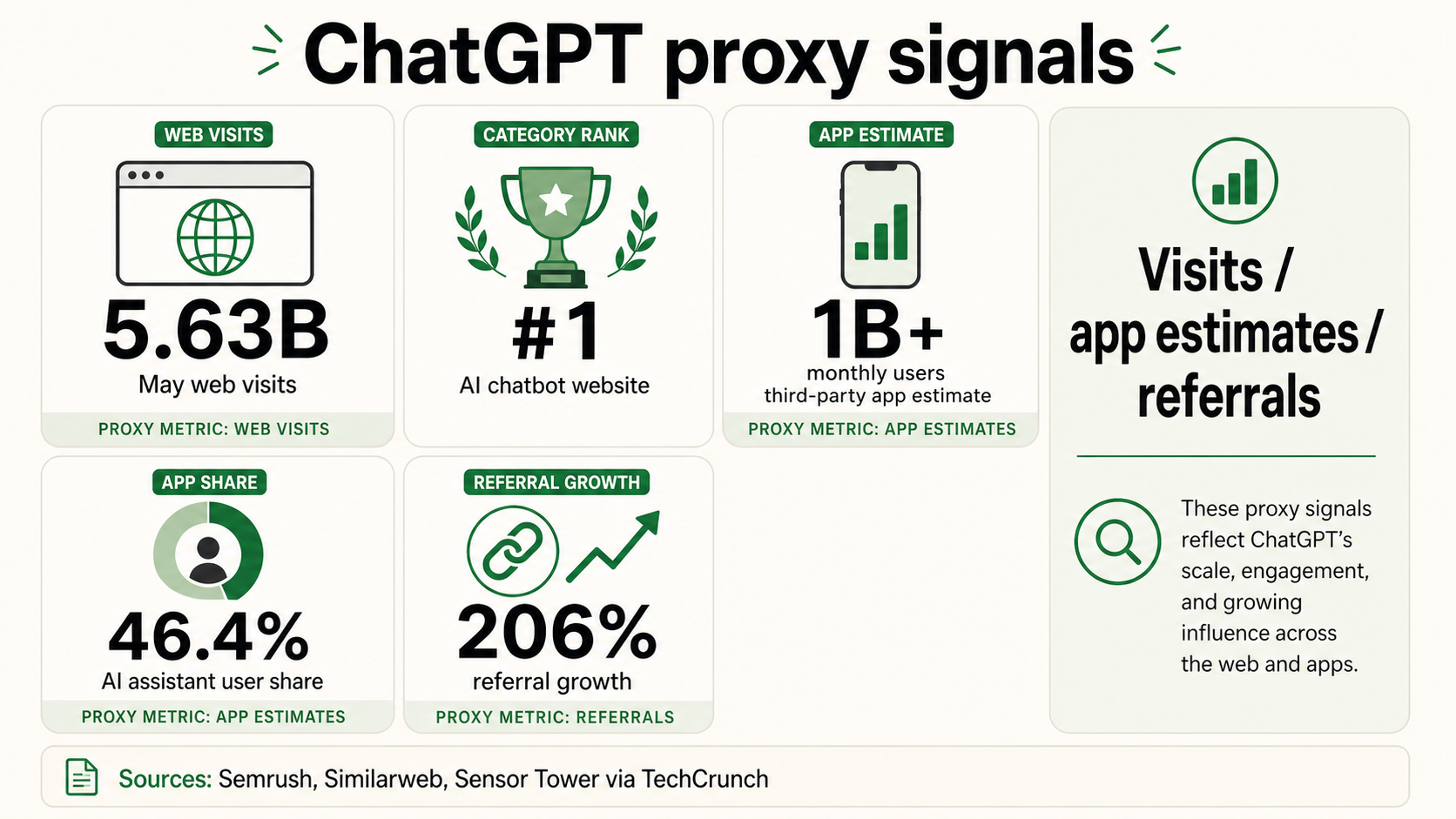
Similarweb shows the same directional story: chatgpt.com is the most visited site in its AI Chatbots and Tools category in May 2026. Its chatgpt.com page also provides audience and engagement estimates, including gender and age distribution. These are useful for channel sizing and competitive monitoring. But visits are not users. A single user can create many visits across devices, logged-out sessions may be counted, and estimates vary by vendor. Use traffic when the business question is demand, SEO, referral behavior, or competitive attention. Use OpenAI’s weekly active user figure when the business question is official product reach.
Mobile/app metrics are even easier to misread. Apple and Google confirm the official ChatGPT apps are free and sync history across devices, with image generation and voice features in the store listings (Apple App Store, Google Play). OpenAI also maintains a ChatGPT download page for mobile and desktop surfaces.
Mobile World Live reported the same Sensor Tower milestone for the May 2026 1B monthly-active estimate. ChatGPT Search adds another metric class. OpenAI introduced ChatGPT Search as a way to get timely answers with links to relevant sources. Semrush later reported that outbound referral traffic from ChatGPT grew 206% in 2025. That is important for SEO and GEO teams, but referral growth is not the same as total ChatGPT usage. Many ChatGPT sessions do not click out to the web at all.
This is also why “ChatGPT versus Google” charts need careful framing. Semrush and Similarweb can compare website visits, referral behavior, and category rankings. They usually cannot see every in-app mobile session, every logged-in workflow, every enterprise workspace interaction, or every query that ends without a click. For marketers, the practical interpretation is more modest and more useful: ChatGPT is becoming a place where people ask questions, compare options, and sometimes click out to sources. Semrush’s referral-growth statistic is a reason to track ChatGPT-driven visits and cited pages, and Similarweb’s traffic-tracker positioning shows that brands now want visibility into ChatGPT prompts, landing pages, and chatbot-driven visits. Those are channel analytics problems, not replacements for official user counts.
Revenue, Pricing, And Monetization Signals
The safest ChatGPT monetization numbers are the official subscriber and paid-user counts. OpenAI says ChatGPT has more than 50 million consumer subscribers and more than 9 million paying business users. Those numbers are more useful than unsourced paid-user estimates because they come directly from OpenAI. They still do not disclose plan mix, churn, ARPU, or consumer-versus-enterprise revenue share.
Pricing shows how OpenAI segments demand. Free access keeps the product broadly available (OpenAI pricing). Go expands usage limits below Plus. Plus remains a $20/month individual plan. Pro launched at $200/month for power users. Business adds workspace administration, a minimum seat model, and business-data protections. Enterprise and Edu add organization-level deployment, security, privacy, admin controls, and sales-led procurement.
ChatGPT monetizes the same product habit across surfaces.
Individual, team, enterprise, education, and app/integration surfaces all sell against the same underlying behavior.
OpenAI is testing a wider consumer monetization stack.
OpenAI says Plus, Pro, Business, and Enterprise stay ad-free while it tests ads in Free and Go in the U.S.
Company-level revenue is not a ChatGPT active-user proof.
Broader OpenAI revenue, funding, valuation, and API token volume explain capacity to support ChatGPT, but do not prove ChatGPT active users.
The interesting business point is not just price. It is that ChatGPT monetizes the same product habit across individual, team, enterprise, education, and app/integration surfaces. Broader OpenAI revenue, funding, valuation, and API token volume can explain the company’s capacity to support ChatGPT, but they do not prove ChatGPT active users. A ChatGPT statistic should stay tied to the product unless the source explicitly says the number is ChatGPT-specific.
What ChatGPT’s Scale Means For Founders And Operators
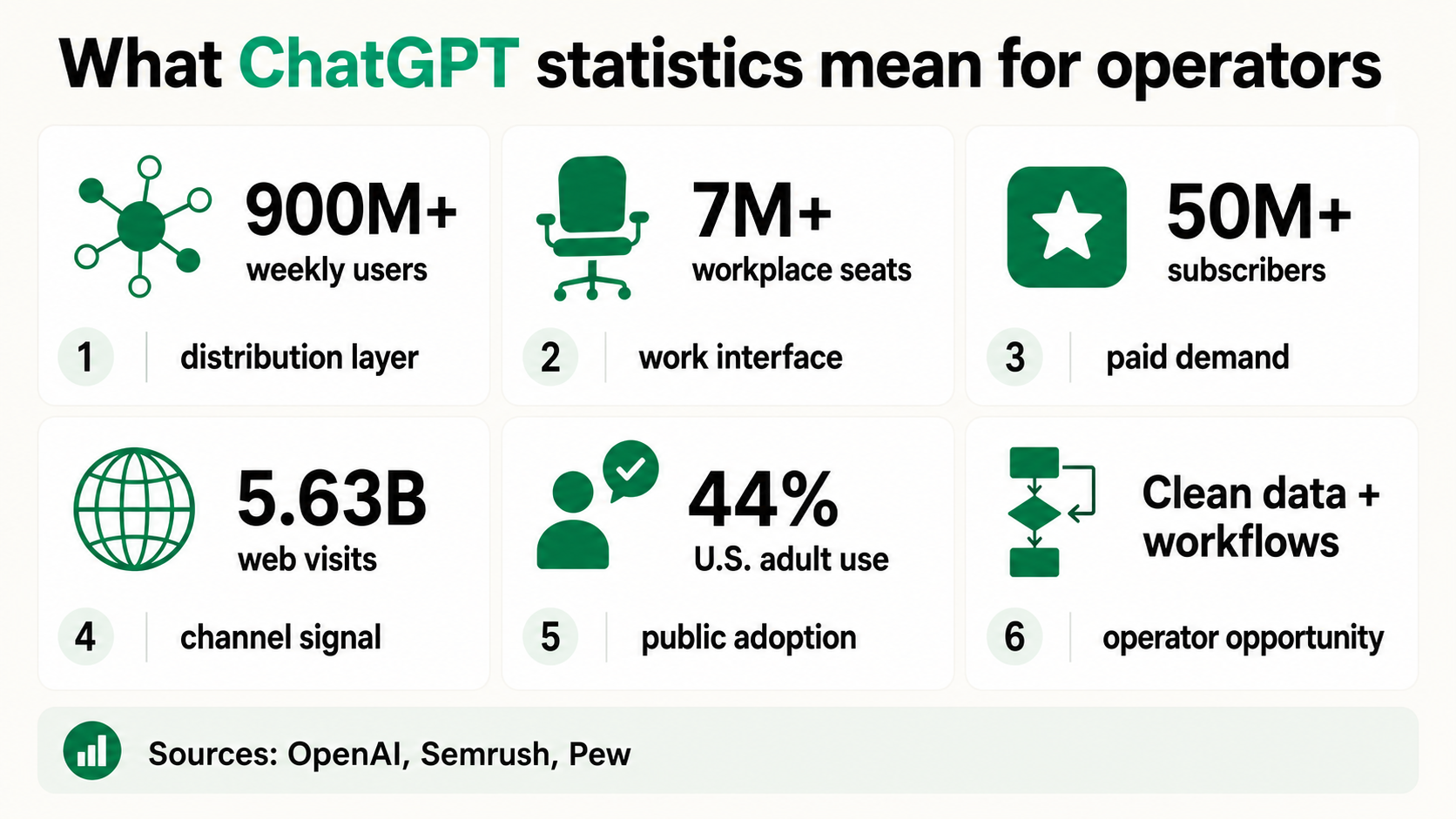
The practical lesson is not simply that ChatGPT is big. It is that different ChatGPT numbers answer different operating questions.
Distribution layer
Compete with a supported task
A product with 900M+ weekly users and 50M+ subscribers shapes expectations for search, writing, analysis, coding, and support. If you compete with a ChatGPT-supported task, your UX needs a reason to exist beyond "we have a chat box too."
OpenAIWork interface
Plug in or govern
With 7M+ workplace seats, 9x Enterprise seat growth, 8x message growth, and 19x Custom GPTs/Projects growth, B2B founders can build products that plug into ChatGPT as a surface, or that govern, enrich, and measure ChatGPT-driven work.
OpenAIProxy metrics
Use each proxy for its job
Semrush visits size attention, Sensor Tower estimates track app fragmentation, and Pew shows U.S. mainstreaming across age groups. Each answers a different operating question.
SemrushMulti-capability adoption
The bottleneck is clean data
Users send more messages and try more capabilities over time. The next bottleneck is often not the model — it is getting clean, current, task-specific data into the workflow and turning output into an action.
OpenAIFor operators, the practical takeaway is that ChatGPT has trained a huge audience to ask for answers, summaries, structured outputs, and workflow shortcuts in natural language. The next bottleneck is often not the model; it is getting clean, current, task-specific data into the workflow and turning the output into an action.
How Not To Misread ChatGPT’s Numbers
Use OpenAI’s official weekly active user count for current product scale. Use 900M+ weekly active users as the main number, and cite OpenAI directly (OpenAI). If a third-party source says “monthly users,” check whether it is app intelligence, web traffic, panel data, survey adoption, or an official OpenAI statement.
Weekly active users are the official scale number.
Use 900M+ weekly active users for product scale, and cite OpenAI directly rather than a third-party "monthly users" figure.
Subscribers and seats are the monetization signal.
50M+ consumer subscribers, 9M+ paying business users, and 7M+ workplace seats are much stronger business signals than traffic estimates.
Web visits and app estimates are demand proxies.
Semrush’s 5.63B visits and Sensor Tower’s 1B+ monthly-user estimate are useful, but not interchangeable with OpenAI’s weekly actives.
Surveys show human adoption, not user counts.
Pew’s 44% U.S. adult ever-use is excellent for social penetration and demographics; it is not a global user count.
Feature announcements prove availability, not usage.
Search, memory, Projects, apps, GPTs, images, and voice show where ChatGPT is going. Unless OpenAI discloses adoption by feature, say "available," not "used by X users."
Finally, treat current product pages as date-sensitive evidence. ChatGPT pricing, model access, plan names, search behavior, app integrations, memory settings, and enterprise features change often. The stable 2026 story is that ChatGPT has official weekly reach at global social-network scale, a large paid subscriber base, rapidly growing work seats, and a widening set of product surfaces. The precise plan limits and feature access are the moving pieces.
Frequently Asked Questions
How many people use ChatGPT in 2026?
OpenAI says ChatGPT has more than 900 million weekly active users as of its 2026 scale update. That is a weekly-active-user count on OpenAI’s own definition, not a monthly active user, registered account, or global market-share figure.
How many people pay for ChatGPT?
OpenAI reports more than 50 million consumer subscribers and more than 9 million paying business users relying on ChatGPT for work. Those official counts do not disclose the Go/Plus/Pro plan mix, churn, ARPU, or consumer-versus-enterprise revenue share.
How many businesses use ChatGPT?
OpenAI says it serves more than 1 million business customers and more than 7 million ChatGPT for Work seats, with Enterprise seats up 9x year over year. The 1 million figure counts organizations paying for ChatGPT for Work or direct developer-platform consumption, so it is not a pure count of ChatGPT Enterprise customers.
How much web traffic does chatgpt.com get?
Semrush estimates chatgpt.com received 5.63 billion visits in May 2026, with a 12:46 average visit duration, and Similarweb ranks it the number-one AI Chatbots and Tools website. Visits are a third-party demand estimate, not a count of unique users, and one person can generate many visits across devices.
What share of U.S. adults use ChatGPT?
Pew Research Center found that 44% of U.S. adults said they ever use ChatGPT in February 2026, up from 34% in 2025 and 18% in 2023. That is self-reported ever-use among U.S. adults, not OpenAI’s active-user count or a global adoption figure.
Is ChatGPT the most-used AI chatbot?
In Pew’s 2026 U.S. survey, ChatGPT led named chatbots at 44% ever-use, ahead of Gemini at 24% and Copilot at 17%. Separately, Sensor Tower data reported by TechCrunch estimated ChatGPT held 46.4% of global AI-assistant users in May 2026, below 50% for the first time as competitors gained ground.
How much does ChatGPT cost?
ChatGPT plans span Free, Go, Plus at $20/month, Pro at $200/month, and Business at $25 per user monthly or $20 per user annually, plus sales-led Enterprise and Edu tiers. Plan names, limits, and model access change often, so the live OpenAI pricing page is the authoritative source.
What do people actually use ChatGPT for?
The OpenAI/NBER consumer-usage study found that practical guidance, seeking information, and writing accounted for nearly 80% of conversations by July 2025, when 700 million weekly users sent about 18 billion messages per week. That means ChatGPT competes with search, docs, and writing tools, not only other chatbots.
Sources and Further Reading
Official OpenAI scale, business & research
Plans, pricing & product surfaces
Surveys, web, mobile & market context