Claude Code Statistics
Last updated on July 7, 2026

Claude Code is a useful case study in how quickly AI coding tools are moving from autocomplete-style assistance toward agentic workflows: terminal commands, file edits, repository navigation, pull-request comments, and longer execution sequences. But “Claude Code statistics” can mean several different things.
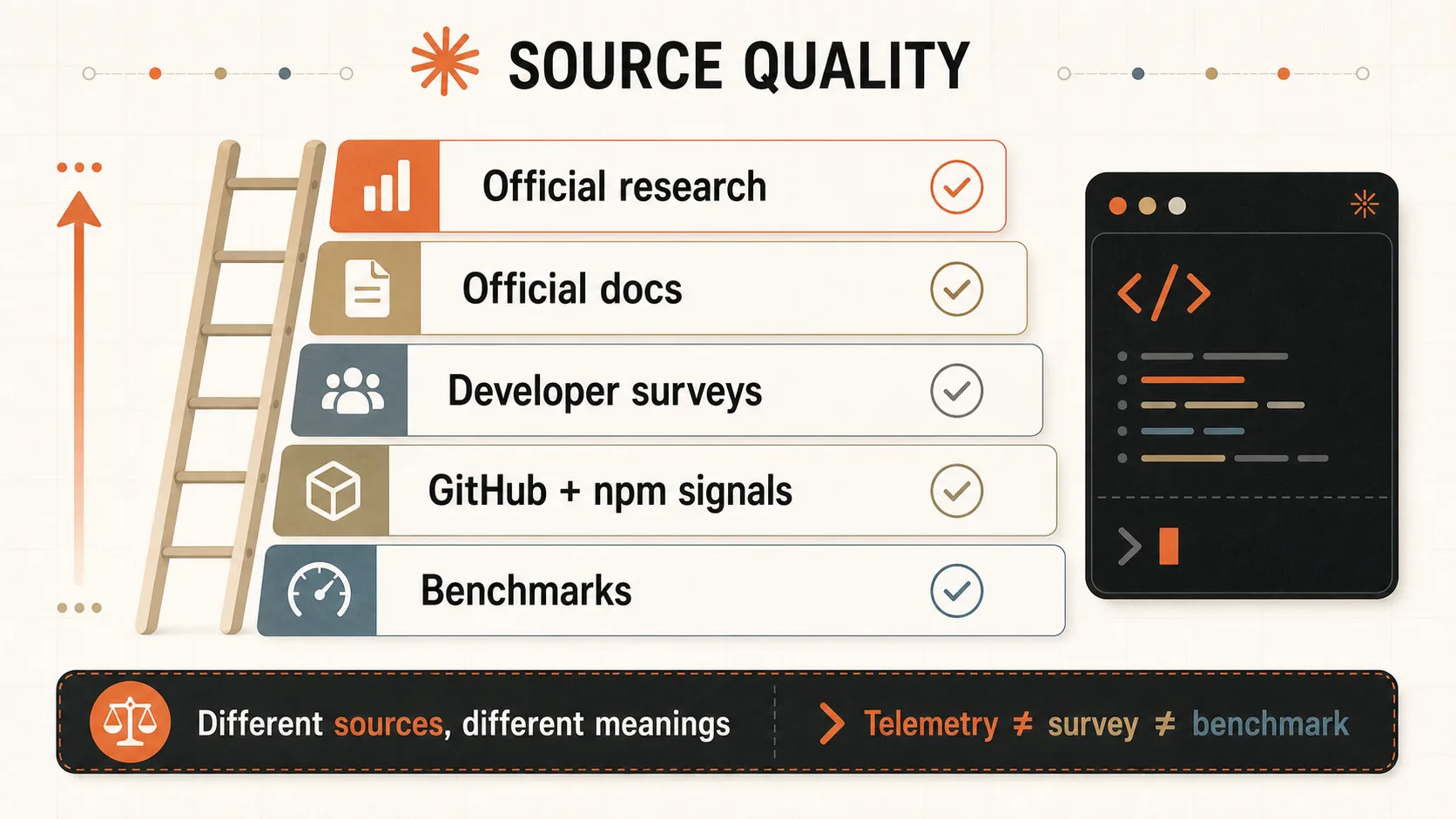
Some numbers describe adoption in developer surveys. Others describe usage behavior inside Claude Code sessions. Others measure technical capability on benchmarks such as SWE-bench Verified or Terminal-Bench. Still others are only ecosystem signals — GitHub stars, npm activity, or public-repository research. This article separates those categories, prioritizing official Anthropic materials, product documentation, developer surveys, GitHub/npm primary sources, academic papers, and independent benchmark organizations. It does not treat unsourced monthly-active-user, revenue, enterprise-customer, or universal-ROI claims as reliable statistics.
Top Statistics
The most detailed numbers come from Anthropic’s own research on Claude Code sessions. Each is direct telemetry or structured analysis — but produced by the vendor, and measured under a specific study design.
Expertise & success rates (expertise study)
Internal autonomy trends
Developer surveys & benchmarks
What Claude Code Is — and What Its Statistics Measure
Claude Code is an agentic coding tool usable from the terminal, IDE, desktop app, and browser, with access through Claude subscriptions or Anthropic Console accounts (Claude Code Docs). That definition matters because Claude Code statistics are not interchangeable with Claude model statistics.
Adoption
Developer surveys
Self-reported use — e.g. whether a respondent uses Claude Code as an AI-enabled development environment. A survey share, not telemetry.
Stack OverflowUsage behavior
In-session telemetry
Sessions, turns, active runtime, autonomy, and task mix from privacy-preserving transcript analysis of real Claude Code use.
AnthropicCapability
Benchmarks
SWE-bench Verified, Terminal-Bench and similar evaluate Claude models with a particular tool scaffold — constrained task performance, not adoption.
AnthropicEcosystem
Public signals
GitHub stars, npm activity, and agent-authored pull requests in public repos — attention and distribution, not confirmed active users.
GitHubAnthropic’s getting-started documentation lists precise install requirements — Node.js 18+, 4 GB+ RAM, and supported systems including macOS 10.15+, Ubuntu 20.04+, Debian 10+, and Windows 10+ through WSL (Anthropic Docs). A practical consequence is that the “unit” of analysis varies: a session may include many tool calls and turns; a GitHub Action invocation is bounded by --max-turns (default 10); a benchmark run gives an agent a specific scaffold; and a survey answer represents self-reported use, not observed telemetry.
Adoption in Developer Surveys
The strongest explicit adoption percentage comes from Stack Overflow’s 2025 Developer Survey — 49,000+ respondents from 177 countries, with an AI-enabled IDE/tool question that explicitly names Cursor, Claude Code, and Windsurf (Stack Overflow).
That 10% should not be confused with the separate finding that Claude Sonnet models were used by 45% of professional developers in the LLM-usage question — “Claude model usage” and “Claude Code as an AI-enabled development environment” are different constructs (Stack Overflow). JetBrains adds strong context: its 2025 State of Developer Ecosystem survey (24,534 developers after cleaning, fielded April–June 2025) found 85% of developers use AI tools and 62% regularly use at least one coding assistant (JetBrains). GitHub’s Octoverse 2025 is different again — observed activity across 180M+ developers and 630M repositories, but it does not publish Claude Code market-share percentages (GitHub Blog).
Usage Patterns: Sessions, Turns, Autonomy, and Task Mix
The most detailed usage statistics come from Anthropic’s “Agentic coding and persistent returns to expertise” study — about 400,000 sessions from 235,000 people over October 2025 to April 2026 (Anthropic). The most striking single number is average active runtime: 20 hours per week per user, measured as active runtime rather than typing time.
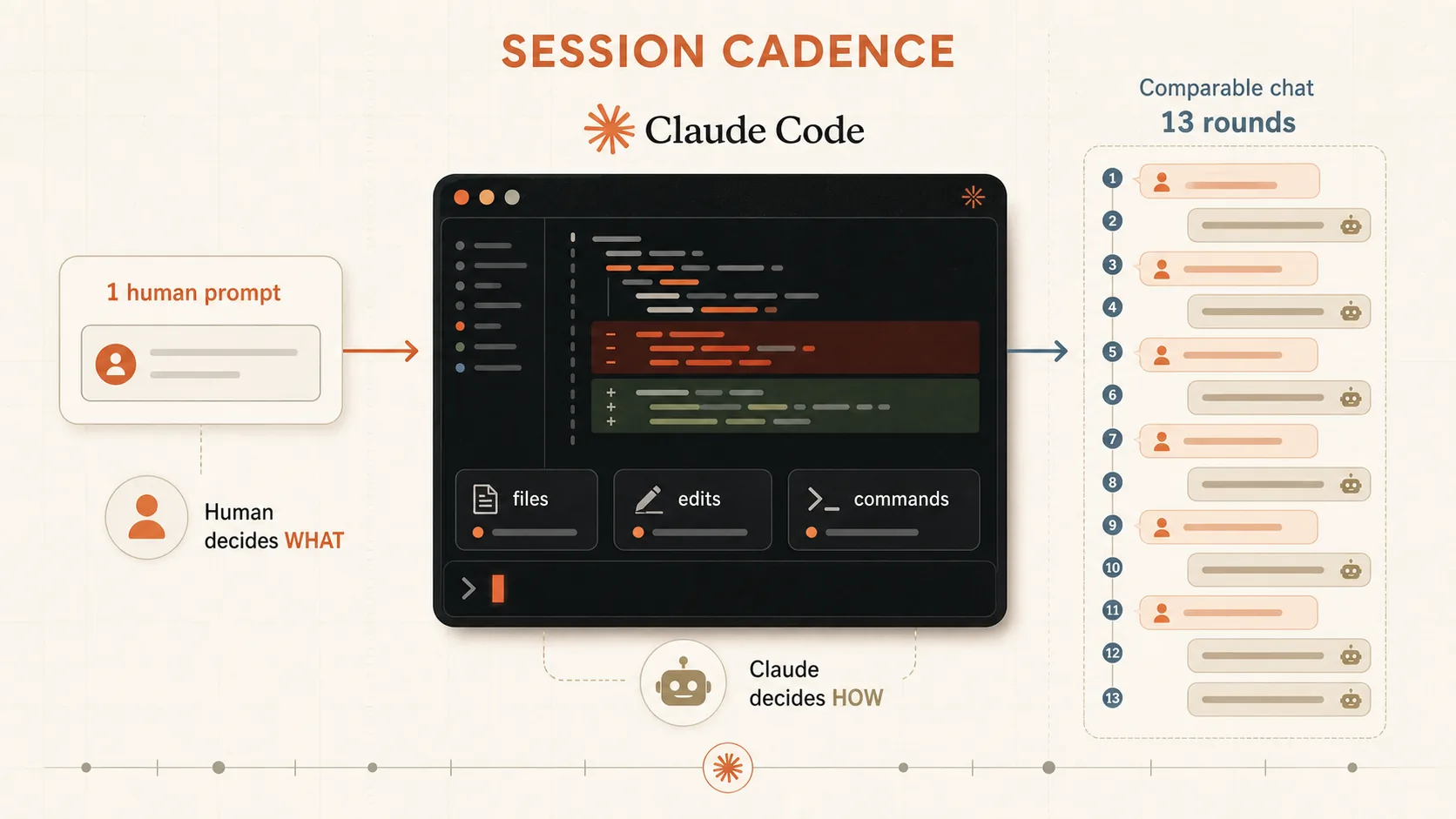
Anthropic’s study states that humans primarily determine what should be done while Claude primarily determines how it is executed (Anthropic). The task mix also shifted: debugging’s share fell by nearly half over the study period, while deployment, data analysis, and non-code document generation grew, and the median value of tasks attempted rose by roughly 25% (Anthropic). The Economic Index series adds that Claude success decreases as task length grows, while multi-turn interaction partially offsets complexity (Anthropic).
Expertise, Success Rates, and the “Persistent Returns to Expertise”
One of the most important findings is that better AI tools do not erase human expertise.
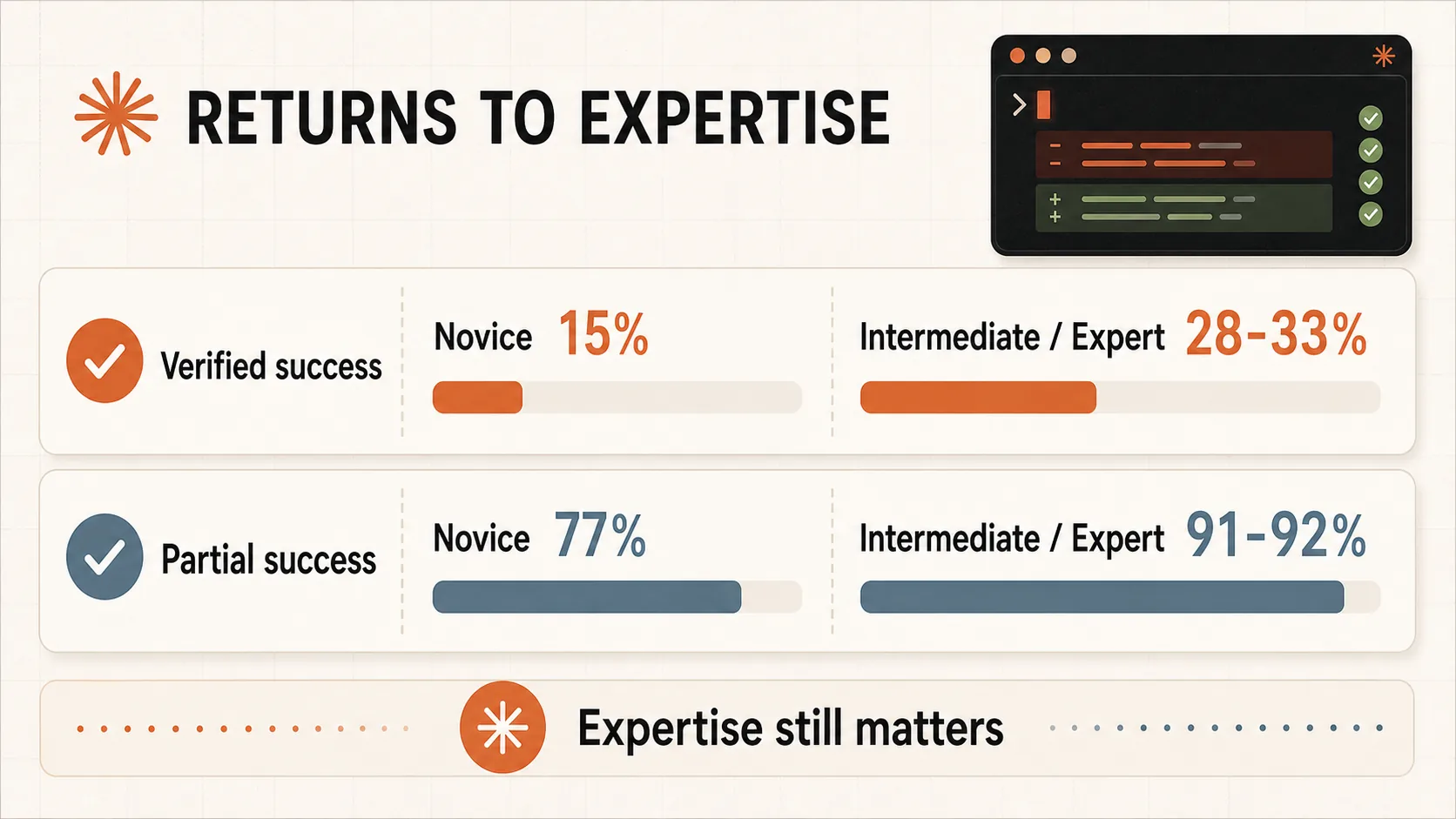
Success metrics depend on the human-AI system, not the model alone: experts are better at specifying tasks, spotting incorrect changes, narrowing scope, and deciding when to intervene. The abandonment finding points the same way — Anthropic reports that novices abandon failing sessions several times more frequently (Anthropic). These rates are measured under a specific study design and success definition; they are better read as evidence that expertise remains complementary to agentic coding than as universal success rates for every repository.
Internal Anthropic Use and Autonomy Trends
Anthropic publishes several statistics about its own internal use. Its Claude Code product page states that, at Anthropic, “the majority of code is now written by Claude Code” (Anthropic) — a strong statement about Anthropic’s own workflow, not a claim about all companies.
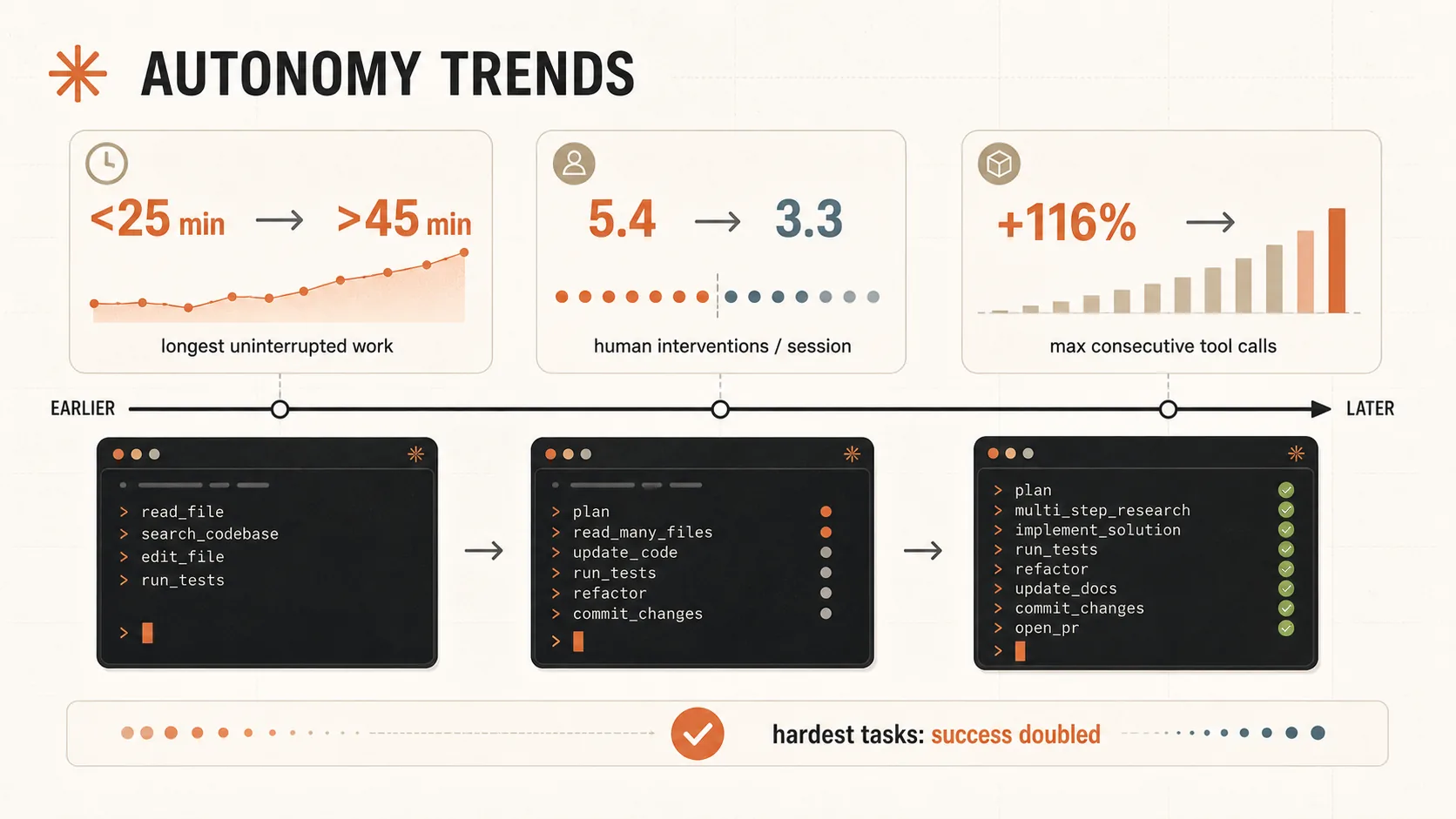
Those numbers suggest longer autonomous stretches and fewer interruptions, but humans did not disappear: for minimal-complexity tasks, 87% of tool calls involved humans, versus 67% for high-complexity tasks (Anthropic). Anthropic also reported that success on employees’ hardest tasks doubled during the observation period — best presented as a relative change, since the dossier does not give absolute start and end percentages. Internal Anthropic data is valuable because it comes from real work, but Anthropic is both the product maker and an unusually AI-native organization, so these figures show what is possible in Anthropic’s environment, not population-level adoption.
Product, Deployment, Security, and Pricing Statistics
Claude Code’s documentation provides concrete operational detail even though it discloses no public user counts, install totals, or revenue.
Operational & pricing facts
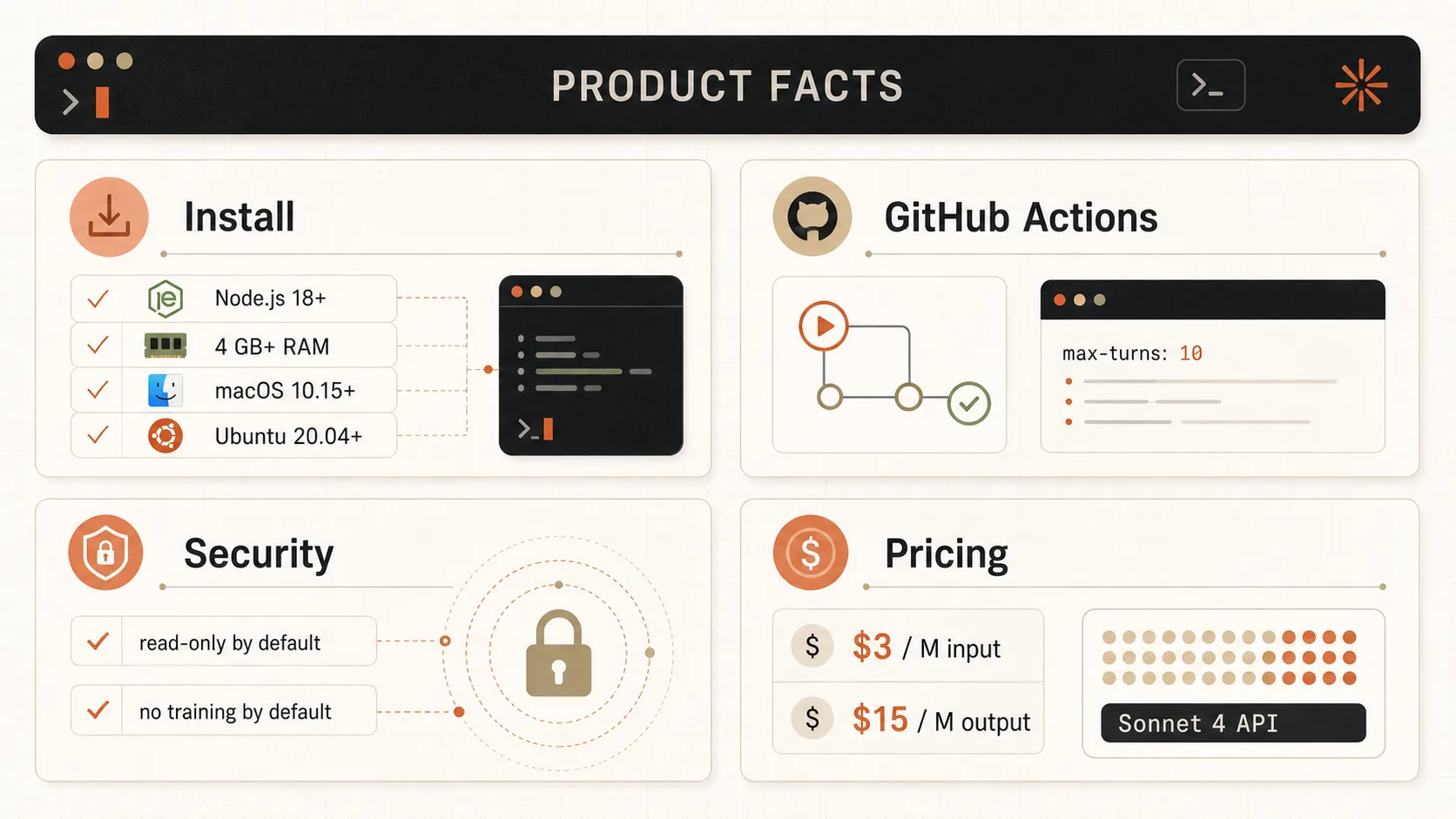
Security documentation describes Claude Code as read-only by default, requiring explicit permission before editing files or running commands, with encrypted credentials, limited retention, and SOC 2 Type II / ISO 27001 referenced through Anthropic’s Trust Center (Anthropic Docs). Data-usage docs state that, by default, Anthropic does not train generative models on code or prompts sent through Claude Code (Anthropic Docs) — for organizations, often more decision-relevant than any benchmark score.
Public Ecosystem Signals: GitHub, npm, and Open-Source Detection
Public ecosystem data can track visibility and developer engagement, but it should not be mistaken for active-user measurement. The canonical repository is anthropics/claude-code, exposing stars, forks, watchers, issues, and releases (GitHub).
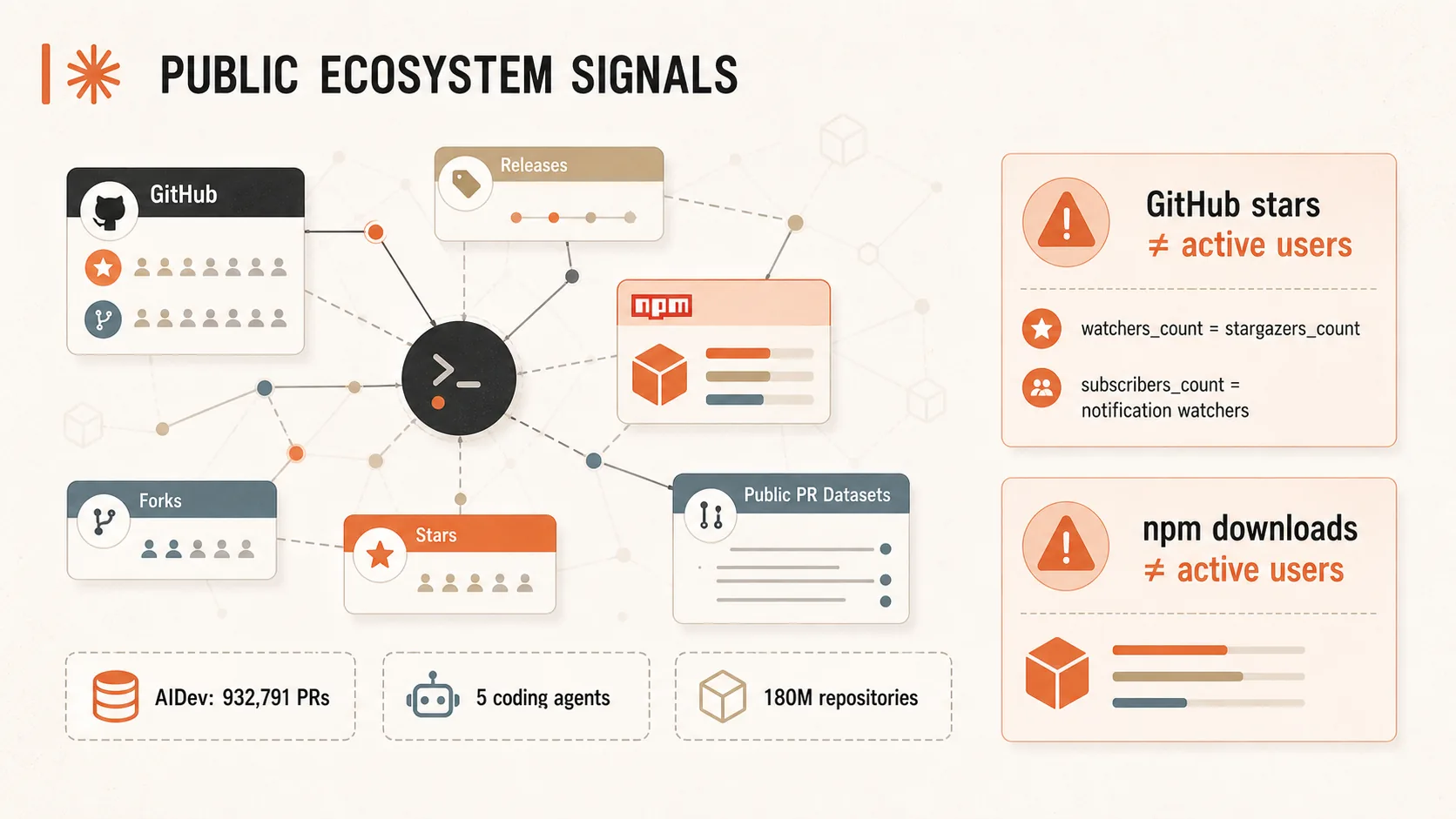
GitHub’s own API semantics matter: in repository metadata watchers_count mirrors stargazers_count, while actual notification watchers are subscribers_count (GitHub Docs). Stars are best treated as attention, forks as experimentation — neither proves production usage. The canonical npm package is @anthropic-ai/claude-code, where download counts would represent package retrievals, not confirmed installs (npm). Academic work is beginning to study agents in public repositories — the AIDev dataset covers 932,791 agent-authored pull requests across five coding agents including Claude Code (arXiv) — but private repos, local-only workflows, and enterprise deployments are missing, so public detection is a lower-bound lens, not a comprehensive count.
Benchmarks and Capability Context
Claude Code statistics often get mixed with Claude model benchmark statistics. That is useful only if the distinction is explicit: benchmarks evaluate Claude models with particular tools, prompts, and execution environments.
On Terminal-Bench, Anthropic reported Claude Opus 4 at 43.2% and Claude Sonnet 4 at 35.5% under a comparable external-agent setup — and separately reported higher scores using Claude Code rather than the identical external framework, illustrating that the surrounding agent software affects measured performance (Anthropic). The safest conclusion: benchmarks measure constrained technical capability, not adoption, productivity, revenue, or market share. A high SWE-bench score does not tell us how many developers use Claude Code every day.
Unsupported or Commonly Misread Claude Code Claims
Several attractive statistics are not supported by the dossier and should not be treated as facts.
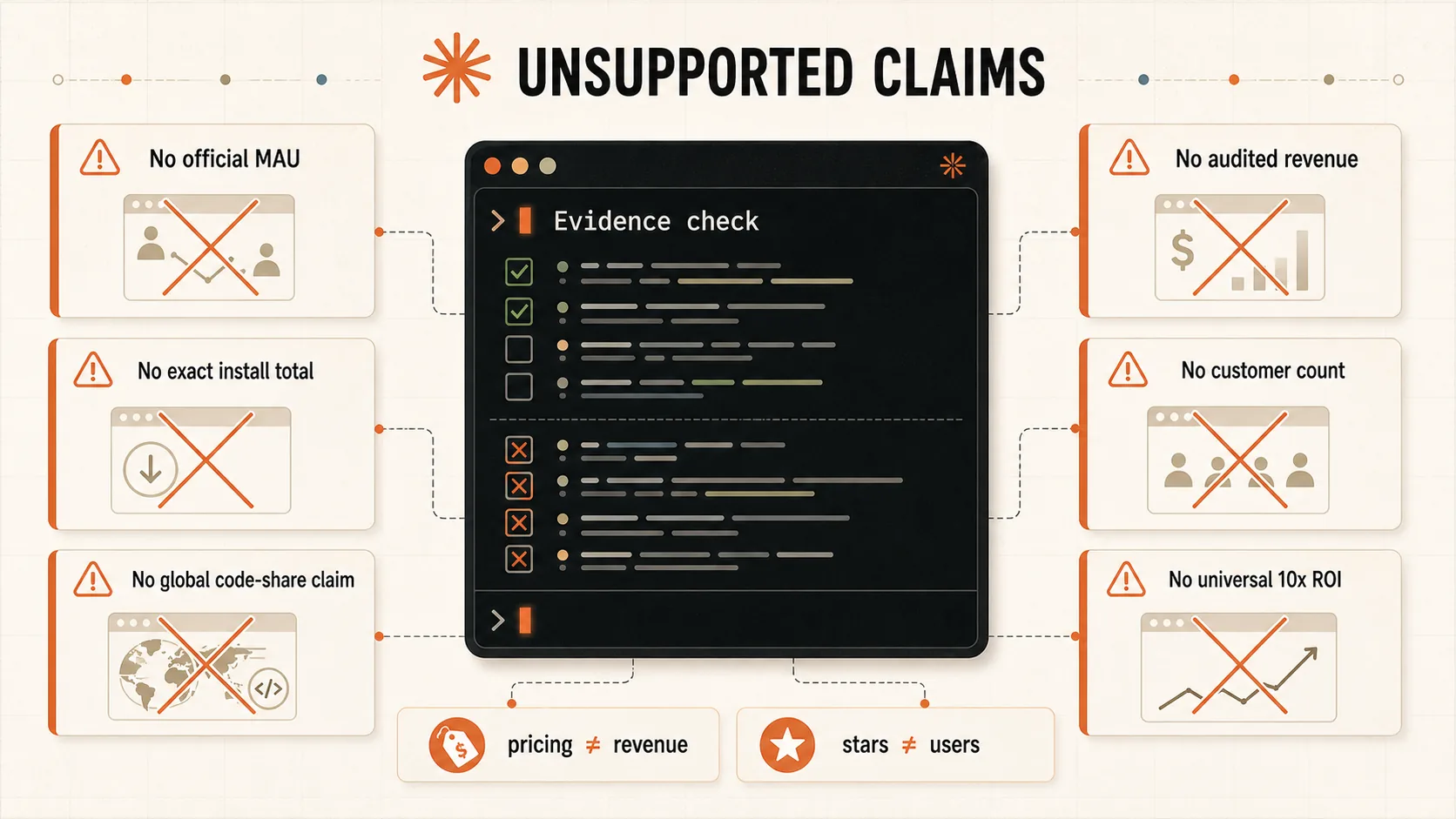
No official monthly-active-user number.
The documentation explains how to install and use Claude Code, but the dossier found no official DAU, MAU, user-count, or install-count disclosures.
No audited revenue figure.
Pricing docs give API token prices ($3 / $15 per million for Sonnet 4), but pricing is not revenue.
npm and enterprise routes are not user counts.
Package retrievals do not equal active users, and support for Bedrock or Vertex AI is a deployment option, not a customer count.
"Majority of code" is an internal statement.
Anthropic says the majority of its own code is written by Claude Code — not a global software-development statistic.
No fixed ROI or "#1" ranking.
The 81,000-user survey found gains often came from expanding scope, not a single multiplier; Stack Overflow’s 10% is one survey share, not a definitive global ranking.
Source Quality Note
The strongest Claude Code-specific evidence comes from Anthropic’s official research on sessions, autonomy, internal work patterns, the Economic Index, and software-development interactions — direct telemetry or structured analysis, but produced by the vendor (Anthropic).
Frequently Asked Questions
How many people use Claude Code?
Anthropic has not disclosed an official monthly- or daily-active-user count. Its largest expertise study analyzed about 400,000 Claude Code sessions from about 235,000 people between October 2025 and April 2026, but that is a study sample, not a total user base.
What share of developers use Claude Code?
In Stack Overflow’s 2025 Developer Survey, 10% of respondents reported using Claude Code as an AI-enabled development environment, compared with 18% for Cursor and 5% for Windsurf. It is a survey share among respondents, not a global market share.
How much time do people spend in Claude Code?
Anthropic’s expertise study found Claude Code users spent an average of 20 hours per week using the tool, measured as active runtime rather than typing time — agentic coding includes long stretches where the model reads files, edits code, and runs commands.
Does expertise still matter when using Claude Code?
Yes. Anthropic found novice users had 15% verified success versus 28%–33% for intermediate and expert users, and expert sessions succeeded more than twice as often as novice sessions — evidence that expertise remains complementary to agentic coding.
How does Claude Code score on coding benchmarks?
Anthropic reported Claude Opus 4 at 72.5% and Claude Sonnet 4 at 72.7% on SWE-bench Verified using a bash and file-editing agent scaffold, and 43.2% / 35.5% on Terminal-Bench under a comparable external-agent setup. These measure constrained capability, not adoption or productivity.
How much does Claude Code cost?
It is available through Claude subscriptions and Anthropic Console. When it uses Anthropic APIs, Claude Sonnet 4 is priced at $3 per million input tokens and $15 per million output tokens, with cache reads at 0.1× the input price. Pricing is not the same as Anthropic’s revenue.
Does Anthropic train on my Claude Code code?
Anthropic’s data-usage documentation states that, by default, it does not train generative models using code or prompts sent through Claude Code, with encrypted credentials and limited retention, and references SOC 2 Type II and ISO 27001 through its Trust Center.
Sources and Further Reading
Anthropic Claude Code research & Economic Index
Official Claude Code documentation
Developer surveys & ecosystem context
GitHub, npm & benchmarks