Claude Statistics
Last updated on July 10, 2026

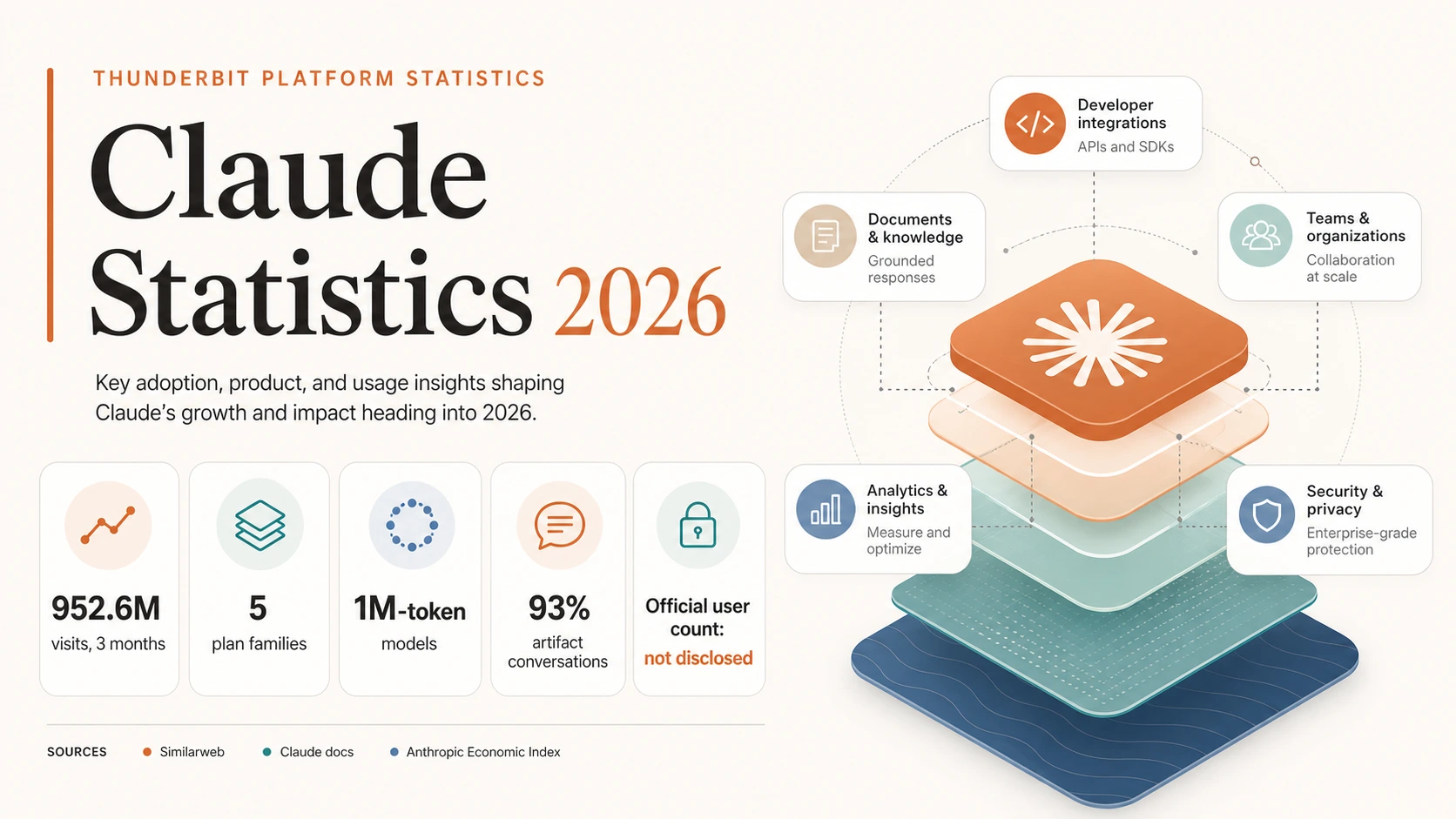
Claude is no longer just a chat window. By mid-2026, Claude is a consumer assistant, a paid subscription product, a desktop and mobile app, a work agent, a developer platform, a cloud-distributed model family, and an enterprise control surface. That makes Claude statistics useful, but also easy to misread.
The strongest public numbers do not collapse into one clean “Claude users” figure. Official Claude and Anthropic pages prove plan tiers, app surfaces, model names, context windows, API pricing, product features, enterprise controls, cloud routes, and usage-pattern samples. Third-party tools estimate web traffic and app growth. Research reports describe how sampled Claude conversations are used. None of those denominators mean the same thing.
The cleanest read in 2026 is this: Claude has broad official product distribution, fast third-party traffic and app momentum, increasingly agentic work surfaces, and a model stack that now reaches 1M-token context windows on current top-tier models. Anthropic does not disclose a single Claude-wide monthly active user count, paid-subscriber count, retention rate, or channel revenue split across Claude.ai, Claude apps, Claude Code, API, cloud marketplaces, Team, and Enterprise.
The Claude Numbers That Matter
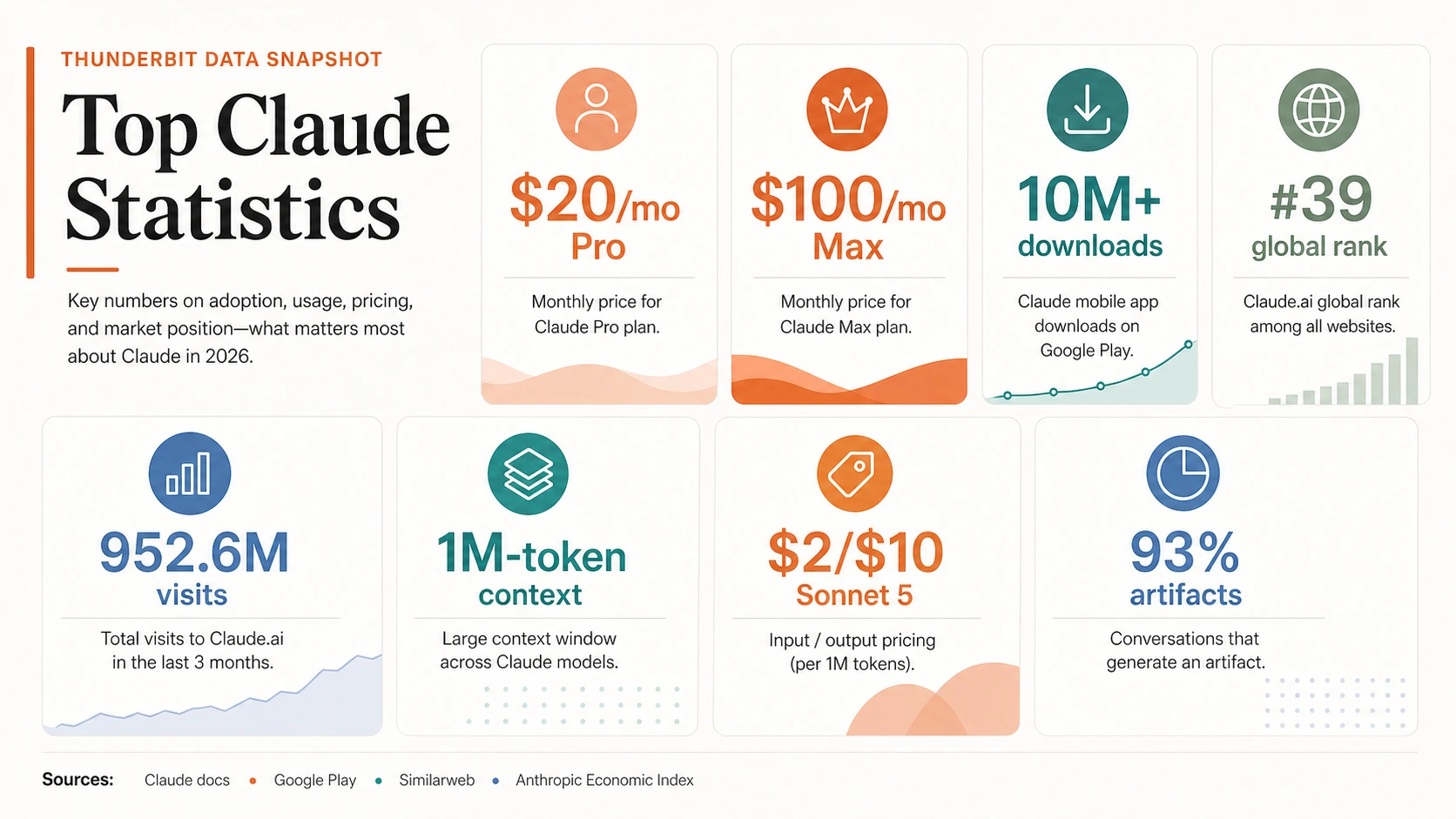
The headline Claude numbers use different denominators, so read them as separate product, reach, model, and behavior signals rather than one figure.
Plans, pricing & product surfaces (official pages)
Reach, model & behavior signals
Read every number by its own denominator
Claude's headline figures answer different questions. Tap a metric to see what it measures — and what it does not prove.
Claude docs, Similarweb, AnthropicClaude Product Reach: Web, Mobile, Desktop, And Apps
Claude’s official surface area now extends well beyond claude.ai. The Claude homepage describes Claude as an AI assistant for personal use or team collaboration, while the download page says users can access all of Claude on desktop and mobile. The desktop app works with files and apps; mobile pairs with desktop; conversations, projects, memory, and preferences sync across devices when signed in (Claude download).
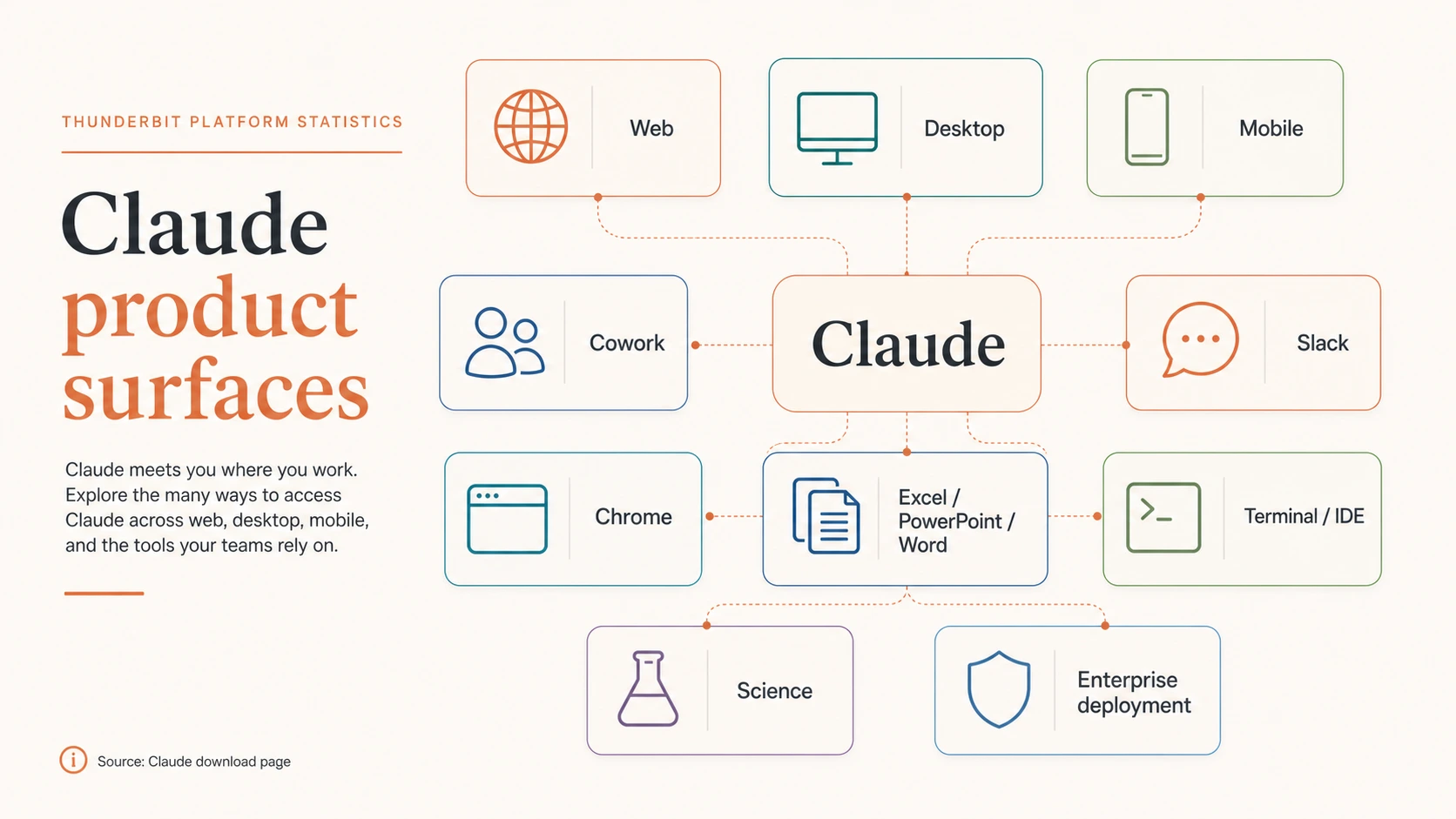
The Claude download page lists macOS, Windows, Windows arm64, ChromeOS, Linux docs, iOS, Android, and enterprise deployment routes. It also lists Cowork across desktop, Chrome, Slack, Excel, PowerPoint, and Word; Claude Code across desktop, terminal, VS Code, JetBrains, and Slack; and a separate Claude Bioscience beta app for life sciences research.
The public app-store picture supports real mobile scale, with the usual caveat. Google Play lists Claude by Anthropic at 4.6 stars, 589K reviews, and 10M+ downloads. Those figures prove store presence and download-band scale. They do not prove current active installs, daily active users, paid users, or retention. The Apple App Store listing confirms iOS availability and product positioning, but it is not a stable public active-user source.
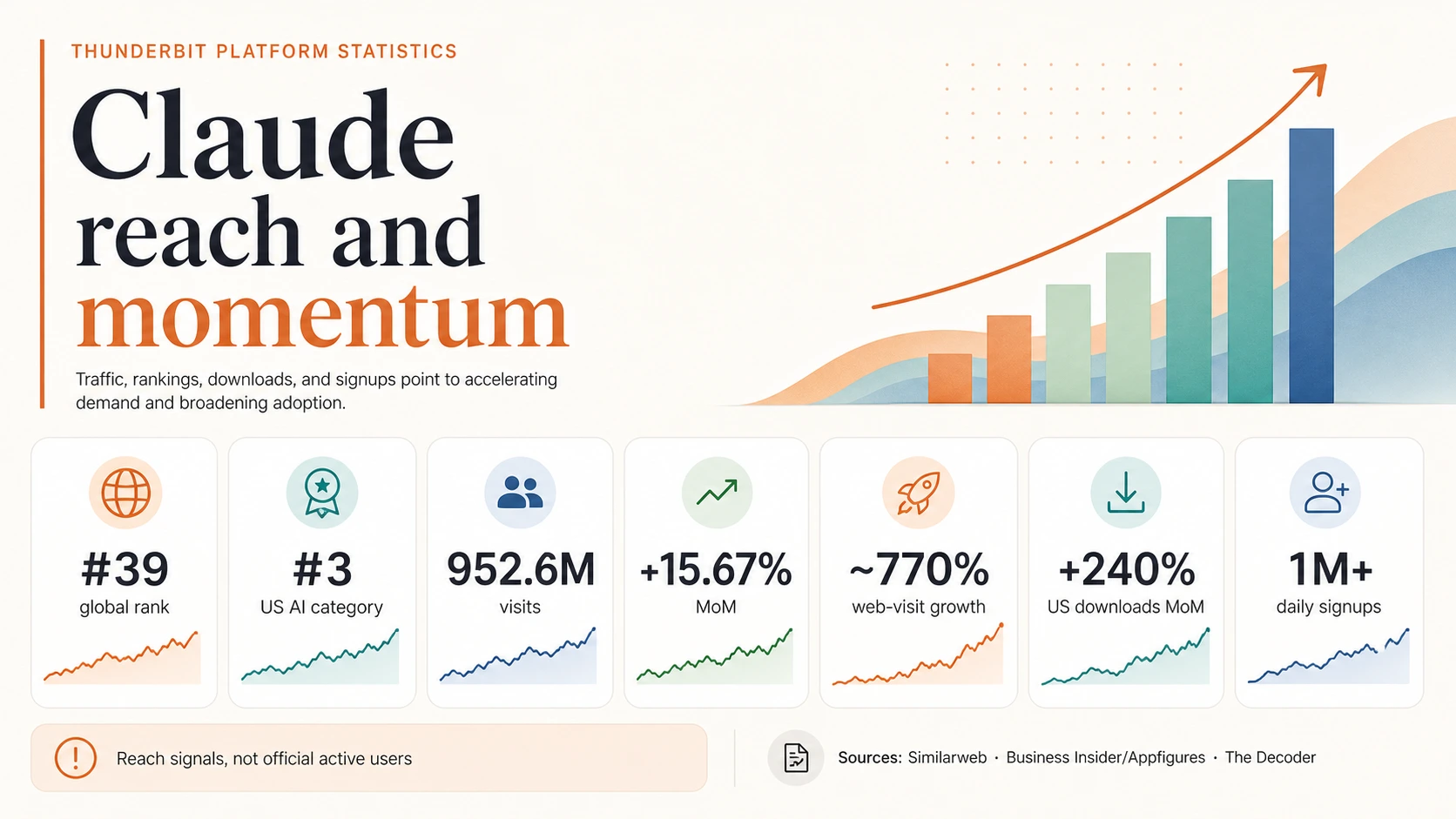
Third-party traffic estimates show a sharp consumer reach curve. Similarweb’s claude.ai page lists May 2026 estimated data with #39 global rank, #48 US rank, #3 US AI Chatbots and Tools rank, 952.6M visits over the last three months, 15.67% month-over-month traffic growth, 26.42% bounce rate, 4.51 pages per visit, and 6:02 average visit duration. It also says 73.78% of desktop visits came from direct traffic.
Claude web-visit growth — a third-party reach curve
Similarweb's Gen AI analysis estimates roughly 770% growth in Claude web visits between September 2024 and March 2026. Points are placed on a linear axis; these are estimated visits from a third-party panel, not official Anthropic active-user totals.
Similarweb Gen AI statsSimilarweb’s Gen AI analysis says Claude web visits grew roughly 770% from September 2024 to March 2026, and Claude app MAU roughly tripled from January to March 2026. That is a strong reach signal, especially when paired with the May 2026 claude.ai rank and engagement estimates. It still needs the right label: estimated visits and app MAU from a third-party data provider are not official Anthropic active-user totals.
App intelligence shows the same pattern from another angle. Business Insider reported, using Appfigures data, that Claude surpassed ChatGPT in the US App Store in early March 2026, that Claude’s US downloads rose 240% month over month in February by 1.1 million downloads, and that Claude was the #1 free iPhone app in the US, Canada, Germany, Ireland, and Luxembourg. The same report said Mike Krieger stated that more than 1 million people were signing up for Claude every day; The Decoder summarized that as a Claude signup milestone.
Plans, Pricing, And Subscriber Surfaces
Claude’s consumer and business packaging explains a lot about Anthropic’s product strategy. The basic plan ladder is clear: Free, Pro, Max 5x, Max 20x, Team, and Enterprise. Free is limited and occasional. Pro is for regular use. Max is for frequent users who need more usage capacity per session.
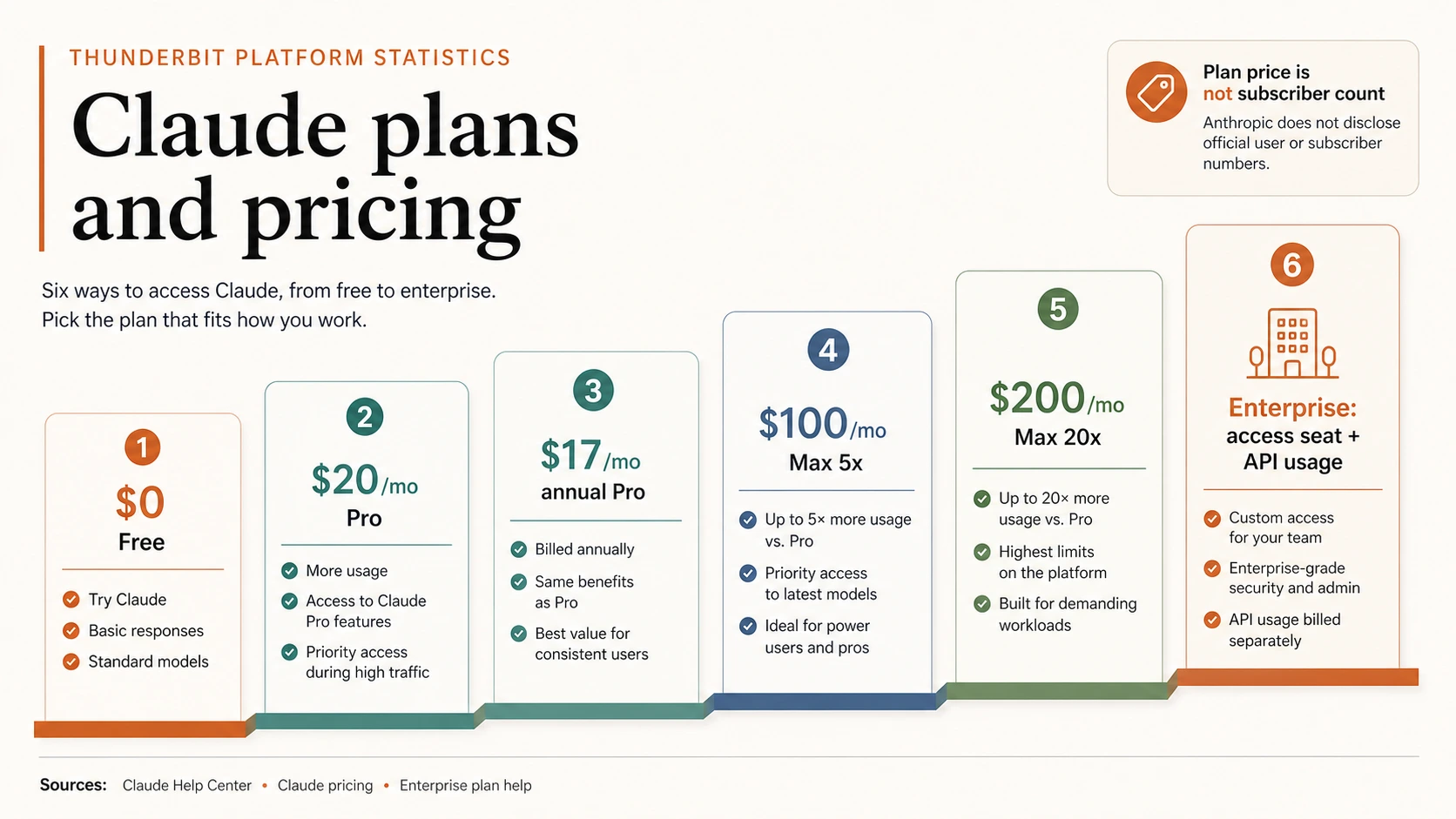
The list prices define buyer segmentation. Pro is $20/month or $200/year in the help guide, while the public pricing page presents the annual discount as $17/month with $200 billed upfront and $20 if billed monthly. The Max page says Max 5x costs $100/month and Max 20x costs $200/month for web subscriptions, while mobile pricing can vary by app platform.
The more important statistic is what paid plans bundle. Claude’s pricing page lists paid-plan features such as Claude Code, Claude Cowork, Claude Design, Claude Science, Research, Memory, Skills, Connectors, Claude for Chrome, Claude for Microsoft 365, Claude for Microsoft Outlook, and file/code-execution features. Claude is priced less like a single chat app and more like an expanding workbench.
Six ways to buy Claude
Limited, occasional access to Claude on web and apps, for casual or first-time use.
Regular-use plan; the pricing page shows $17/month with annual billing or $20 monthly.
For frequent users who need more usage capacity per session; mobile pricing can vary by app platform.
Adds admin controls, project sharing, domain capture, integrations, and usage analytics next to the individual chat experience.
The seat fee covers access; usage is billed separately at API rates. Adds audit logs, SCIM, custom retention, Compliance API, Analytics API, and customer-managed encryption keys.
Pro and Max users get Claude on web, desktop, and mobile plus Claude Code in the terminal under one subscription; IDE usage counts toward the same limits.
One unified paid plan now spans chat, desktop, coding, and integrations. Enterprise changes the denominator — access seats are billed separately from usage. Tap a tier to see what it packages.
Claude plan guideClaude Code illustrates the shared-subscription idea without taking over the Claude-wide story. Anthropic says Pro and Max users can use Claude on web, desktop, mobile apps and Claude Code in the terminal with one unified subscription (Claude Code with Pro/Max). IDE usage in VS Code, Cursor and other VS Code forks, and JetBrains IDEs counts toward the same usage limits. The key Claude-wide point is shared packaging: Claude’s paid plan is now a bundle across chat, desktop, coding, agentic work, and integrations.
Enterprise changes the denominator. The Enterprise plan is for organizations needing security, compliance controls, and scalable AI across teams. It includes Team plus security features, but its pricing model separates access seats from usage billed at API rates (Enterprise plan help). That means a Team seat, an Enterprise access seat, an API-consuming Enterprise workload, and a consumer Pro subscription are different commercial objects — a consumer subscription count would not describe the same thing as an enterprise seat count or usage-billed deployment.
Claude Model Ecosystem And API Availability
Claude’s model statistics are among the cleanest official facts because Anthropic and its cloud partners publish model names, IDs, context windows, output limits, pricing, and release status. The models overview lists Claude Fable 5, Claude Opus 4.8, Claude Sonnet 5, and Claude Haiku 4.5 as the current comparison set, with API IDs such as claude-fable-5, claude-opus-4-8, claude-sonnet-5, and claude-haiku-4-5-20251001.
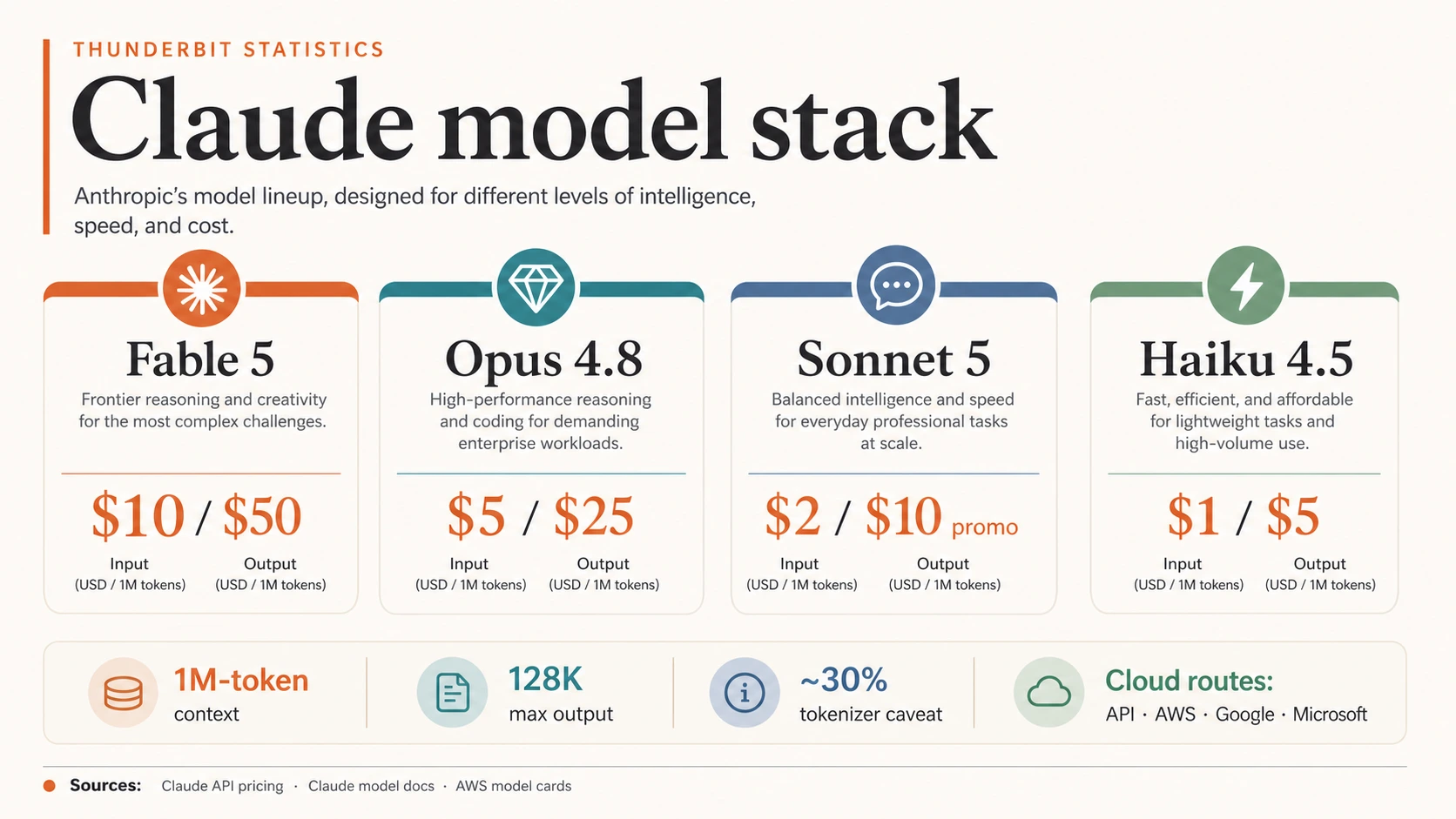
The model family also shows how Claude is being packaged for different work. The overview describes Fable 5 as next-generation intelligence for long-running agents, Opus 4.8 for complex agentic coding and enterprise work, Sonnet 5 as the best combination of speed and intelligence, and Haiku 4.5 as the fastest model with near-frontier intelligence.
The headline spec is context. Claude Sonnet 5 supports a 1M-token context window by default and 128K max output tokens (Sonnet 5 docs). Claude Opus 4.8 supports a 1M-token context window by default on the Claude API, Amazon Bedrock, Google Cloud, and Microsoft Foundry, also with 128K max output tokens (Opus 4.8 docs). AWS’s Fable 5 model card lists Fable 5 as active on Bedrock with a 1M-token context window and 128K max output.
Claude API list pricing (per million tokens, input / output)
These are list prices for token throughput, not subscriptions, app usage, or enterprise seat revenue. Tokenizer changes matter for cost comparisons: the pricing docs note that the newer tokenizer for newer Opus models, Fable 5, Mythos models, and Sonnet 5 can produce about 30% more tokens for the same text.
Cloud routes make Claude a distributed model ecosystem. AWS Bedrock model cards verify current Claude models and their launch status, context windows, max output, and knowledge cutoffs (AWS Opus 4.8, AWS Sonnet 5). Google Cloud lists Claude partner models and documents route-specific details such as Agent Platform request-response logging and FedRAMP boundaries (Google Cloud Claude docs). Microsoft Foundry says Claude models may be hosted on Azure or on Anthropic infrastructure and require an Azure Marketplace subscription (Microsoft Foundry Claude docs). Those cloud facts are important for procurement and architecture, but model availability is not model usage share.
Claude.ai Usage Patterns And Economic Index Signals
Anthropic’s Economic Index is the best public source for understanding what people do with Claude, because it uses Claude traffic rather than generic surveys alone. The March 2026 report says its February sample included 1 million conversations from Claude.ai and the first-party API. For Claude.ai, the top 10 tasks accounted for 19% of traffic in February 2026, down from 24% in November 2025, which suggests use cases were diversifying.
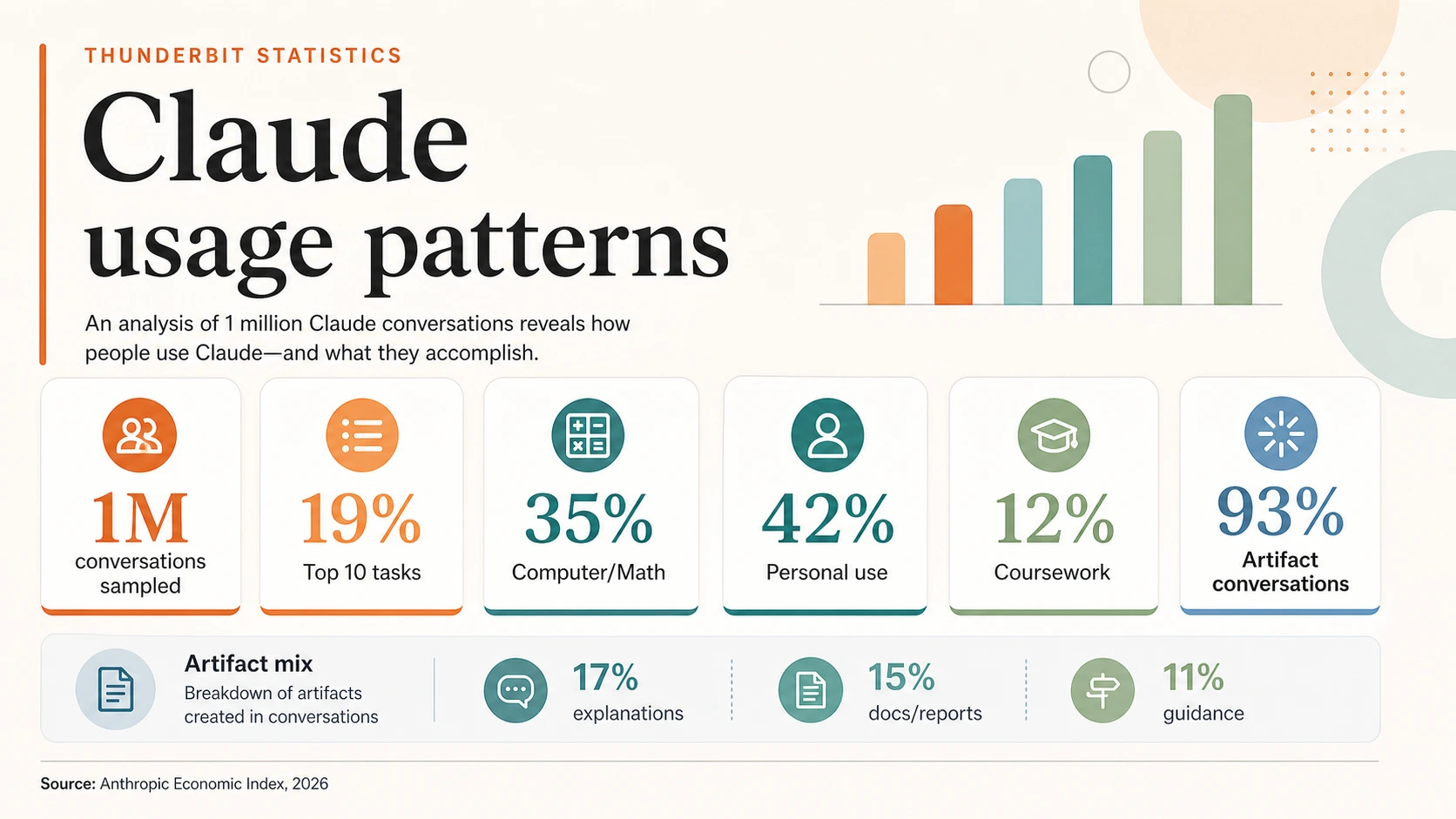
The same March report says Computer and Mathematical tasks accounted for 35% of Claude.ai conversations, that coursework fell from 19% to 12%, and that personal use rose from 35% to 42% between November 2025 and February 2026. Those numbers are powerful because they describe task mix, not because they reveal total users. The January 2026 Economic Index gives a baseline: the top 10 Claude.ai tasks made up 24% of traffic, and software error modification represented 6% of Claude.ai conversations.
The June 2026 report shifts from task categories to artifacts and cadence. Anthropic says continuous privacy-preserving telemetry now samples a slice of conversations every day, classifies chat and Cowork conversations by the primary output Claude produces, and identifies an artifact in 93% of conversations. The most common artifacts are explanations at 17%, documents and reports at 15%, and guidance at 11%.
The geographic research adds another layer. The Economic Index geography report says the US led global Claude.ai use with 21.6%, followed by India, Brazil, Japan, and South Korea, and introduces the Anthropic AI Usage Index, which compares a country’s share of Claude.ai use with its share of the working-age population.
Country briefs show why raw share can mislead. India accounted for 5.8% of global Claude.ai consumer use in a November 2025 sample, second after the US, but ranked much lower per capita; in India, 45.2% of O*NET-mapped Claude tasks were software-related and 51.3% of use was work-related (India brief). Australia accounted for 1.6% of global Claude.ai traffic in the February 2026 sample and had an AI Usage Index of 4.1, meaning usage was more than four times what working-age population alone would predict (Australia brief).
Enterprise, Team, Trust, And Workflow Adoption
Claude’s enterprise story is less about a public seat count and more about controls, billing, workflow reach, and integrations. The Enterprise plan is designed for organizations needing advanced security, compliance controls, and scalable AI across teams. It includes everything in Team plus audit logs, SCIM, custom retention, Compliance API, Analytics API, and customer-managed encryption keys.
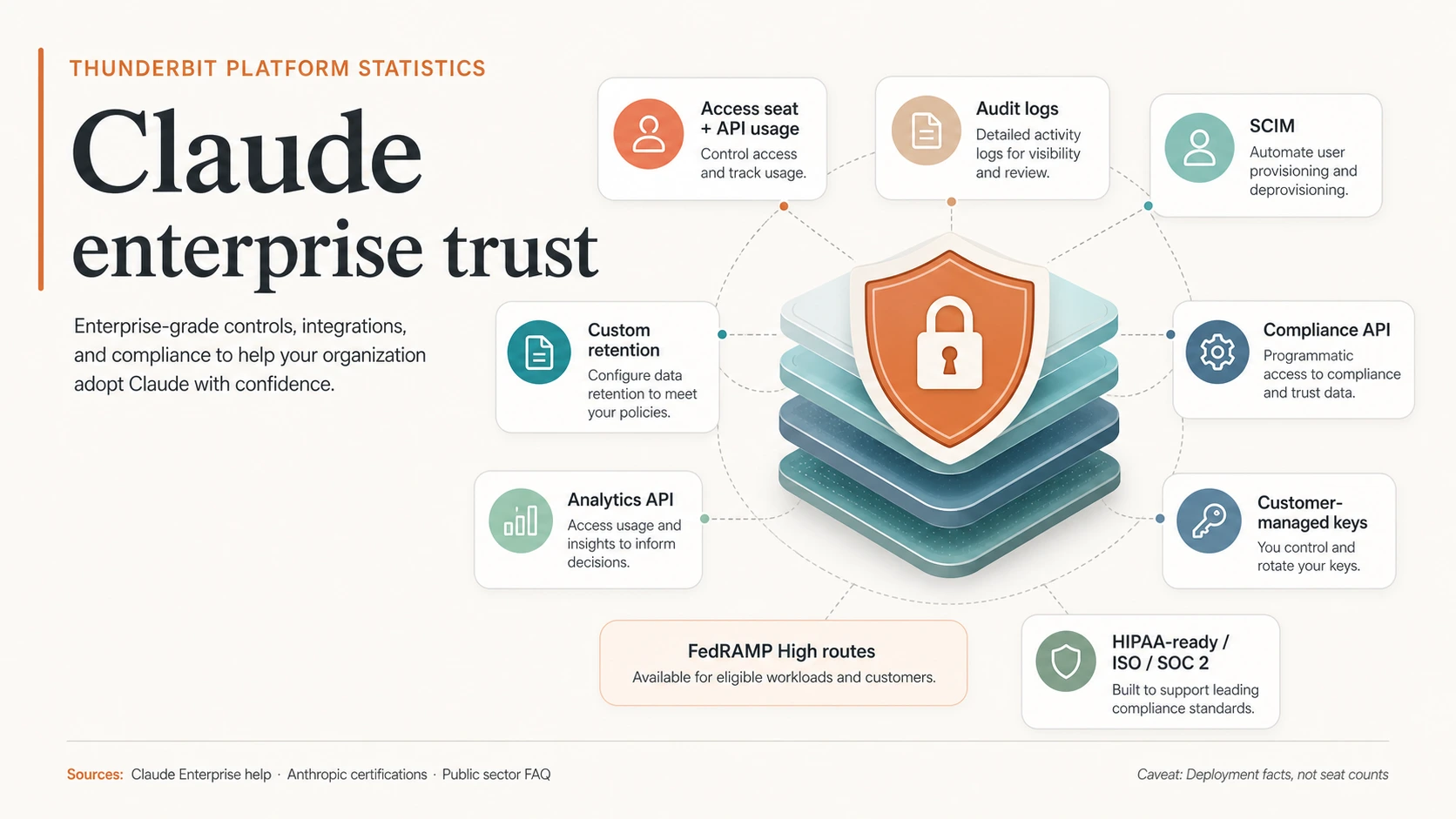
The trust layer is visible in official compliance sources. Anthropic’s certification page says commercial products such as Claude for Work and the Anthropic API maintain HIPAA-ready configuration, ISO 27001:2022, ISO/IEC 42001:2023, and SOC 2 Type I & II. The Trust Center is the portal for compliance artifacts and controls. The public-sector FAQ says Claude for Government, Claude via Amazon Bedrock in AWS GovCloud, and Google Vertex with Assured Workloads are FedRAMP High.
Enterprise controls
Audit logs, SCIM & managed keys
The Enterprise plan adds audit logs, SCIM, custom data retention, a Compliance API, an Analytics API, and customer-managed encryption keys on top of Team.
Enterprise plan helpCompliance
ISO 27001 · ISO 42001 · SOC 2
Commercial products maintain HIPAA-ready configuration, ISO 27001:2022, ISO/IEC 42001:2023, and SOC 2 Type I & II, per the certification page.
Anthropic certificationsPublic sector
FedRAMP High routes
Claude for Government, Claude via Amazon Bedrock in AWS GovCloud, and Google Vertex with Assured Workloads are FedRAMP High.
Public sector FAQAgentic work
Cowork completes multi-step tasks
Claude Cowork is an agentic system for knowledge work that runs on desktop, connects to local files and apps, and completes multi-step tasks from start to finish.
Claude CoworkThe product layer points toward managed work, not just chat. Claude Tag extends that concept into Slack: Anthropic launched Claude Tag on June 23, 2026 in beta for Claude Enterprise and Team customers, saying teams can tag @Claude in Slack, connect it to channels, tools, data, and codebases, and delegate tasks. Anthropic also said its internal version of Claude Tag created 65% of its product team’s code — a product-example statistic, not proof that customers see the same percentage.
Claude Design adds a different kind of adoption signal. Anthropic launched Claude Design in research preview for Pro, Max, Team, and Enterprise users in April 2026. A June 2026 update says more than 1 million people used Claude Design in its first week, and that the product now works with design-system imports, direct canvas editing, Claude Code handoff, and connectors including Adobe, Base44, Canva, Gamma, Lovable, Miro, Replit, Vercel, and Wix.
Claude for Small Business shows workflow packaging for nontechnical operators. Anthropic says the package puts Claude inside tools such as QuickBooks, PayPal, HubSpot, Canva, DocuSign, Google Workspace, and Microsoft 365, and ships with 15 ready-to-run agentic workflows across finance, operations, sales, marketing, HR, and customer service, plus 15 skills (Small Business solution). Claude Science broadens the vertical picture: Anthropic introduced Claude Science on June 30, 2026 as an AI workbench for scientists that integrates common research tools, produces auditable artifacts, and provides flexible access to computing resources. That is not an adoption count — it is evidence that Claude’s product surface is moving toward domain-specific work environments.
Benchmarks, Model Performance, And Production Caveats
Claude model announcements and docs often include benchmark or capability claims, but those numbers need to stay in their lane. A benchmark score can support a capability statement under a defined harness. It does not prove production return on investment, safety, retention, or customer success.
The cleanest public model-performance facts are configuration facts rather than leaderboard claims: 1M-token context, 128K max output, adaptive thinking, cloud availability, and pricing. Sonnet 5 supports 1M context by default, 128K max output, adaptive thinking, and availability through the Claude API, AWS, Google Cloud, and Microsoft Foundry. Opus 4.8 supports 1M context, 128K max output, adaptive thinking, fast mode research preview, and improved long-context and agentic behavior according to its docs.
Cloud launch facts (AWS Bedrock model cards)
The stronger operator question is not whether one Claude model wins one benchmark. It is whether the chosen model fits the task shape. Anthropic’s model-choice guide says selection needs to balance capabilities, speed, and cost. The API pricing docs then force the cost check: list prices, cache costs, batch prices, tokenizer behavior, cloud-route premiums, and workload length all affect the final bill. A 1M-token window can hold very large documents or repositories, but teams still need retrieval strategy, prompt compaction, cache policy, evaluation sets, latency budgets, and human review loops. The official context-window number is real; the production outcome comes from how the number is used.
Market Context: Claude In The AI Assistant And Enterprise AI Stack
Claude’s growth makes more sense inside the broader AI wave, but the category numbers are not Claude metrics. Stanford’s 2026 AI Index puts generative-AI adoption at 53% of the population within three years, faster than the PC or internet over comparable timeframes. Enterprise-demand panels point the same way — Menlo Ventures estimates Anthropic reached about 40% of enterprise LLM spend in 2025 — but those are provider- and category-level signals, not Claude.ai consumer usage. The enterprise-spend, market-share, and EBIT-impact detail is covered in our Anthropic statistics analysis.
The practical conclusion holds: Claude is gaining demand in both consumer and enterprise channels, but each leaves different evidence. Consumer demand shows up in app ranks, web visits, downloads, and signups; enterprise demand shows up in spend panels, cloud availability, product controls, and packaged workflows; model demand shows up indirectly through API routes and pricing pages. None of those alone is enough to infer a total Claude active-user number.
What Claude Does Not Publish
The missing numbers matter. Anthropic does not publicly disclose a Claude-wide monthly active user total, weekly active user total, daily active user total, paid-subscriber total, plan mix, retention rate, churn rate, country-level active-user count, model usage share, API request volume by model, or revenue split across Claude.ai, Claude mobile, Claude Desktop, Claude Code, Team, Enterprise, direct API, AWS, Google Cloud, and Microsoft Foundry.
An estimated visit is not a user count.
The 952.6M Similarweb figure is estimated web traffic from a third-party panel, not unique visitors, active users, or subscribers.
A download band is not an active-user count.
The Google Play 10M+ band and app-store ranks prove store presence and momentum, not current active installs, DAU, or retention.
A daily signup quote is not retention.
The 1M+ daily signups figure is a top-of-funnel executive quote; it does not reveal week-later return or conversion to paid.
A sampled conversation share is not a headcount.
Economic Index denominators are sampled conversations, traffic shares, and artifacts, not a total number of Claude users.
A plan price is not a subscriber count.
The $20 Pro or $200 Max list prices define packaging; they do not reveal how many people sit in each plan.
That absence is normal for a private AI platform, but it changes how public statistics work. A Similarweb visit estimate is not a user count. A Google Play download band is not an active-user count. A Business Insider signup quote is not a retention metric. A Menlo enterprise LLM spend estimate is not Claude.ai consumer usage. A Ramp business adoption panel is not universal market share. The Economic Index reports are unusually valuable for task and artifact patterns, but their denominators are sampled conversations, not a total headcount.
Why These Numbers Matter For Founders And Operators
For product builders, Claude’s 2026 data says the platform is no longer just a text assistant. The download page, Cowork page, Claude Design update, Claude Tag announcement, Claude Science announcement, and small-business launch show a move toward app-connected, tool-using, domain-specific work. That matters for any startup competing with Claude: the benchmark is not only answer quality, but where the assistant can act.
Build-route view
Start with model + route docs
The models overview, pricing docs, Sonnet 5 and Opus 4.8 notes, rate-limit docs, and AWS/Google/Microsoft route docs are more actionable than generic ranking claims.
Claude docsGTM view
Third-party reach is directional
Similarweb estimates web momentum, Appfigures-based reporting explains early-2026 app momentum, and Sensor Tower reports compare mobile growth — none replaces first-party analytics or retention cohorts.
The VergeEnterprise-buyer view
The quiet controls matter most
Enterprise billing structure, audit logs, SCIM, retention, Compliance and Analytics APIs, managed keys, certifications, and FedRAMP routes decide whether a team can move from experiments to managed deployment.
Enterprise plan helpAnalyst view
Denominator hygiene is the discipline
Use "estimated visits" for Similarweb, "downloads" for app stores, "signups" for the Krieger quote, "sampled conversations" for Economic Index, "plan price" for subscriptions, and "model availability" for docs.
SimilarwebFor AI product teams building on Claude, the model facts are more actionable than generic ranking claims. Start with the models overview, pricing docs, Sonnet 5 migration notes, Opus 4.8 notes, rate-limit docs, and the AWS model catalog, then test prompt lengths, tool calls, output sizes, latency, cache hit rates, and review loops against the workload that matters. For analysts, the main discipline is denominator hygiene — Claude’s public numbers are strong enough without turning them into unsupported active-user claims.
Making Sense Of Claude’s Numbers
Use official Claude and Anthropic pages for product facts, plan facts, model facts, API pricing, release status, cloud routes, trust controls, and Claude.ai usage-pattern research. Product pages such as Claude pricing, Claude download, models overview, API pricing, and Enterprise plan help are the best places to verify current facts before making product or procurement decisions.
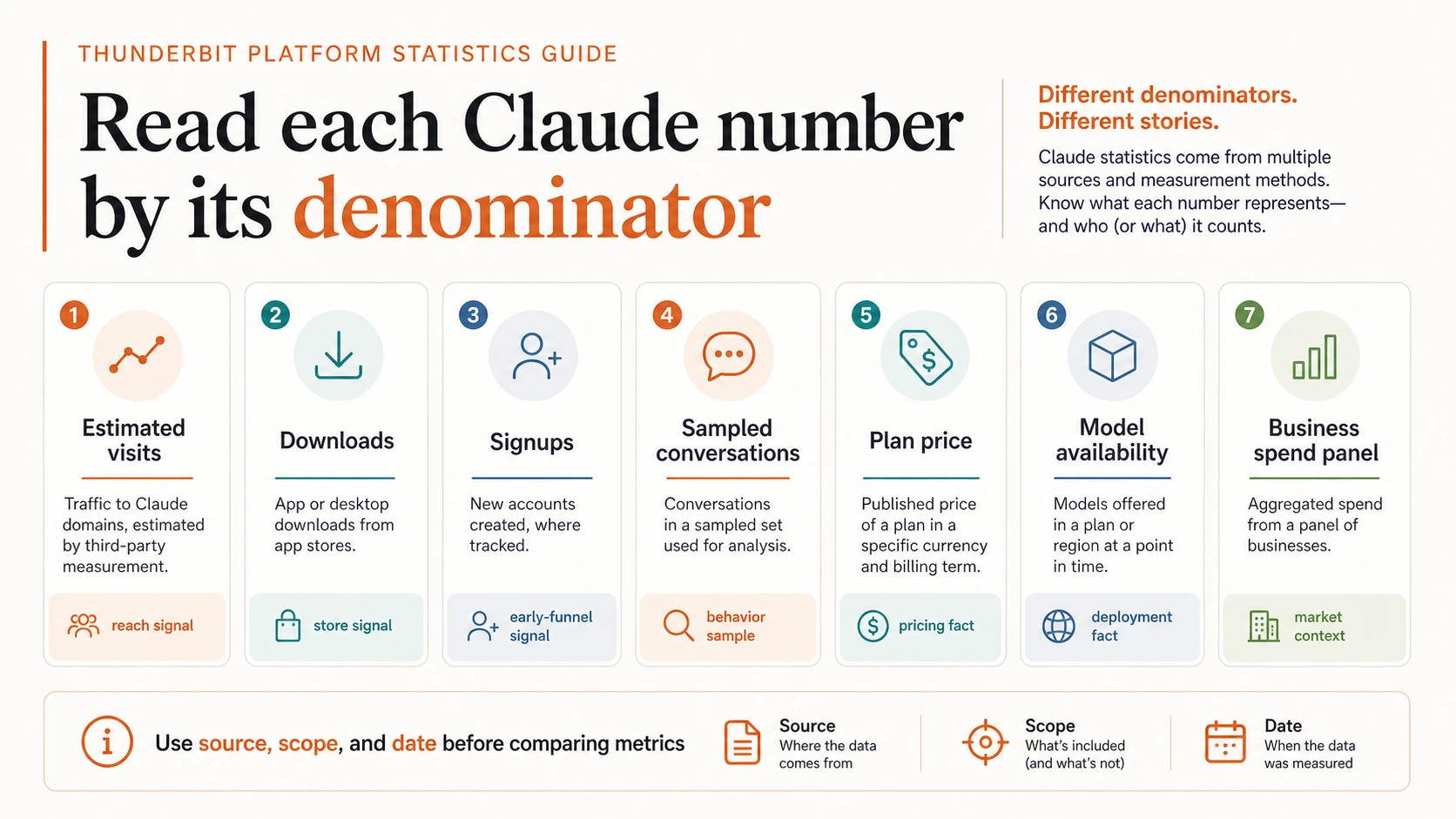
Use third-party web and app intelligence as directional reach evidence: Similarweb can estimate traffic and engagement, while Business Insider, The Decoder, and The Verge can summarize app-intelligence signals — useful when labeled as estimates, not when inflated into official usage. Use Economic Index findings for behavior: Anthropic’s March 2026, June 2026, geography, India, and Australia reports are strong for task mix, artifacts, geography, and work patterns, but not a replacement for an official user denominator. Use market reports from Stanford, McKinsey, Menlo, and Ramp for context, not as Claude.ai active users.
Frequently Asked Questions
How many people use Claude in 2026?
Anthropic does not publish a single Claude-wide monthly active user count. The strongest public reach signals are Similarweb estimating 952.6 million claude.ai visits over the three months to May 2026, a Google Play band of 10M+ downloads, and a Business Insider report of more than 1 million daily signups in early 2026. Those are estimated visits, download bands, and signup momentum, not an official active-user total.
What are the Claude plan prices in 2026?
Claude has five plan families: Free, Pro, Max, Team, and Enterprise. The Claude plan guide lists Free at $0, Pro at $20/month or $200/year, Max 5x at $100/month, and Max 20x at $200/month, while the pricing page shows Pro at $17/month with annual billing. Enterprise uses a seat fee for access plus usage billed separately at API rates.
What is the Claude context window and model lineup?
Claude's current main models are Claude Fable 5, Claude Opus 4.8, Claude Sonnet 5, and Claude Haiku 4.5, per the models overview. Fable 5, Opus 4.8, and Sonnet 5 are listed with a 1M-token context window and 128K max output tokens in official and cloud-provider docs.
How much does the Claude API cost per token?
Direct API list pricing is $10/$50 per million input/output tokens for Fable 5, $5/$25 for Opus 4.8, $1/$5 for Haiku 4.5, and $2/$10 for Sonnet 5 through August 31, 2026 before $3/$15 standard pricing. Anthropic also notes that newer-tokenizer models can emit about 30% more tokens for the same text, which can raise effective cost even when per-token prices look unchanged.
How fast is Claude web traffic growing?
Similarweb's Gen AI analysis estimates Claude web visits grew roughly 770% between September 2024 and March 2026, and that Claude app monthly active users roughly tripled between January and March 2026. These are third-party panel estimates of visits and app MAU, not official Anthropic active-user figures.
What do people actually use Claude for?
Anthropic's March 2026 Economic Index, based on 1 million sampled conversations, says Computer and Mathematical tasks made up 35% of Claude.ai conversations, personal use rose to 42%, and coursework fell to 12%. The June 2026 report says 93% of chat and Cowork conversations produced an artifact, most often explanations (17%), documents and reports (15%), and guidance (11%).
Which country uses Claude the most?
The Economic Index geography report says the United States led global Claude.ai use with 21.6%, followed by India, Brazil, Japan, and South Korea. India accounted for 5.8% of global consumer use in a November 2025 sample, and Australia had 1.6% with an AI Usage Index of 4.1, meaning usage was more than four times its working-age population share.
Does Claude publish enterprise seat counts?
No. Anthropic does not disclose a public Claude enterprise seat count. The Enterprise plan is documented through its controls instead — audit logs, SCIM, custom retention, a Compliance API, an Analytics API, and customer-managed encryption keys, with access seats billed separately from usage at API rates.
Sources and Further Reading
Official Claude plans, pricing & product pages
Models, pricing & cloud documentation
Reach, app intelligence & usage research
Enterprise, trust, products & market context