Codex Statistics
Last updated on July 15, 2026

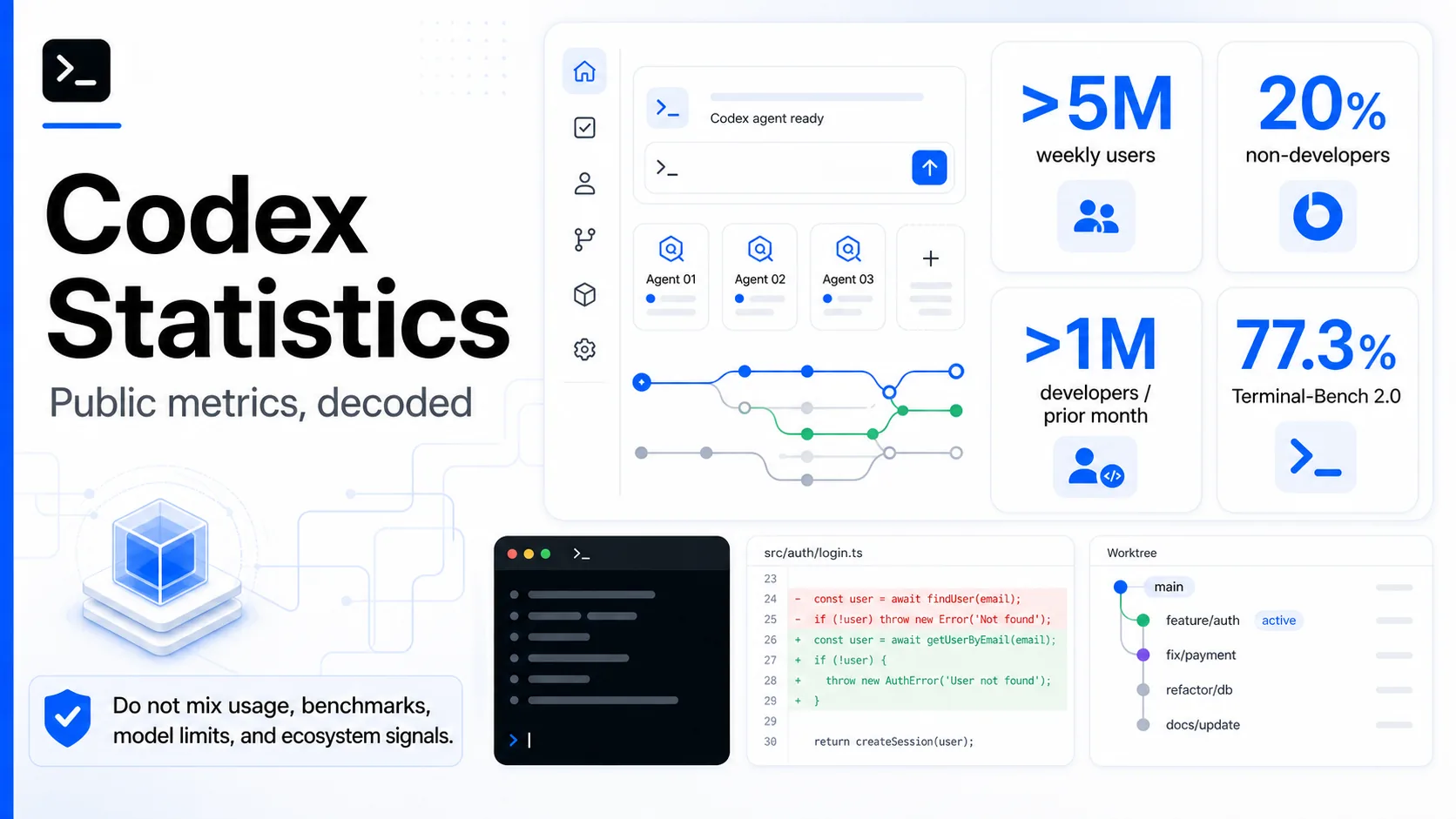
Codex is OpenAI’s agentic software-engineering product line: a coding agent available across ChatGPT, cloud tasks, CLI, IDE extensions, GitHub workflows, desktop apps, and API models. The public statistics fall into four categories that should not be mixed — company-reported usage metrics, product-release milestones, capability-benchmark scores, and broader developer-AI adoption surveys.
The headline number is company-reported: OpenAI says more than 5 million people use Codex weekly, with non-developers about 20% of users and growing more than 3× as fast as developers (OpenAI). That is a weekly-user metric — not monthly or daily active users, revenue, paid seats, or market share. This article summarizes the best-supported Codex statistics from the research dossier, separates user adoption from ecosystem signals, and explains the caveats behind each number.
Top Statistics
OpenAI’s usage figures are company-reported and informative, but not independently audited in the dossier. Read them as product-ecosystem signals, each with a specific population and time window.
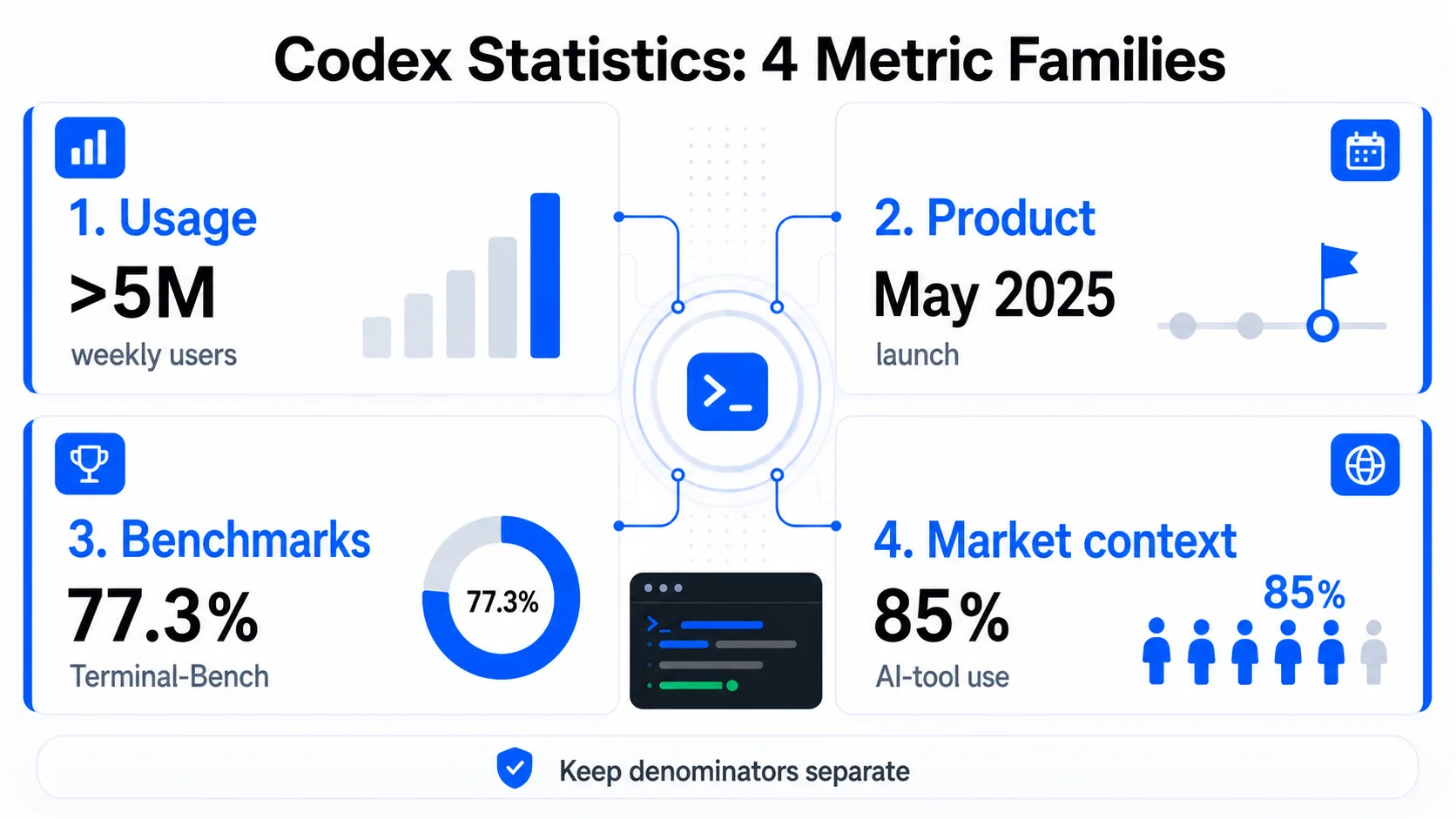
Adoption & usage (company-reported)
GPT-5.3-Codex benchmarks (xhigh reasoning)
Models, surfaces & timeline
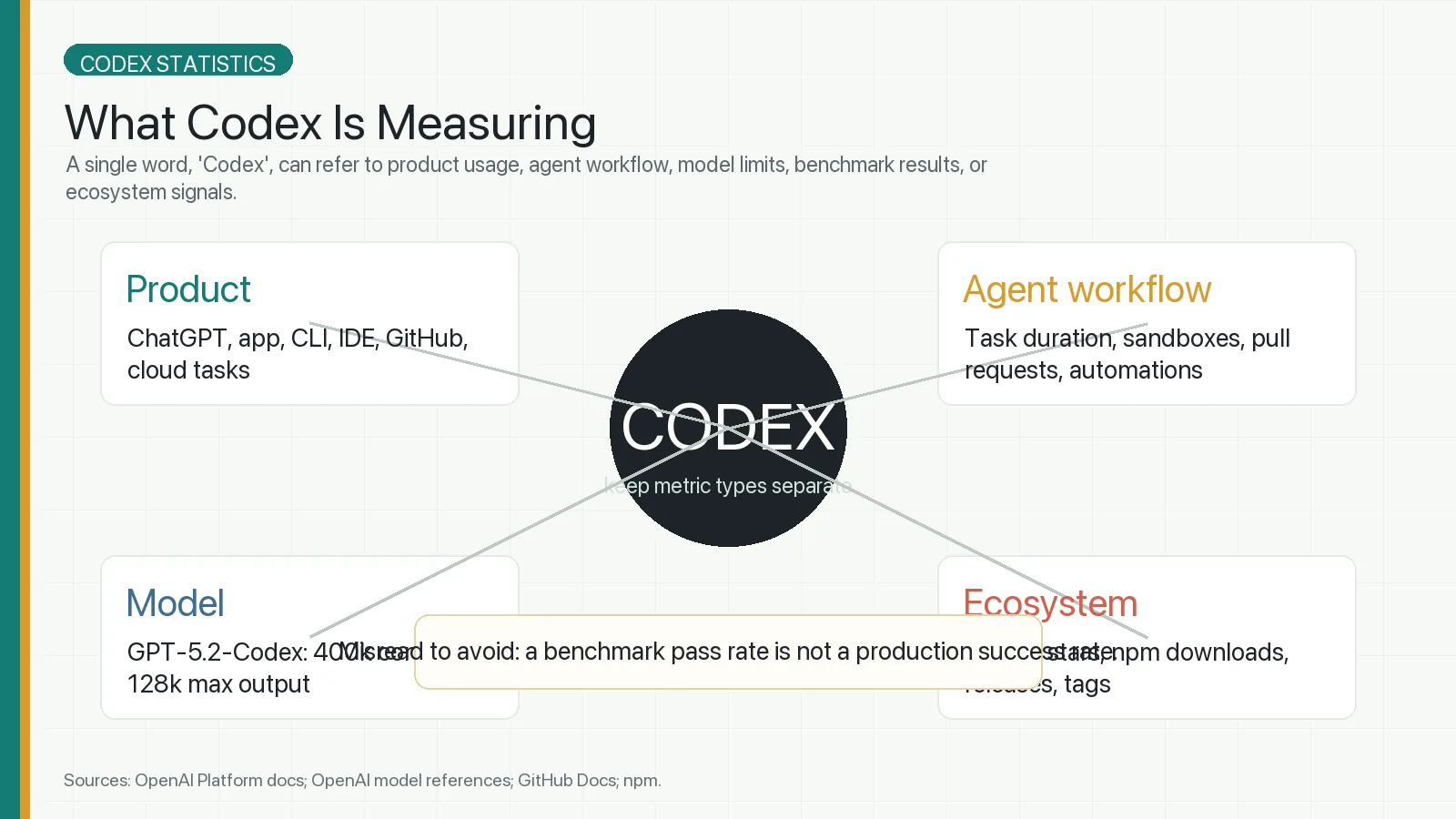
What Codex Is Measuring: Product, Agent, Model, or Workflow?
“Codex” is not a single metric category. In OpenAI’s materials it refers to a product suite and agent platform spanning cloud tasks, CLI, IDE, web/mobile, GitHub, and CI/CD-style workflows (OpenAI Platform).
Product usage
People & sessions
Weekly users, prior-month developers, and usage growth — company-reported metrics inside OpenAI’s product ecosystem.
OpenAIModel capability
Technical limits
GPT-5.2-Codex and codex-mini-latest context windows, max output tokens, and reasoning levels — model-reference facts, not usage.
OpenAI DevelopersBenchmarks
Controlled evaluations
SWE-Bench Pro, Terminal-Bench 2.0, OSWorld-Verified — pass rates under specific setups, not private-monorepo success.
OpenAIEcosystem
Attention & distribution
GitHub metadata and npm downloads for openai/codex — attention and distribution signals, not active-user counts.
GitHub DocsThe basic rule for interpreting the numbers: adoption statistics refer to people or usage inside OpenAI’s ecosystem; model-reference statistics refer to technical limits; benchmark statistics refer to controlled tasks; and ecosystem statistics such as GitHub metadata or npm downloads are attention or distribution signals.
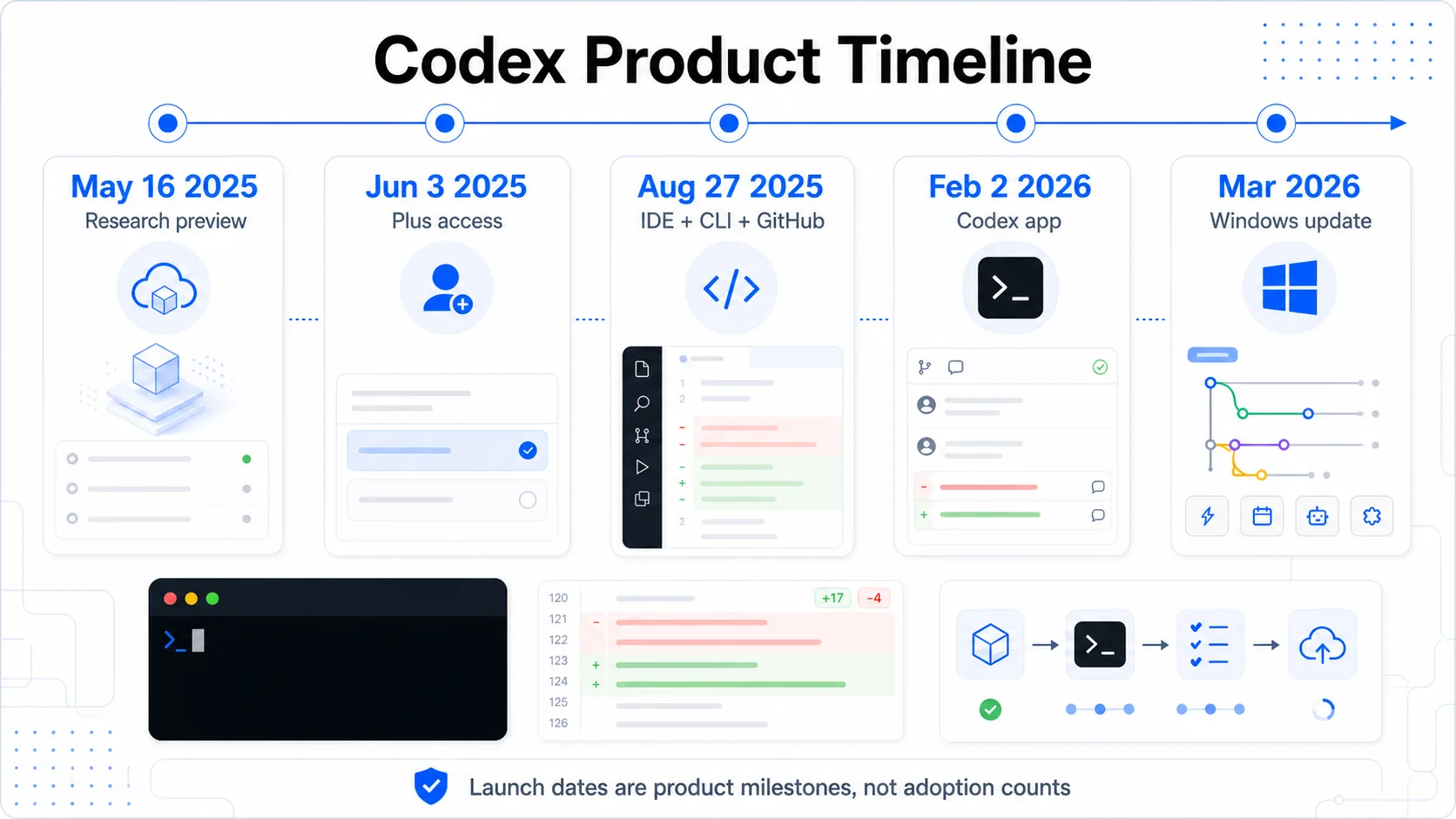
Launch and Product Timeline
The public Codex timeline anchors the adoption and benchmark numbers to product chronology.
Research-preview launch
Codex introduced May 16, 2025 as a cloud coding agent powered by codex-1, running each task in an isolated cloud sandbox with internet disabled by default; ChatGPT Plus added June 3, 2025.
Upgrades across surfaces
August 27 release notes recorded the IDE extension, ChatGPT sign-in, an upgraded CLI, GitHub reviews, browser automation, configurable internet access, and a 90% cut in median task-completion time via container caching.
Codex app
The Codex app launched February 2, 2026 (macOS, later Windows) with parallel agents, worktrees, automations, skills, and ChatGPT login — usage included with Plus, Pro, Business, Enterprise, and Edu.
Reuters later reported that OpenAI expanded partnerships with major global consulting firms to accelerate enterprise Codex deployments (Reuters via Investing.com). These reports are useful for go-to-market context, but they do not replace OpenAI’s own definitions for usage counts.
User Adoption and Usage Statistics
The most important adoption statistic is OpenAI’s report that more than 5 million people use Codex weekly (OpenAI). It is a company-reported weekly-user figure and should not be converted into monthly active users, daily active users, paid subscribers, or market share.
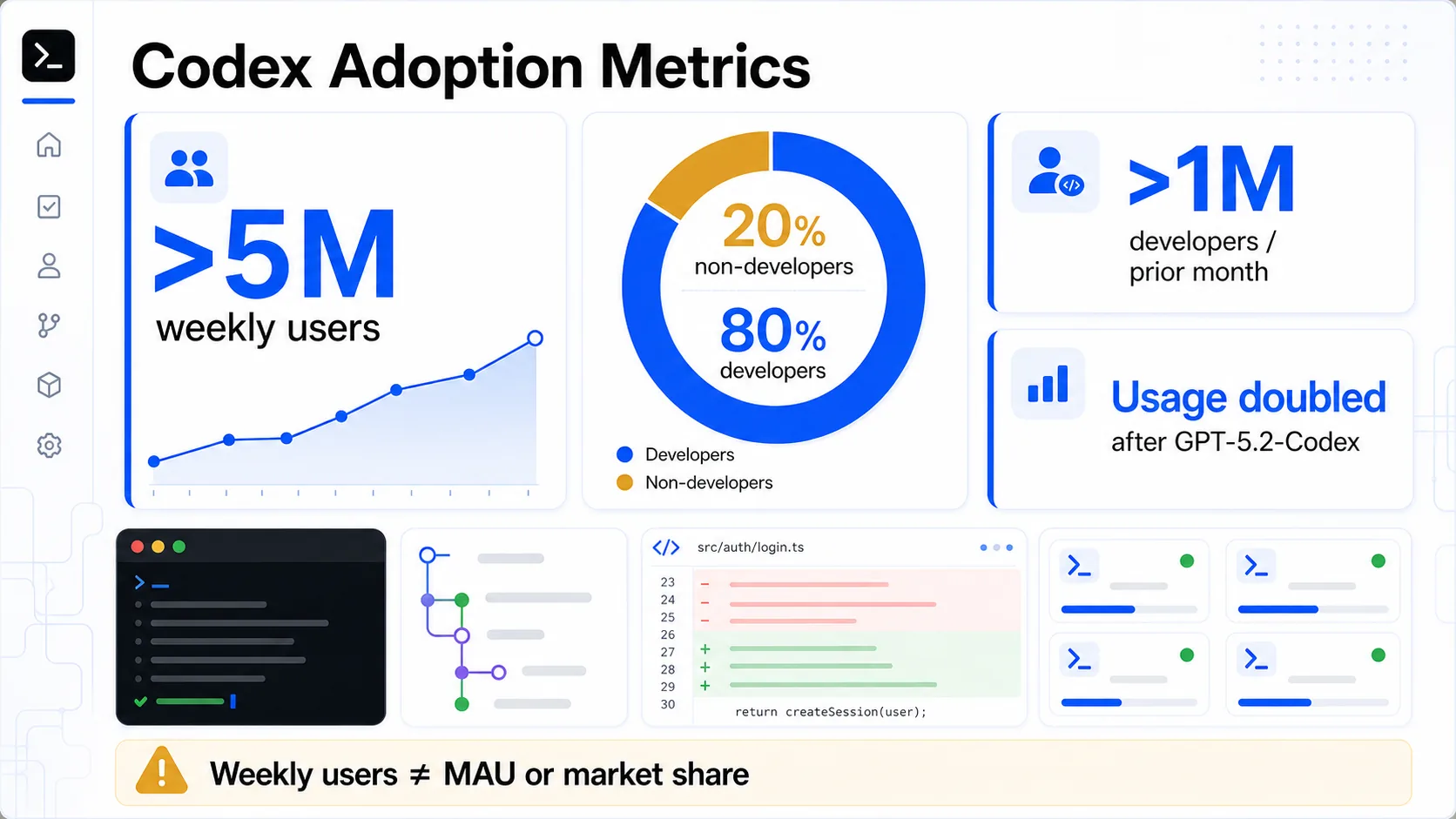
That non-developers are about 20% of users and growing more than 3× as fast as developers changes the interpretation of Codex from a pure developer tool to a broader work-delegation interface. Internal adoption at OpenAI appears unusually strong — but the dossier warns against treating it as representative of ordinary enterprises. The growth multipliers are striking but baseline-sensitive:
Growth multiples can look large when the starting base is small, so they should be read as directionally useful, not as standalone market-size evidence. Axios also reported that Codex surpassed 5 million weekly active users with knowledge-worker adoption growing faster than developer adoption, citing OpenAI research (Axios) — but because the underlying statistic originates with OpenAI, the accurate wording is still “OpenAI reports,” not “independently measured.”
Surfaces: ChatGPT, CLI, IDE, GitHub, App, and API
Codex statistics are easier to interpret when grouped by surface — each surface has a different measurement denominator.
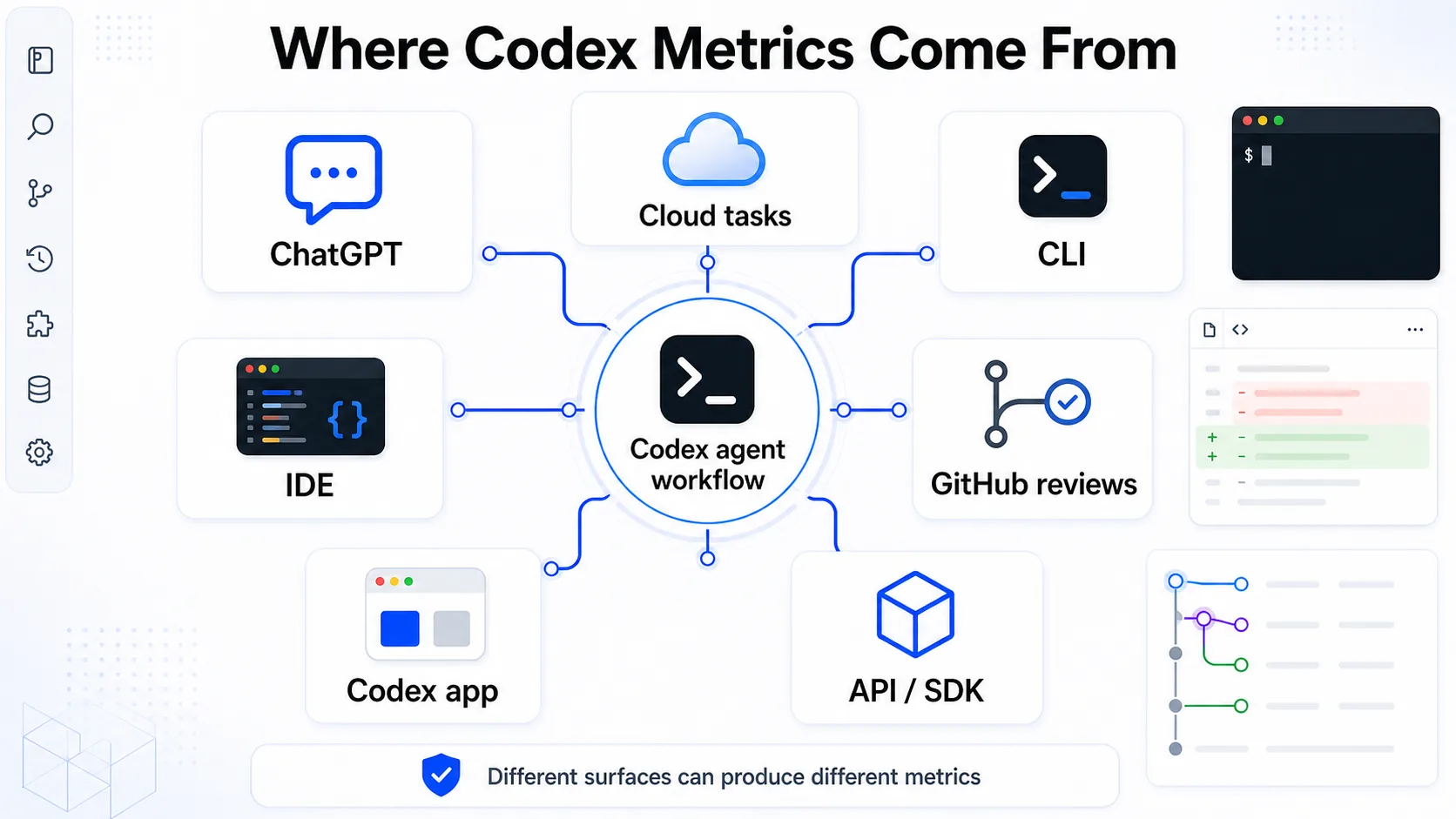
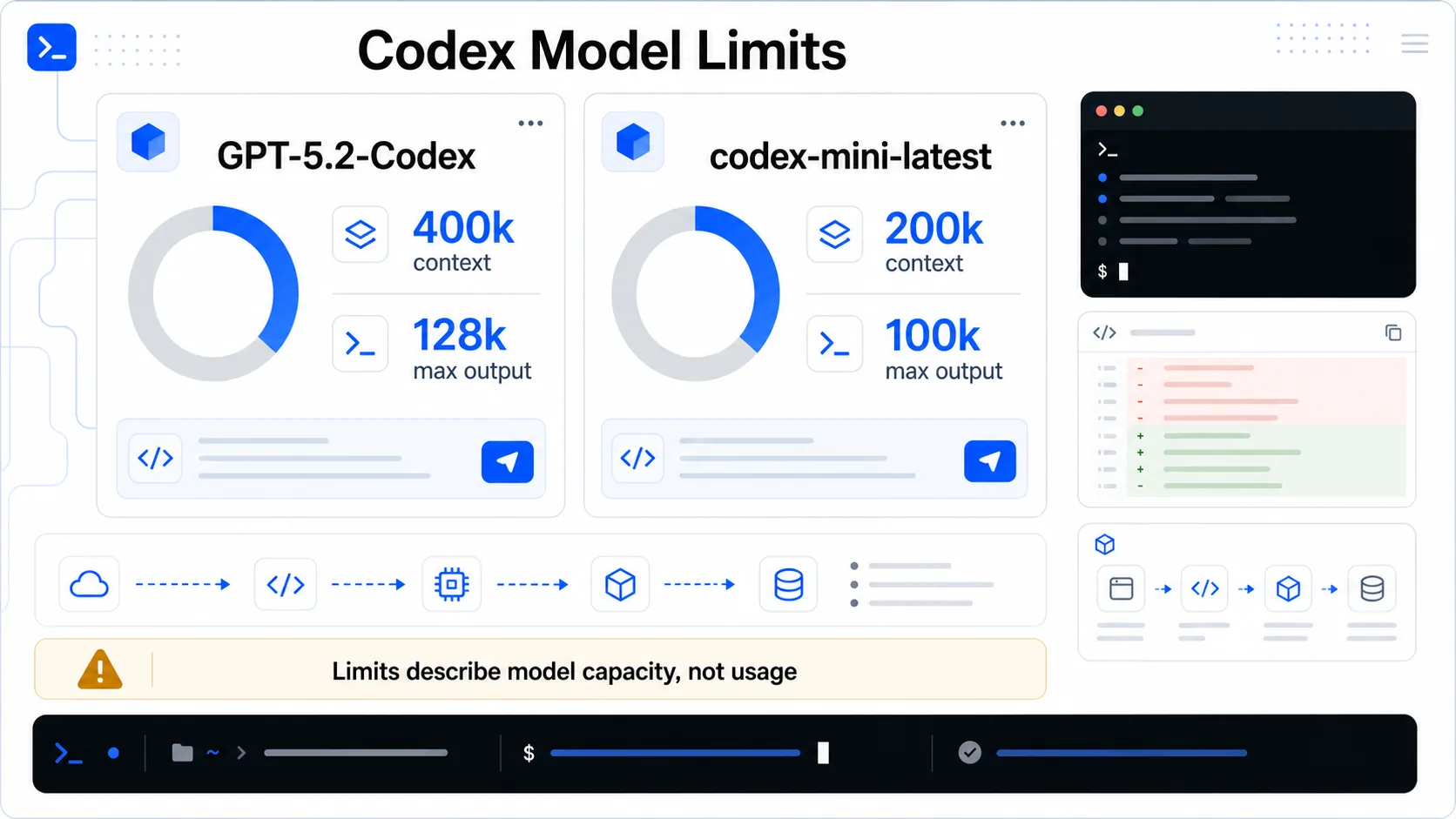
In ChatGPT, Codex launched as a sidebar-accessible coding agent. In the CLI it became a local-agent workflow that can hand off to the cloud and connect to MCP servers through ~/.codex/config.toml (OpenAI Platform). The IDE extension supports VS Code, Cursor, and other VS Code forks, using editor context to reduce prompting (OpenAI). In GitHub, Codex can review pull requests via @codex and produce PRs from cloud tasks (OpenAI Help). At the API layer, the GPT-5.2-Codex model reference lists a 400,000-token context window and 128,000 max output tokens, while codex-mini-latest lists 200,000 and 100,000 respectively (OpenAI Developers).
Capability Benchmarks and What They Do Not Prove
Benchmark statistics are among the easiest Codex numbers to quote and to overinterpret. OpenAI reported GPT-5.3-Codex at 56.8% on SWE-Bench Pro Public, 77.3% on Terminal-Bench 2.0, and 64.7% on OSWorld-Verified, using “xhigh” reasoning effort (OpenAI).
These are model-evaluation results under specific configurations — not measures of how often Codex will succeed in a company’s private monorepo, with that company’s tests, permissions, dependencies, and review standards. Crucially, the three benchmarks measure different things and should not be compared directly: SWE-Bench Pro emphasizes longer-horizon professional tasks (Scale AI); Terminal-Bench 2.0 defines 89 realistic terminal tasks (arXiv); and OSWorld measures executable computer use across full operating systems (arXiv).
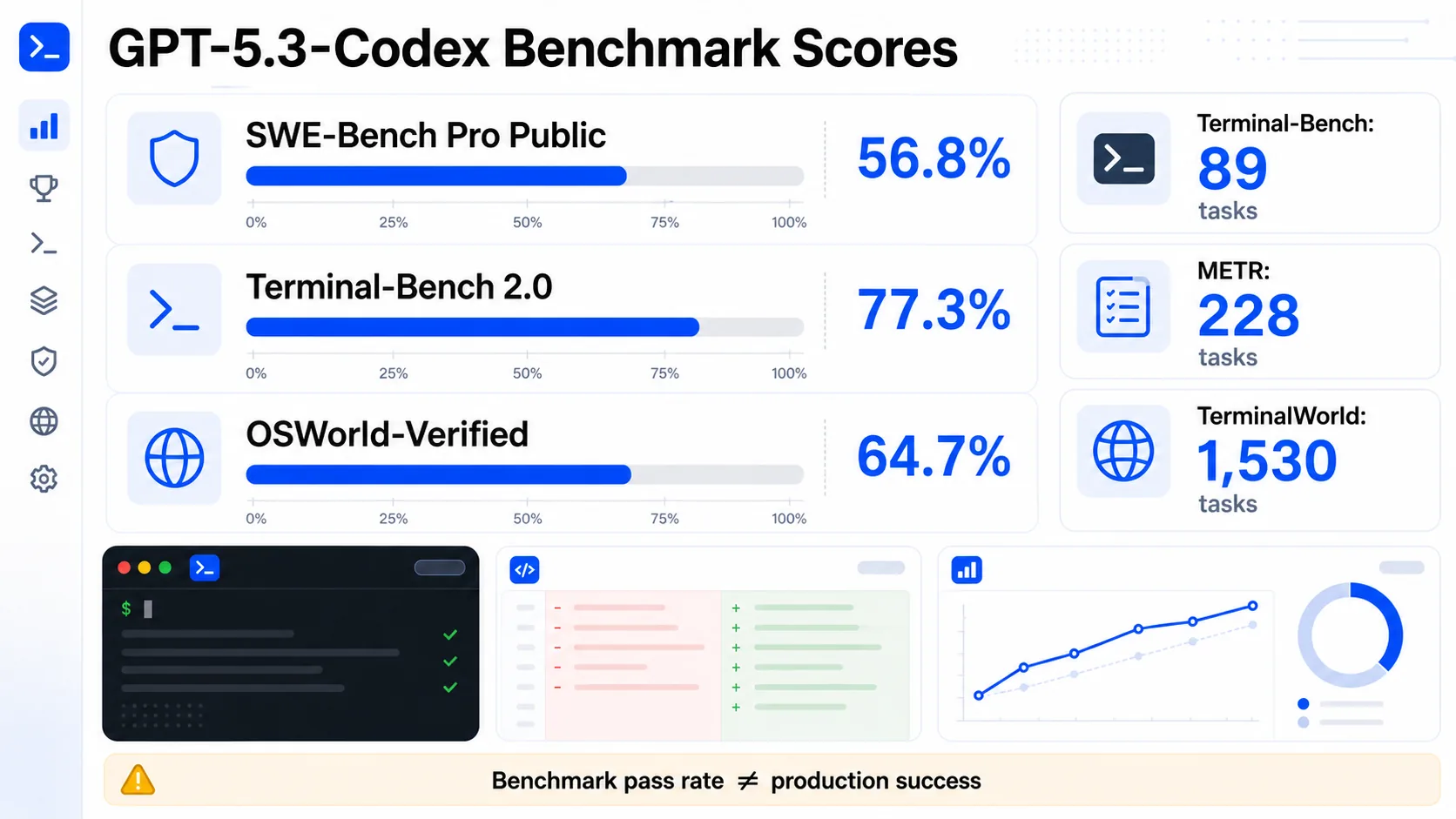
Benchmark diversity reinforces the caution. TerminalWorld introduces an automatically generated benchmark with 1,530 validated tasks and reports a weak correlation (Pearson r = 0.20) with expert-curated Terminal-Bench, suggesting the two measure complementary capabilities (arXiv). METR’s time-horizon framework adds another dimension: its Time Horizon 1.1 update expanded the task suite from 170 to 228 tasks and long 8h+ tasks from 14 to 31 (METR).
Security, Sandboxing, and Deployment Controls
Security is central to Codex statistics because agentic coding tools operate on codebases, dependencies, tests, terminals, and sometimes networked resources. OpenAI’s original launch stated that each task runs in an isolated cloud sandbox with internet access disabled by default during execution (OpenAI).
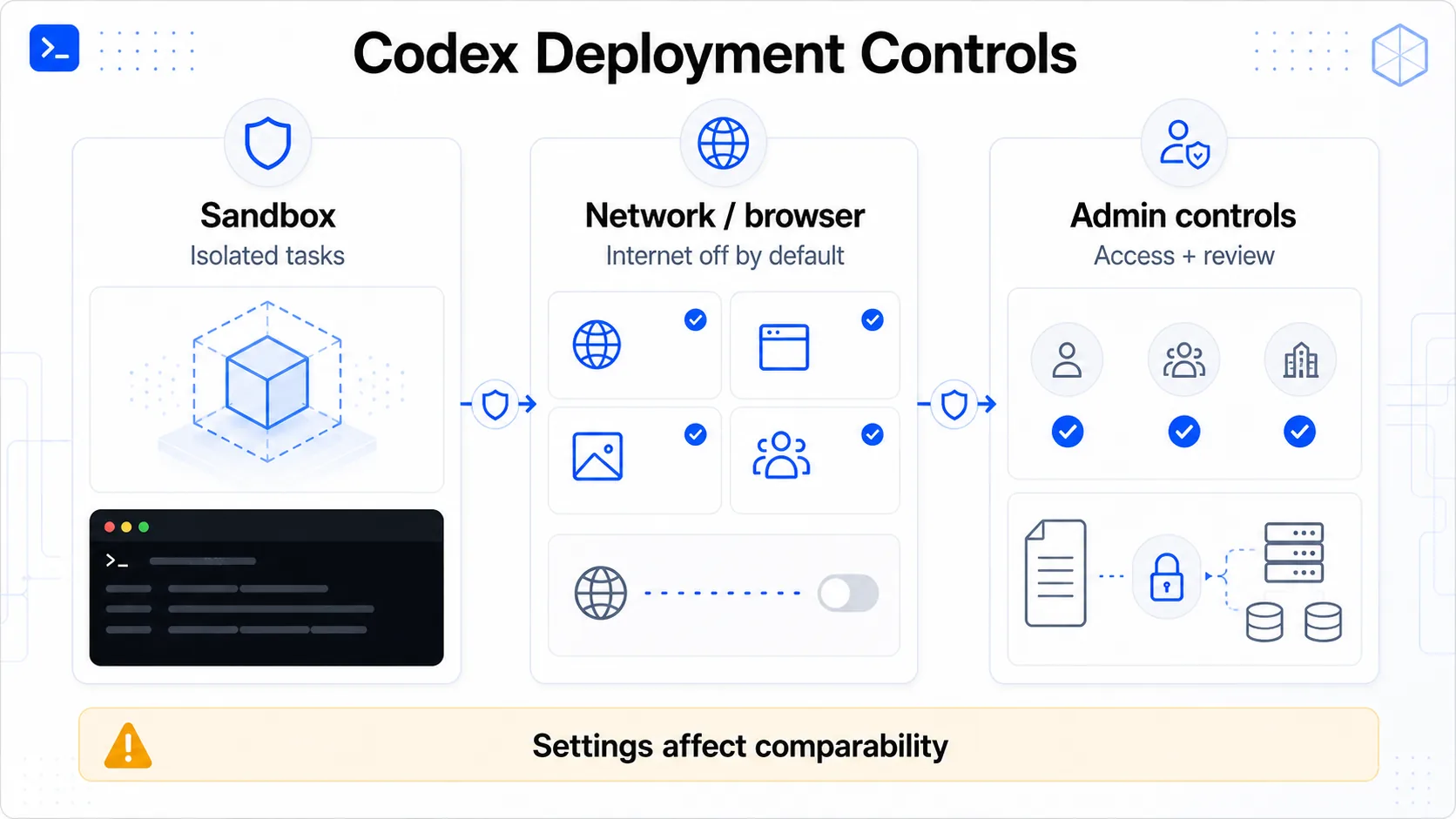
The GPT-5-Codex system card describes deployment across terminal, IDE, cloud, GitHub, and ChatGPT mobile, along with sandboxing and configurable network-access mitigations (OpenAI PDF). This matters for metric comparisons: a task completed in a no-network sandbox is not directly comparable with one completed using configurable internet access and browser automation. Enterprise and education release notes add an administrative layer including RBAC, a compliance API, and admin controls.
Developer-AI Market Context
Codex adoption sits inside a broader shift toward AI-assisted software development. Survey statistics are useful context, but they measure different populations and should not be blended into a single “developer adoption rate.”
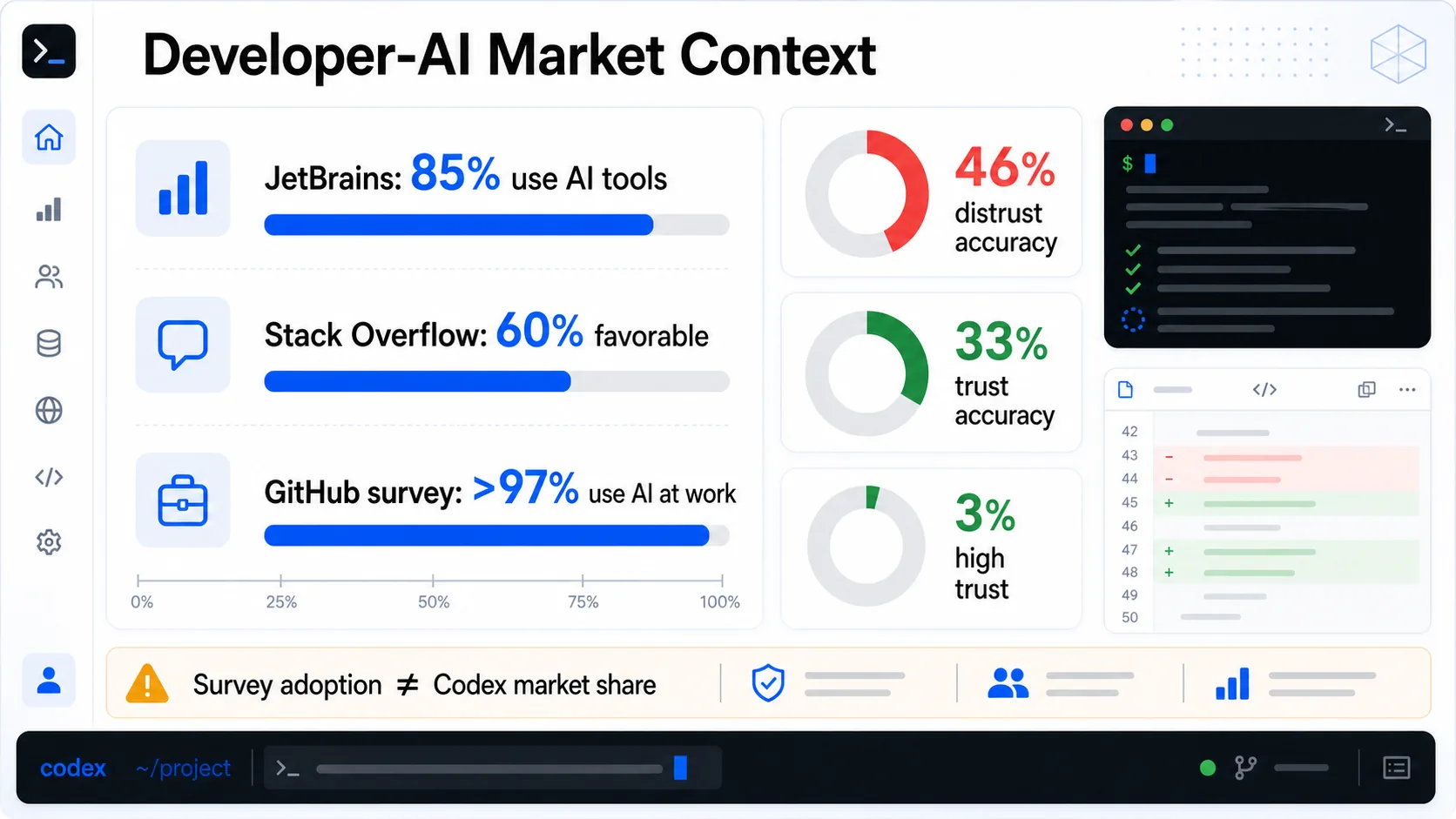
Stack Overflow’s 2025 survey reported AI sentiment at 60% favorable, while 46% distrusted AI output accuracy (up from 31% in 2024), 33% trusted it, and only 3% highly trusted it (Stack Overflow). Among out-of-the-box AI assistants, it reported ChatGPT and GitHub Copilot as the most used:
JetBrains’ 2025 survey (24,534 developers across 194 countries, April–June 2025) reported 85% regularly use AI tools and 62% rely on at least one AI coding assistant, agent, or code editor (JetBrains). GitHub’s 2024 survey reported more than 97% of surveyed developers used AI coding tools at work, while only 38% of U.S. developers said their organizations actively encouraged adoption (GitHub Blog). None of these provide a Codex-specific market-share denominator.
Ecosystem Signals: GitHub, npm, and What Not to Infer
The Codex open-source and package ecosystem provides useful public signals, but not active-user counts. The canonical repository is openai/codex and the official npm package is @openai/codex (npm).
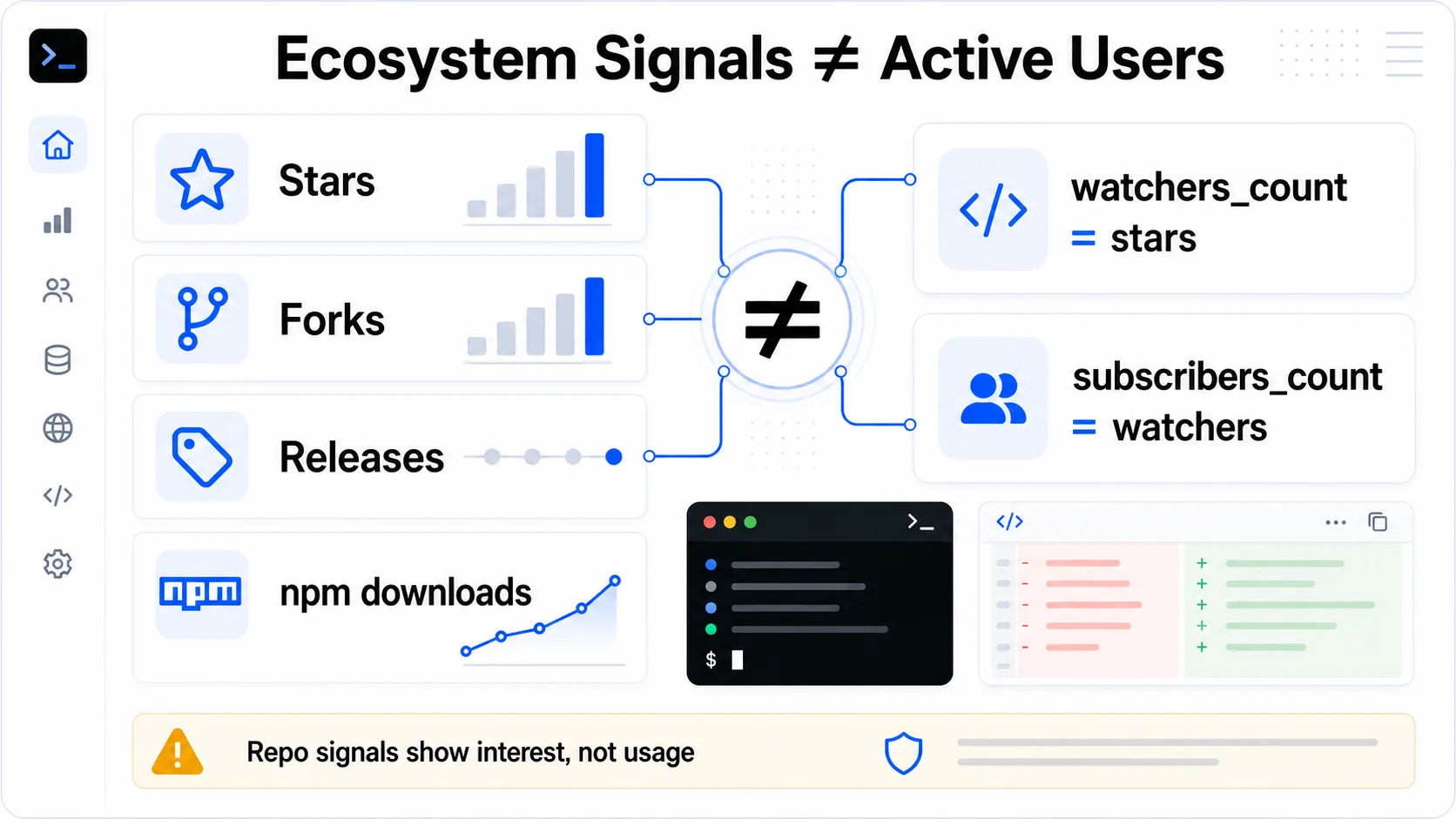
GitHub’s own definitions are crucial: stargazers_count, watchers, and watchers_count all represent stars, while subscribers_count represents repository watchers (GitHub Docs). Package downloads are also not active users — they can be inflated by CI systems, reinstalls, mirrors, and automation. Stars indicate awareness, forks indicate experimentation; neither proves production usage. OpenAI’s weekly-user and monthly-developer figures remain the only direct product-usage metrics in the dossier.
Productivity Claims and Case-Study Caveats
Codex is often discussed in productivity terms, but the public evidence base is uneven. OpenAI says its engineers use Codex daily across Security, Product Engineering, Frontend, API, Infrastructure, and Performance Engineering (OpenAI PDF) — meaningful workflow examples, but not randomized productivity trials.
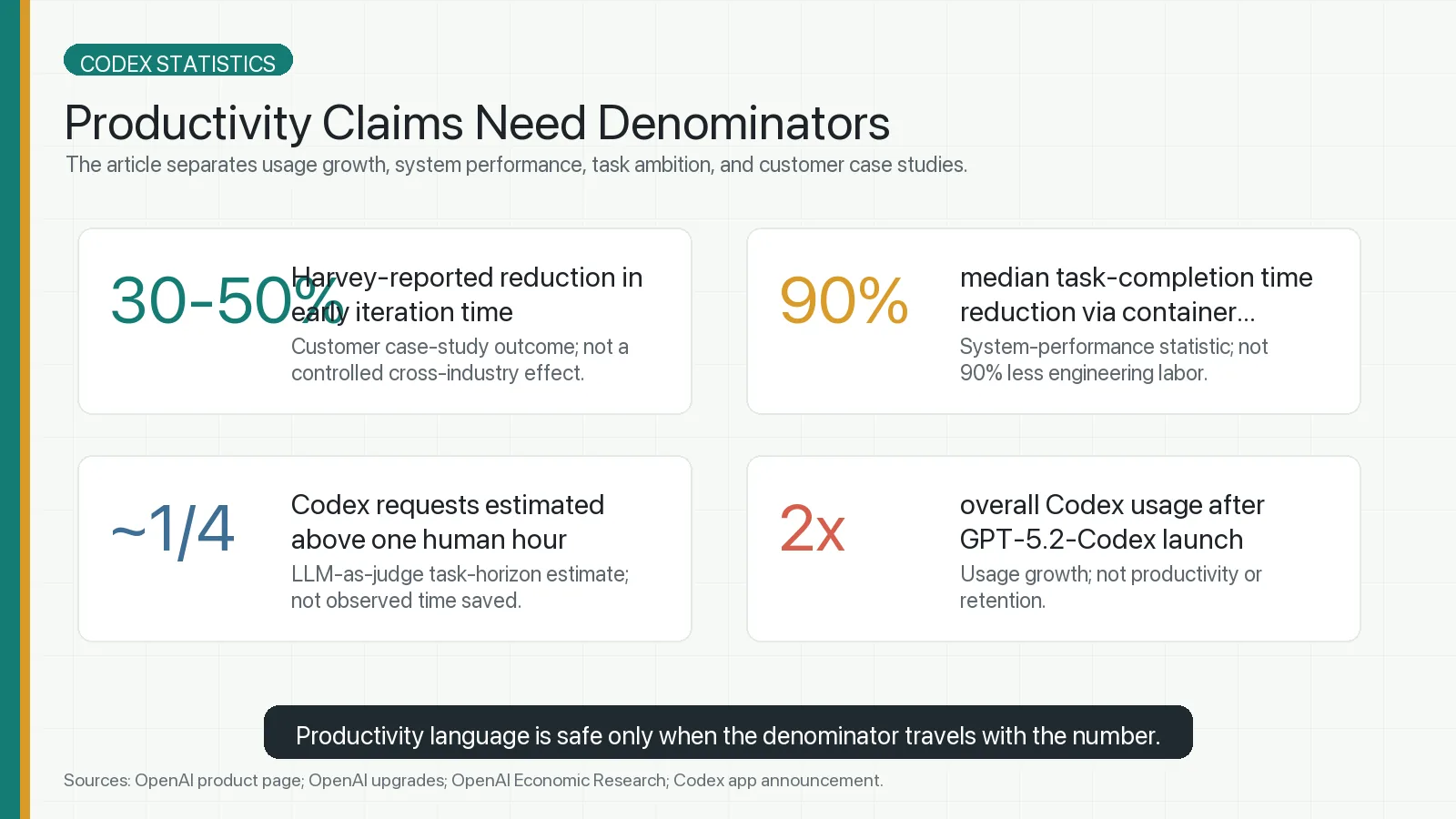
The Codex product page includes a Harvey-reported 30–50% reduction in early iteration time (OpenAI) — a customer-reported outcome that should not be generalized into “Codex improves productivity by 30–50%” across all teams. And the 90% reduction in median task-completion time via container caching is a system-performance statistic, not a 90% reduction in engineering labor (OpenAI).
Metric Definitions and Common Misreadings
The safest way to summarize Codex is to keep metric definitions explicit.
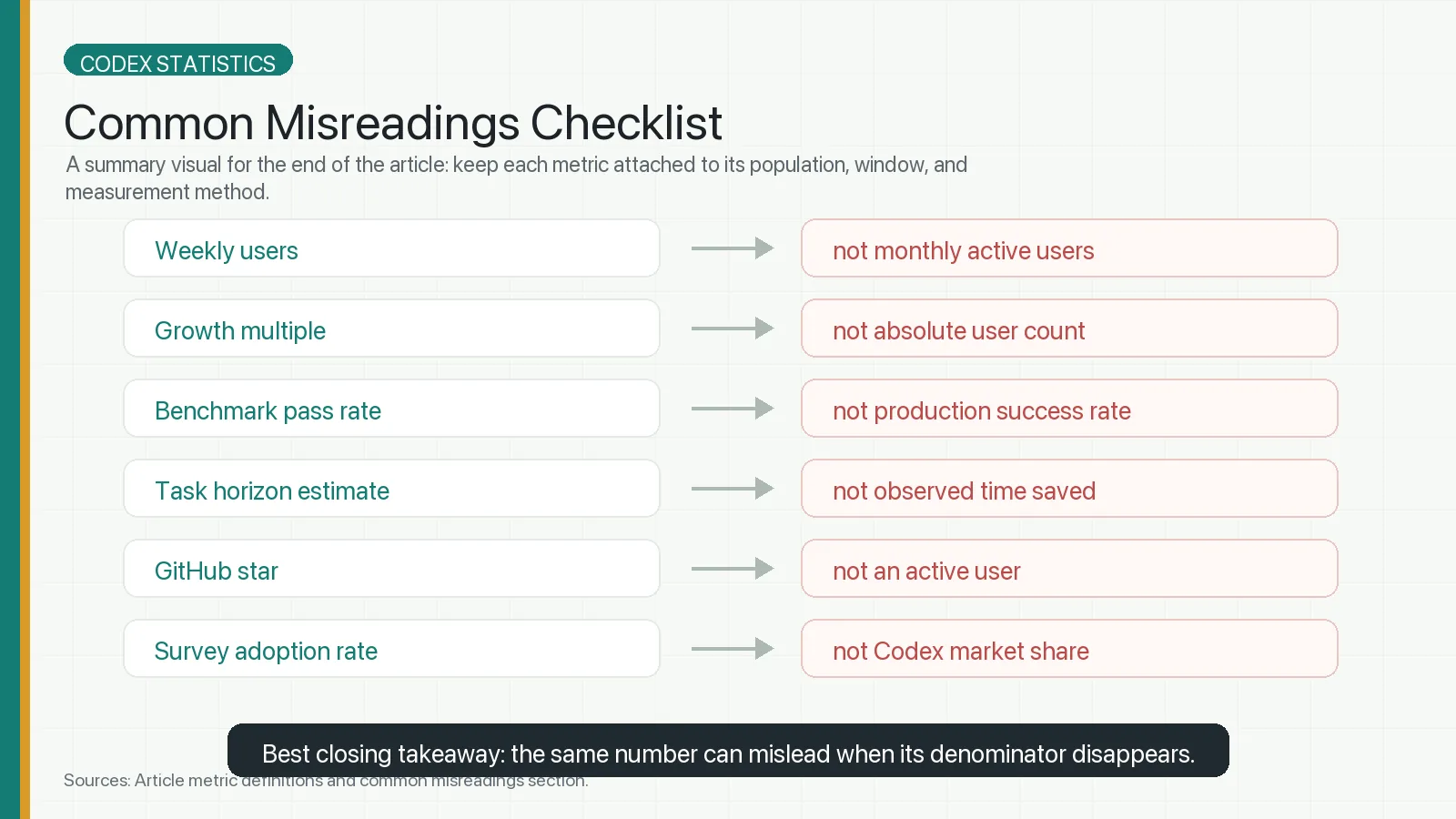
A weekly-user metric is not monthly active users.
The "5 million weekly" figure and the "one million developers in the prior month" figure have different populations and time windows.
A growth multiple is not a user count.
The 137×, 189×, and 12× figures are measured against an August 2025 baseline and do not reveal absolute numbers.
A benchmark pass rate is not a production success rate.
56.8% / 77.3% / 64.7% are benchmark results under a stated reasoning-effort setting; production success depends on codebase, tests, and review.
A task-horizon estimate is not observed time saved.
The one-hour horizon figure is an LLM-as-judge assessment of transcripts, not measured human time.
Stars, downloads, and survey rates are not market share.
GitHub stars are not users, npm downloads are distribution events, and survey adoption rates measure different samples — none is a Codex market-share denominator.
Source Quality Note
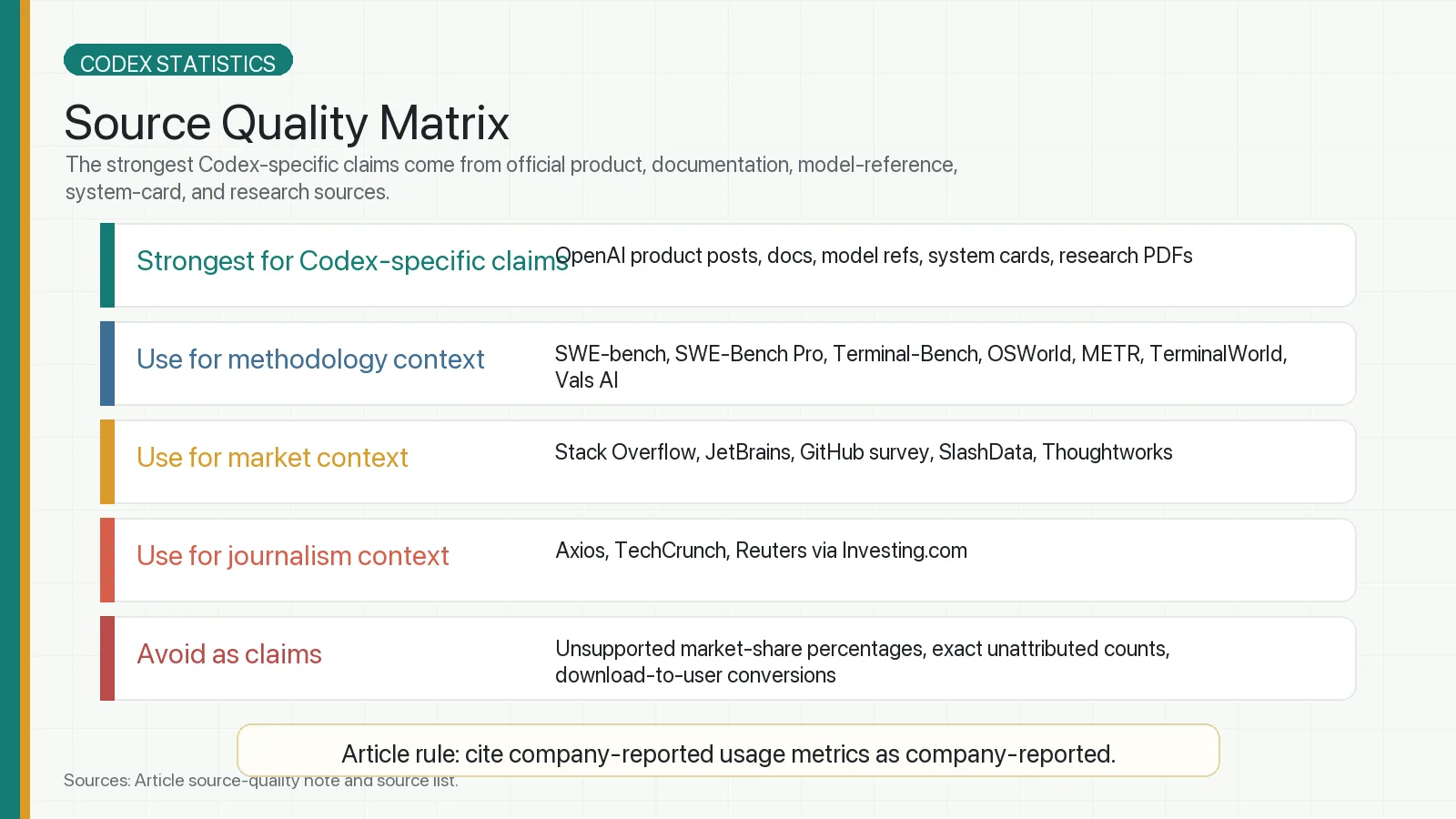
This article uses only the supplied research dossier as its factual base. The strongest Codex-specific sources are OpenAI product announcements, documentation, system cards, developer model references, and research PDFs.
Frequently Asked Questions
How many people use OpenAI Codex?
OpenAI reports that more than 5 million people use Codex weekly, and separately that more than one million developers used it in the prior month at the Codex app announcement. These are company-reported figures with different populations and time windows, and they are not monthly active users, paid seats, or market share.
What share of Codex users are non-developers?
OpenAI says non-developers are about 20% of Codex users and are growing more than 3× as fast as developers — a shift that reframes Codex from a pure developer tool toward a broader work-delegation interface.
How well does Codex score on benchmarks?
OpenAI reported GPT-5.3-Codex at 56.8% on SWE-Bench Pro Public, 77.3% on Terminal-Bench 2.0, and 64.7% on OSWorld-Verified using "xhigh" reasoning effort. These are different benchmarks measuring different things and should not be compared directly or read as production success rates.
When did OpenAI launch Codex?
OpenAI introduced Codex on May 16, 2025 as a research-preview cloud coding agent powered by codex-1, added ChatGPT Plus availability on June 3, 2025, shipped major upgrades on August 27, 2025, and launched the Codex app on February 2, 2026.
What is Codex’s context window?
The GPT-5.2-Codex model reference lists a 400,000-token context window and 128,000 max output tokens, while codex-mini-latest lists a 200,000-token context window and 100,000 max output tokens.
Does OpenAI disclose Codex revenue?
No. The dossier contains no audited or official Codex revenue figure. Usage is included with ChatGPT Plus, Pro, Business, Enterprise, and Edu with optional extra credits, but that is a packaging fact, not disclosed revenue.
Do GitHub stars or npm downloads show Codex adoption?
No. GitHub stars indicate attention and npm downloads are distribution events that can be inflated by CI systems and automation. OpenAI’s weekly-user and prior-month-developer figures are the only direct product-usage metrics in the dossier.
Sources and Further Reading
Official OpenAI Codex product sources
Documentation, model references & system cards
Benchmarks & evaluation methodology
Developer surveys, ecosystem & journalism