Cursor Statistics
Last updated on July 13, 2026

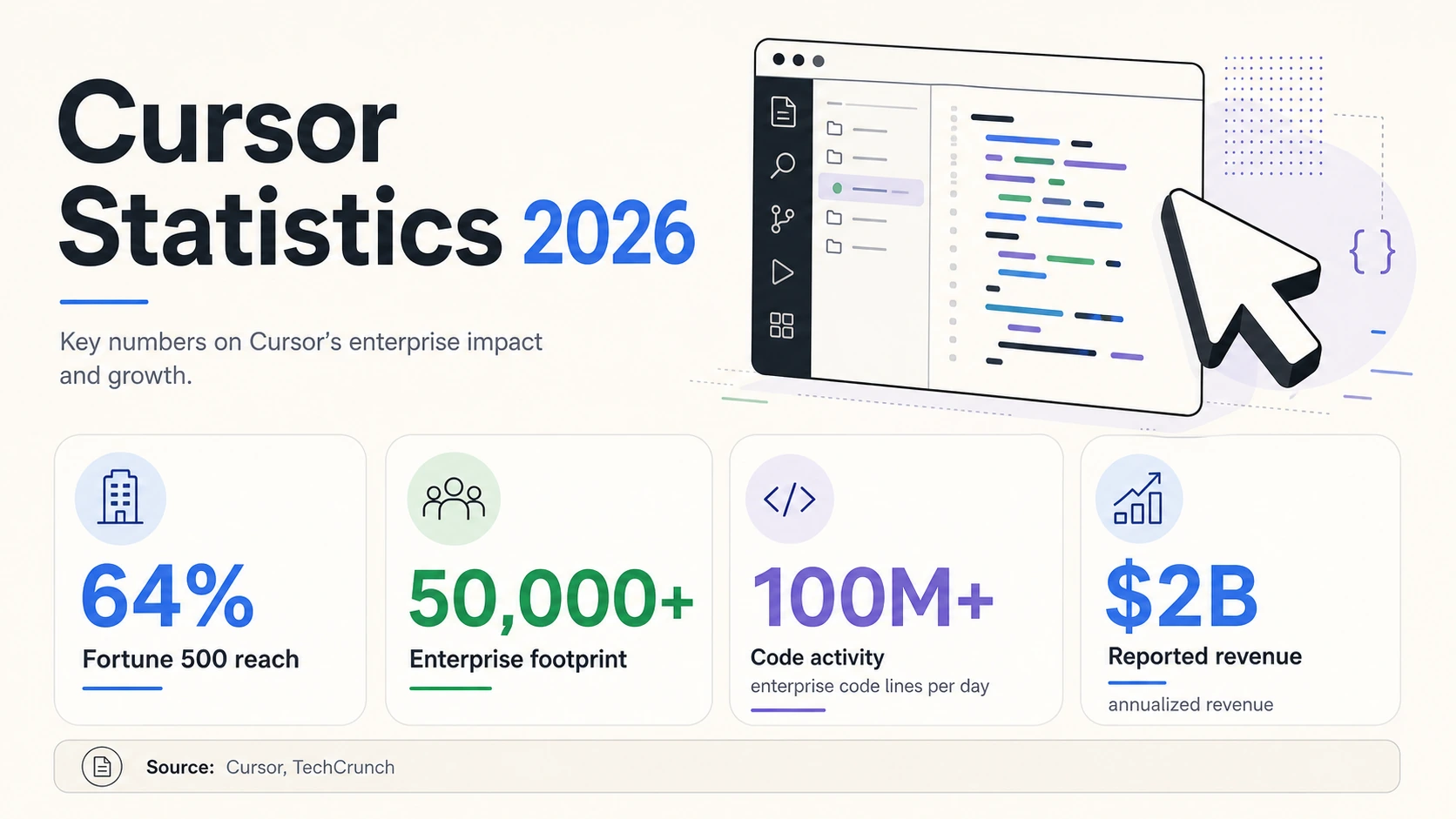
Cursor’s public numbers now look less like a small developer-tool story and more like a live test of how fast AI coding can turn into an enterprise software category. Cursor says millions of developers at ambitious companies code with it, its enterprise page claims 64% of Fortune 500 companies use it, and the same page cites 50,000+ enterprises and 100M+ lines of enterprise code written per day tied to Cursor workflows.
Those are unusually direct first-party statistics for a private AI startup. But they still need careful reading. Cursor’s official pages are strong for product, pricing, enterprise, security, and customer-surface claims. They are not the same as audited revenue, monthly active users, paid seats, churn, or market share. The most useful way to read Cursor in 2026 is as a layered metric stack: official product traction from Cursor, reported Anysphere financial momentum from outlets such as TechCrunch and The Guardian, and AI coding category context from Stack Overflow, GitHub, and GitLab.
The Most Important Cursor Statistics In 2026
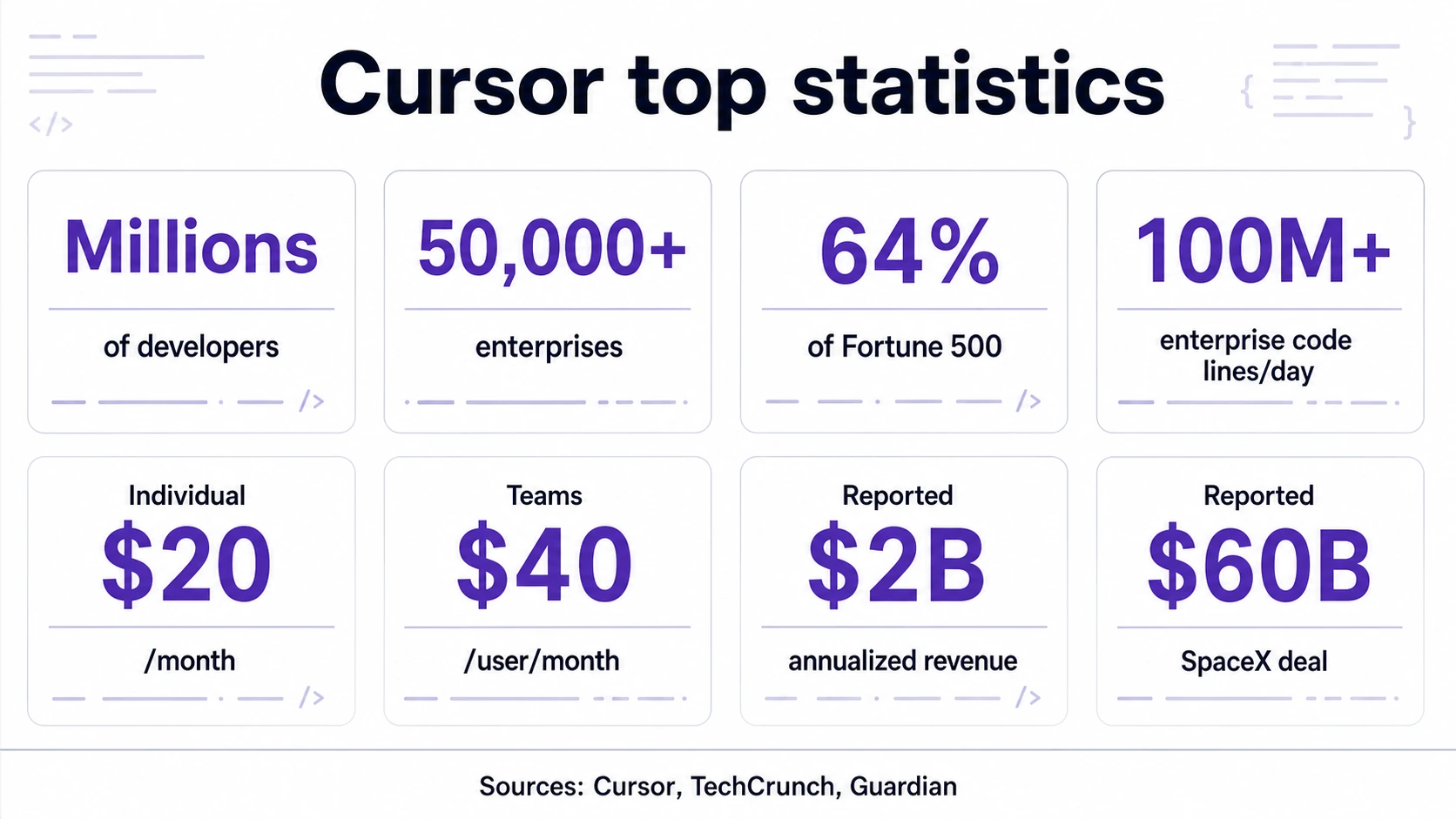
The headline Cursor figures use different denominators, so read them as separate reach, enterprise, pricing, and reported-revenue signals rather than one number.
Official product & enterprise claims (Cursor)
Reported company economics (press)
Read every number by its own denominator
Cursor's headline figures answer different questions. Tap a metric to see what it measures — and what it does not prove.
CursorThe Layers Behind Cursor’s Numbers
Cursor has three kinds of numbers in public view, and they should not be collapsed into one fake market-share story. The first layer is official product evidence: plan prices from Cursor pricing, model support from Cursor’s homepage, enterprise controls from Cursor Enterprise, and security posture from Cursor Security. These are the best sources for current product facts.
Official product evidence
Plan prices, model support, enterprise controls, and security posture straight from Cursor. The best source for current product facts — but not audited usage.
Reported company evidence
TechCrunch’s $500M ARR / $9.9B valuation and $2B annualized revenue reports, plus The Guardian’s $60B SpaceX deal. Useful for momentum; still reported private-company figures, not SEC-style audited results.
Category context
Stack Overflow’s 84% AI-use number, GitHub’s 180M+ developer platform, and GitLab’s 91% multi-tool number show why Cursor’s market exists. They do not reveal Cursor’s active users.
This distinction matters because Cursor is often discussed with proxy metrics. Website traffic, Reddit buzz, search demand, GitHub stars, social posts, and survey mentions can show attention, but none of them equals paying customers. Even official customer logos should be read narrowly: they show named relationships, not deployment depth. A Coinbase quote, an NVIDIA quote, or a Stripe quote can prove that Cursor wants those customer stories in public; it cannot prove total seat count across all customers.
Cursor Product Scale: What Is Publicly Known
The strongest current product-scale number is Cursor’s own statement that millions of developers code with Cursor. The exact wording is broad: it does not say monthly active users, weekly active users, or paid users. Still, it is more useful than traffic estimates because it comes directly from Cursor.
The enterprise page is more specific. Cursor says 64% of Fortune 500 companies use Cursor, 50,000+ enterprises choose to build with Cursor, and 100M+ lines of enterprise code are written per day with Cursor. Those are Cursor-specific first-party enterprise claims, current as of July 2026, and they should be read as vendor-disclosed reach and workflow signals rather than independently audited usage counts.
NVIDIA
40,000 engineers assisted by AI
Jensen Huang says every one of NVIDIA’s 40,000 engineers is assisted by AI and that productivity has increased — a named quote, not a seat count.
Cursor EnterpriseCoinbase
Every engineer had used Cursor
Brian Armstrong says every Coinbase engineer had utilized Cursor by February 2025 — evidence a tool crossed procurement, not renewal depth.
Cursor EnterpriseRippling
150 → 500+ engineers in weeks
Albert Strasheim says adoption grew from 150 to over 500 engineers, roughly 60% of the organization, in a few weeks.
Cursor EnterpriseHistory
Launched March 2023
Business Insider reported Cursor launched in March 2023, disclosed 40,000+ customers in 2024, and reached millions of developers by end of 2025.
Business InsiderThose quotes are valuable because they show which enterprises Cursor is willing to name publicly. They are not a denominator for all customers. A named quote can show that a tool crossed procurement, security, and cultural barriers inside a visible company. It does not tell readers how many paid seats exist at each company, whether the deployment is still expanding, or what renewal behavior looks like.
Anysphere Company Economics: Funding, Valuation, And Reported Revenue
Anysphere’s financial story has moved so quickly that every figure needs a date. In June 2025, TechCrunch reported that Anysphere had reached a $9.9B valuation and surpassed $500M ARR, citing Bloomberg and sources. The same report said Cursor’s paid paths included a $20 Pro offering and a $40 monthly business subscription, which broadly matches the current Individual $20 and Teams $40/user/month public plan surface.
Reported revenue run rate — three reported points
Each point is a reported Anysphere figure on a linear axis, so the steep rise is the story: reported annualized revenue moved from $0.5B in mid-2025 to $2B in February 2026, with a forecast of more than $6B by year-end. These are reported private-company figures, not audited GAAP revenue.
TechCrunchBy April 2026, TechCrunch reported that Cursor had reached $2B annualized revenue in February 2026 and was forecasting more than $6B annualized run rate by the end of 2026. The same report said Cursor had reached positive gross margins on large-enterprise sales while still losing money on individual developer accounts. That distinction is central: AI coding tools can grow ARR fast while still fighting model-inference cost pressure.
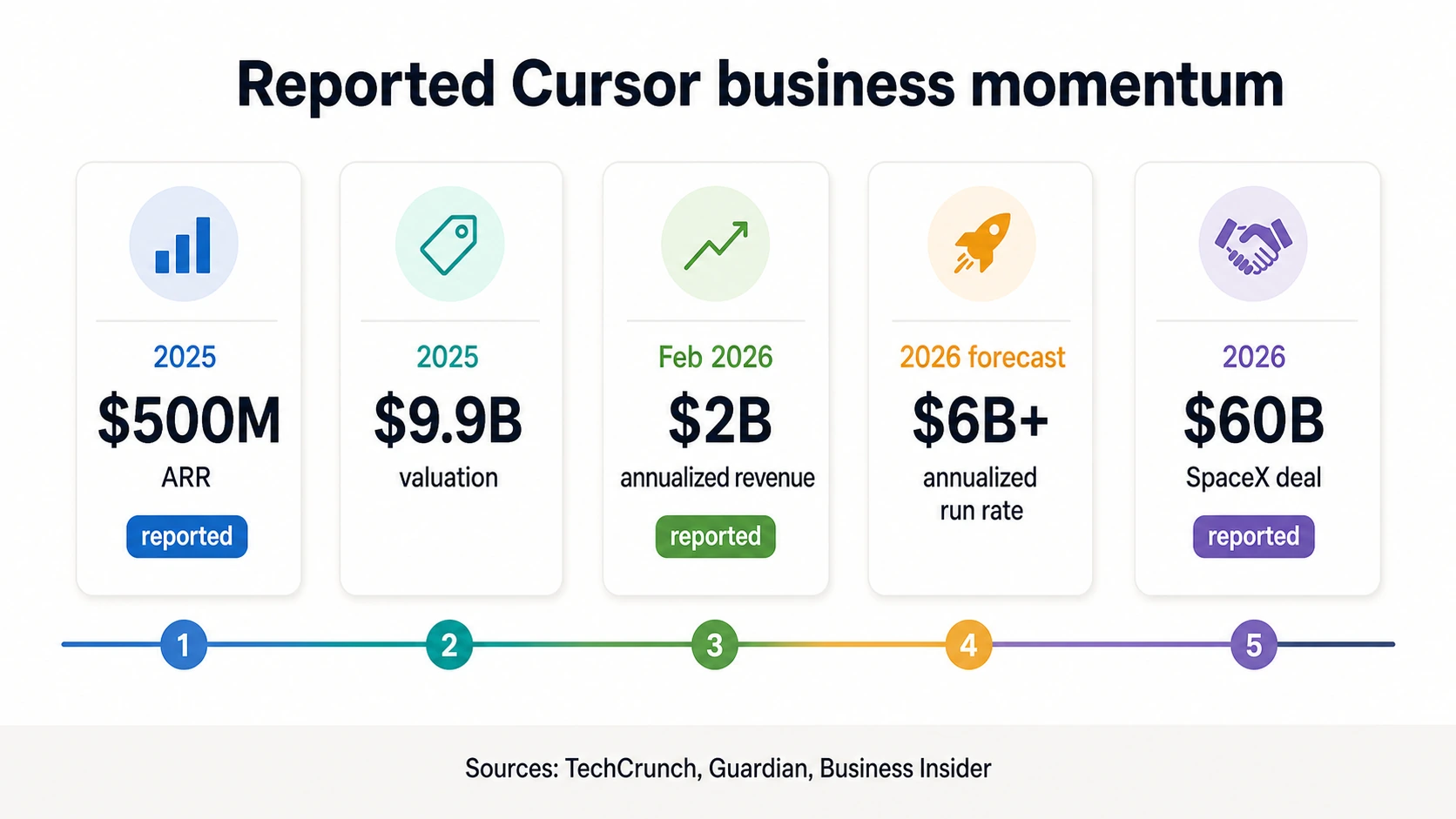
The next reported company-scale jump was the SpaceX deal. The Guardian reported, with Reuters contributing, that SpaceX agreed to buy the startup behind Cursor for $60B, that Anysphere would be paid in stock, and that the transaction was expected to close in Q3 2026. The same report says SpaceX had earlier secured an option to buy Cursor for $60B or pay for a partnership.
Pricing And Packaging: What Cursor Is Selling
Cursor’s public pricing now reveals a clear buyer ladder. Hobby is free. Individual is $20/month. Teams is $40/user/month. Enterprise is custom. That is straightforward enough for an operator to benchmark against GitHub Copilot, Claude Code, Replit, and other AI coding tools, but it is not enough to back-calculate revenue.
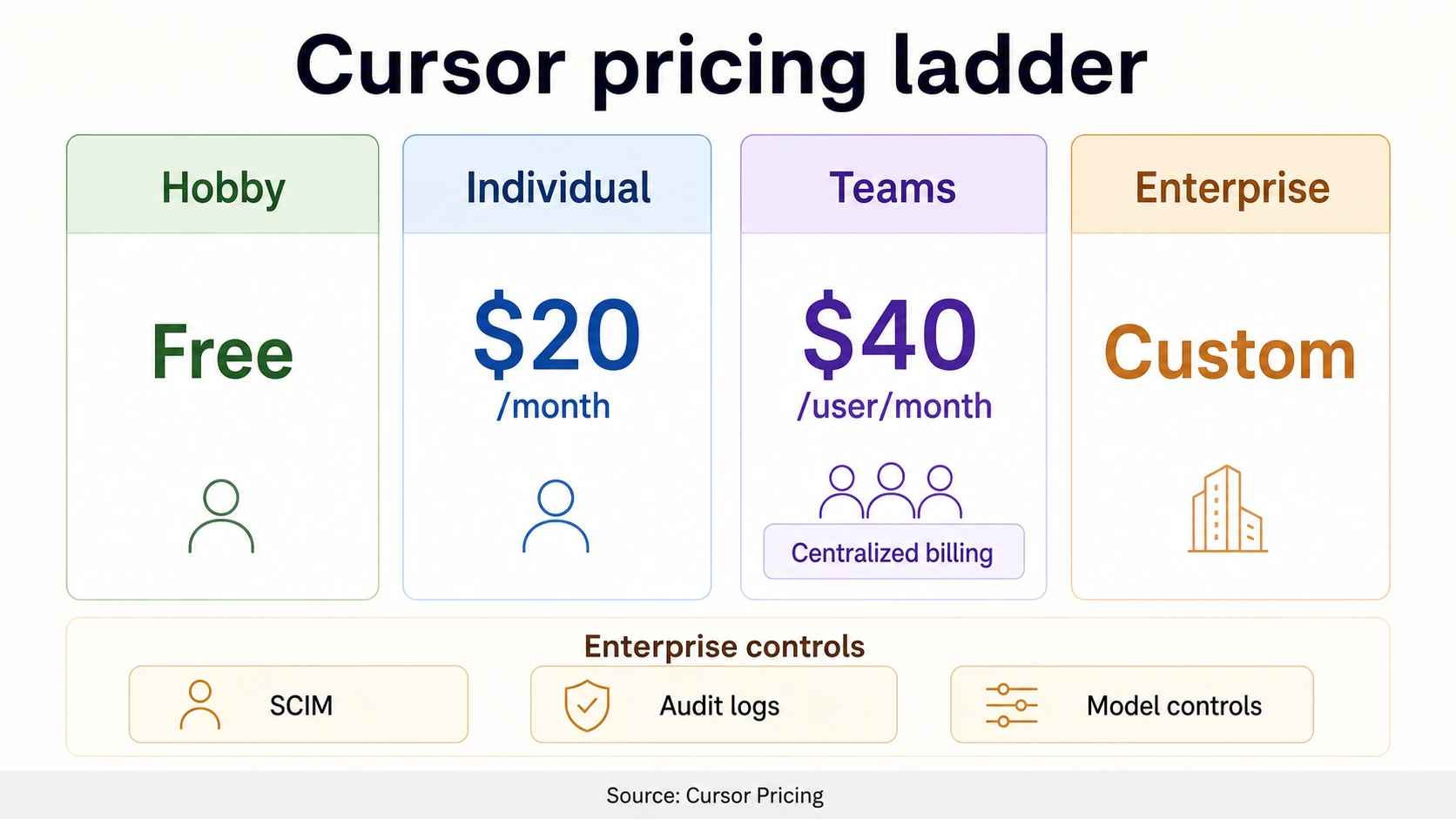
The feature ladder is more interesting than the base prices. Individual adds extended Agent limits, frontier-model access, MCPs, skills and hooks, cloud agents, and Bugbot on usage-based billing. Teams adds centralized team billing and administration, a team marketplace for rules, skills, and plugins, cloud agents and automations with shared team context, usage analytics, team-wide privacy mode, and SAML/OIDC SSO. Enterprise adds procurement and governance features individual developers do not need: pooled usage, invoice/PO billing, SCIM seat management, repository/model/MCP access controls, audit logs and service accounts, and an AI code tracking API.
For founders and technical GTM teams, the pricing surface says two things. First, Cursor is not monetizing only through individual developer enthusiasm — its official packaging is built for IT, security, procurement, and engineering management. Second, the pricing list still does not reveal consumption economics. AI coding IDEs increasingly sell seats plus usage, and model choice can change cost. That is why TechCrunch’s reported enterprise gross-margin improvement matters, but only as a reported company-economics signal, not as a customer-count statistic.
Product Surface: From AI Editor To Agent Platform
Cursor’s 2026 product story is model optionality plus workflow depth. The homepage says users can choose between OpenAI, Anthropic, Gemini, xAI, and Cursor models. The CLI page shows model-selection examples such as Composer 2.5, Opus 4.8, GPT-5.5 High Fast, Gemini 3.1 Pro, and Grok 4.3. That is a product-positioning advantage: Cursor can sit above model labs while routing work to different models.
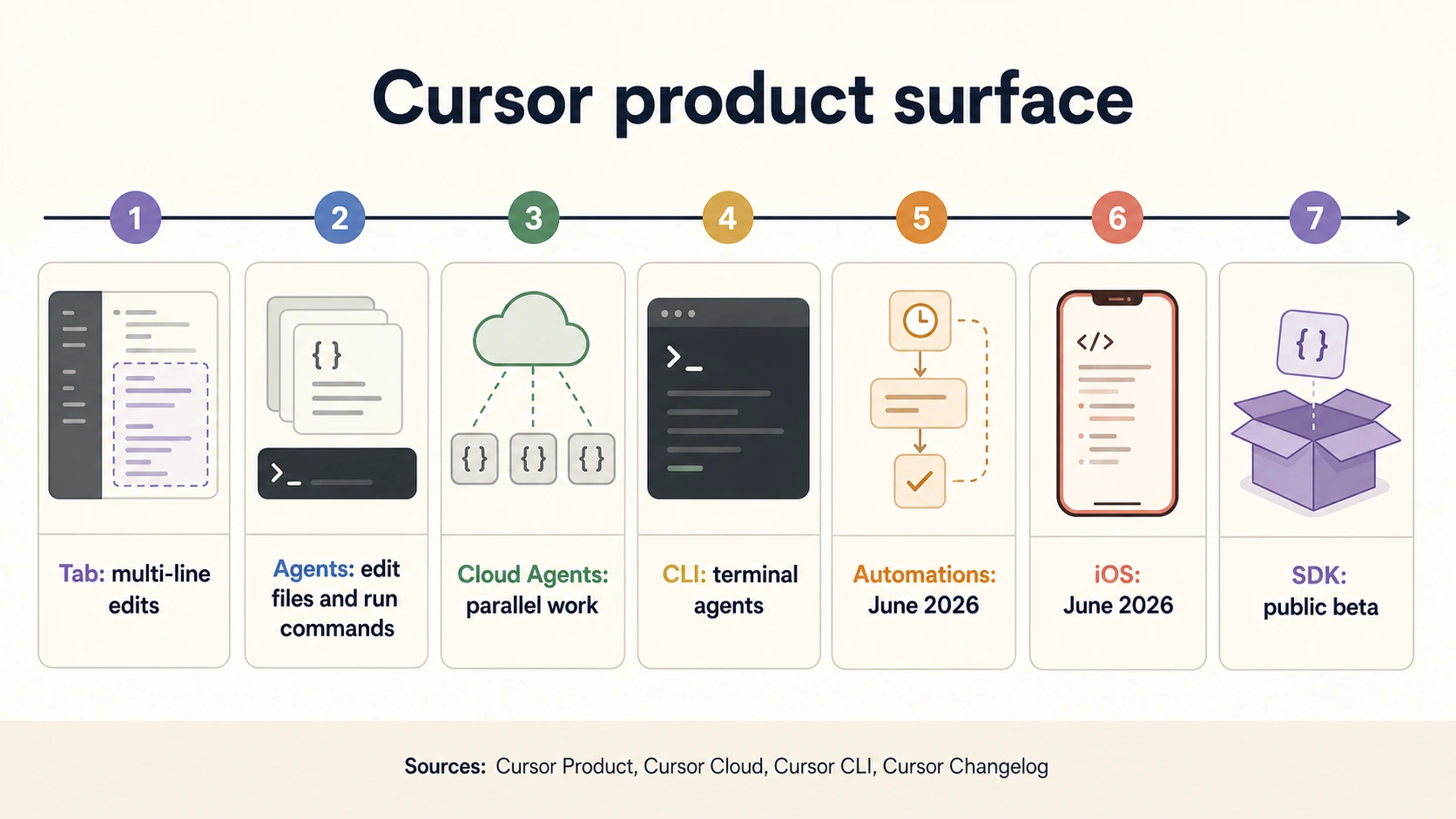
At the same time, Cursor is building in-house model leverage. Composer 2.5 is available in Cursor, built on Moonshot’s Kimi K2.5, and trained with 25x more synthetic tasks than Composer 2. Cursor also says it is working with SpaceXAI on a larger model using 10x more total compute, while a separate post says the SpaceX partnership gives access to xAI’s Colossus infrastructure for model training via the SpaceX partnership.
The product surface has expanded well beyond autocomplete. Cursor Tab supports multi-line changes and cross-file jumps, sees in-session context and recent changes, and uses a proprietary model built exclusively for Cursor. Cursor’s product page says agents can edit files, run terminal commands, search the web, and debug with execution data. Cursor Cloud says cloud agents can control their own computers and be launched from desktop and mobile.
Cursor Tab
Multi-line changes and cross-file jumps, in-session context, and a proprietary model built exclusively for Cursor.
Agents
Edit files, run terminal commands, search the web, and debug with execution data — inside the editor.
Cloud Agents
Run in isolated VMs, control their own computers, produce merge-ready PRs, and launch from web, mobile, desktop, Slack, and GitHub.
CLI & Automations
Model-selectable terminal agents plus June 2026 automations and a team marketplace on the changelog.
SDK
The Cursor SDK lets teams build agents with Cursor’s runtime, harness, and models.
The timeline also points toward agentic software development rather than just inline suggestions. Cursor’s February 2026 post says cloud agents can produce merge-ready PRs, be controlled through a remote desktop, and that more than 30% of Cursor’s own internal merged PRs are now created by agents in cloud sandboxes. Its self-hosted cloud-agent post says agents can run in isolated virtual machines and keep code and tool execution in customer infrastructure. Its SDK post says the Cursor SDK lets teams build agents with Cursor’s runtime, harness, and models. Changelog frequency is not customer adoption, but Cursor’s changelog and blog are useful evidence that it is shipping across editor, cloud, mobile, enterprise, and model surfaces at once.
Enterprise Readiness: Privacy, Security, And Governance
Cursor’s enterprise statistics become more believable when read next to its governance surface. The enterprise page says Cursor supports SAML-based SSO, SCIM user provisioning, centralized security controls, model/MCP/agent rule configuration, audit logs, and AI code tracking. That is the control plane enterprises need when AI coding tools move from experiments to daily workflows.
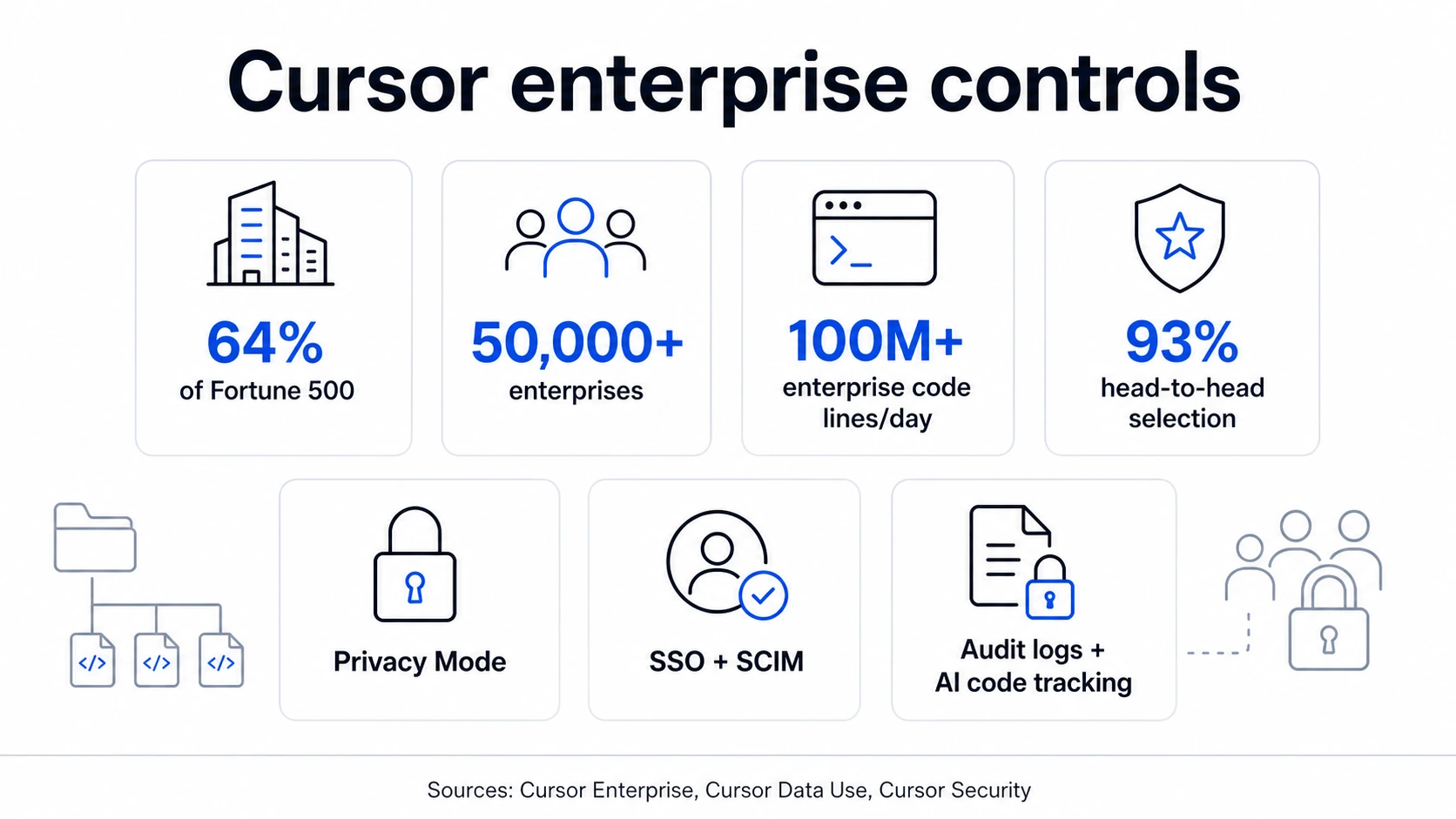
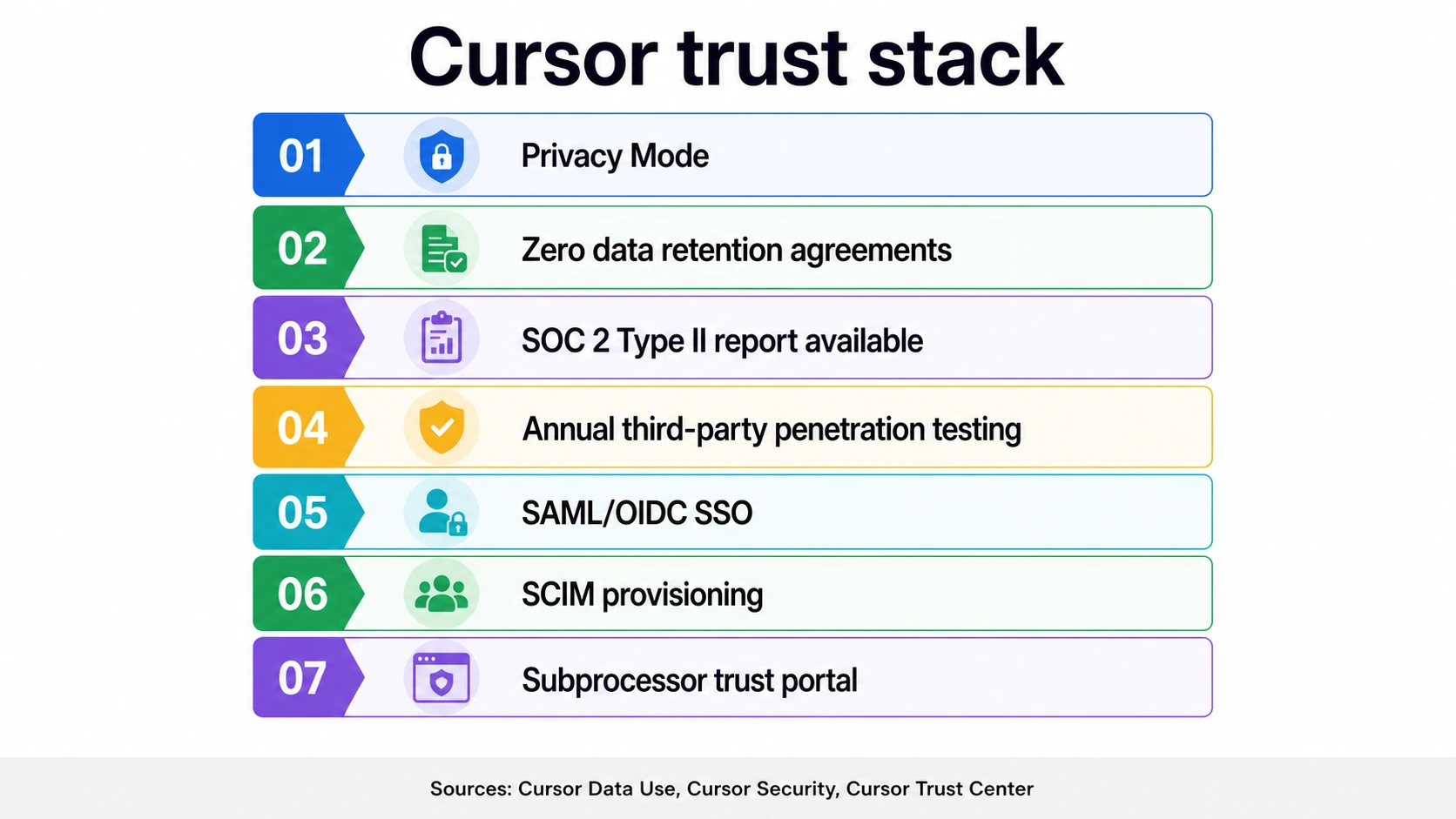
Privacy Mode is especially important. Cursor’s Data Use page says that when Privacy Mode is enabled, Customer Data is not used for training by Cursor, and Cursor maintains zero data retention agreements with all model providers. It also says model providers will not store or train on the data under that mode. The same page includes a real caveat: risk classifiers may run, abuse-triggered data can be retained for investigation, and non-ZDR models may be marked or require admin opt-in.
Security posture is also publicly documented. Cursor’s security page says a SOC 2 Type II attestation report is available on request, that Cursor commits to at-least-annual third-party penetration testing, and that subprocessors are published through its trust portal. It also says Cursor uses least-privilege infrastructure access and enforces MFA.
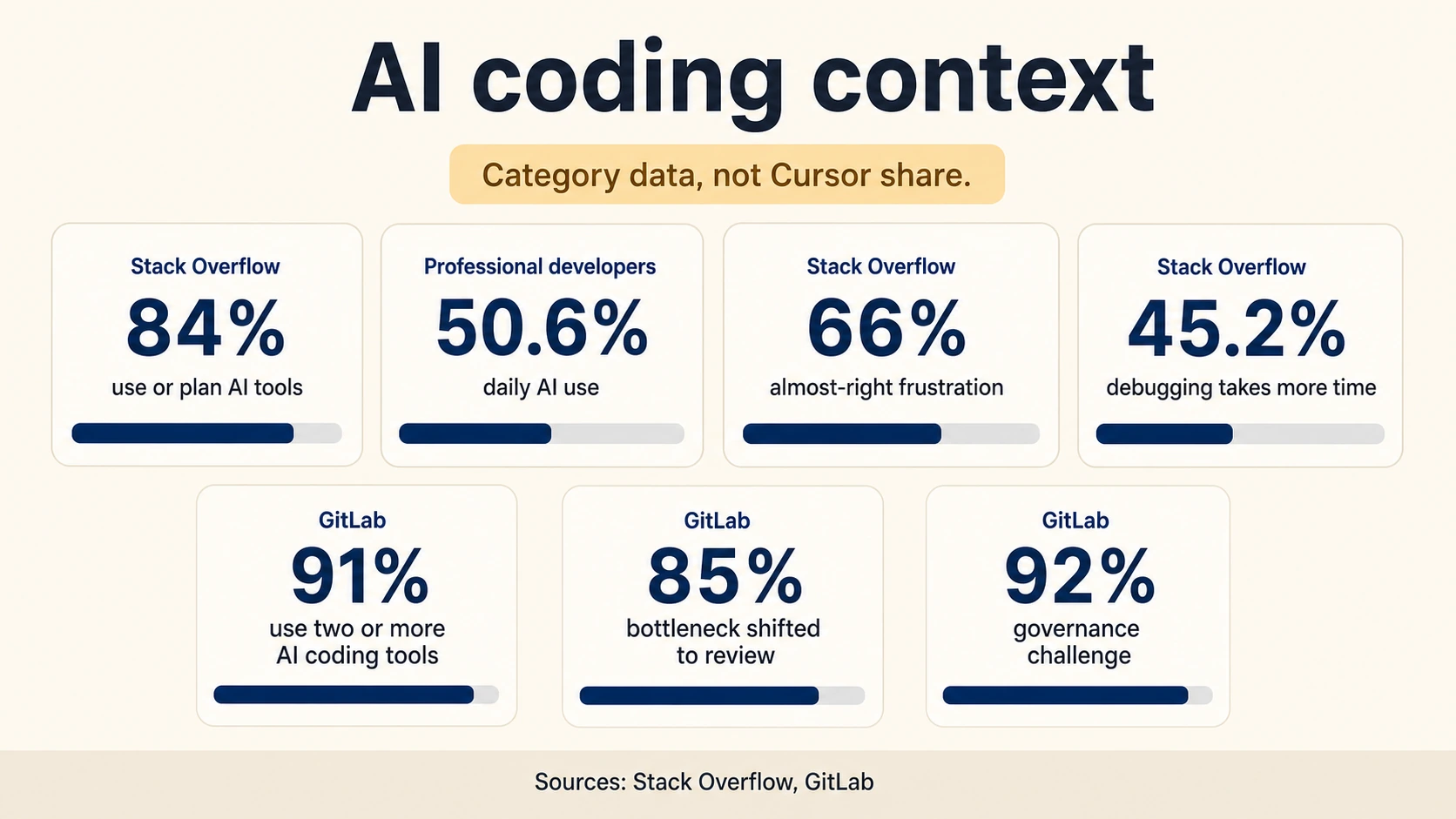
The broader category explains why these controls are not cosmetic. GitLab’s 2026 survey says 80% of organizations adopted AI tools faster than they developed policies to govern them, 43% cannot reliably distinguish AI-generated code from human-written code in their own codebase, and 85% agree AI has shifted the bottleneck from writing code to reviewing and validating it. That makes Cursor’s enterprise controls a commercial signal: teams may start with a developer who loves the editor, but enterprise renewal depends on governance — who can use which model, where agents can run, which repositories are allowed, and whether generated code can be tracked.
Cursor In The AI Coding IDE And Editor Market
Cursor’s market context is huge, but the denominator is not Cursor-specific. Stack Overflow’s 2025 Developer Survey says 84% of respondents use or plan to use AI tools in development, and 50.6% of professional developers use AI tools daily. That confirms AI coding is mainstream among survey respondents. It does not tell readers what share use Cursor.
Stack Overflow also shows the adoption tension. It says positive sentiment toward AI tools fell to around 60% in 2025, and its main survey page says 66% cite AI solutions that are “almost right” as the top frustration, while 45.2% say debugging AI-generated code is more time-consuming. Cursor’s emphasis on codebase context, debugging, and agent review fits that problem, but Stack Overflow’s numbers belong to the broader developer population.
The editor angle is especially relevant. Stack Overflow’s technology section says newer AI-enabled editors such as Claude Code and Cursor are attracting interest from developers already using VS Code. That matters because Cursor is not merely a chat app: it occupies the place where files, terminal commands, version control, tests, and code-review decisions happen. JetBrains’ 2025 ecosystem survey is another reminder about denominator discipline: JetBrains reports 24,534 developers after data cleaning and notes possible response bias. When a Cursor-related number lacks sample, timing, or methodology, it deserves more caution than a transparent survey table.
Demand Signals And Proxies
Cursor has enough official adoption and product data that weak proxies do not need to carry the story. Traffic estimates, search trends, Reddit posts, and social clips can show attention, but they are weak candidates for headline evidence unless the source and methodology are strong. A traffic estimate is not a user count. Search demand is not paid adoption. Social excitement is not retention.
The strongest demand proxy is the shape of Cursor’s own hiring and product surface. Its careers page lists roles across sales, customer success, user operations, marketing, engineering, revenue operations, design, solutions, and finance, including international sales and field-engineering roles across ANZ, APJ, Japan, EMEA, London, Singapore, New York, and San Francisco. Hiring pages still do not prove revenue, but they show the company is staffing GTM and enterprise-deployment functions.
Cursor’s acquisition of Graphite is also a product-expansion signal. Cursor said Graphite had built a code-review platform used by hundreds of thousands of engineers and had entered a definitive agreement to be acquired. That number belongs to Graphite’s pre-acquisition code-review platform, not Cursor’s total users. The more important point is strategic: Cursor is expanding from code generation into review and collaboration.
How Cursor Compares In The AI Coding Market
Cursor competes in several layers at once. Against GitHub Copilot, it has to win inside the developer workflow GitHub already owns. Against Claude Code and Codex, it has to prove that an AI-first IDE/editor can be more useful than a model-native coding agent. Against JetBrains AI, Replit, Windsurf/Codeium, and open-source assistants, it has to justify enterprise pricing, governance, and switching effort.
Where Cursor sits in the stack
Cursor Tab lives in the edit loop, Cloud Agents run work in parallel, and the CLI brings agents to terminals — a full workflow, not completions inside someone else’s IDE.
Cursor can route to OpenAI, Anthropic, Gemini, xAI, and Cursor models while investing in Composer 2.5 and SpaceXAI training infrastructure. Optionality, but also strategic risk if model labs compete directly.
Enterprise controls govern how teams use models, repos, MCPs, browser access, network access, and generated code — the layer where renewal actually gets decided.
TechCrunch reported Cursor ran at negative gross margins until recently due to third-party models, then moved toward profitability in some segments using Composer plus cheaper models. A key business statistic, not a user statistic.
Cursor competes on product location, model routing, and enterprise governance at the same time. Tap a layer to see the Cursor-specific difference — and the strategic risk that comes with it.
CursorThe clearest Cursor-specific difference is product location. Cursor’s Tab lives in the edit loop, its Cloud Agents run work in parallel, its CLI brings agents to terminals, and its enterprise controls govern how teams use models, repos, MCPs, browser access, network access, and generated code. Reported gross-margin pressure shows why this matters: TechCrunch reported Cursor had operated at negative gross margins until recently because of reliance on third-party models, and that Composer plus less expensive models helped it move toward profitability in some segments.
What This Means For Founders, Operators, And Engineering Leaders
For founders, Cursor’s numbers show that the application layer can still create enormous value on top of foundation models. Cursor’s reported $500M ARR in 2025, reported $2B annualized revenue in early 2026, official 64% Fortune 500 claim, and reported $60B SpaceX deal all point to one lesson: workflow ownership can matter as much as model ownership.
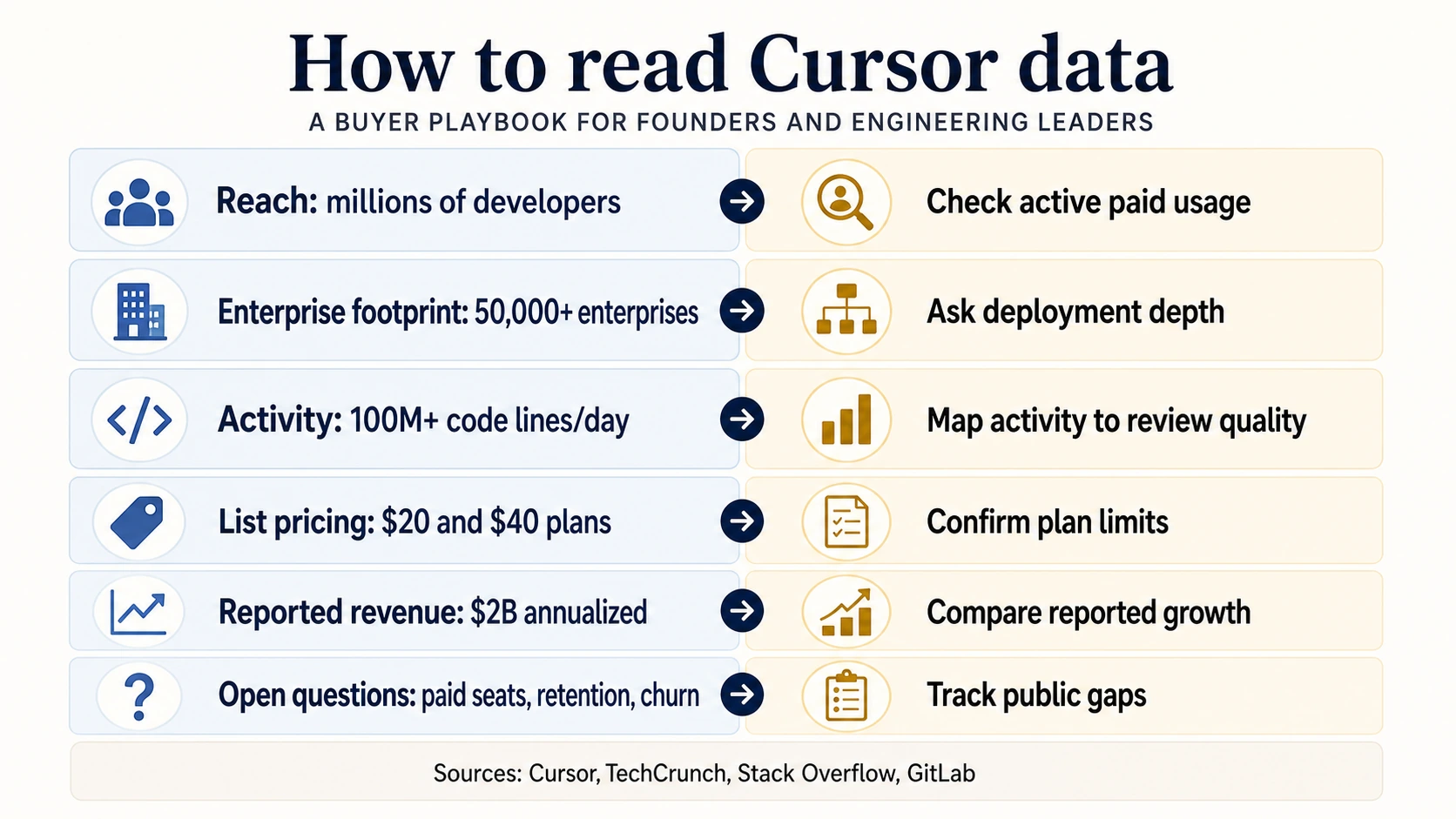
For GTM teams, the denominator map matters. “Millions of developers” from Cursor Careers, “50,000+ enterprises” from Cursor Enterprise, and “$2B annualized revenue” from TechCrunch are all strong, but they answer different questions. Use developer count for reach, enterprise count for organization breadth, and reported revenue for business momentum. Do not blend them into a fake paid-seat estimate.
Reach view
Millions of developers
Use it for top-of-funnel reach — not as a monthly-active-user or paid-seat number.
CursorBreadth view
50,000+ enterprises, 64% Fortune 500
Use it for organization breadth — how many companies have a relationship, not deployment depth per company.
CursorMomentum view
Reported $2B annualized revenue
Use it for business momentum — a reported private-company figure, not audited GAAP revenue or paid-seat count.
TechCrunchOpen questions
Seats, retention, churn
The numbers Cursor does not publish — paid-seat count, retention, and churn — are exactly the ones a buyer still has to test.
CursorFor engineering leaders, the sharper lesson is that AI coding tools are becoming managed infrastructure. A team can start with Individual $20/month, but scaled deployment quickly runs into SAML/OIDC SSO, SCIM, model controls, audit logs, AI code tracking, privacy mode, and self-hosted cloud agents. For AI-tool buyers, the category context says adoption is no longer the hard part — Stack Overflow says 84% use or plan AI tools and GitLab says 91% of organizations run two or more AI coding tools. The hard part is control, traceability, model policy, and quality, which is exactly where Cursor’s enterprise pages now spend much of their energy.
What To Watch Through The Rest Of 2026
The first thing to watch is whether Cursor’s official enterprise numbers get more granular. A move from 64% of Fortune 500, 50,000+ enterprises, or 100M+ enterprise code lines per day to a disclosed active-user or paid-seat number would materially improve the public picture. The second is pricing and usage packaging: changes to usage pools, premium model access, cloud-agent pricing, or enterprise usage commitments would say a lot about model-cost pressure and enterprise demand.
The third is model independence. Cursor’s Composer 2.5, SpaceX model-training partnership, and reported SpaceX acquisition all point toward deeper control over model economics — the open question is whether Cursor stays an attractive neutral routing layer for OpenAI, Anthropic, Gemini, xAI, and Cursor models while building its own. The fourth is governance: GitLab’s survey says 85% agree AI shifted the bottleneck from writing code to reviewing and validating it, and Cursor’s response is a combination of Bugbot, AI code tracking, enterprise controls, self-hosted agents, and code-review expansion through Graphite.
Frequently Asked Questions
How many developers and companies use Cursor?
Cursor says millions of developers code with it and that 50,000+ enterprises build with Cursor, including 64% of Fortune 500 companies. These are official Cursor claims for reach and organization breadth, not monthly-active-user counts or paid-seat numbers.
How much revenue does Cursor (Anysphere) make?
TechCrunch reported Cursor reached $2 billion in annualized revenue in February 2026 and was forecasting more than $6 billion annualized run rate by year-end, after surpassing $500 million ARR in mid-2025. These are reported private-company figures, not audited GAAP revenue.
What is Cursor worth in 2026?
TechCrunch reported a $9.9 billion valuation for Anysphere in June 2025, and The Guardian reported that SpaceX agreed to buy the startup behind Cursor for $60 billion, with the deal expected to close in Q3 2026. Both are reported figures, not audited or completed public transactions.
How much does Cursor cost?
Per Cursor pricing, Hobby is free, Individual is $20 per month, Teams is $40 per user per month, and Enterprise is custom, with usage-based billing layered on top. List prices explain packaging, not realized revenue per user.
Is Cursor safe and enterprise-ready?
Cursor says Privacy Mode means Customer Data is not used for training by Cursor and that it maintains zero data retention agreements with all model providers, while its security page says a SOC 2 Type II report is available on request and it commits to at-least-annual third-party penetration testing. The Data Use page also notes exceptions for risk classifiers and abuse investigation.
What models can Cursor use?
Cursor says users can choose between OpenAI, Anthropic, Gemini, xAI, and Cursor models, with CLI examples including Composer 2.5, Opus 4.8, GPT-5.5 High Fast, Gemini 3.1 Pro, and Grok 4.3. Cursor also builds its own Composer models, with Composer 2.5 built on Moonshot's Kimi K2.5.
Does Cursor publish a monthly active user number?
No. Cursor does not publish a single monthly-active-user or paid-seat count. Its public statistics are reach, enterprise, code-activity, pricing, and preference metrics, while revenue and valuation come from press reports — each with its own denominator.
What share of the AI coding market does Cursor have?
There is no official Cursor market-share figure. Category surveys give context — Stack Overflow says 84% of respondents use or plan to use AI tools and GitLab says 91% of organizations run two or more AI coding tools — but those denominators belong to the whole developer population, not Cursor.
Sources and Further Reading
Official Cursor product, pricing & enterprise
Cursor blog & changelog
Reported company economics (press)