GitHub Copilot Statistics
Last updated on July 15, 2026

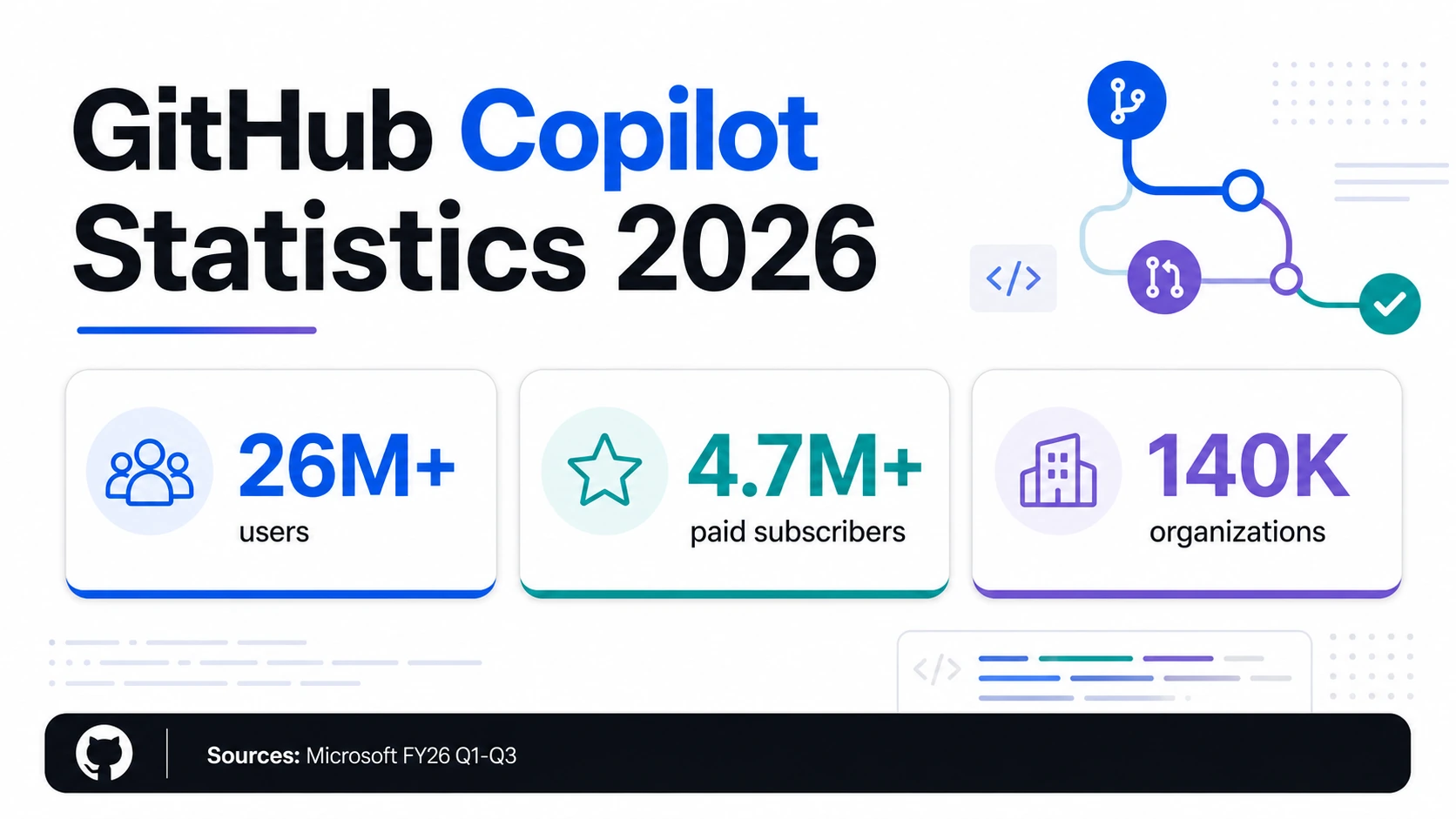
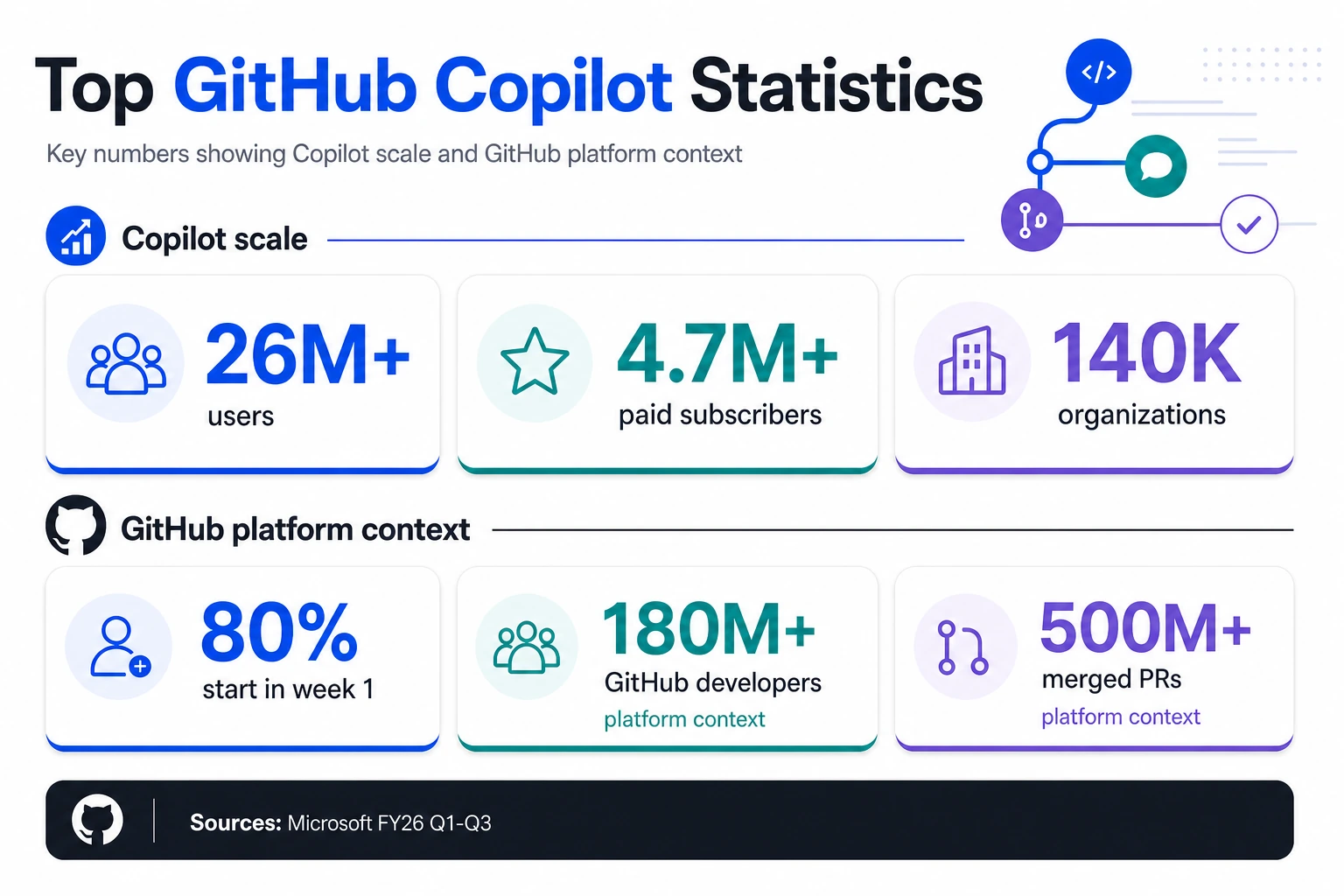
GitHub Copilot is one of the few AI coding products with public numbers at three useful levels: broad users, paid subscribers, and organizations. Microsoft said Copilot had over 26 million users in FY26 Q1, over 4.7 million paid subscribers in FY26 Q2, and nearly 140,000 organizations using Copilot in FY26 Q3.
Those numbers make Copilot the cleanest public commercial anchor in AI coding, but they also create an easy trap. A Copilot user is not automatically a monthly active user. A paid subscriber is not an organization. An organization count does not reveal how many developers use Copilot daily. GitHub’s over 180 million developers and over 500 million merged pull requests are powerful distribution context, but they are GitHub platform metrics, not Copilot usage metrics.
The real 2026 story is that Copilot has moved from AI pair programmer to developer workflow layer. It now spans IDE completions, chat, pull requests, code review, CLI, cloud agent, Agent HQ, third-party agents, model choice, MCP, usage telemetry, and usage-based billing. That makes Copilot statistics useful only when the denominator is clear.
GitHub Copilot At Scale
The headline Copilot numbers use different denominators, so read them as separate user, subscriber, and organization signals rather than one figure.
Copilot scale (Microsoft investor updates)
Platform context, onboarding & CLI
Read every number by its own denominator
Copilot's headline figures answer different questions. Tap a metric to see what it measures — and what it does not prove.
Microsoft FY26 Q1–Q3The Three Numbers That Get Confused
The safest way to read GitHub Copilot statistics is as a ladder. At the top is Microsoft’s over 26 million users claim, which is the broadest public Copilot scale signal. That number should be quoted as a company-reported user figure, not as monthly active users, daily active users, or paid users unless Microsoft defines it that way. A GitHub spokesperson previously clarified to TechCrunch that an earlier 20 million Copilot figure referred to all-time users, which is a useful reminder to keep user wording conservative.
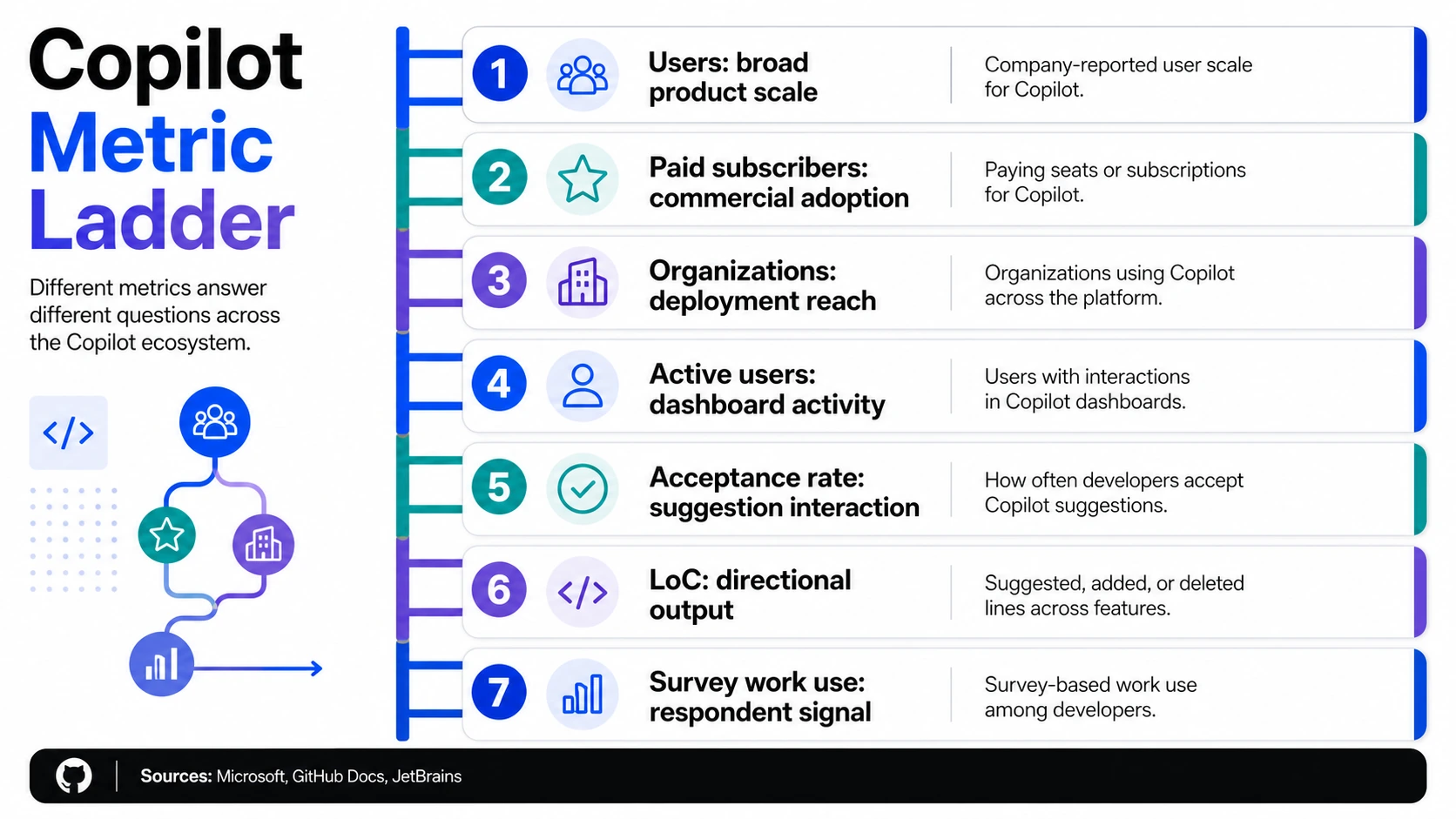
The next rung is paid adoption. Microsoft’s over 4.7 million paid Copilot subscribers is more commercially meaningful than broad user scale because it reflects paying seats or subscriptions, and Microsoft also gave a 75% year-over-year growth rate. But paid subscribers still do not reveal daily active use, accepted suggestions, pull-request outcomes, security impact, or team-level value.
Organization reach sits on another rung. Microsoft’s nearly 140,000 organizations figure shows that Copilot is widely deployed across organizational accounts, and the same FY26 Q3 call said enterprise subscribers nearly tripled year over year. That is not the same as 140,000 enterprise customers with the same deployment depth. One organization may have a small pilot; another may have tens of thousands of developers.
Internal usage metrics are a different category. GitHub’s own usage-metrics docs group Copilot metrics into adoption, engagement, acceptance rate, lines of code, and pull request lifecycle metrics. In the reconciliation docs, a user is considered active if the user-initiated interaction count is greater than zero, and code-completion acceptance rate is accepted code activity divided by generated code activity.
That definition is valuable because it prevents sloppy claims. Copilot active users inside an enterprise dashboard are not the same thing as Microsoft’s public 26 million user figure. Acceptance rate is not productivity. Lines of code are directional output, not reviewed and shipped software; GitHub’s LoC docs explicitly frame those metrics as a directional measure of suggested, added, and deleted lines across completions, chat, and agent features.
Survey adoption belongs on yet another rung. JetBrains says 29% of professional developers in its January 2026 survey used GitHub Copilot at work, while Stack Overflow says 50.6% of professional developers used AI tools daily. Those are useful workflow signals, but survey adoption is not Copilot market share and should not be blended with Microsoft’s product telemetry.
Copilot Scale: Users, Paid Subscribers, And Organizations
GitHub Copilot’s scale story starts with Microsoft’s FY26 Q1 claim: Copilot was “the most popular AI pair programmer” and had over 26 million users. That is a large public number for a named AI coding product. It is also broader than a paid metric, which is why careful wording matters. Treat it as company-reported user scale unless a later Microsoft or GitHub source defines it as active use.
The broad-user figure has moved up over time. In July 2025, a GitHub spokesperson told TechCrunch that Copilot had crossed 20 million all-time users; by the FY26 Q1 call Microsoft was citing over 26 million users. Both are broad-reach numbers, not active or paid counts, so the trend is a scale signal rather than an engagement one.
Broad Copilot user scale over time
Both points are company-reported broad-reach figures on a linear axis from zero — the July 2025 20M all-time count TechCrunch attributed to a GitHub spokesperson, and Microsoft's over-26M user figure in the FY26 Q1 call. Neither is a monthly-active or paid metric.
TechCrunch; Microsoft FY26 Q1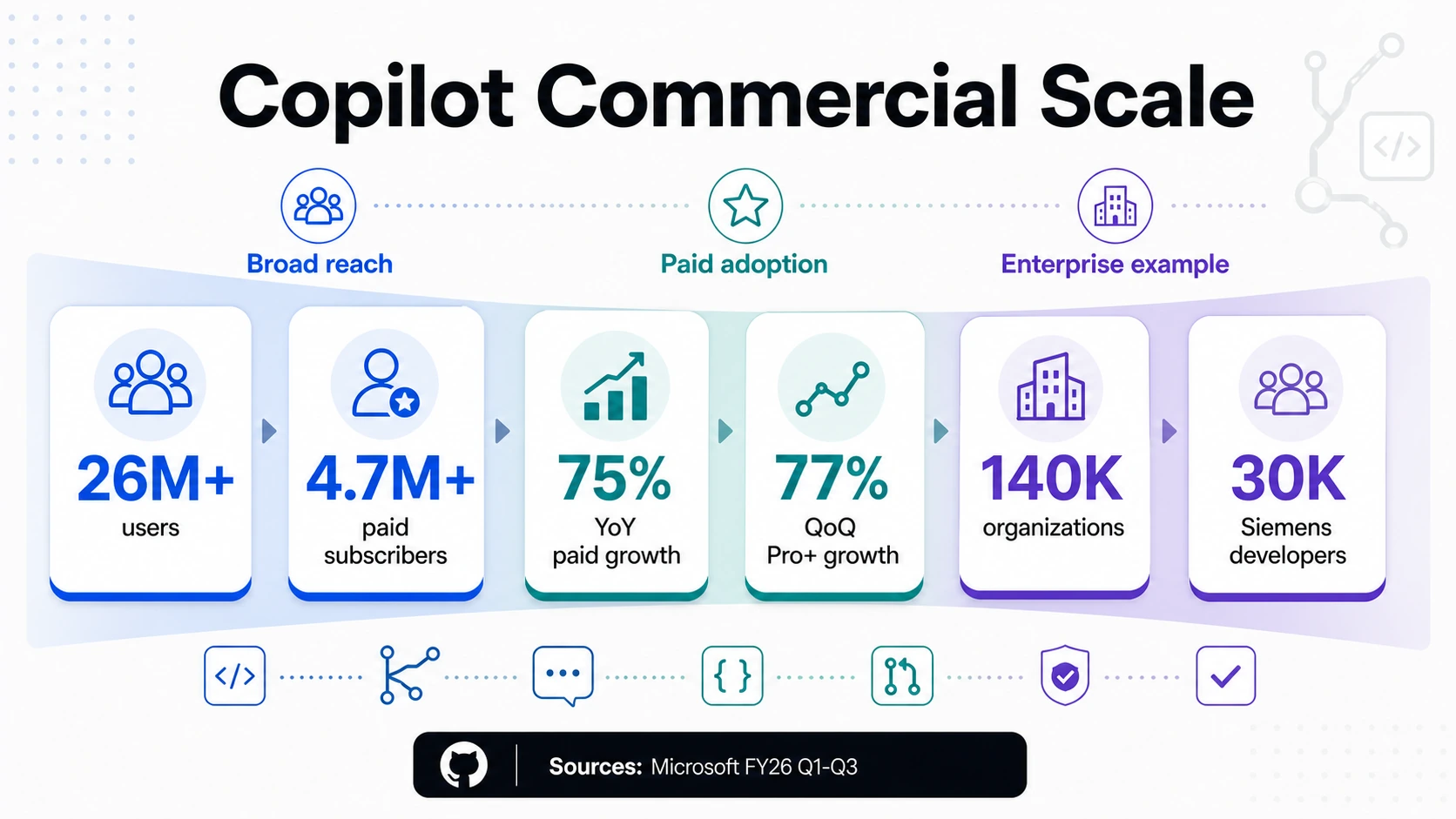
The paid metric is cleaner. In FY26 Q2, Microsoft said GitHub Copilot had over 4.7 million paid subscribers, up 75% year over year (Microsoft FY26 Q2). Microsoft also said Copilot Pro+ subscriptions for individual developers rose 77% quarter over quarter, showing growth in higher-usage individual tiers, not only enterprise procurement.
The organization metric shows how far Copilot has spread into teams. In FY26 Q3, Microsoft said nearly 140,000 organizations used GitHub Copilot and that enterprise subscribers had nearly tripled year over year. That is the best public proof that Copilot is not merely an individual developer add-on. It has become an organization-level software purchase.
Still, the organization count needs a caveat. It does not tell whether an organization has five seats or 50,000 seats. It does not disclose active use, accepted code, or production outcomes. It also should not be rewritten as “customers” unless the source uses that exact customer denominator. “Organizations using Copilot” is strong enough without inflating it.
Named enterprise examples help ground the scale. Microsoft said Siemens went all in on GitHub after a successful Copilot rollout to 30,000 developers. Microsoft also said tens of thousands of AMD developers used Copilot and accepted hundreds of thousands of lines of code suggestions each month (Microsoft FY26 Q1). These are useful proof points, but they are named cases, not averages across the 140,000 organizations.
Use for broad product reach.
The FY26 Q1 user figure is the widest public scale signal — company-reported, not an active-user count.
Use for commercial adoption.
The FY26 Q2 paid-subscriber figure reflects paying seats or subscriptions, up 75% year over year.
Use for organizational reach.
The FY26 Q3 organization figure shows deployment breadth across accounts, not deployment depth.
GitHub Platform Context: Developers, Pull Requests, And Distribution
Copilot’s distribution advantage comes from GitHub’s platform base. Microsoft said GitHub had over 180 million developers, was growing at the fastest rate in its history, and was adding a developer every second. That is not a Copilot user count, but it does explain why Copilot can reach developers through GitHub accounts, repositories, pull requests, Actions, issues, and IDE integrations.
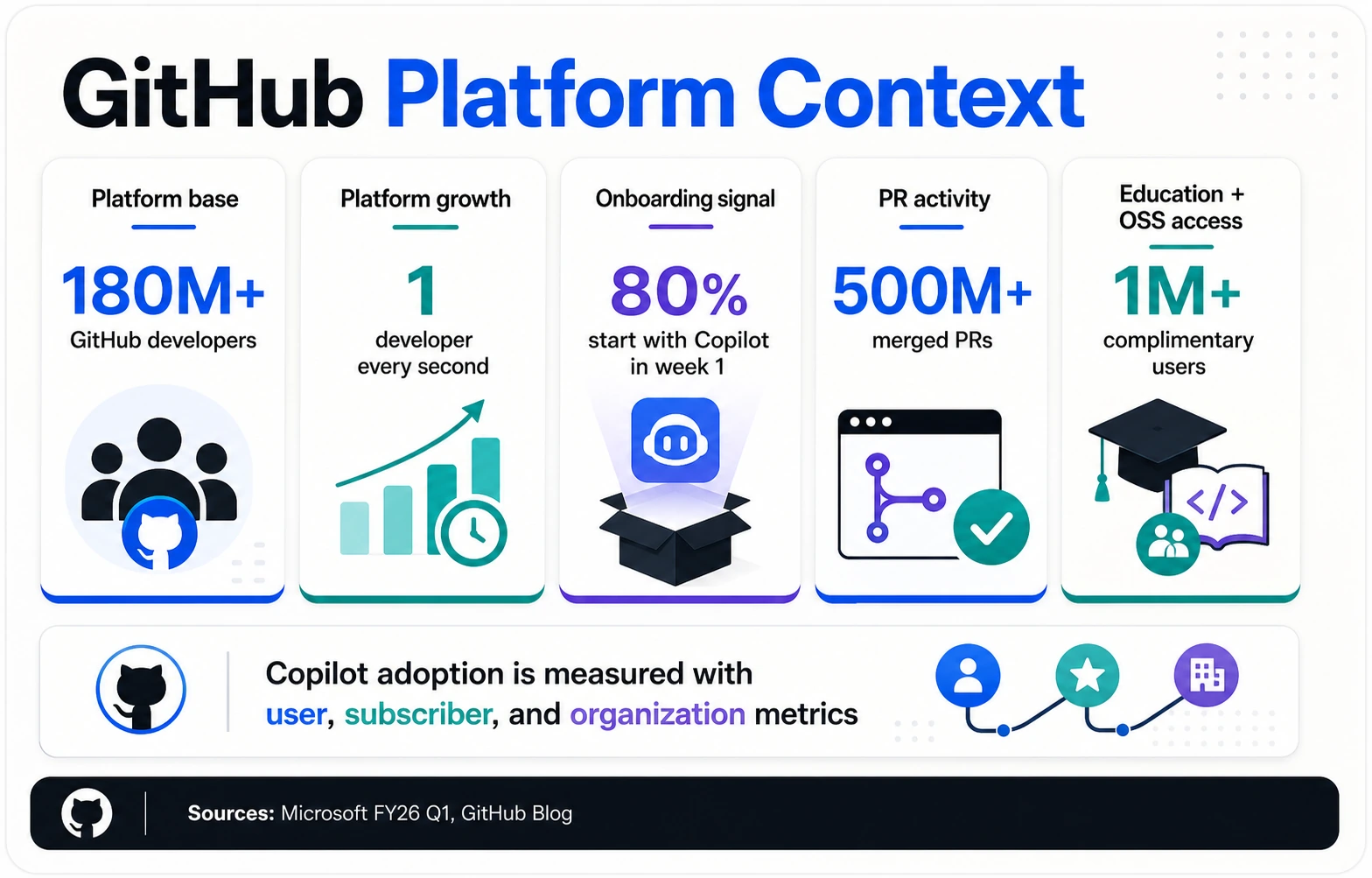
The most interesting onboarding statistic is Microsoft’s claim that 80% of new developers on GitHub start with Copilot within their first week. That is a distribution and activation signal. It says Copilot is embedded early in the GitHub journey. It does not say how many of those developers become retained active users or paid subscribers.
Pull-request activity is another useful denominator. Microsoft said over 500 million pull requests were merged on GitHub over the previous year as AI coding agents drove record usage. That number matters because Copilot’s agentic features increasingly end in pull requests, reviews, and branches. It still should not be framed as Copilot-created PRs unless GitHub publishes that narrower metric.
GitHub made Copilot easier to try before the 2026 billing shift. In December 2024, GitHub announced a free Copilot tier in VS Code and said GitHub had passed 150 million developers; that free tier gave signed-in personal GitHub users 2,000 code completions and 50 chat messages per month at launch (GitHub free Copilot in VS Code). Current GitHub Docs now list Copilot Free as a plan for individual developers without organization or enterprise access, with limited Copilot features and auto model selection.
GitHub’s open-source and education programs also matter for distribution. Octoverse 2024 said more than 1 million open-source maintainers, verified students, and teachers had used Copilot at no cost, with a 100% increase in that complimentary program in 2024. That is not the same as paid adoption, but it explains why Copilot can spread through students, maintainers, and new developers before a paid purchase happens.
Product Surface: From Inline Suggestions To Agent HQ
GitHub Copilot started in the public imagination as autocomplete, but current GitHub Docs describe a much broader product. The official features page lists Copilot Chat, inline suggestions, pull request summaries, GitHub Desktop commit messages, Copilot CLI, Copilot cloud agent, third-party coding agents, Copilot code review, and agent mode in IDEs.
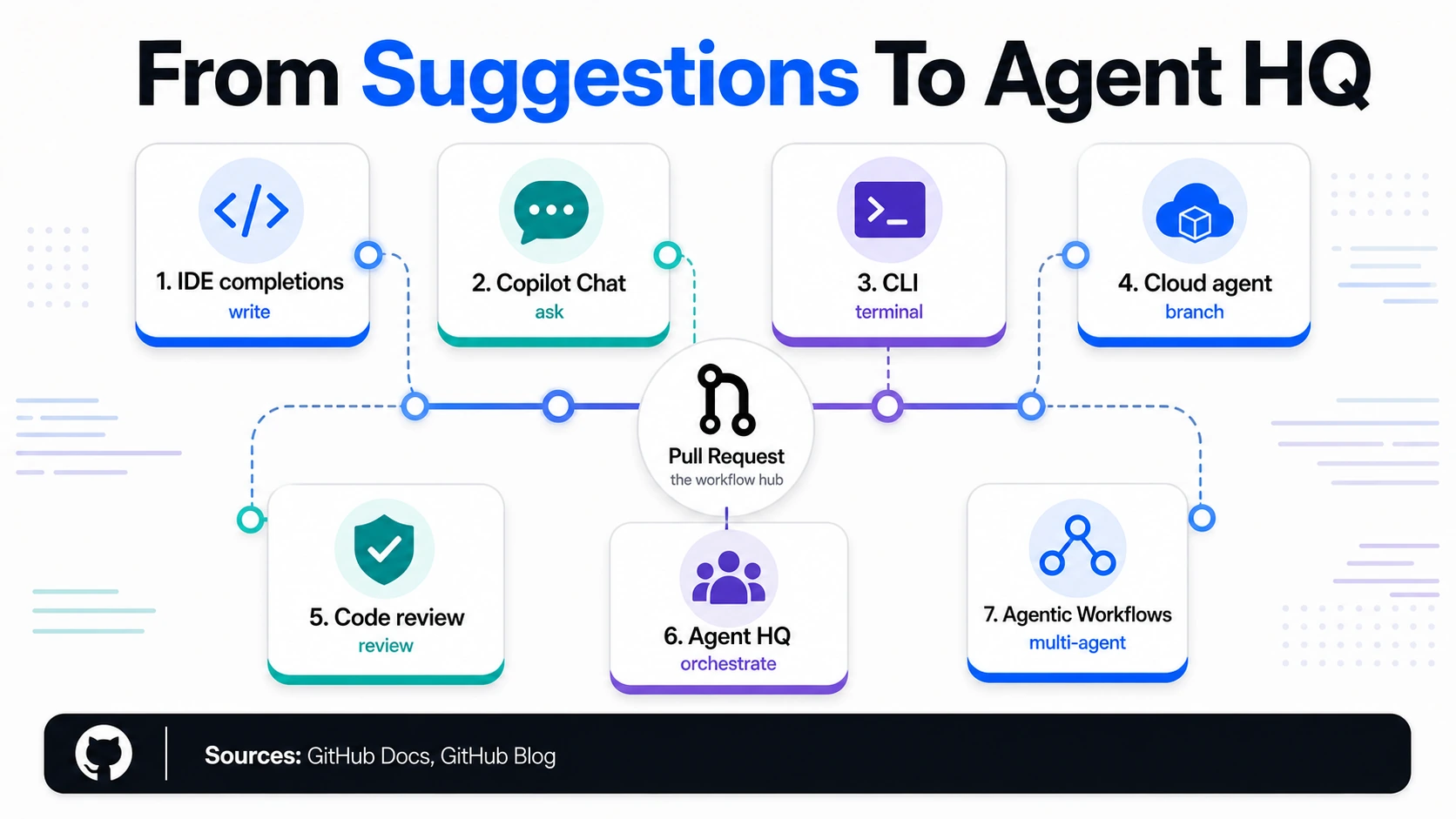
Inline suggestions still matter because they are the lowest-friction surface. GitHub Docs say Copilot provides suggestions for many languages and frameworks, and works especially well for Python, JavaScript, TypeScript, Ruby, Go, C#, and C++ (GitHub code suggestions). But the product no longer stops at ghost text in an editor.
Copilot Chat now appears across GitHub, supported IDEs, GitHub Mobile, and Windows Terminal according to GitHub Docs. Copilot CLI lets developers work from the terminal and move sessions between local tools, GitHub.com, or mobile (GitHub features). Microsoft said Copilot CLI usage was nearly doubling month over month in FY26 Q3, which makes CLI one of the few Copilot surfaces with a public growth signal (Microsoft FY26 Q3).
Copilot cloud agent moves Copilot into asynchronous work. GitHub’s docs describe it as an autonomous AI agent that can research a repository, create an implementation plan, make code changes on a branch, and open a pull request for review. The cloud-agent start page shows how broad the entry points have become: GitHub issues and dashboards, GitHub Mobile, IDEs, REST API, GitHub CLI, GitHub MCP Server, Jira, Slack, Microsoft Teams, Azure Boards, Linear, and Raycast.
Copilot's product surface, by entry point
The lowest-friction surface — ghost-text completions in the editor, strongest for Python, JavaScript, TypeScript, Ruby, Go, C#, and C++.
Conversational help across GitHub, supported IDEs, GitHub Mobile, and Windows Terminal.
Terminal-first Copilot that moves sessions between local tools, GitHub.com, or mobile — usage nearly doubling month over month in FY26 Q3.
An autonomous agent that researches a repo, plans, makes changes on a branch, and opens a pull request for review — triggerable from issues, IDEs, API, Slack, Jira, Linear, and more.
Copilot reviews pull requests; billed on two components — AI credits for the model interaction plus GitHub Actions minutes for context gathering.
The organizing layer for coding agents from OpenAI, Anthropic, Google, Cognition, xAI, open-source, and in-house models, built around PRs, Issues, and Actions.
Copilot is no longer one autocomplete box. Tap a surface to see what it is and where it runs — from ghost text to agent orchestration.
GitHub DocsAgent HQ is the strategic layer. GitHub introduced Agent HQ at Universe 2025 as a single workflow for orchestrating agents across developer work. Microsoft’s FY26 Q1 transcript called Agent HQ the organizing layer for coding agents from OpenAI, Anthropic, Google, Cognition, xAI, open-source models, and in-house models, built around GitHub primitives such as PRs, Issues, and Actions.
The feature matrix shows why product-surface statistics need date labels. GitHub lists support across VS Code, Visual Studio, JetBrains, Eclipse, Xcode, and NeoVim, but not every feature is available in every client; the feature matrix marks some features as preview and notes that the page itself is in public preview. For example, code completion is broadly supported, while advanced agent skills, BYOK, custom agents, vision, and workspace indexing vary by IDE and version.
The platform is also opening to other agents. GitHub Agentic Workflows support GitHub Copilot, Anthropic Claude, OpenAI Codex, and Google Gemini engines, with Copilot as the default if no engine is specified. That makes Copilot both a product and a workflow layer for multiple coding agents.
Pricing And Billing: The June 1, 2026 Shift
The most important Copilot business-model change in 2026 was the move to usage-based billing. GitHub announced that all Copilot plans would transition on June 1, 2026, replacing premium requests with GitHub AI Credits and calculating usage from input, output, and cached tokens based on model rates (GitHub billing announcement). GitHub’s legacy billing change docs state the same change more directly: before June 1, 2026, billing was premium request-based; after June 1, 2026, the cost of an interaction depends on the model and token count.
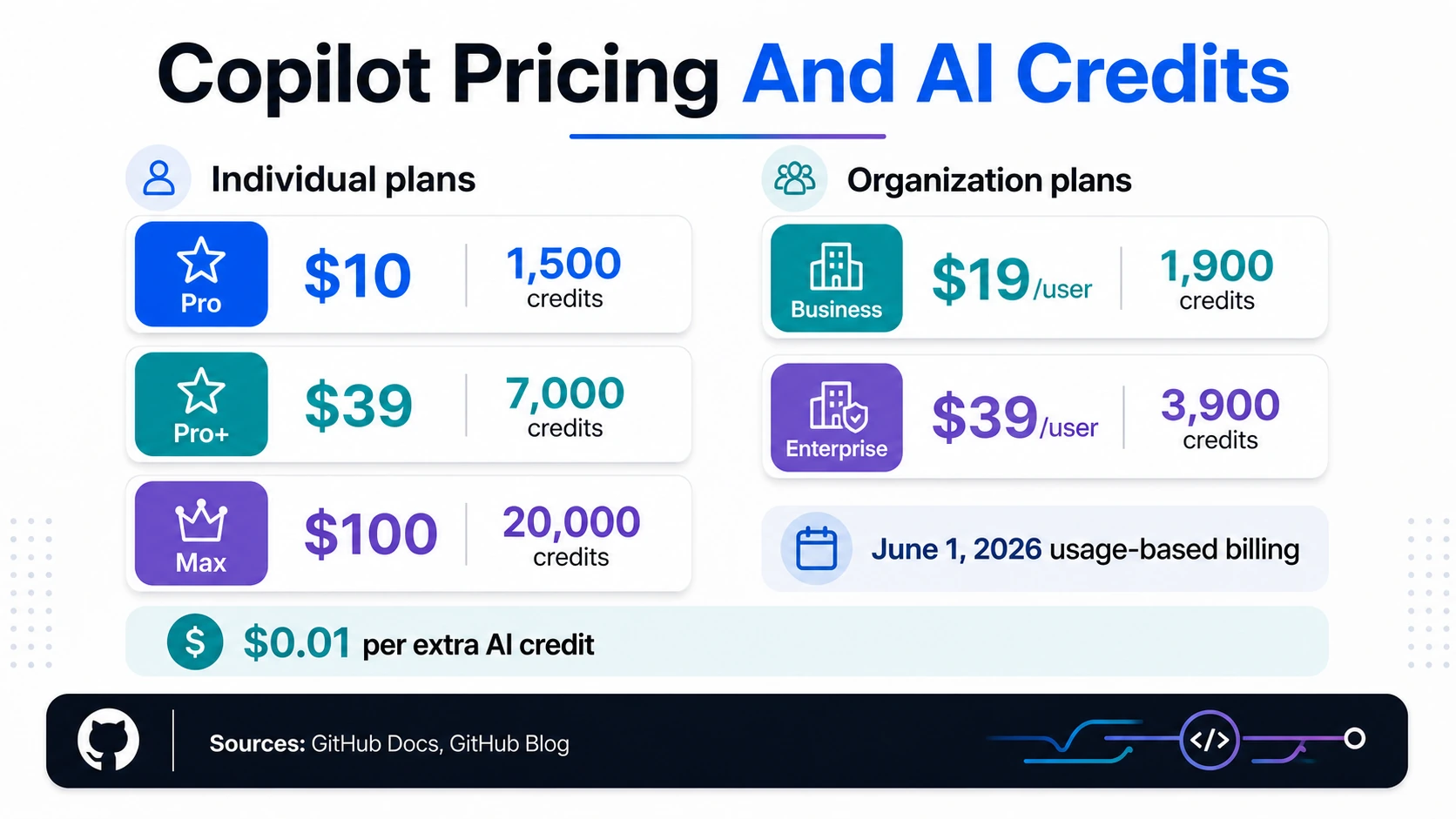
Current individual-plan docs list three paid individual tiers. Copilot Pro is $10 per month with 1,500 total monthly AI credits; Copilot Pro+ is $39 per month with 7,000 total monthly AI credits; Copilot Max is $100 per month with 20,000 total monthly AI credits (GitHub individual plans). Copilot Free includes 2,000 code completions per month, while Copilot Student includes unlimited completions according to the same current page.
Copilot plans and included AI credits (current GitHub Docs)
Organization pricing is seat-based plus usage-based. GitHub Docs list Copilot Business at $19 per user per month, including 1,900 AI credits per user, and Copilot Enterprise at $39 per user per month, including 3,900 AI credits per user for GitHub Enterprise Cloud (GitHub organization billing). Usage beyond the included pool is charged at $0.01 per AI credit, and paid plans keep code completions and next edit suggestions unlimited under the current docs.
This changes how engineering leaders should think about Copilot economics. Before usage-based billing, a team could often reason mainly in seats and request allowances. After the transition, model choice, token volume, agentic workflows, code review, and CLI/cloud-agent activity all become cost-relevant. Microsoft explicitly said in FY26 Q3 that GitHub was moving to usage-based pricing to align pricing with usage and costs (Microsoft FY26 Q3).
Code review is a good example. GitHub Docs say Copilot code reviews have two cost components: AI credits for the model interaction and GitHub Actions minutes for agentic context gathering and tool use (GitHub code review docs). GitHub’s billing announcement also said Copilot code review would consume GitHub Actions minutes in addition to AI Credits.
Model Choice And Enterprise AI Controls
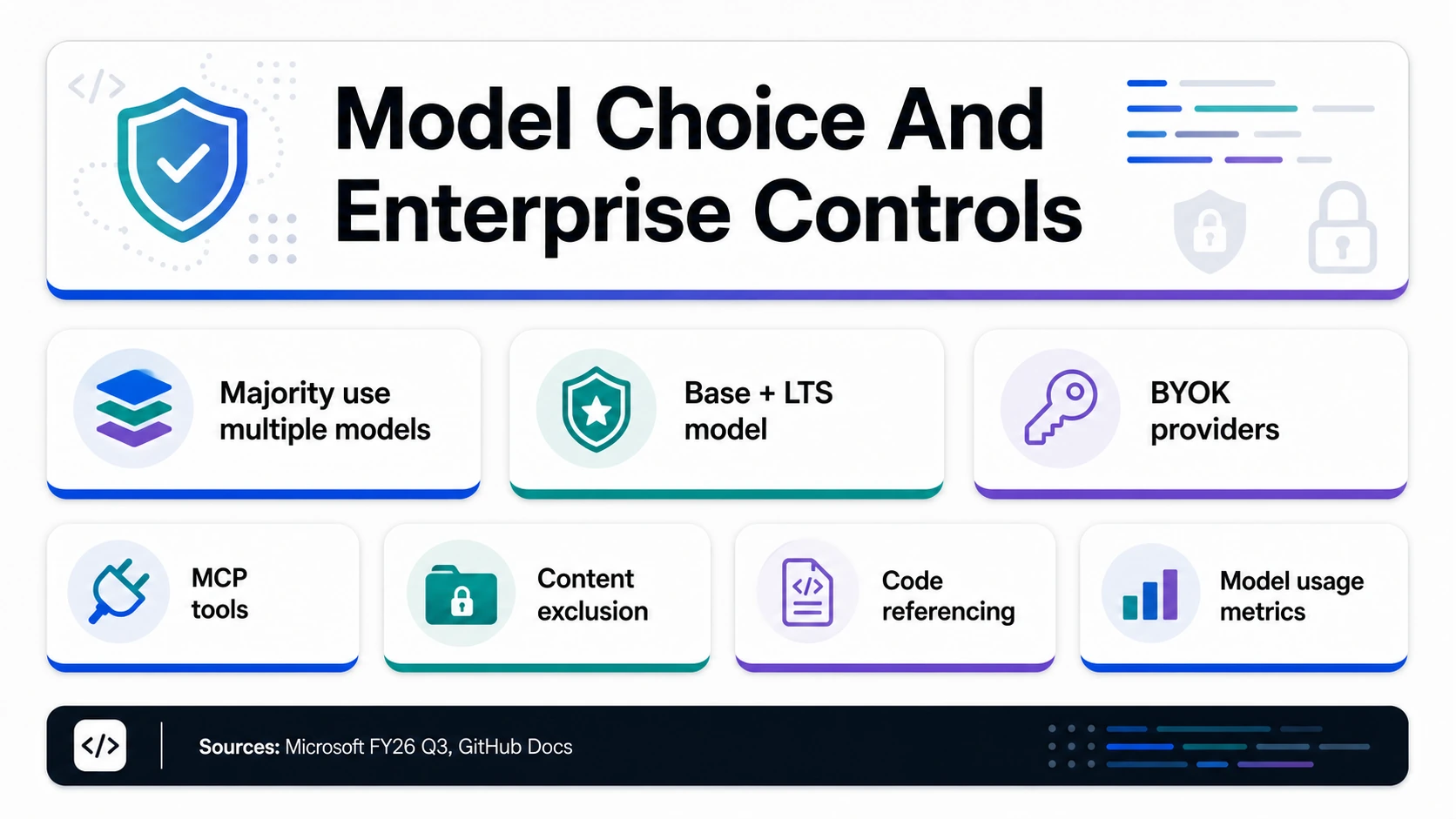
Copilot is no longer best understood as a single-model coding assistant. Microsoft said in FY26 Q3 that the majority of Copilot users leverage multiple models. GitHub Docs also show that model availability depends on plan, client, and organization or enterprise restrictions (configuring model access).
Model hosting is an enterprise concern. GitHub Docs describe how different model families are hosted. For Google models, GitHub says prompts and metadata are sent to Google Cloud Platform under Google’s data commitments; for Microsoft’s MAI-Code-1-Flash, the model is hosted on Azure in GitHub’s tenant; for open-weight models, GitHub says they are hosted on US-based Azure AI Foundry infrastructure managed by GitHub and Microsoft, and prompts and responses are not sent to the original model developers (GitHub model hosting).
GitHub added a stability concept for enterprises. On March 18, 2026, GitHub designated GPT-5.3-Codex as both the base model and long-term support model for Copilot Business and Copilot Enterprise, with LTS support lasting one year from designation (base and LTS models). That matters because enterprises need more than the newest model; they need predictable availability, migration windows, and admin controls.
The model catalog changes quickly. GitHub announced MAI-Code-1-Flash for Copilot in June 2026 and then made it generally available for Copilot Business and Copilot Enterprise on June 26, 2026. The same family of updates shows why model facts in Copilot statistics need exact dates.
Bring-your-own-key support adds another governance layer. GitHub’s enterprise BYOK docs list supported provider keys from Anthropic, AWS Bedrock, Google AI Studio, Microsoft Foundry, OpenAI, OpenAI-compatible providers, and xAI, while cautioning that fine-tuned model functionality and output quality can vary. GitHub’s MCP docs also position Model Context Protocol as a way to extend Copilot with existing tools and services across major Copilot surfaces, including IDEs, CLI, the Copilot app, and GitHub.com agent delegation.
Enterprise controls are not only about models. Content exclusion lets organizations configure files that Copilot should ignore; excluded content does not inform inline suggestions, chat responses, or Copilot code review. Code referencing checks suggestions for matches with publicly available code and can discard matches or show references depending on policy settings (GitHub code suggestions).
The governance pattern is clear: Copilot’s 2026 product statistics are not only about how many people use it. They are also about which models are enabled, how usage is billed, which context is allowed, how suggestions are referenced, and how teams measure model and feature use.
Copilot Usage Metrics: What Teams Can Actually Measure
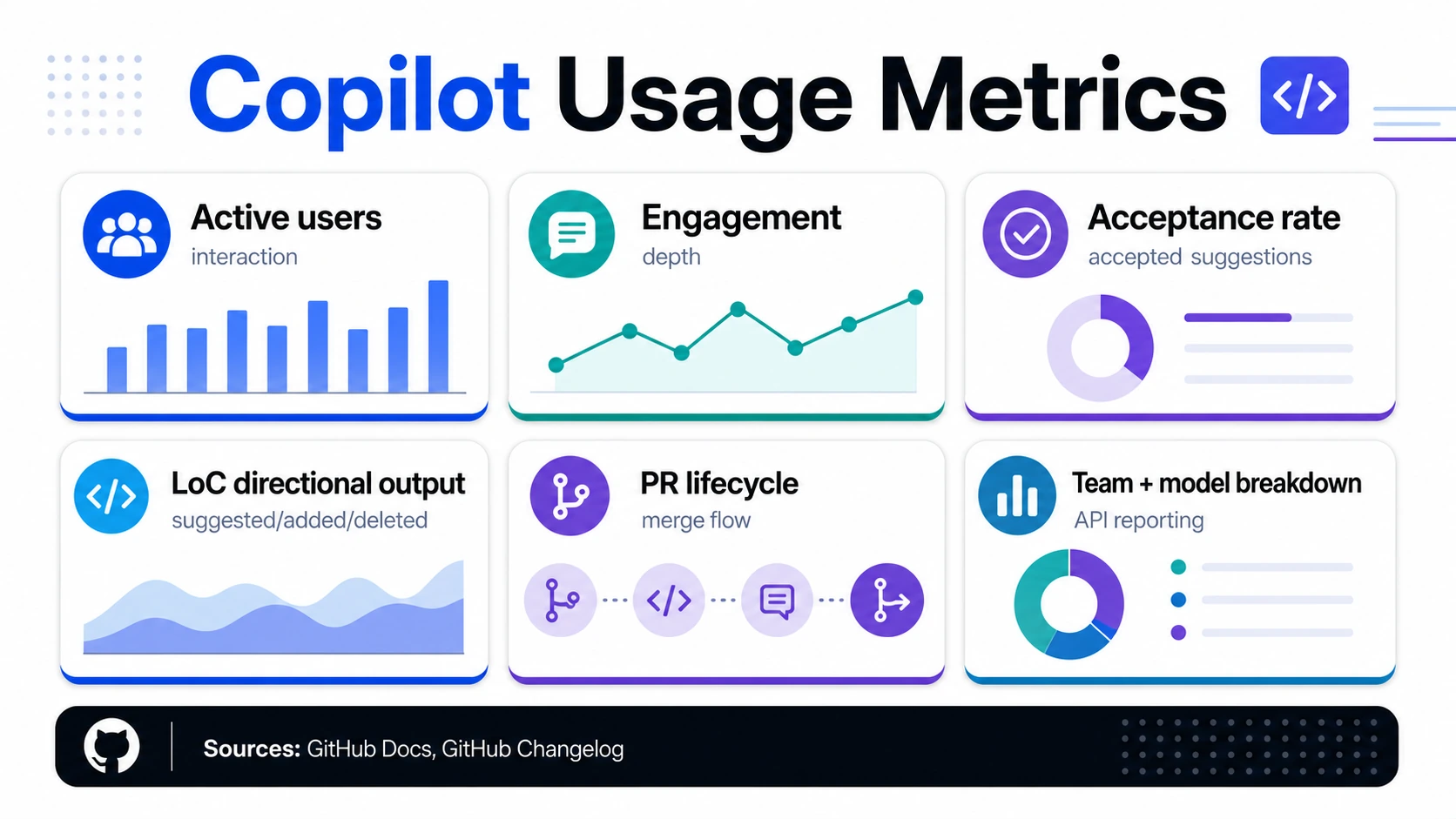
Copilot’s public adoption numbers are useful for market context. Enterprise leaders need a different set of metrics after rollout. GitHub’s usage-metrics docs say Copilot metrics fall into adoption, engagement, acceptance rate, lines of code, and pull request lifecycle metrics.
Five categories of Copilot usage metrics
Daily active users are unique users who interacted with Copilot on a given day; active status ties to a user-initiated interaction count above zero. Prefer this over “licenses assigned.”
Frequency and breadth across features, such as average chat requests per active user. Shows how deeply active developers actually use Copilot.
How often developers accept suggestions, calculated consistently across dashboard and API/export fields. It can signal relevance, but a high acceptance rate does not automatically mean high-quality software.
A directional measure of Copilot output — suggested, added, or deleted lines across completions, chat, and agent features. Directional output is not merged, tested, secure, or maintainable code.
PR creation and merge counts, median time to merge, and review suggestion activity — letting teams compare overall PR activity with PRs created by Copilot. The level where Copilot becomes more than code generation.
After rollout, licenses assigned is the weakest metric. Tap a category to see what it captures — and what it should not be read as.
GitHub DocsAdoption answers whether licensed developers are actively using Copilot. GitHub’s metrics docs define daily active users as unique users who interacted with Copilot on a given day, and the reconciliation docs tie active-user status to a user-initiated interaction count greater than zero (metric reconciliation). This is the number a team should prefer over “licenses assigned” when evaluating whether a rollout is alive.
Engagement shows depth of use. GitHub says engagement metrics include frequency and breadth across features, such as average chat requests per active user. Acceptance rate measures how often developers accept suggestions and is calculated consistently across dashboard and API/export fields. It can signal relevance, but a high acceptance rate does not automatically mean high-quality software.
LoC metrics are especially easy to misuse. GitHub says lines-of-code metrics are a directional measure of Copilot output, quantifying suggested, added, or deleted lines across completions, chat, and agent features. Directional output is useful, but it is not the same as merged, tested, secure, or maintainable code.
Pull request lifecycle metrics bring Copilot closer to delivery outcomes. GitHub says these include pull request creation and merge counts, median time to merge, and review suggestion activity, allowing teams to compare overall pull request activity with pull requests created by Copilot. This is the level where Copilot becomes more than a code-generation tool: teams can study whether AI-assisted workflows change throughput and cycle time.
The metrics product became more operational in 2026. GitHub announced Copilot usage metrics as generally available on February 27, 2026, with dashboard and API access, organization-level visibility, fine-grained access controls, and data residency support. GitHub then added plan mode telemetry on March 2, 2026 and model-level resolution for auto model selection on March 20, 2026.
Team-level reporting is another important milestone. On May 14, 2026, GitHub announced a user-teams report that can be joined with per-user usage reports to produce team-level Copilot metrics, including active users, completions, chats, language, IDE, feature, and model breakdowns. The caveats are operationally important: teams with fewer than five Copilot-seated users are excluded, and users who belong to multiple teams can be counted in each team aggregate, so team totals cannot be summed to reproduce an organization total.
Productivity, Security, And Governance
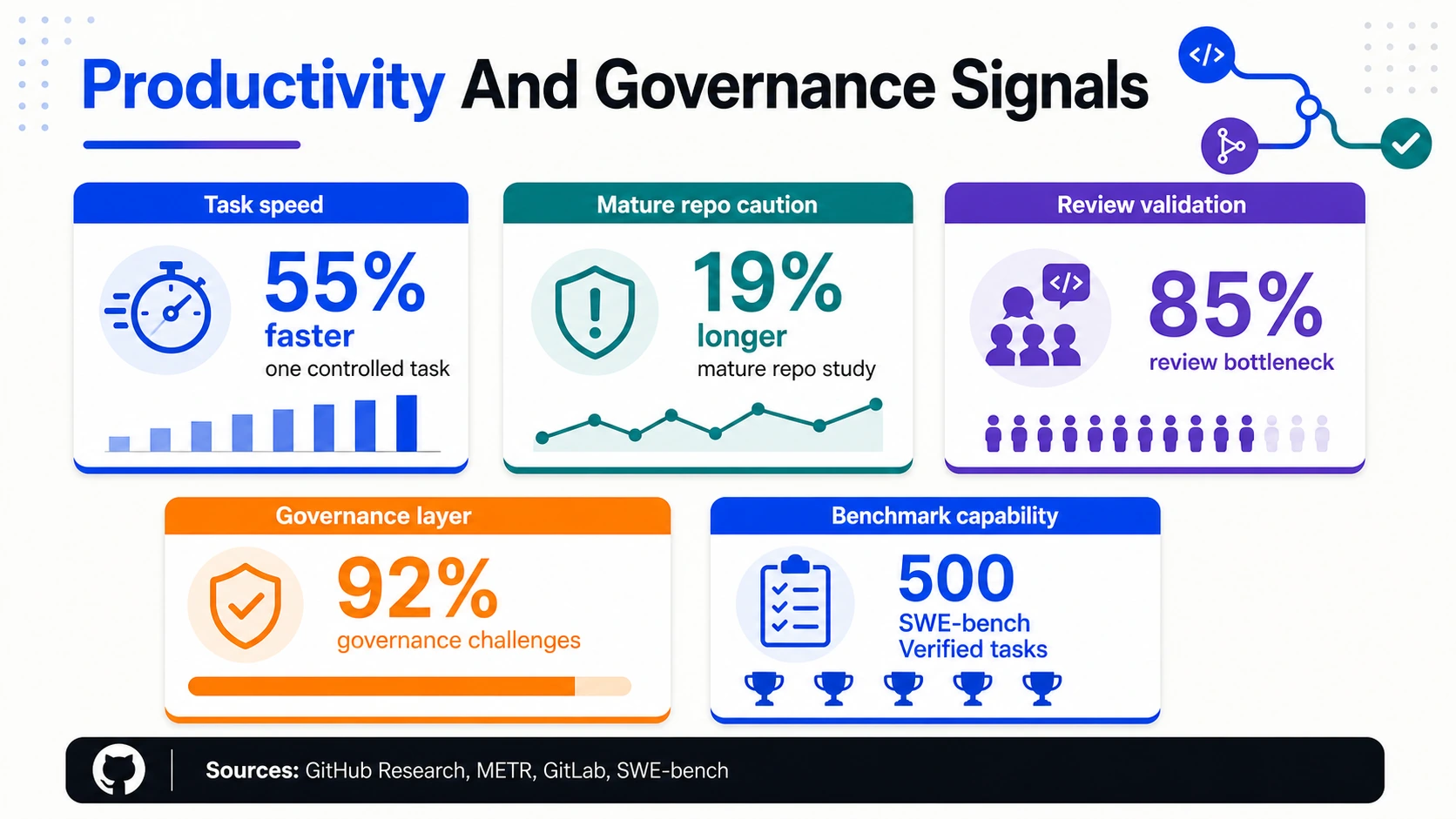
The most cited Copilot productivity statistic is GitHub’s controlled task study. Developers using Copilot completed a JavaScript HTTP-server task 55% faster, averaging 1 hour 11 minutes compared with 2 hours 41 minutes for developers without Copilot; GitHub reported statistical significance and a 95% confidence interval from 21% to 89% (GitHub productivity research). That is strong evidence for one bounded task setting.
The same study should not become a universal claim that all developers are 55% faster. GitHub’s research page itself discusses why developer productivity is difficult to measure and uses a broader productivity frame that includes satisfaction, performance, activity, communication, and efficiency. The safer claim is that Copilot can materially speed certain tasks and improve flow, while team-level outcomes depend on task type, codebase, review, tests, and deployment system.
Broader AI-development research reinforces that mixed picture. Google’s DORA 2025 summary says 90% of software-development professionals use AI at work, with a median two hours daily spent with AI; 65% heavily rely on AI for software development; more than 80% report productivity gains; and 59% report positive influence on code quality. But DORA also reports a trust paradox: only 24% report a lot or great deal of trust in AI, while 30% report little or no trust.
METR is the most useful counterweight because it measured task time rather than only self-reported productivity. In a 2025 randomized controlled trial, experienced open-source developers working on mature repositories took 19% longer when allowed to use early-2025 AI tools, even though they expected AI to speed them up by 24% and later believed it had sped them up by 20%. METR later said its early-2025 result was out of date and changed experiment design because newer AI-agent usage patterns made measurement harder. The lesson is not that Copilot slows teams down. The lesson is that productivity depends on the job.
Governance is where Copilot’s agentic future becomes operational. GitLab’s 2026 AI Accountability survey says 85% of respondents agree AI shifted the bottleneck from writing code to reviewing and validating it, 92% report some governance challenge with AI-generated code, and 80% agree their organization adopted AI tools faster than it developed policies to govern them. That is not a Copilot-specific survey, but it explains the environment Copilot buyers are operating in.
GitHub’s own cloud-agent risk docs are frank about why controls are needed. Copilot cloud agent can push code changes, so GitHub says it mitigates risk by limiting who can trigger the agent, restricting which branch it can push to, requiring human review before merge, restricting workflow runs until approved, and preventing the requester from approving the resulting pull request in certain protected workflows. GitHub also says Copilot cloud agent uses CodeQL, checks new dependencies against the GitHub Advisory Database, uses secret scanning, and records analysis details in session logs.
Responsible-use docs add the human side. GitHub’s Copilot Chat responsible-use card warns that generated code can be inaccurate, biased toward certain languages or styles, match public code, or expose security vulnerabilities if not reviewed carefully. Older academic work found concrete risks in AI-assisted coding: “Asleep at the Keyboard?” generated 1,689 programs across 89 scenarios and found about 40% vulnerable in that setup (arXiv 2108.09293), while a 2022/2023 user study found participants with access to an AI code assistant wrote significantly less secure code and were more likely to believe their code was secure (arXiv 2211.03622). Those papers should be treated as historical security evidence, not current Copilot vulnerability rates.
Benchmarks should get the same careful treatment. SWE-bench Verified is a human-validated subset of 500 software-engineering tasks for evaluating coding agents and language models. It is useful for understanding capability progress, especially as Copilot becomes more agentic. It is not evidence of active users, paid subscribers, organization count, or production quality.
Market Context: Copilot In The AI Coding Tool Stack
Developer surveys show why Copilot matters beyond Microsoft earnings. JetBrains’ January 2026 AI Pulse survey covered 10,000+ professional developers worldwide and found that 90% regularly used at least one AI tool at work for coding and development tasks. It also found 74% had adopted specialized developer AI tools such as coding assistants, editors, or agents, not just general chatbots.
Within that survey, GitHub Copilot remained the most widely known and adopted AI coding tool: 76% awareness and 29% work use worldwide. JetBrains also said Copilot adoption reached 40% among companies with more than 5,000 employees, while Cursor and Claude Code each reached 18% work use overall (JetBrains AI Pulse).
That does not mean Copilot has 29% market share. It means 29% of the surveyed professional developers used Copilot at work in that survey. The number is still valuable because it supports the claim that Copilot is common in real work, not just widely known.
Stack Overflow gives the broader developer sentiment backdrop. In its 2025 AI section, Stack Overflow reports that 84% of respondents use or plan to use AI tools in the development process, and 50.6% of professional developers use AI tools daily (Stack Overflow 2025). But Stack Overflow also reports that more developers distrust AI output accuracy than trust it, with 46% distrusting accuracy and only 33% trusting it. High adoption and low trust can coexist.
That tension fits Copilot’s product direction. Copilot is not only trying to generate more code. It is adding code review, usage metrics, model governance, content exclusion, code referencing, agent logs, safe outputs, and workflow controls. The product is responding to the same market reality that surveys show: developers want AI help, but teams need trust, traceability, and cost control.
Why This Matters For Engineering Leaders And Operators
For founders, Copilot validates the paid AI developer-tool market. A product with 26M+ users, 4.7M+ paid subscribers, and nearly 140K organizations is not a novelty category. But it also makes generic “AI coding assistant” positioning weaker. Competing or adjacent products need to own a narrower pain point: codebase context, migration, review automation, testing, dependency upgrades, security triage, model governance, cost management, release workflow, or agent orchestration.
Engineering leaders
Measure activation, not lines generated
The first rollout metric is whether licensed developers become active users — GitHub defines active users through user-initiated interaction counts. Then track sustained use, feature mix, model mix, AI-credit consumption, review burden, PR cycle time, and security signals.
GitHub DocsFinance & operations
The June 1, 2026 billing shift changes governance
Seat price still matters, but AI-credit pools, token consumption, model choice, code review, and agent workflows now affect cost. Review usage data alongside budgets and model policies before invoices surprise the organization.
GitHub DocsFounders
Own a narrower pain point
Copilot proves paid AI developer-tool demand but weakens generic "AI coding assistant" positioning. The opening is codebase context, migration, review automation, security triage, model governance, or agent orchestration.
Microsoft FY26 Q2Technical GTM
The message is governed delivery, not "AI writes code"
Developers already know AI writes code. The useful message is that AI-assisted development is shifting from individual code generation to governed software delivery — where Copilot's roadmap points.
Agent HQFor technical GTM teams, the cleanest Copilot message is not “AI writes code.” Developers already know that. The more useful message is that AI-assisted development is shifting from individual code generation to governed software delivery. Copilot’s own product roadmap points there: code review, cloud agent, Agent HQ, usage metrics, model controls, content exclusion, and safe agentic workflows.
What The Numbers Do And Don’t Prove
The missing numbers are as important as the published ones. GitHub and Microsoft publish user scale, paid subscribers, organization counts, and platform context, but they do not publish a clean daily-active Copilot number, a channel split of paid revenue, or an average seats-per-organization figure.
A user count shows reach, not active use.
The 26M+ figure is a company-reported user number, not monthly or daily active users unless Microsoft defines it that way.
A paid-subscriber count shows adoption, not daily use.
The 4.7M+ figure counts paying seats or subscriptions; it does not reveal accepted suggestions, PR outcomes, or team value.
An organization count shows breadth, not depth.
The ~140K figure does not tell whether an organization has five seats or 50,000, or how deeply Copilot is deployed.
Acceptance rate and LoC are directional, not quality.
GitHub itself frames acceptance rate and lines of code as directional signals, not measures of merged, tested, secure software.
A survey or benchmark is not telemetry.
JetBrains 29% work use and SWE-bench Verified 500 tasks measure respondents and capability, not Copilot active users or ROI.
Putting Copilot’s Numbers In Context
Use Microsoft investor transcripts for Copilot’s broadest public scale numbers: users, paid subscribers, organizations, GitHub developers, new-developer onboarding, PR volume, enterprise subscriber growth, multiple-model usage, and CLI growth (Microsoft FY26 Q1, Microsoft FY26 Q2, Microsoft FY26 Q3).
Use GitHub Docs for current product facts: plans, prices, AI-credit allowances, billing mechanics, model hosting, feature availability, usage metrics, content exclusion, code referencing, and responsible-use controls. Use JetBrains, Stack Overflow, DORA, and GitLab for context about developer work adoption, trust, governance, and review bottlenecks, while remembering their denominators are survey populations rather than Copilot telemetry.
Frequently Asked Questions
How many people use GitHub Copilot in 2026?
Microsoft said GitHub Copilot had over 26 million users in FY26 Q1. That is a company-reported user figure, not a monthly or daily active user count, so it should be quoted as broad product reach rather than active usage.
How many paid GitHub Copilot subscribers are there?
Microsoft said GitHub Copilot had over 4.7 million paid subscribers in FY26 Q2, up 75% year over year, and that Copilot Pro+ subscriptions for individual developers rose 77% quarter over quarter. That counts paying seats or subscriptions, not daily active use.
How many organizations use GitHub Copilot?
Microsoft said nearly 140,000 organizations used GitHub Copilot in FY26 Q3, and that Copilot enterprise subscribers had nearly tripled year over year. An organization count shows deployment breadth, not how many seats each organization has or how deeply Copilot is used.
How much does GitHub Copilot cost in 2026?
Current GitHub Docs list Copilot Pro at $10 per month, Copilot Pro+ at $39 per month, and Copilot Max at $100 per month for individuals, plus Copilot Business at $19 per user per month and Copilot Enterprise at $39 per user per month. All plans moved to usage-based billing on June 1, 2026, with extra usage charged at $0.01 per AI credit.
What changed with GitHub Copilot billing on June 1, 2026?
GitHub moved all Copilot plans to usage-based billing on June 1, 2026, replacing premium requests with GitHub AI Credits calculated from input, output, and cached tokens based on each model's rates. After the change, the cost of an interaction depends on the model and token count rather than a fixed request allowance.
Is GitHub Copilot the most used AI coding tool?
In JetBrains' January 2026 AI Pulse survey of 10,000+ professional developers, GitHub Copilot was the most widely known and adopted AI coding tool at 76% awareness and 29% work use, versus 18% work use each for Cursor and Claude Code. That is a survey respondent signal, not product telemetry or market share.
Does GitHub Copilot really make developers 55% faster?
GitHub's controlled study found developers completed one JavaScript HTTP-server task 55% faster with Copilot, averaging 1 hour 11 minutes versus 2 hours 41 minutes, with a 95% confidence interval from 21% to 89%. That is bounded evidence for one task; a separate METR 2025 trial found experienced developers on mature repositories took 19% longer with early-2025 AI tools, so productivity depends on the job.
What is the difference between GitHub Copilot users and GitHub developers?
GitHub Copilot had over 26 million users in FY26 Q1, while GitHub itself had over 180 million developers. The 180 million figure is a GitHub platform metric and distribution context, not a Copilot usage number, so the two should not be merged.
Sources and Further Reading
Microsoft investor scale numbers
GitHub product, pricing & billing docs
Usage metrics, models & governance docs