Replit Statistics
Last updated on July 8, 2026

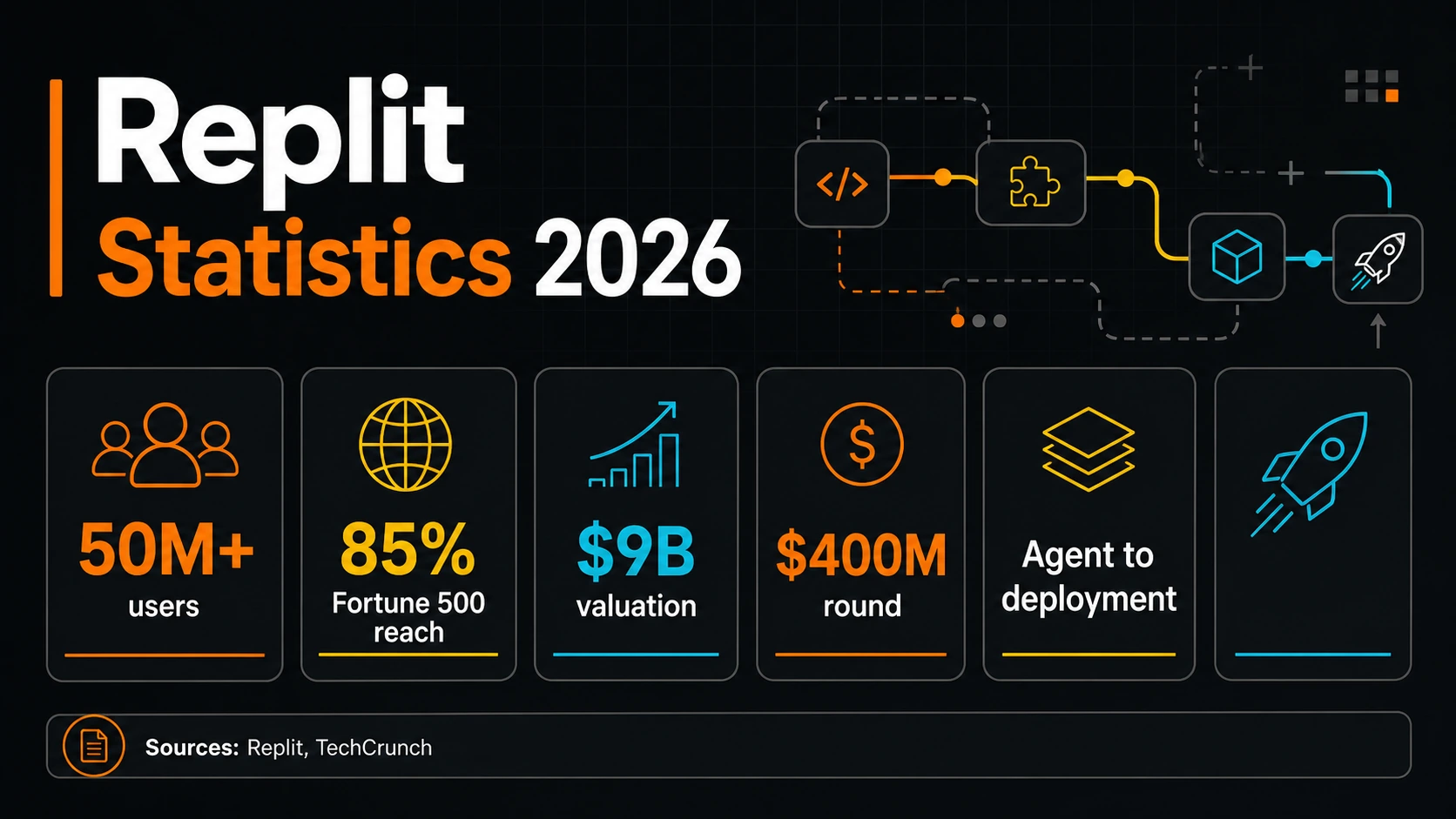
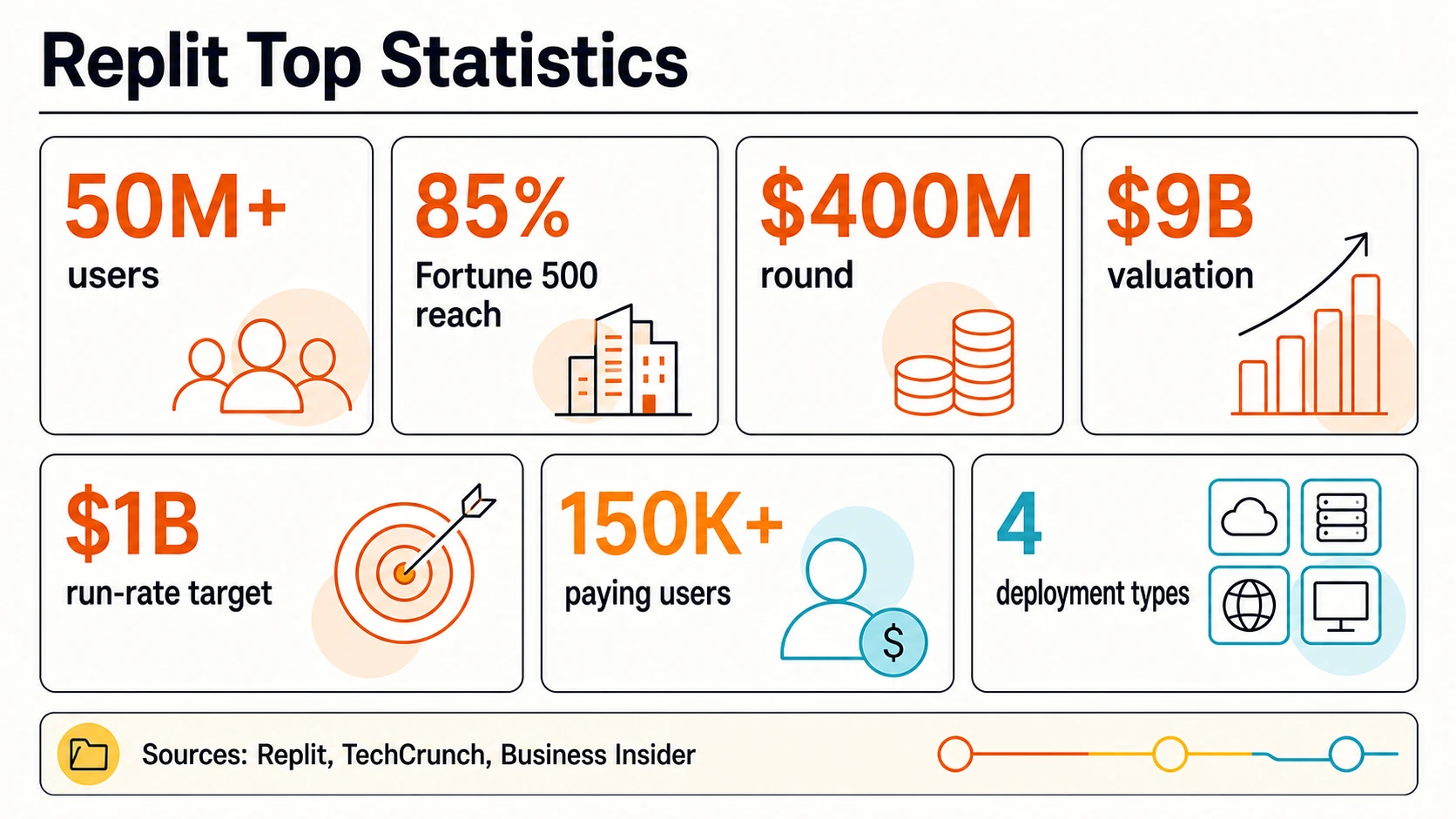
Replit is one of the clearest examples of how software creation is being re-bundled in 2026. The public numbers no longer describe only an online IDE or a classroom coding tool — Replit now reports more than 50 million users building apps, says it has users from 85% of the Fortune 500, and announced a $400 million round at a $9 billion valuation in March 2026.
Those numbers are real, useful, and easy to misread. A user-count milestone is not the same as monthly active developers. A Fortune 500 footprint is not a seat count. A valuation is not revenue. A generated app is not always a production deployment. Replit’s 2026 data makes the most sense when the platform is read as four connected surfaces: a cloud development workspace, an AI app builder, a publishing and deployment layer, and a private company with enterprise and consumer monetization (Replit AI, Replit Agent docs, Replit Deployments docs, Replit pricing).
Here is the clearest way to read Replit in 2026: user and developer counts show reach, valuation and funding show capital, run-rate revenue and paying users show commercial traction, Agent and deployment facts show product surface, and enterprise controls show buyer posture. None of those alone proves daily active usage, retention, or how many production apps are live.
Replit’s Public Numbers
The headline Replit figures use different denominators, so read them as separate reach, financing, revenue, and product signals rather than one number.
Financing & revenue trajectory (official + reputable reporting)
Users, paying users & creation history
Read every number by its own denominator
Replit's headline figures answer different questions. Tap a metric to see what it measures — and what it does not prove.
ReplitThe Denominator Behind Each Replit Number
Replit’s public data is strongest when each number stays in its own lane. 50M+ users is a reach metric, not an active-developer metric (Replit). 85% of the Fortune 500 is a company-footprint metric, not a spend or seat count (Replit). $9 billion valuation is a financing metric, not annual revenue (TechCrunch). The $1 billion run-rate revenue target is a forward-looking trajectory, not completed audited revenue (Replit).
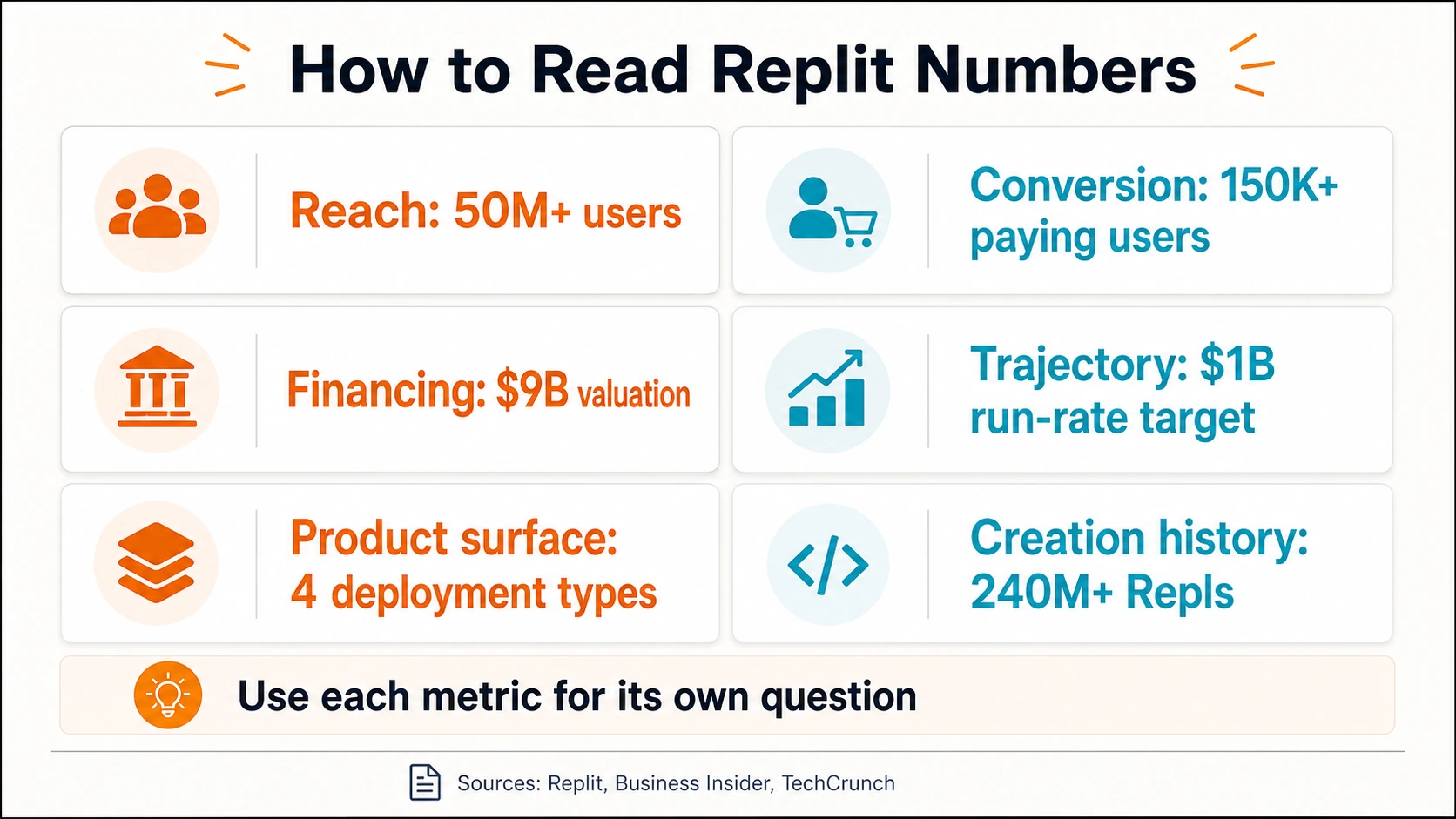
The biggest trap is treating “apps built” or “projects created” as the same thing as production businesses. Replit reported 240M+ Repls in 2023 and later described a platform with apps, deployments, Agent builds, artifacts, and published apps — but a created Repl can be a classroom exercise, a prototype, a private workspace, a hobby project, or a production service (Replit, Agent overview, Deployments docs).
The second trap is comparing Replit only with AI coding assistants. Replit competes for some of the same developer attention as GitHub Copilot, Cursor, Codex, and Claude Code, but its measurable product surface is broader: browser workspace, project runtime, AI app builder, visual design, database, publishing, domain, monitoring, enterprise controls, and integrations (Replit AI, Agent docs, Custom Domains docs, Monitoring docs).
Replit User, Developer, And Project Scale
Replit’s historical user curve starts with developer-community scale and broadens into a mixed-creator platform.
Replit's public scale milestones (mixed labels — read the note)
Labels shift over time from developers (2023) to software creators (2024) to all users (2026), so this is a reach curve, not a like-for-like active-user series. Sources: Replit blog posts and Business Insider.
In February 2023, Replit said it had reached 20 million developers who had created 240M+ Repls (Replit). By April 2023, its company-stats block had expanded the picture: 22.5 million developers from 200+ countries, 235 million projects created, 25 billion monthly external visits to hosted apps and sites, 1 million containers running concurrently, and 10TB of packages cached (Replit). Those numbers are excellent for infrastructure context, but external visits are traffic to hosted apps, not Replit accounts — they should not be read as active monthly users.
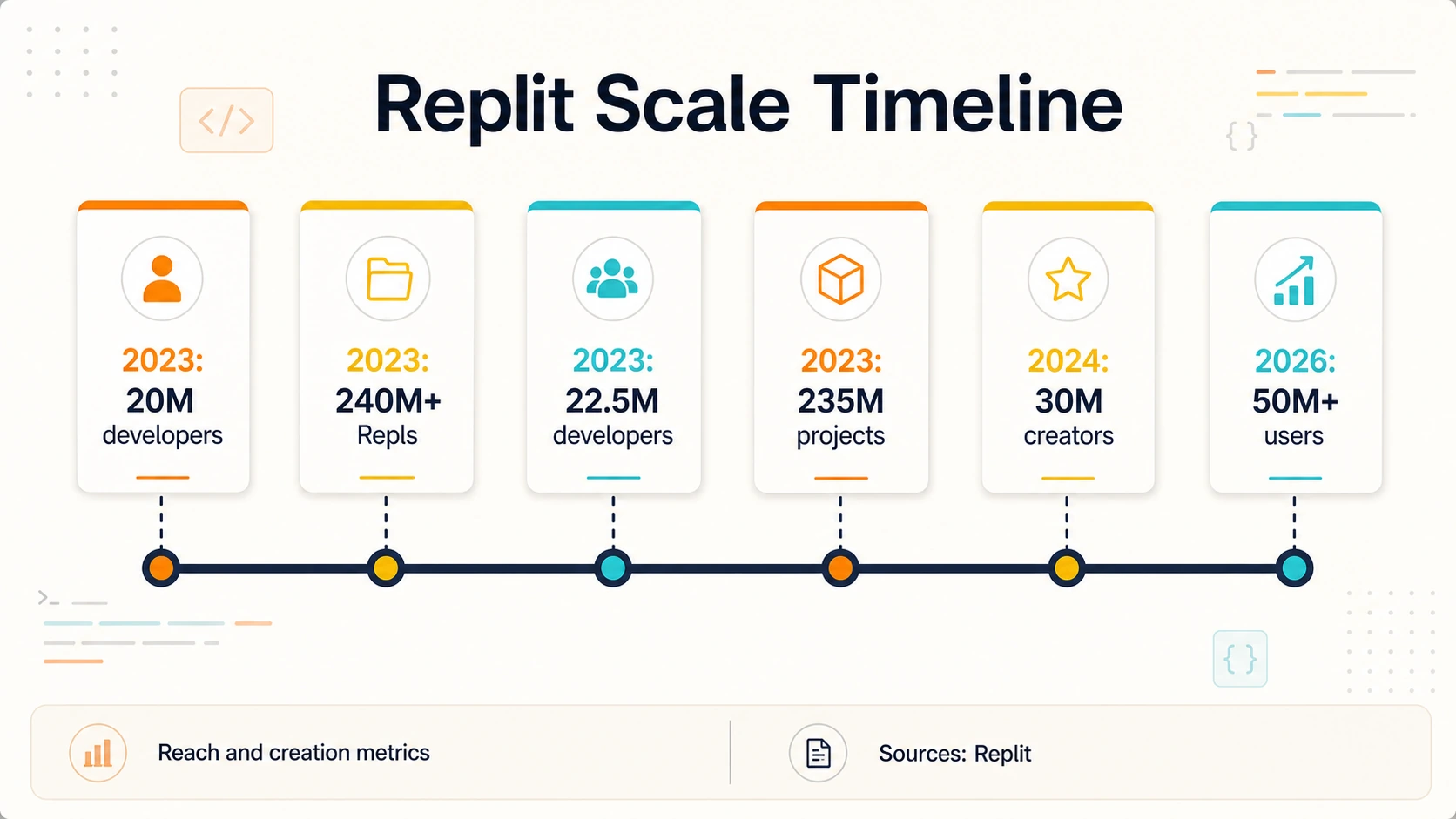
The 2024 Teams launch shifted the label from developers to software creators. Replit said it had grown to over 30 million software creators worldwide and that over 50% of business signups were not engineers, while an image in the post described 58% of builders as non-engineers (Replit). The right takeaway is that Replit’s audience was broadening beyond professional developers — the number does not identify paid business seats.
Business Insider then reported a 40 million total user base in 2025, with over 150,000 paying users as of June 2025 based on a leaked investor memo (Business Insider). That paying-user figure is one of the most useful public denominators, but it must remain attributed: it is not current July 2026 official dashboard data, and it does not split paying users across Core, Pro, Enterprise, education, or legacy plans. The current official top-line is more than 50 million users, used in April 2026 for Replit’s Google Cloud Partner of the Year recognition and again in the March 2026 funding narrative (Replit).
Replit AI: Agent, Assistant, And The App-Builder Pivot
Replit’s AI history matters because the platform has moved from coding assistance toward app creation. In early 2023, Ghostwriter offered completion, generation, transformation, explanation, and chat inside the IDE; the 2023 recap says Replit then moved from Ghostwriter to Replit AI for All, making code completion free while members got advanced models (Ghostwriter Chat, 2023 recap).
Replit Agent changed the denominator. The September 2024 launch defined Agent as an AI system that can create and deploy applications — setting up the environment, installing dependencies, executing code, and moving from idea to deployment (Replit). The Assistant launch then split the product into two jobs: Agent for 0-to-1 creation and Assistant for 1-to-10 refinement of existing projects (Replit).
Ghostwriter → Replit AI for All
IDE-embedded coding AI — completion, generation, explanation, chat — with code completion made free for all users.
Replit Agent + Assistant
Agent handles 0-to-1 creation and deployment; Assistant handles 1-to-10 refinement of existing projects.
Agent-first: v2, Agent 3, Design Mode
2-3x speed improvements; Agent 3 could test itself and work for 200 minutes autonomously; Design Mode built sites in under 2 minutes.
Agent 4, launched March 11
Claimed 10x faster production-ready apps than Agent 3, with web apps, mobile apps, slide decks, data apps, and animations in one project.
By 2025, Replit said it had become Agent-first. Its year-in-review says Agent v2, Agent 3, and Design Mode delivered 2-3x speed improvements, while Agent 3 could test itself, work for 200 minutes autonomously, and build other agents; Design Mode could create interactive designs and static sites in under 2 minutes, and Replit began rolling Agent with Claude Sonnet 4.5 and Opus 4.5 to builders (2025 Replit in Review). Agent 4, launched March 11, 2026, is designed around design, speed, multi-output projects, and collaboration, with a 10x faster production-ready-app claim versus Agent 3 (Agent 4 launch, multiple-artifact docs).
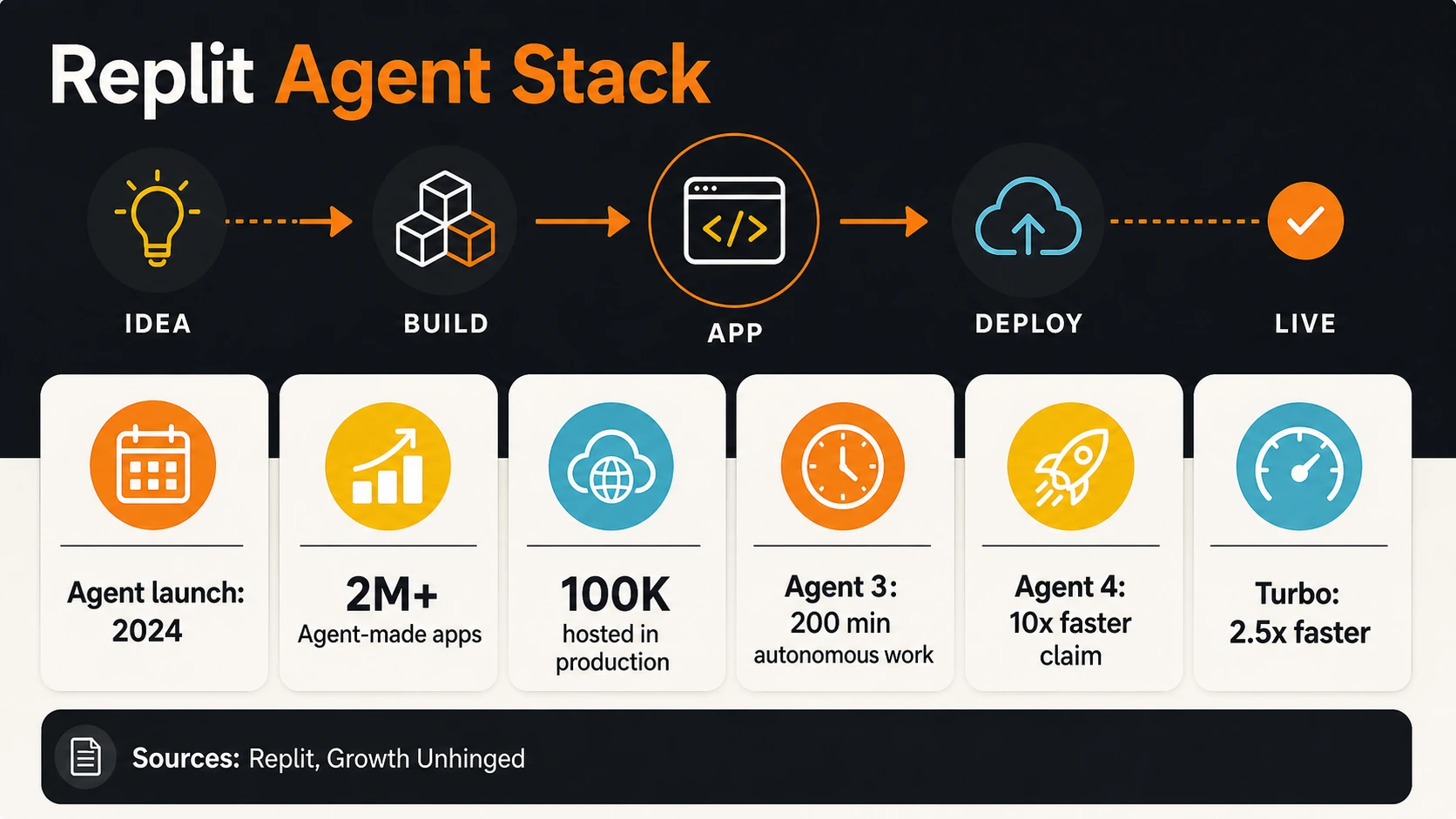
The strongest current Replit AI usage claim outside Replit’s own product pages comes from Growth Unhinged. Kyle Poyar reported that Amjad Masad told him Replit Agent had made more than 2 million apps in six months, with 100,000 hosted in production, and that Replit’s subscriber base was growing 45% monthly since Agent’s release (Growth Unhinged).
Pricing, AI Credits, And Plan Packaging
Replit’s pricing is now a product statistic because Agent use, credits, deployments, and collaboration all shape how the company monetizes usage. Replit’s February 2026 Pro announcement introduced Pro at $100/month, dropped Core to $20/month, and said Teams users would be upgraded to Pro for the remainder of their term; Pro offers tiered monthly credits from $100 to $4,000/month, one-month credit rollover, up to 15 builders, pooled credits, and no per-user fees (Pro announcement).
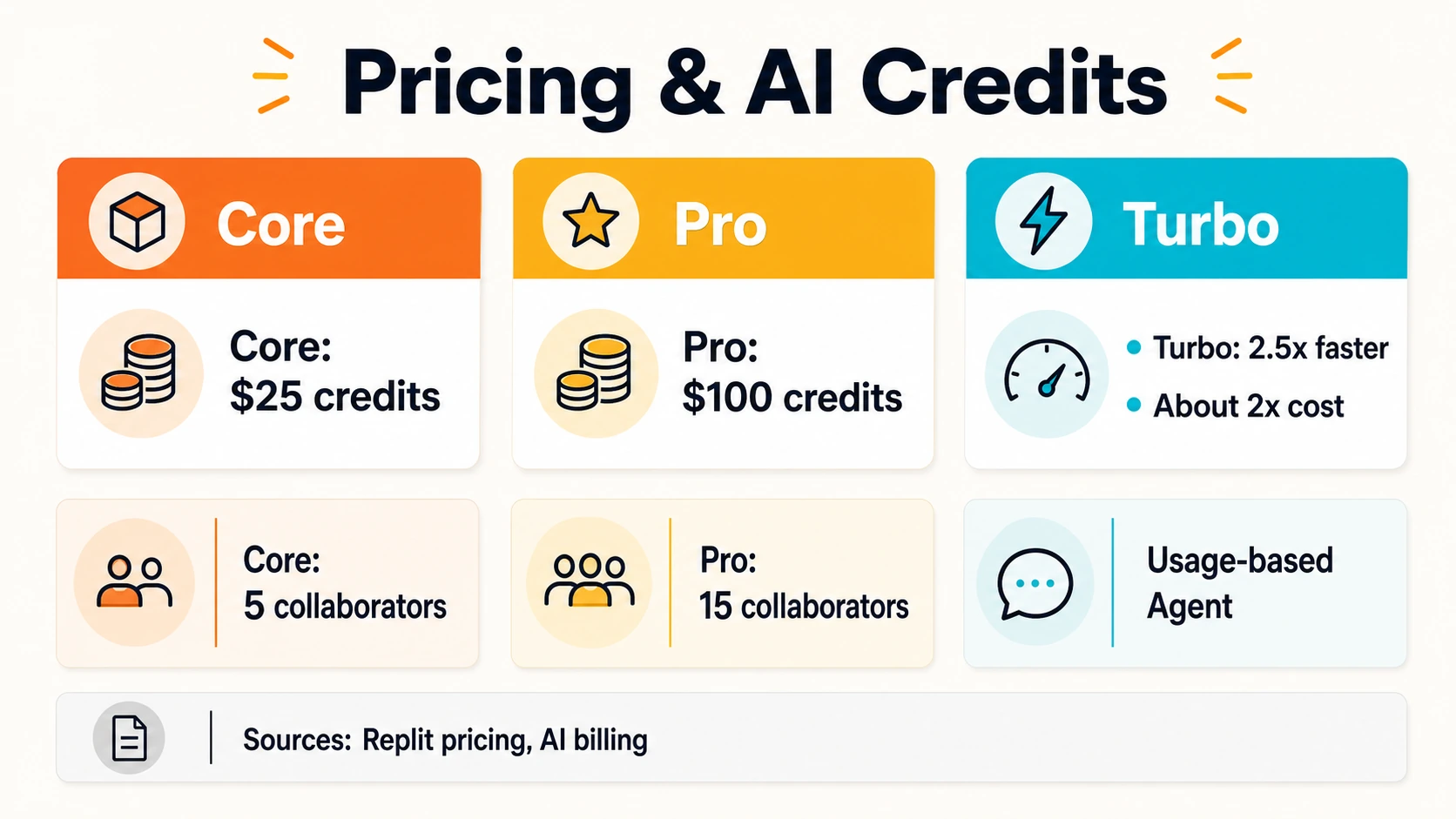
The current pricing page, checked July 5, 2026, shows Starter, Core, Pro, and Enterprise (Replit pricing). Starter is free with daily Agent credits, a built-in database, one published project, and private or password-protected deployments. Core is $25 monthly or $20/month billed annually with $25 of monthly credits, up to 5 collaborators, up to 2 parallel agents, unlimited workspaces, and badge removal. Pro is $100 monthly or $95/month billed annually with $100 monthly credits, up to 15 collaborators, 50 viewers, up to 10 parallel agents, the most powerful models, database rollbacks for 28 days, and premium support (Replit pricing).
Replit’s AI billing docs explain why credit counts matter: AI features use usage-based billing, with Agent priced by the work it performs through checkpoints — all Agent interactions are billable, though smaller requests cost less (AI billing docs). Agent modes add another usage layer: Lite is for quick edits, Economy balances cost and quality, Power uses more capable models for harder tasks, High effort can invoke frontier models, and Turbo is a Pro/Enterprise option that Replit says can be 2.5x faster at about 2x the cost of Power (Agent modes). That structure is a monetization signal: Replit is not selling only a seat — it is selling a blend of collaboration, AI work, cloud services, and deployment capacity.
Deployments, Published Apps, And Hosted Workflows
Deployment is where Replit differs most from narrow code-completion tools. Replit’s AI page tells users they can ask Agent for an app, deploy it, and share it, and its deployment docs document four publishing modes: Autoscale, Static, Reserved VM, and Scheduled deployments (Replit AI, Deployments docs).
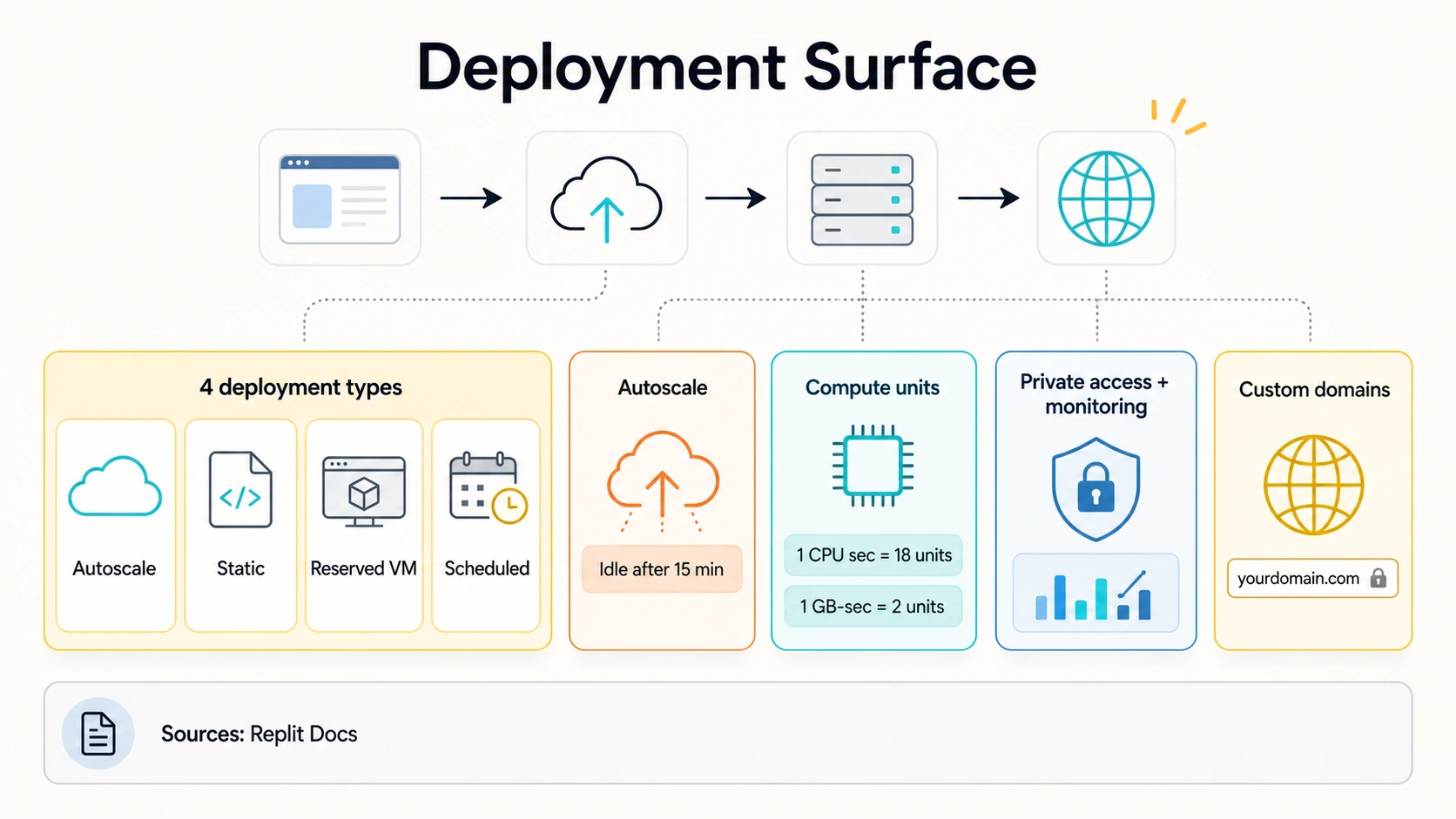
Four ways to publish on Replit
Request-based cloud compute that adds servers when busy and scales to zero when idle. The app starts on the first request, then goes idle after 15 minutes of inactivity.
Hosts static files — HTML, CSS, JavaScript — with caching and scaling. Docs explicitly note Static is not compatible with Agent-generated full-stack apps, which should use Autoscale or Reserved VM.
Dedicated resources for predictable performance, custom domains, configurable port mappings, monitoring, and always-on use cases such as API servers and chat bots.
Runs jobs on a schedule rather than serving continuous traffic — one of the four documented publishing modes for recurring tasks.
Each deployment type targets a different workload. Tap a type to see what it is built for.
Replit deployments docsDeployment pricing docs say Autoscale is request-based and define 1 CPU second as 18 compute units and 1 GB-second as 2 compute units (deployment pricing). The publishing surface also includes privacy and operations: private deployments add login-gated access with Public, Workspace only, Only you, and password-protected patterns (Private Deployments); custom domains are available for Autoscale, Reserved VM, and Static with Replit-provided TLS/SSL and automatic DNS setup (Custom Domains); and published-app monitoring gives analytics for page views, top URLs, referrers, HTTP status, request durations, browsers, devices, top countries, and uptime-style monitoring on Core, Pro, and Enterprise (Monitoring).
Use deployment facts for product-surface analysis, not adoption volume. They prove Replit can host, meter, monitor, and protect apps. They do not prove how many production apps are live across Replit unless the source says so.
Teams, Enterprise, Security, And Customer Evidence
Replit’s public enterprise proof has three layers: broad footprint, product controls, and customer examples. The broadest footprint is Replit’s own 85% of the Fortune 500 claim, which belongs in the reach layer — it does not say how many Fortune 500 employees use Replit, how much they spend, or whether Replit is standardized across those companies (Replit).
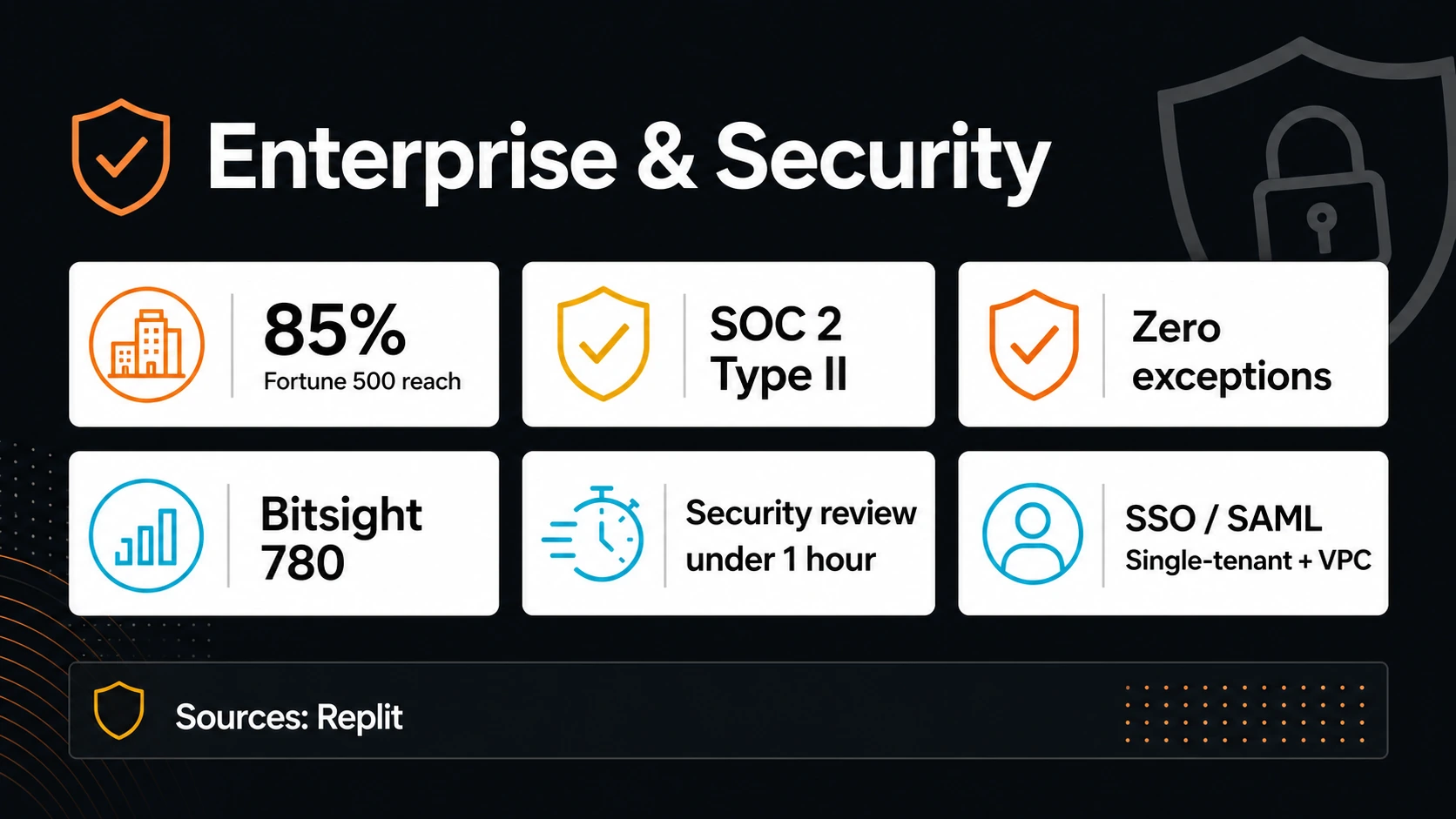
Enterprise controls are visible in the current product pages. Replit’s Enterprise plan lists SSO/SAML, advanced privacy controls, design system support, data warehouse connections, custom groups, dedicated support, single-tenant environments, region selection, static outbound IPs, and VPC peering (Replit pricing). The 2025 review says Replit Enterprise reached SOC 2 Type II certification with zero exceptions and a Bitsight 780 security score, while adding multiple SSO providers per organization and admin analytics later in the year (2025 Replit in Review).
Footprint
85% of the Fortune 500
A reach signal — large firms with at least some Replit users — not a count of paid seats, spend, or company-wide rollouts.
ReplitCompliance
SOC 2 Type II · Bitsight 780
Replit Enterprise reached SOC 2 Type II with zero exceptions and a Bitsight 780 security score in the 2025 review.
ReplitSecurity Agent
Review in under an hour
Replit says Security Agent completes a comprehensive review in under an hour (larger projects up to 15 minutes) using Semgrep and HoundDog.ai — not a guarantee every app is secure.
ReplitCustomer proof
SaaStr: 7 apps in 3 months
SaaStr built 7 production apps in 3 months, saved $200,000+ annually, and served 30,000+ monthly users on that app set.
ReplitCustomer examples make the enterprise story concrete. Replit says UKG, a human capital management platform with over 16,000 employees, uses Replit for rapid prototyping, product development, and internal tools, and reports a 400% increase in ability to gather product-led feedback before engineering investment (Replit). The partnership layer widened in 2026: Replit announced availability directly inside Claude (Claude integration), Agent Customization with Custom Instructions and Skills (Custom Skills), a Shopify storefront workflow (Shopify), and a Microsoft Fabric collaboration for enterprise data apps (Microsoft Fabric). These support Replit’s platform strategy but should not be counted as adoption unless paired with usage metrics.
Replit Company Economics
Replit’s company metrics accelerated after the AI app-builder pivot. TechCrunch reported that Replit raised $250 million in September 2025 at a $3 billion valuation, and that annualized revenue had moved from $2.8 million to $150 million in under a year; PitchBook estimated Replit had raised about $478 million in total by then (TechCrunch).
Replit revenue trajectory — company-reported and memo-based
Each point is a reported figure on a linear axis, so the steep rise is the story. Note the labels mix annualized run-rate and annual-sales framings, and later points come from a leaked investor memo, not audited results.
TechCrunch & Business Insider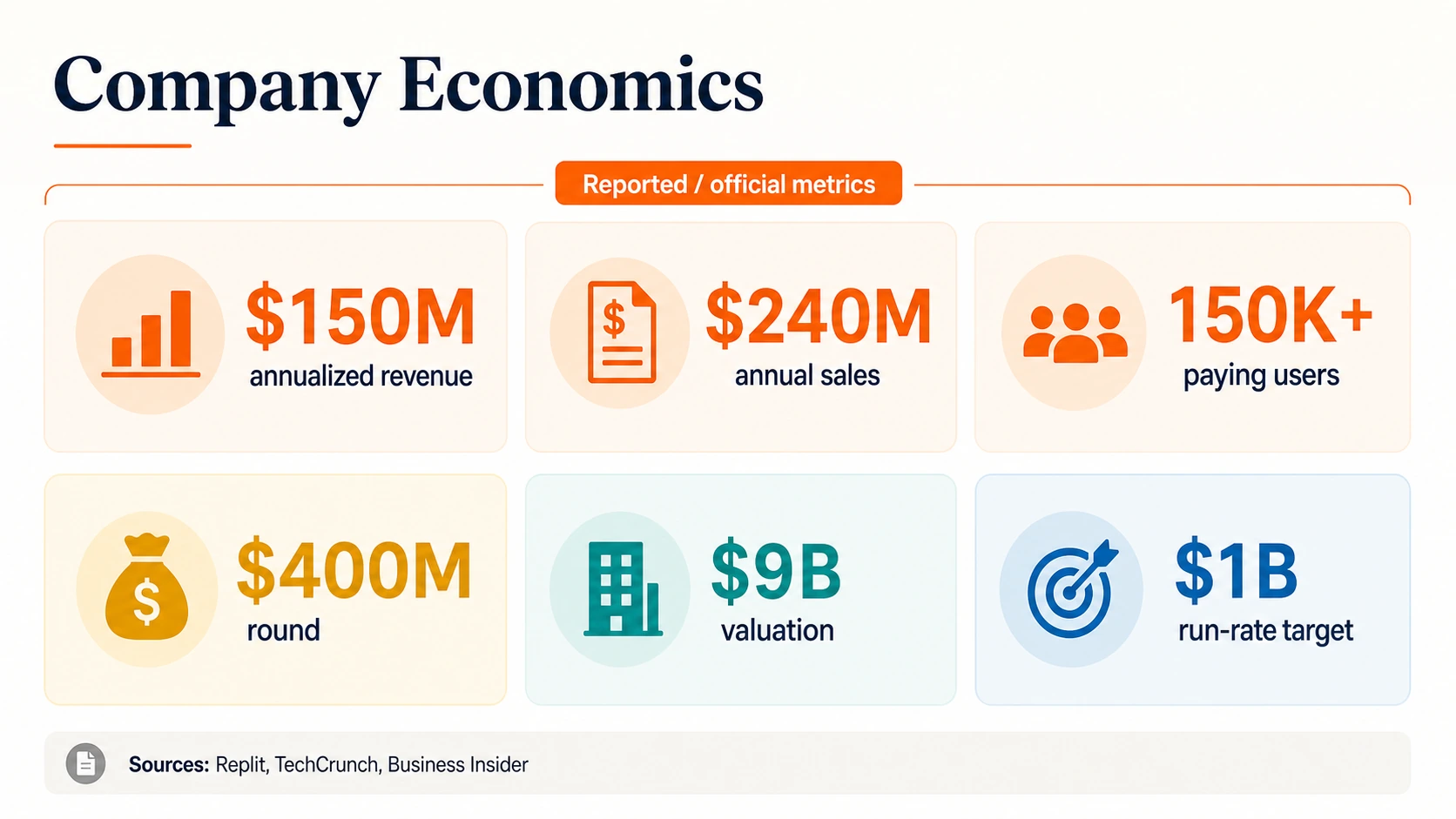
Business Insider added a different revenue view in October 2025. Based on a leaked investor memo, it reported that Replit expected to surpass $1 billion in revenue by 2027, was generating about $240 million in annual sales at the time, and had revenue of $2.8 million the prior year before Agent accelerated sales; it also reported over 150,000 paying users as of June 2025 out of a 40 million user base (Business Insider). The March 2026 round multiplied the story: Replit’s official post says it raised $400 million at a $9 billion valuation, with investors including Georgian, G Squared, Prysm Capital, 1789 Capital, YC, Coatue, a16z, Craft Ventures, QIA, Accenture Ventures, Databricks Ventures, Okta Ventures, and Tether; TechCrunch confirmed the $400 million Series D and $9 billion valuation while noting Replit did not disclose updated ARR with the round (Replit, TechCrunch).
Market Context: AI Coding, Cloud IDEs, And App Builders
The broader developer market explains why Replit’s pivot found demand. Stack Overflow’s 2025 Developer Survey drew 49,000+ responses from 177 countries; its AI section says 84% of respondents use or plan to use AI tools and 51% of professional developers use AI tools daily (Stack Overflow 2025, AI section). JetBrains’ 2025 report says 85% of developers now use AI tools and 62% rely on at least one coding assistant, based on 24,534 developers after data cleaning (JetBrains reports, methodology). GitHub’s 2024 Octoverse said 73% of open-source survey respondents used AI tools for coding or documentation (Octoverse 2024).
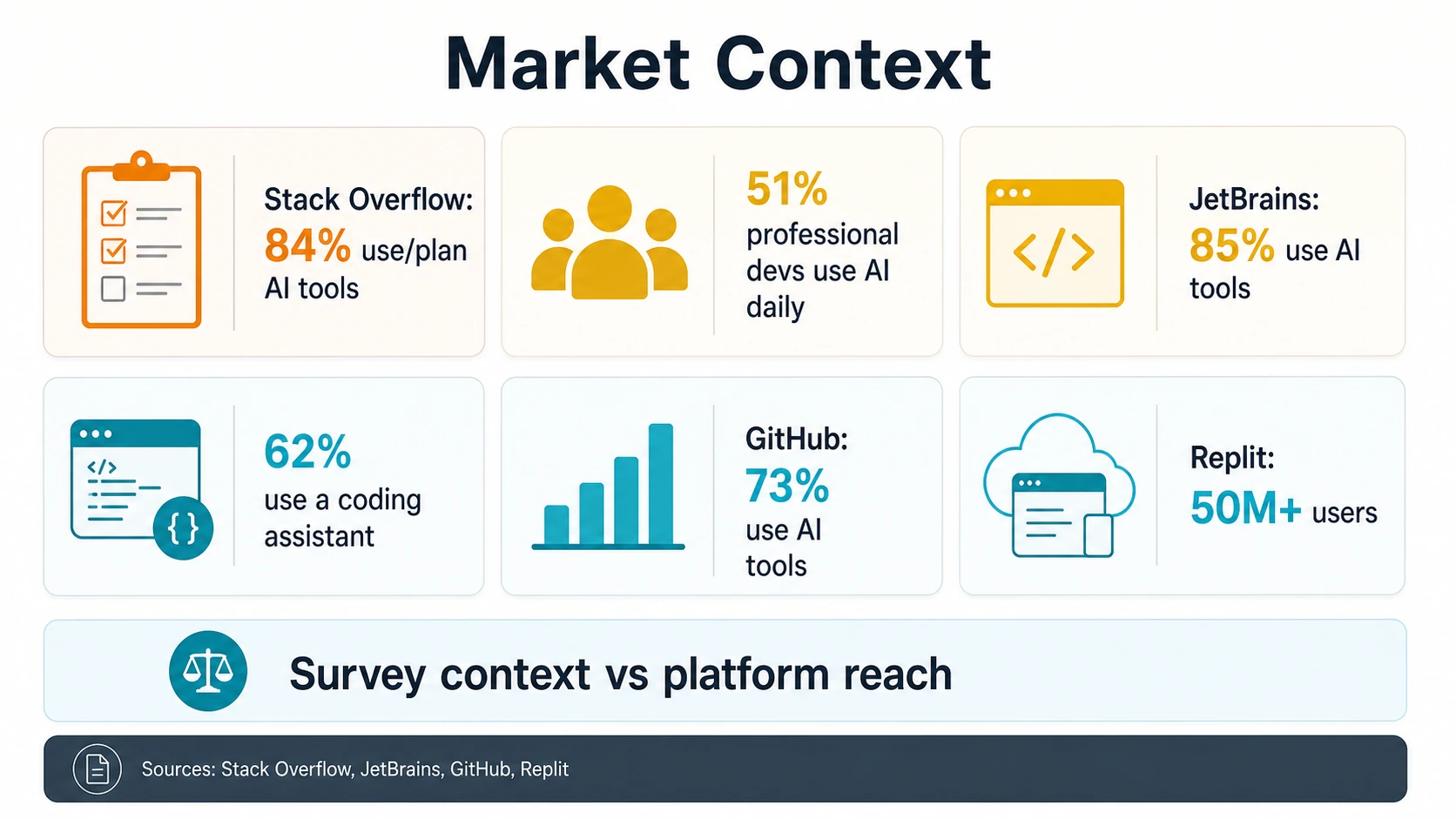
Those surveys are category context, not Replit market share. The honest comparison is structural: Copilot-style tools help inside a coding workflow, while Replit is trying to own a larger loop from idea to app, app to deployment, and deployment to monitored, shareable software (Replit AI, Agent overview, Deployments docs, Monitoring).
Replit Risks, Gaps, And Caveats
The biggest public-data gap is active usage. Replit discloses or is reported to have users, developers, projects, external visits, generated apps, paying users, a revenue trajectory, and a valuation — but it does not publish a current public MAU, DAU, retention, net revenue retention, deployed-app total, churn, or active-team count (Replit, Business Insider, TechCrunch).
A user count shows reach, not active usage.
The 50M+ figure counts people who have built on Replit, not daily or monthly active developers.
A Fortune 500 footprint shows breadth, not spend.
The 85% figure counts companies with any Replit users, not paid seats, active teams, or standardization.
A valuation shows capital, not revenue.
The $9B valuation is a financing metric — Replit did not release updated ARR with the round.
A created Repl is not a production business.
The 240M+ Repls span class exercises, prototypes, hobby projects, and private workspaces, not just live services.
Pricing and product facts are date-sensitive.
Replit moved from Ghostwriter to Replit AI, launched Core and Pro, sunset Teams, and changed Core pricing — recheck official pages on the day you cite them.
The fourth caveat is source class. Replit’s official pages are strong for current product facts and official claims; TechCrunch and Business Insider are useful for private-company finance and memo-based metrics; developer surveys are useful for category context. SEO stat roundups, scraped database pages, LinkedIn reposts, Reddit threads, and social commentary should not anchor Replit user, revenue, or market-share claims when stronger sources are available.
The Operator’s Read On Replit
Replit’s 2026 numbers point to a broader shift: software creation is moving from a professional-developer-only workflow toward a mixed workflow where operators, product managers, designers, founders, students, and engineers all build software.
Reach view
Read 50M+ as breadth
The 50M+ user claim, 85% Fortune 500 reach, and non-engineer signup signals support a broadening audience — but the clean denominator is reach, not daily active usage.
ReplitFounder view
Pricing is the monetization signal
Core and Pro combine credits, collaborators, parallel agents, deployments, viewers, model access, and rollbacks — evidence that AI app-builders can monetize usage and capability, not just seats.
Replit pricingGTM view
Separate adoption from capability
Replit has strong evidence on reach, funding, run-rate target, product velocity, and use cases; it is weaker on retention, active usage, and production-app totals.
ReplitProduct view
Ask how much lifecycle it absorbs
The right comparison is not assistant vs assistant — it is how much of the loop Replit covers: prompting, planning, design, artifacts, connectors, databases, publishing, domains, monitoring, and security review.
Agent docsFor educators and community builders, Replit’s older developer numbers still matter. 20 million developers, 240M+ Repls, 30 million software creators, and 50M+ users show a platform long used for learning, experimentation, and sharing — the mistake would be to treat education and community reach as enterprise spend (Replit, Teams, Google Cloud award).
How To Keep The Numbers Straight
Use 50M+ users for reach, not active usage. Use 150,000+ paying users as of June 2025 only as a Business Insider-reported private-company denominator, not current official Replit billing data. Use $400M at $9B for financing, not revenue. Use the $1B run-rate target as a 2026 trajectory claim, not a completed annual result. Use 20M developers and 240M+ Repls as historical developer-community milestones; use 235M projects, 25B monthly external visits, and 1M concurrent containers as 2023 infrastructure context, not current Agent adoption; and use Agent 4, Lite/Economy/Power, Turbo, Core/Pro credits, and deployment types as current product facts checked on July 5, 2026 (Replit, TechCrunch, Business Insider, Replit pricing).
Frequently Asked Questions
How many users does Replit have in 2026?
Replit says more than 50 million users build apps on the platform, a figure it cited in April 2026 for its Google Cloud Partner of the Year recognition and in its March 2026 funding narrative. That is a reach and registered-user metric, not a count of monthly or daily active developers.
What is Replit worth?
Replit announced a $400 million round at a $9 billion valuation in March 2026, up from a $3 billion valuation about six months earlier. TechCrunch confirmed the $400 million Series D and $9 billion valuation but noted Replit did not release updated ARR with the round.
How much revenue does Replit make?
TechCrunch reported Replit reached $150 million in annualized revenue by September 2025, up from $2.8 million in under a year, and Business Insider reported about $240 million in annual sales in October 2025 from a leaked investor memo. Replit also says it is on track to hit $1 billion in run-rate revenue by the end of 2026, which is a target, not an audited result.
How many paying users does Replit have?
Business Insider reported over 150,000 paying users as of June 2025, out of a 40 million total user base at the time, based on a leaked investor memo. That figure should stay attributed and is not current July 2026 official Replit billing data.
What is Replit Agent and how fast is Agent 4?
Replit Agent is an AI system that can create and deploy applications from a natural-language prompt, first launched in September 2024. Agent 4, launched March 11, 2026, is claimed by Replit to ship production-ready apps 10x faster than Agent 3 and to build web apps, mobile apps, slide decks, data apps, and animations in one project.
How much does Replit cost?
As of July 5, 2026 Replit shows Starter (free), Core ($25 monthly or $20/month annually with $25 of monthly credits and up to 5 collaborators), Pro ($100 monthly or $95/month annually with $100 monthly credits and up to 15 collaborators), and Enterprise. AI features use usage-based billing, with Agent priced by the work it performs through checkpoints.
What deployment types does Replit support?
Replit documents four publishing modes: Autoscale, Static, Reserved VM, and Scheduled deployments. Autoscale is request-based and scales to zero when idle, defining 1 CPU second as 18 compute units and 1 GB-second as 2 compute units, while Reserved VM provides always-on dedicated resources.
Does Replit publish a monthly active user number?
No. Replit does not publish a current public MAU, DAU, retention, net revenue retention, deployed-app total, or churn figure. Its public statistics are user-reach, funding, valuation, revenue-trajectory, paying-user, and product-surface metrics, each with its own denominator.
Sources and Further Reading
Replit funding, revenue & company posts
Replit AI, Agent, pricing & deployment docs
Historical scale, enterprise, security & customers