OpenAI Statistics
Last updated on July 15, 2026

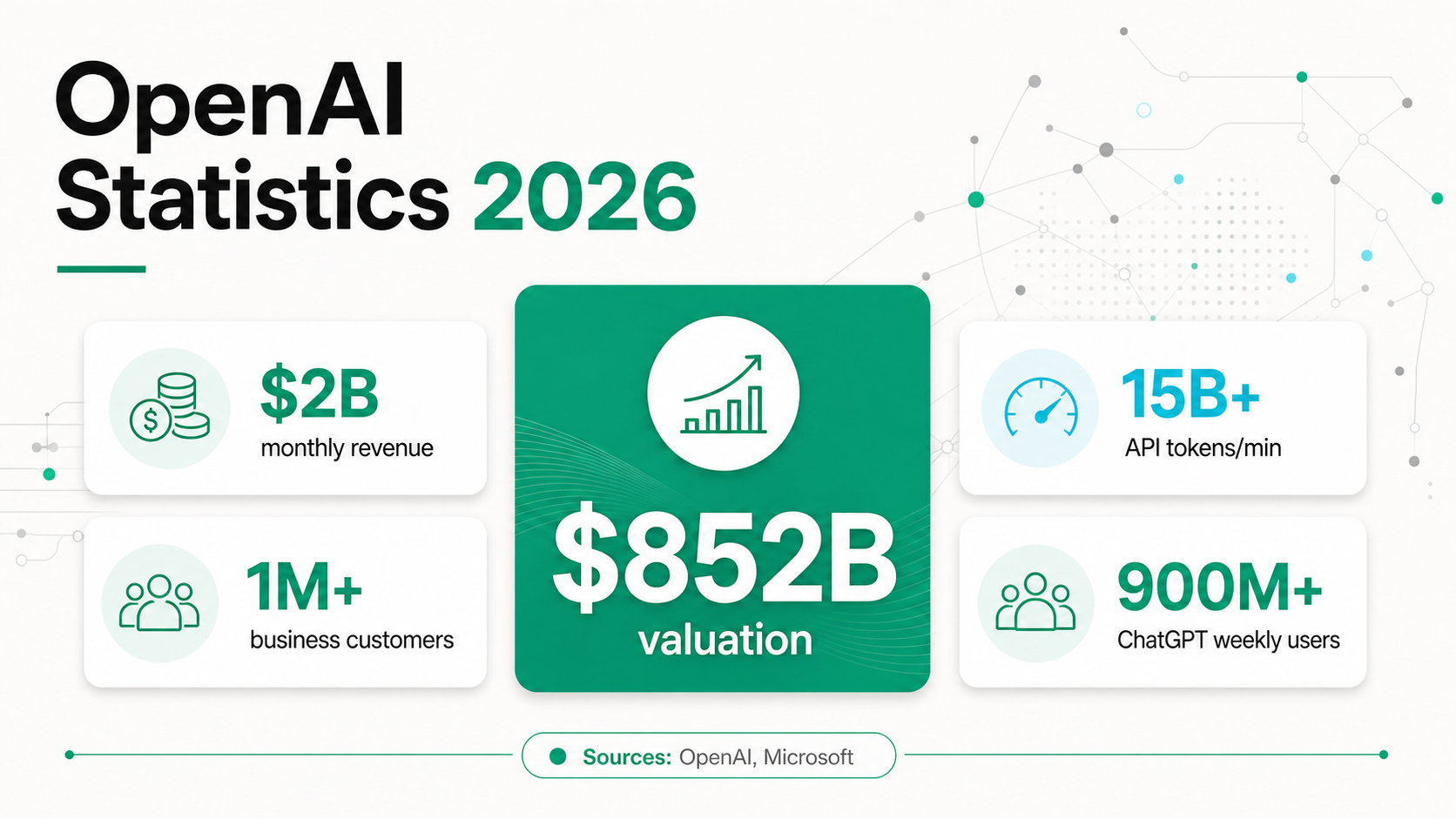
OpenAI in 2026 is hard to describe with a single kind of statistic. It is a model lab, a consumer app operator, an enterprise vendor, a developer platform, a coding-agent provider, a compute buyer, and a private-capital story all at once — so its numbers only make sense with careful labels.
An $852 billion post-money valuation, $2 billion in monthly revenue, 900 million-plus weekly ChatGPT users, 1 million-plus business customers, and 15 billion-plus API tokens per minute are all real and all useful — but they measure different things. Collapse them into one “OpenAI users” figure and the numbers become exciting but wrong.
The safest way to read OpenAI is as a layered platform. ChatGPT gives it consumer distribution; business plans turn distribution into workplace adoption; the API turns models into infrastructure for other products; Codex and agent tooling extend it into long-running work; compute partnerships and capital rounds fund the next layer of models; benchmark scores describe capability; and security pages describe deployability. Each layer has its own denominator.
The OpenAI Numbers That Matter
The headline OpenAI numbers use different denominators, so read them as separate company, customer, platform, and consumer signals rather than one figure.
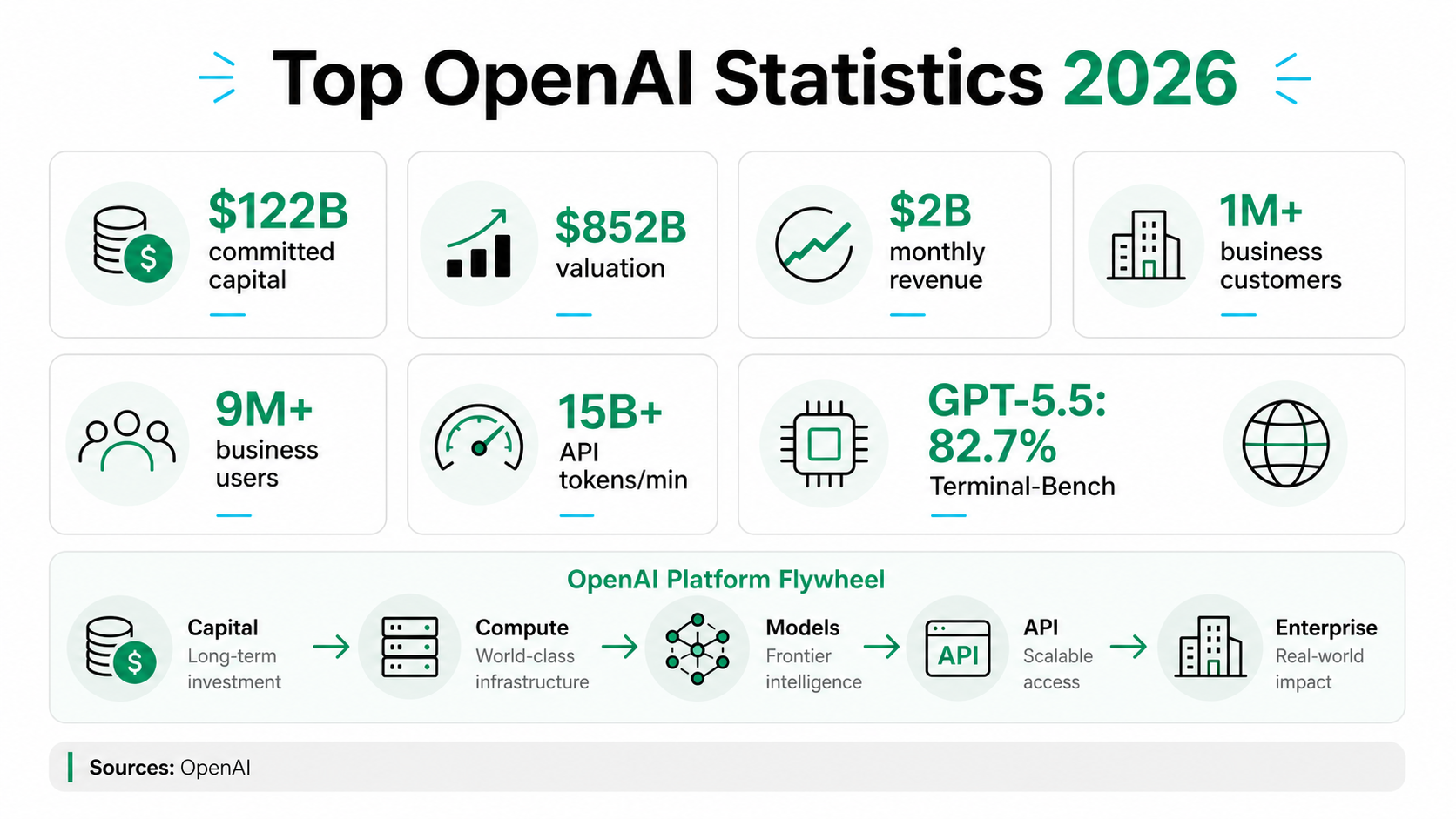
Company scale (official OpenAI statements)
Platform, customers & consumer reach
Read every number by its own denominator
OpenAI's headline figures answer different questions. Tap a metric to see what it measures — and what it does not prove.
OpenAICompany Scale: Revenue, Valuation, Capital, And Structure
OpenAI’s company-scale numbers are extraordinary even before any product detail. On March 31, 2026 it said it had closed its latest round with $122 billion in committed capital at an $852 billion post-money valuation in its funding announcement. That followed a February 2026 announcement of $110 billion in new investment at a $730 billion pre-money valuation, including $30 billion from SoftBank, $30 billion from NVIDIA, and $50 billion from Amazon in its scaling update.
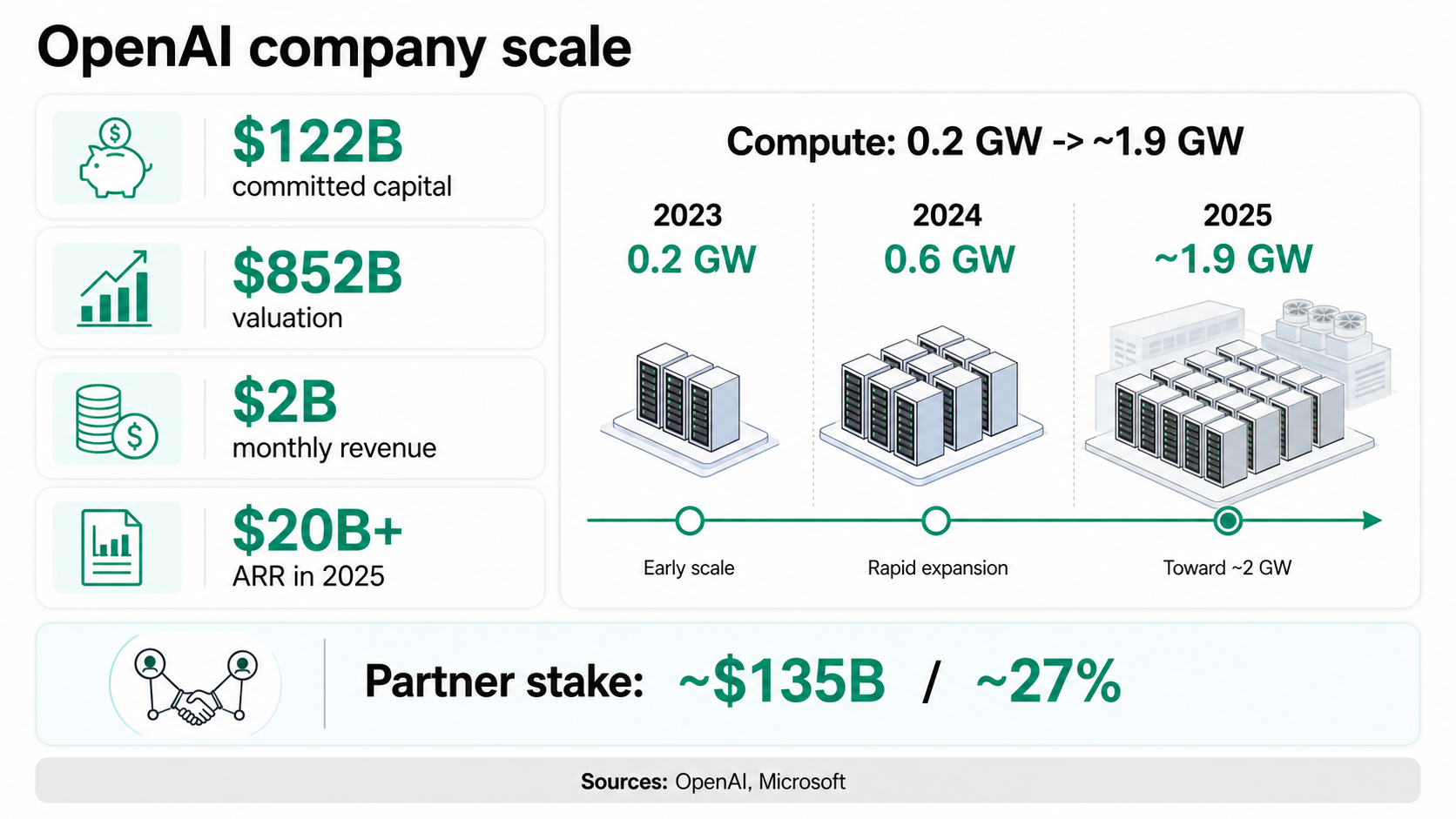
OpenAI paired those capital figures with revenue scale. In the March announcement it said it was generating $2 billion in revenue per month, and in a separate business-model post it said revenue grew roughly 3× year over year — from $2 billion ARR in 2023 to $6 billion in 2024 and more than $20 billion in 2025. Because OpenAI is still private, these are official company statements, not public-company audited segment disclosures.
ARR — three years, roughly 3× a year
Each point is an official OpenAI ARR statement on a linear axis, so the steepening rise is the story: revenue roughly tripled year over year from 2023 to 2025.
OpenAIThe compute bridge is just as important as the revenue bridge. OpenAI says compute grew from 0.2 GW in 2023 to 0.6 GW in 2024 and about 1.9 GW in 2025, nearly tracking the revenue curve (business-model post). That matters because OpenAI is not only a software-distribution story; it is also a capacity story, where more compute supports training, serving, lower latency, higher throughput, and cheaper delivery at scale.
Compute capacity (gigawatts, company-reported)
Compute capacity is a capacity metric, not a usage or demand metric. Source: OpenAI business-model post.
The Microsoft relationship is another company-scale statistic, but it should not be simplified into “Microsoft controls OpenAI.” OpenAI says the nonprofit is now the OpenAI Foundation and the for-profit is OpenAI Group PBC, with the Foundation continuing to control the Group through special voting and governance rights (structure page). Microsoft says it holds an investment valued at roughly $135 billion, about 27% on an as-converted diluted basis, after previously holding 32.5% of the for-profit (Microsoft, OpenAI).
Microsoft’s 2025 annual report adds a filing-grade anchor: it said it had made total funding commitments of $13 billion to OpenAI Global, LLC and accounts for the investment under the equity method. Microsoft also said OpenAI contracted to buy an incremental $250 billion of Azure services and that Microsoft no longer had a right of first refusal to be OpenAI’s compute provider; the SEC 8-K furnished that partnership blog as an exhibit, confirming it was not just marketing copy.
Business Platform And Enterprise Adoption
OpenAI’s business platform now has enough public data to separate reach from depth. The reach metric is more than 1 million business customers — organizations actively paying OpenAI for business use, either through ChatGPT for Work or direct model consumption on the developer platform (1M businesses). Named customers include Amgen, Commonwealth Bank, Booking.com, Cisco, Lowe’s, Morgan Stanley, T-Mobile, Target, and Thermo Fisher Scientific.
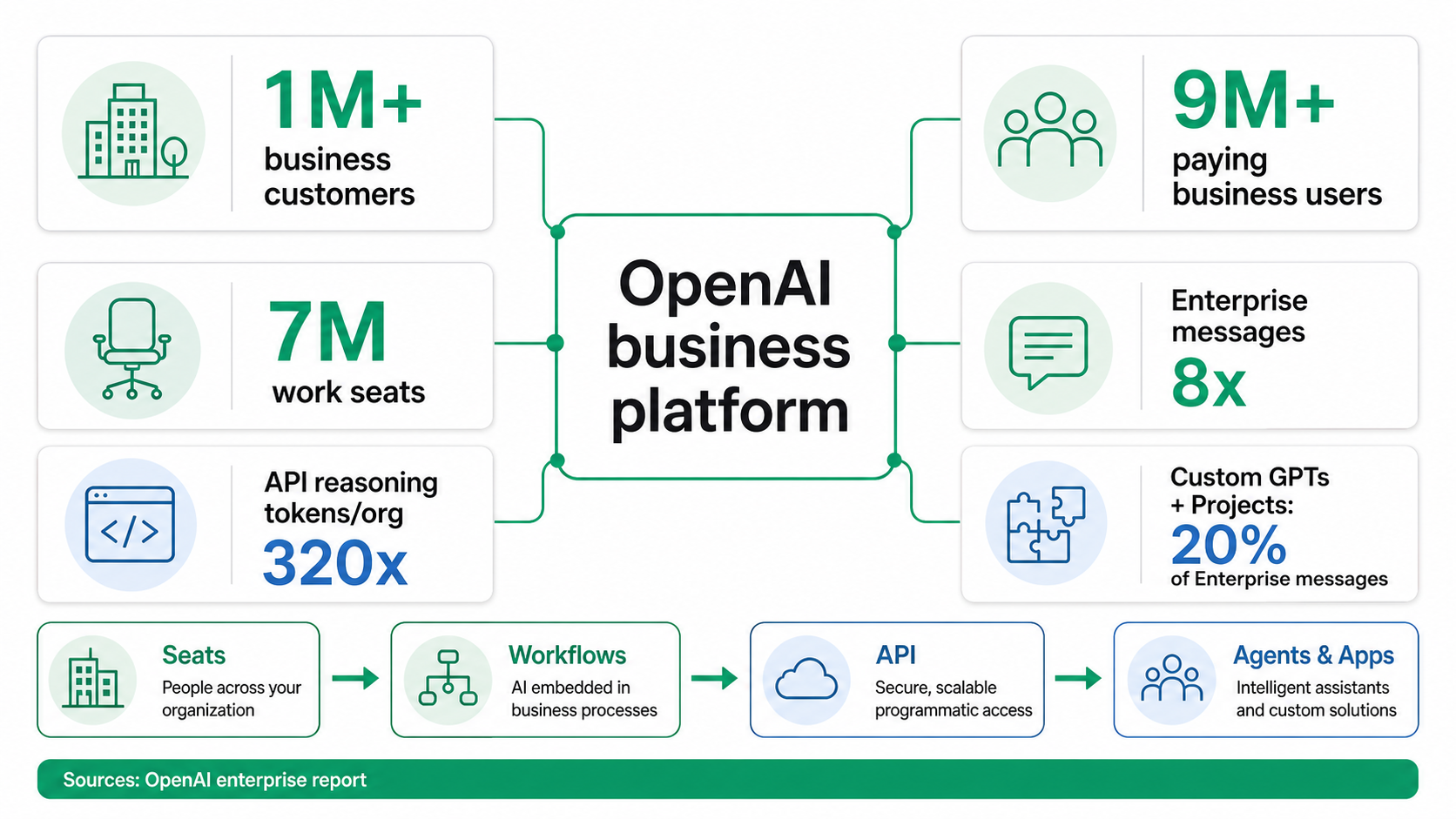
The user and seat numbers are different objects. OpenAI said more than 9 million paying business users rely on ChatGPT for work (scaling update). A few months earlier it said ChatGPT for Work had more than 7 million total seats, up 40% in two months, and that ChatGPT Enterprise seats specifically had grown 9× year over year (1M businesses). A company can have many seats, one paying seat, or direct API consumption, so “customer,” “seat,” and “user” should stay separate.
Customer breadth
1M+ business customers
Organizations paying for business use via ChatGPT for Work or direct developer-platform consumption — a reach metric, not a usage count.
OpenAIPaid users
9M+ paying business users
People relying on ChatGPT for work — distinct from the customer count and from total seats.
OpenAIMessage depth
Enterprise messages 8×
Weekly Enterprise messages grew about 8× since November 2024, while the average employee sent 30% more messages.
OpenAI enterprise reportWorkflow surfaces
~19× Custom GPTs & Projects
Weekly users of Custom GPTs and Projects rose roughly 19× year-to-date, and about 20% of Enterprise messages ran through one recently.
OpenAI enterprise reportThe depth metrics come from OpenAI’s State of Enterprise AI report, which also shows API intensity inside organizations: more than 9,000 organizations had processed over 10 billion API reasoning tokens, and nearly 200 had exceeded 1 trillion. That is a better production signal than a logo list because it shows repeated use at high token thresholds — but it still does not reveal total API customers, retention, or spend distribution.
Customer examples are compelling but should stay in their lane. OpenAI says Cisco used Codex in engineering workflows and cut code-review times by 50%, while Carlyle’s AgentKit evaluation platform cut development time on a multi-agent due-diligence framework by over 50% and improved agent accuracy by 30% (1M businesses). Those examples show what can happen in specific deployments, not average ROI across all OpenAI customers.
API And Developer Ecosystem
OpenAI’s developer ecosystem is large, but the clean public stats are still limited. DevDay 2025 says 4 million developers had built with OpenAI. That is a powerful reach statistic, but “have built” is cumulative — it is not the same as monthly active developers, paying API accounts, or production applications.
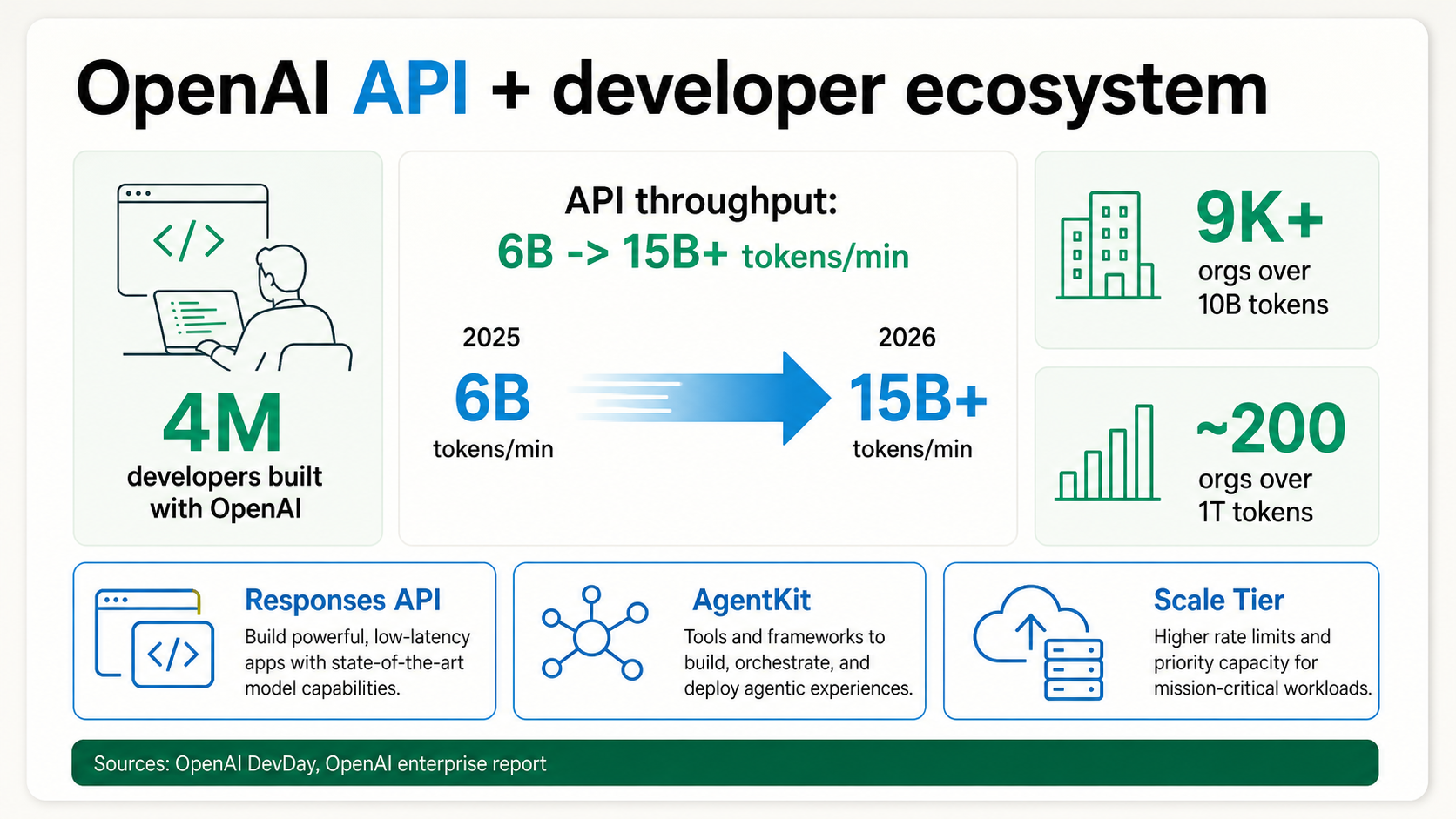
The API throughput numbers are more direct. DevDay 2025 listed 6 billion tokens per minute on the API platform; in 2026 OpenAI said its APIs process more than 15 billion tokens per minute (enterprise update). For a platform operator, tokens per minute is closer to infrastructure utilization than to user count — it reflects throughput, not necessarily customer diversity.
The platform has also shifted from “call a model” toward “build an agent.” OpenAI’s March 2025 agent-tools post introduced the Responses API, built-in tools such as web search, file search, and computer use, the Agents SDK, and tracing for agent workflows; AgentKit later added Agent Builder, a Connector Registry, ChatKit, and expanded evaluation features. There is a current-product caveat, though: OpenAI’s Agent Builder documentation says Agent Builder is being deprecated and is scheduled to shut down on November 30, 2026, while ChatKit remains available. For builders, that is exactly why current platform statistics need dates — a launch metric can become a migration note within a year.
OpenAI API pricing (per 1M tokens, input / output)
Enterprise API capacity is a separate product. OpenAI’s Scale Tier lets customers buy token units with a minimum purchase period, using a combined input/output token-per-minute bundle for GPT-5.4 where output tokens count by the pay-as-you-go output-to-input ratio. That matters for buyers because OpenAI’s platform economics are not only list price per token — they also include latency, throughput, caching, batch discounts, priority processing, and contract-level commitments.
Model Families, Benchmarks, And Pricing
GPT-5.5 is the strongest current example of OpenAI’s capability layer. OpenAI says GPT-5.5 is rolling out in ChatGPT and Codex and, after an April 24, 2026 update, GPT-5.5 and GPT-5.5 Pro are available in the API, with a 400K context window in Codex and 1M context for API developers (GPT-5.5).
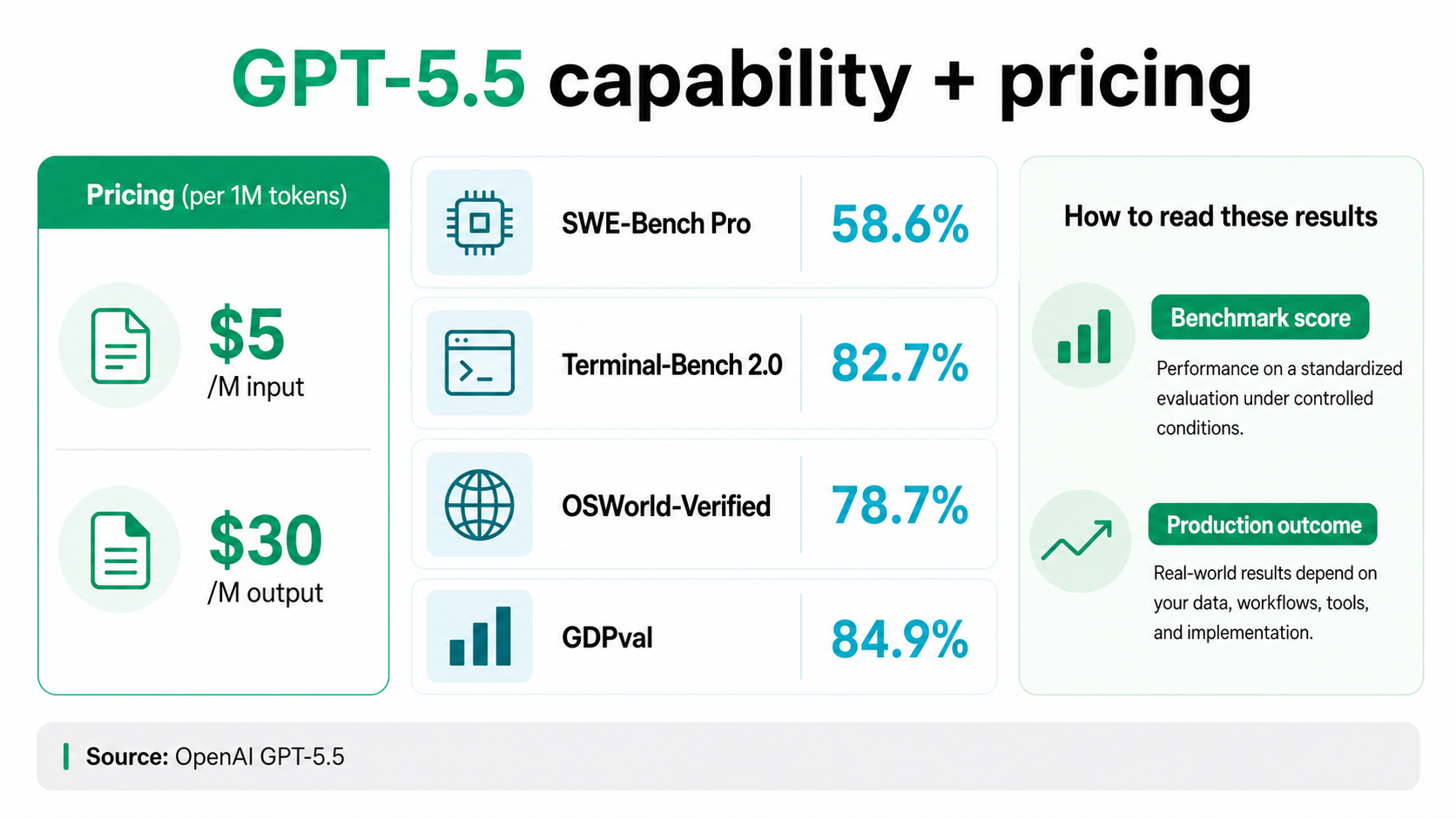
OpenAI’s GPT-5.5 release gives a useful benchmark spread across coding, professional work, computer use, tool use, academic tasks, cybersecurity, and long context.
The benchmark caveat belongs right next to the numbers. OpenAI notes that some evaluations ran with reasoning effort set to xhigh and in a research environment, which may differ from production ChatGPT behavior. A 82.7% Terminal-Bench 2.0 score does not mean every terminal automation succeeds 82.7% of the time inside a company’s repository, tool stack, permissions, and review process. For release-cadence context, GPT-5.4 scored 57.7% SWE-Bench Pro, 75.1% Terminal-Bench 2.0, and 83.0% GDPval, with a clearer enterprise-work emphasis on spreadsheets, presentations, documents, and Codex integration.
The model release notes show how fast this layer changes: in May 2026, OpenAI updated GPT-5.5 Instant and retired older ChatGPT models including o3 and GPT-4.5, while noting no API changes for those retirements. That is why model stats need a publication date, not just a number.
Consumer Distribution: ChatGPT Reach Is Not The Whole OpenAI Story
OpenAI’s consumer distribution is why many of the business-platform numbers matter. The company says ChatGPT has more than 900 million weekly active users and more than 50 million consumer subscribers (scaling update), up from the 800 million-plus weekly users it cited at DevDay 2025.
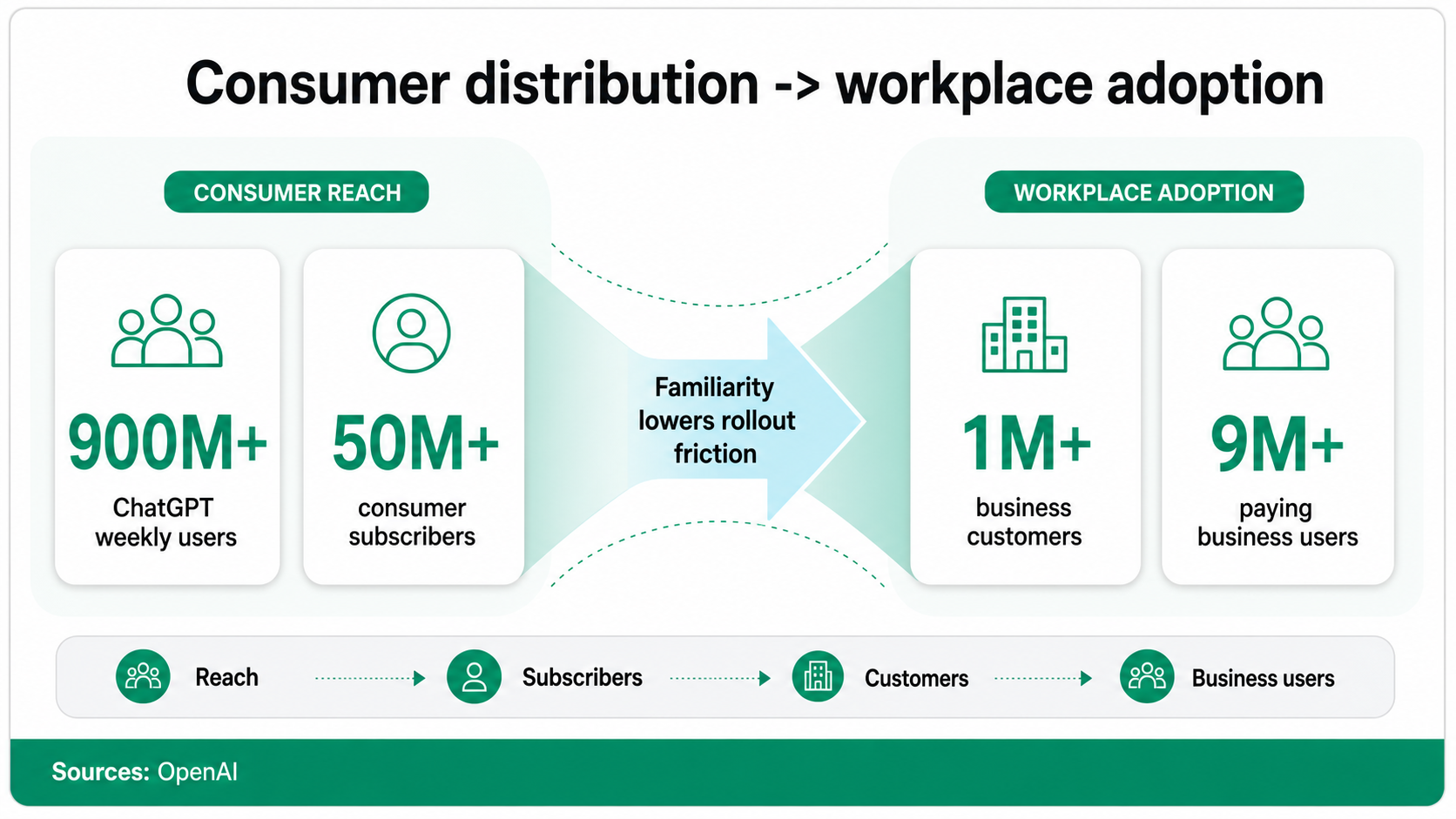
From consumer reach to workplace adoption
The top of the funnel — consumer reach and familiarity, growing from 800M+ at DevDay 2025.
Paying individuals on consumer plans — distinct from business seats and API accounts.
The workplace layer, built on ChatGPT for Work and the developer platform — where reach turns into paid adoption.
OpenAI’s own enterprise report says broad consumer familiarity can shorten pilots — but value shows up only when companies embed AI into workflows with admin controls, data policy, and procurement.
ChatGPT distribution and business adoption are different objects. Tap each layer to see what it counts and how it converts.
OpenAIThose numbers should not be turned into a ChatGPT-only growth story. ChatGPT weekly users are not business customers; consumer subscribers are not API customers. Consumer familiarity can shorten pilots, but business rollouts still depend on admin controls, data policy, use cases, procurement, security review, and integration — as OpenAI itself notes across its business data and enterprise privacy pages. A product can have massive reach and still need a different go-to-market motion for business adoption.
Compute, Infrastructure, And Partnerships
Compute is one of the clearest differences between OpenAI and a normal SaaS company. OpenAI calls compute the scarcest resource in AI and describes its portfolio as diversified across providers, with high-end hardware for frontier training and lower-cost infrastructure for high-volume serving (business-model post). The numbers are concrete: 0.2 GW in 2023, 0.6 GW in 2024, and about 1.9 GW in 2025.
The February 2026 capital update tied investment directly to compute and partnerships: $50 billion from Amazon, $30 billion from NVIDIA, and $30 billion from SoftBank, alongside a strategic partnership with Amazon and next-generation inference compute with NVIDIA. The Microsoft agreement adds another dimension through the $250 billion incremental Azure service purchase and changes to right-of-first-refusal language (Microsoft).
Trust, Privacy, Safety, And Governance
OpenAI’s enterprise numbers become more meaningful when paired with its trust controls. OpenAI says it does not train models on organization data by default across ChatGPT Enterprise, Business, Edu, Healthcare, Teachers, and the API platform, and that business data is encrypted at rest with AES-256 and in transit with TLS 1.2 or higher (business data).
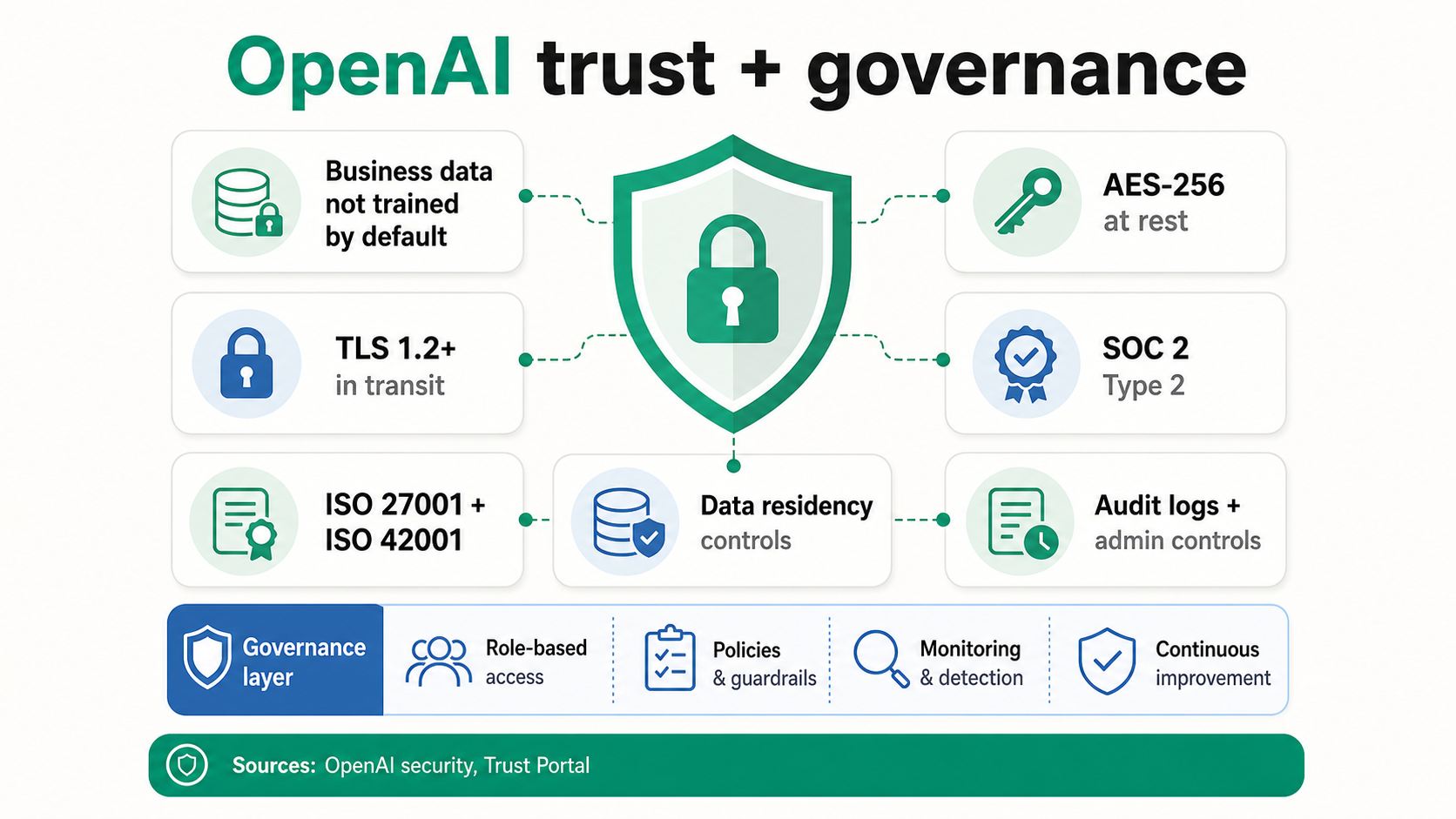
Data controls
No training on org data by default
Applied across ChatGPT Enterprise, Business, Edu, Healthcare, Teachers, and the API platform, with zero data retention for qualifying API customers.
OpenAI business dataEncryption
AES-256 at rest · TLS 1.2+ in transit
Alongside retention controls, data residency, in-region GPU inference options, MFA, SAML SSO, SCIM, RBAC, audit logs, and an Admin API.
OpenAI business dataCompliance
SOC 2 Type 2 · ISO 27001 / 42001
OpenAI reports a SOC 2 Type 2 examination and ISO/IEC 27001, 27017, 27018, 27701, and 42001 certifications in specified scopes.
OpenAI securitySafety posture
System cards & offline evals
The GPT-5.5 system card describes offline evaluations plus additional API safeguards — valuable for risk posture, but not a replacement for customer-side governance.
GPT-5.5 system cardOpenAI’s security page lists the SOC 2 Type 2 examination and ISO/IEC 27001, 27017, 27018, 27701, and 42001 certifications in specified scopes, and the Trust Portal says the most recent SOC 2 report covers January 1, 2025 to June 30, 2025 for the API Platform, ChatGPT Enterprise, Edu, and Team. Safety is a separate category from security compliance — system cards describe model risk posture, but they do not replace customer-side red teaming, monitoring, and use-case validation.
Market Context: What OpenAI Numbers Mean In The Broader AI Economy
OpenAI’s scale sits inside a market expanding quickly. Stanford’s 2026 AI Index says industry produced over 90% of notable frontier models in 2025, organizational adoption reached 88%, generative AI reached 53% population adoption within three years, and U.S. private AI investment hit $285.9 billion in 2025.
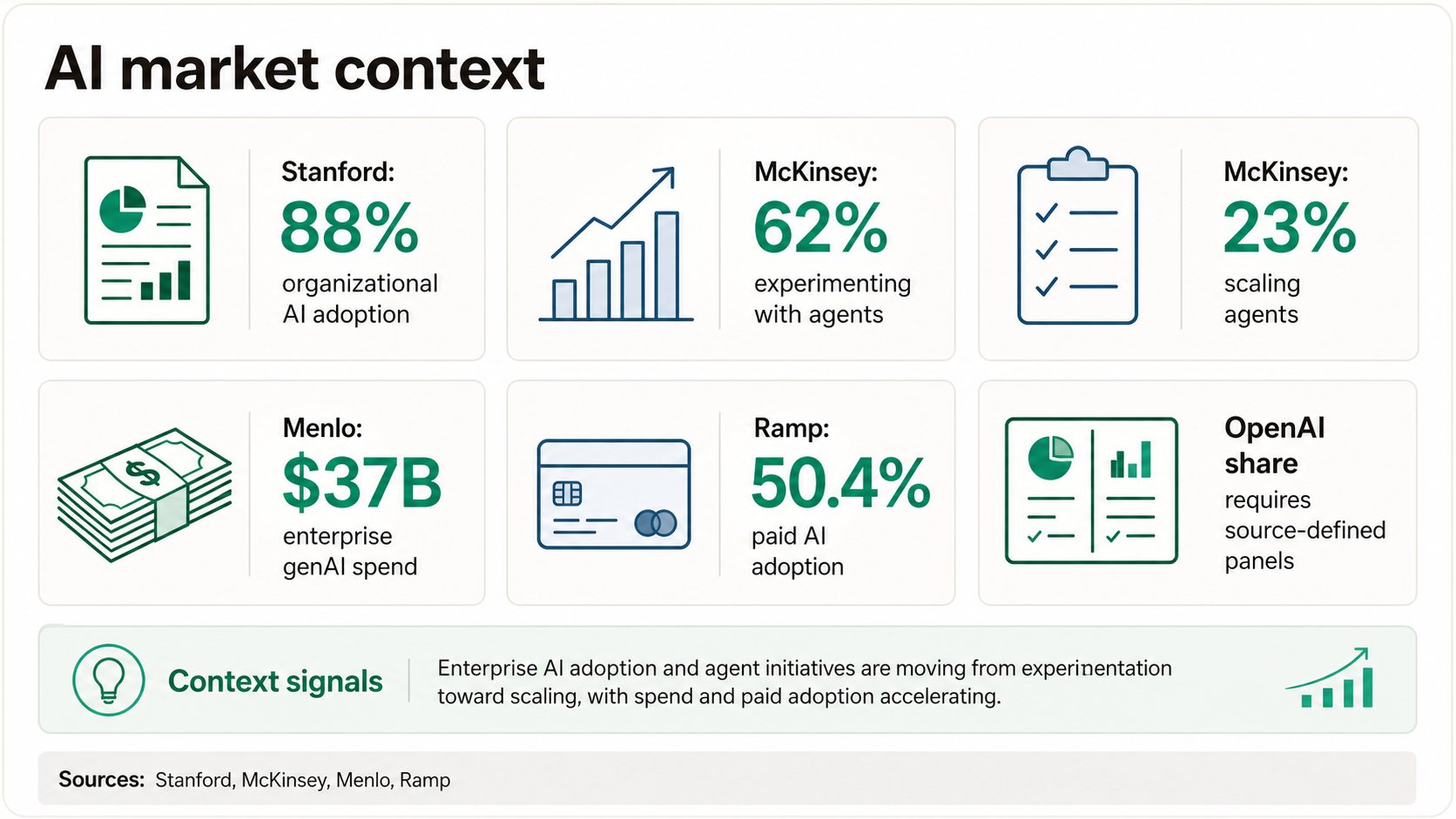
McKinsey’s 2025 survey gives the counterweight: 88% of organizations regularly use AI in at least one function, up from 78% a year earlier, but roughly one-third had begun scaling AI while nearly two-thirds remained in experimentation or pilots. Menlo Ventures’ enterprise generative-AI report estimates $19 billion in application-layer and $18 billion in infrastructure spend in 2025, with departmental AI spend of $7.3 billion — coding alone at $4.0 billion, or 55% of departmental spend, which helps explain why Codex matters for the broader platform.
Ramp’s April 2026 update adds a paid-spend panel: among Ramp businesses, paid AI adoption crossed 50.4% in March, with OpenAI at 35.2% and Anthropic at 30.6%. Ramp says its index uses corporate-card and invoiced payments, so this is a business-spend signal, not a universal market-share census. The pattern across these sources is useful: AI adoption is broad, agent adoption is rising, enterprise scaling is uneven, and paid vendor selection can shift quickly.
What This Means For Founders And Operators
The practical lesson is not simply that OpenAI is big. It is that OpenAI’s scale is multi-dimensional and each number answers a different operating question.
OpenAI can claim every layer at once.
Consumer distribution, business adoption, developer reach, API throughput, model cadence, capital access, and enterprise controls — very few AI companies have all of those in public numbers.
API throughput is a top-tier platform signal.
15B+ tokens per minute, 9,000+ orgs above 10B reasoning tokens, and nearly 200 above 1T all point to a large, growing production workload base — not just experimentation.
The strongest numbers do not erase the missing ones.
There is no clean product-by-product revenue split, gross margin, profitability, net revenue retention, paid API customer count, monthly active developers, or independent average ROI by deployment.
Benchmarks are one part of buyer evaluation.
GPT-5.5 scores well across coding, terminal, computer-use, and academic tasks, but production value also depends on price, latency, context, data policy, connectors, evals, and human review.
OpenAI creates room for dependency and differentiation.
Strong primitives — models, APIs, agent tooling, ChatKit, Codex, enterprise controls — lower the floor, but the opportunity is workflow specificity: domain data, process integration, auditability, and measurable outcomes.
Reading OpenAI’s Numbers With Discipline
Use official OpenAI pages for first-party facts — revenue statements, funding announcements, product availability, API pricing, model releases, business customers, enterprise usage, and security controls. Use Microsoft and SEC sources for Microsoft/OpenAI partnership and investment facts. Use Stanford, McKinsey, Menlo, and Ramp for the market around OpenAI, not as replacements for OpenAI-specific data. Treat SEO statistic roundups, scraped database pages, and social posts as leads to verify, not final evidence.
Frequently Asked Questions
What is OpenAI worth in 2026?
On March 31, 2026, OpenAI said it had closed its latest round with $122 billion in committed capital at an $852 billion post-money valuation. This is a private post-money valuation set by investors, not a public-market capitalization, and OpenAI has said it might remain private for a while even after filing a confidential S-1.
How much revenue does OpenAI make?
OpenAI said in March 2026 that it was generating $2 billion in revenue per month, and separately reported ARR growth from $2 billion in 2023 to $6 billion in 2024 and more than $20 billion in 2025. Because OpenAI is still private, these are official company statements rather than audited GAAP segment disclosures.
How many users does ChatGPT have?
OpenAI says ChatGPT has more than 900 million weekly active users and more than 50 million consumer subscribers, up from 800 million-plus weekly users cited at DevDay 2025. Weekly active users are a ChatGPT distribution metric, not a count of OpenAI business customers or API customers.
How many business customers does OpenAI have?
OpenAI reports more than 1 million business customers, defined as organizations paying for business use through ChatGPT for Work or direct model consumption on the developer platform, plus more than 9 million paying business users. Customer, seat, and user are distinct: the company separately reported over 7 million ChatGPT for Work seats.
How much compute does OpenAI have?
OpenAI says its compute capacity grew from 0.2 gigawatts in 2023 to 0.6 gigawatts in 2024 and about 1.9 gigawatts in 2025. These are capacity figures tied to partnerships and investment, such as $50 billion from Amazon and $30 billion from NVIDIA, not measures of live demand or utilization.
How good is GPT-5.5 on benchmarks?
OpenAI reports GPT-5.5 results including 58.6% on SWE-Bench Pro, 82.7% on Terminal-Bench 2.0, 78.7% on OSWorld-Verified, and 84.9% GDPval wins or ties. OpenAI notes some evaluations ran at elevated reasoning effort in a research environment, so a benchmark score is a capability signal, not a guaranteed production success rate.
How much of OpenAI does Microsoft own?
Microsoft says that after recapitalization it holds an investment in OpenAI Group PBC valued at about $135 billion, roughly 27% on an as-converted diluted basis, down from 32.5% of the for-profit previously. Microsoft also said OpenAI contracted to buy an incremental $250 billion of Azure services and that Microsoft no longer holds a right of first refusal to be OpenAI’s compute provider.
Does OpenAI publish profit or margin numbers?
No. OpenAI publishes revenue statements, funding, valuation, user reach, business customers, and API throughput, but not a clean product-by-product revenue split, gross margin, profitability, net revenue retention, paid API customer count, or monthly active developers. Those gaps are normal for a private company and should shape how the available numbers are read.
Sources and Further Reading
Official OpenAI funding, revenue & scale
Models, API, pricing & developer platform
Enterprise usage, trust & Microsoft partnership