AI Search Statistics
Last updated on July 15, 2026

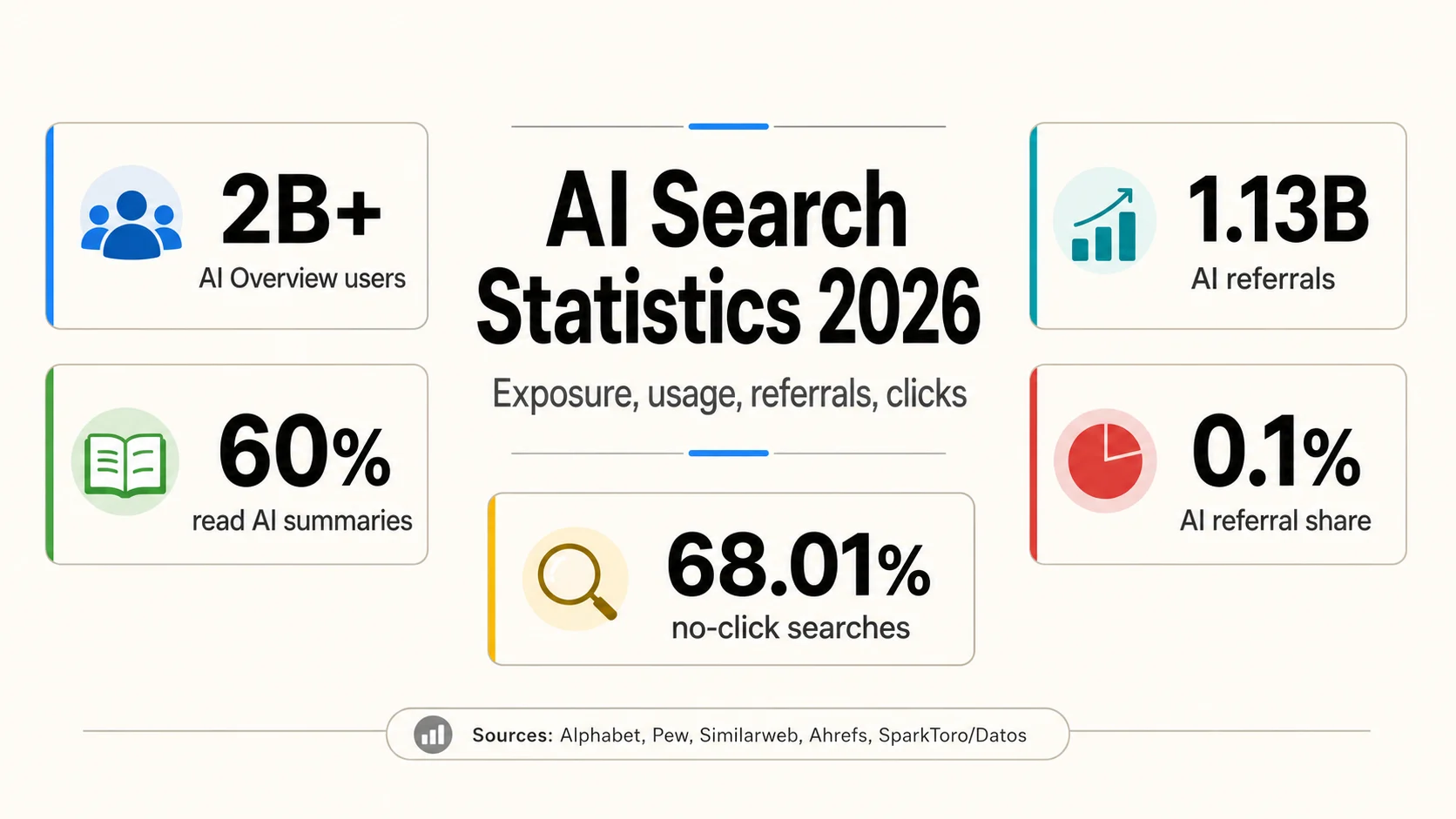
AI search is already big enough to measure in 2026, but not with one clean market-share number. The strongest public data points live in different buckets: Google-scale AI answers inside search results, consumer use of AI for information, standalone answer-engine visits, AI assistant referrals to websites, no-click search behavior, and the money still flowing through traditional search advertising.
That separation matters. A person who reads an AI summary in Google Search is not the same denominator as a person who uses ChatGPT Search every week. A visit from Perplexity is not the same thing as an active AI-search user. A Google AI Overview impression is not a website referral. Search ad revenue is not AI-search market size. The useful 2026 view is a denominator map: exposure, usage, visits, referrals, clicks, citations, and spend — each measured by its own base.
Where AI Search Stands In 2026
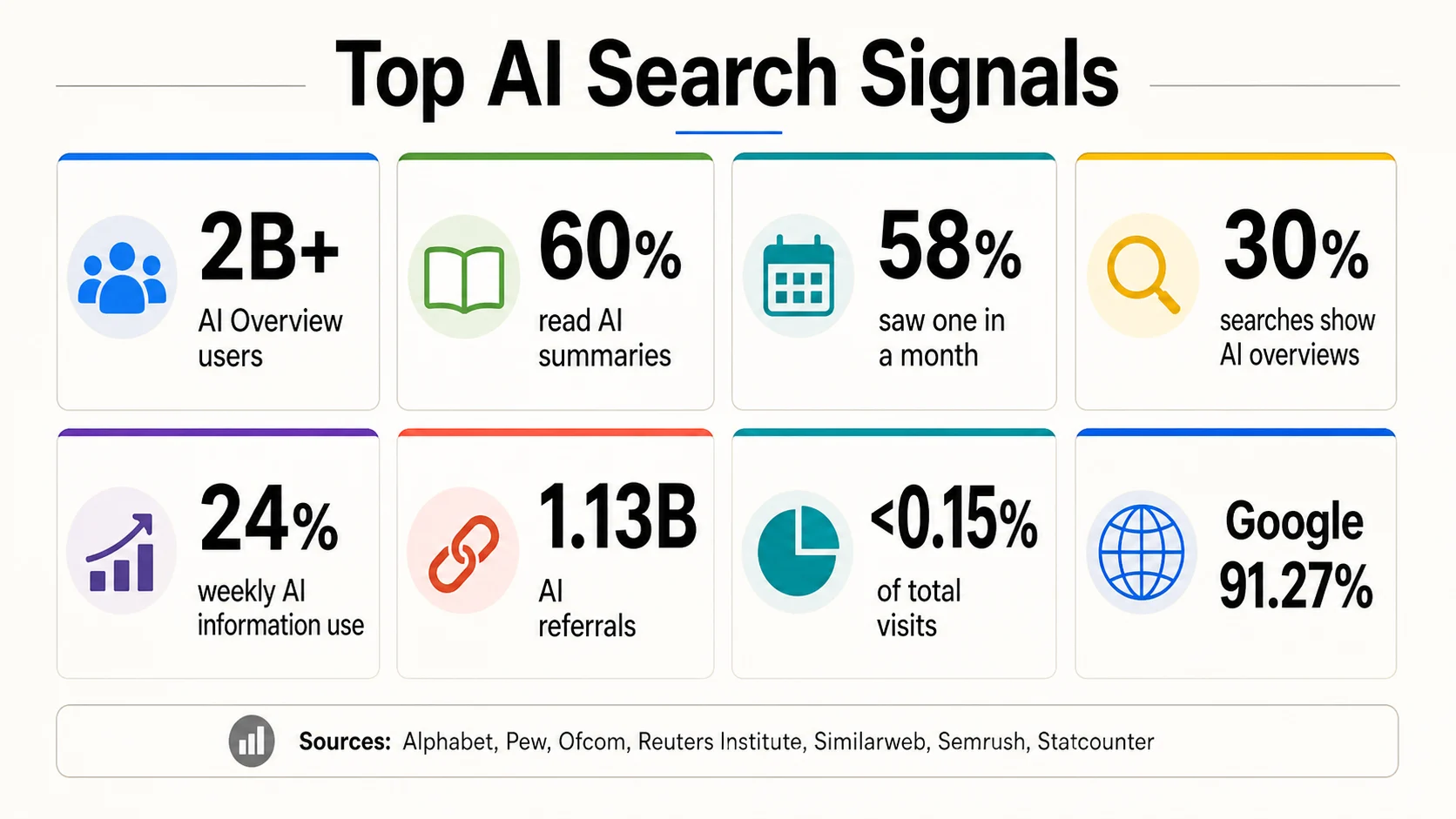
The headline AI-search numbers all use different denominators, so read them as separate exposure, usage, referral, and click signals rather than one figure.
Exposure & usage (official disclosures and surveys)
Referrals, clicks & market baseline
Read every number by its own denominator
AI-search figures answer different questions. Tap a metric to see what it measures — and what it does not prove.
Pew, Similarweb, SparkToro, IABWhat Actually Counts As AI Search?
AI search is not one product category with one denominator. It is a set of search and discovery experiences that use generative AI to retrieve, summarize, cite, compare, or act on web information.
The first layer is AI inside traditional search results. Google Search Central describes AI Overviews and AI Mode as search features that surface relevant links and may use query fan-out, where the system issues multiple related searches across subtopics and data sources to build a response (Google Search Central). Google’s 2026 optimization guide says generative AI features in Search are rooted in core ranking and quality systems, use retrieval-augmented generation, and rely on crawlable, indexed content from the Search index (Google Search Central).
AI inside traditional search results
Google AI Overviews and AI Mode; Bing generative search. Answers appear on top of the classic results page, often via query fan-out.
Assistant search
ChatGPT Search, available to Free, Plus, Team, Edu, and Enterprise users through chatgpt.com and the apps, plus Copilot answer surfaces.
Answer engines
Perplexity returns conversational answers backed by verifiable sources; Brave builds AI answers into Brave Search with contextual enrichments.
AI-mediated discovery
Product comparison, retail, travel, and banking journeys that may never look like search, yet route users to sites via generative AI.
The second layer is assistant search. OpenAI’s help center says ChatGPT Search is available to ChatGPT Free, Plus, Team, Edu, and Enterprise users and can be reached through chatgpt.com and the desktop and mobile apps (OpenAI Help Center). OpenAI’s crawler docs distinguish OAI-SearchBot, GPTBot, and other user agents so site owners can manage how OpenAI products access their content (OpenAI docs). Microsoft has Bing generative search and Copilot answer surfaces, and its 2026 Bing Webmaster Tools preview shows citations across Microsoft Copilot, AI-generated summaries in Bing, and partner integrations (Bing Webmaster Tools).
The third layer is answer engines. Perplexity says it searches the web and returns conversational answers backed by verifiable sources (Perplexity Help Center). Brave says its AI-powered answers are built into Brave Search and that Ask Brave combines AI Answers, longer follow-ups, and contextual enrichments such as videos, news, products, and shopping (Brave AI, Ask Brave). These tools are part of AI search, but their visits or queries should not be treated as the whole AI-search market.
The fourth layer is AI-mediated discovery that may not look like search at all. Adobe’s retail data measures traffic from generative AI sources to commerce sites, while McKinsey frames AI-powered search as part of consumer product discovery and decision journeys (Adobe, McKinsey). A buyer may ask an assistant to compare products, read a generated answer, click one source, search the brand later on Google, and finally convert through a direct visit. Only one of those steps may show up as an AI referral.
Adoption: Exposure Is Bigger Than Habit
The broadest adoption-style numbers in 2026 are exposure numbers. Pew’s February 2026 result that 60% of U.S. adults have read AI summaries at the top of search results is strong proof that AI-generated search summaries are mainstream enough for ordinary users to notice (Pew). Pew’s browsing panel adds behavioral grounding: 58% of respondents had at least one search query with an AI-generated summary during the observed month (Pew Data Labs).
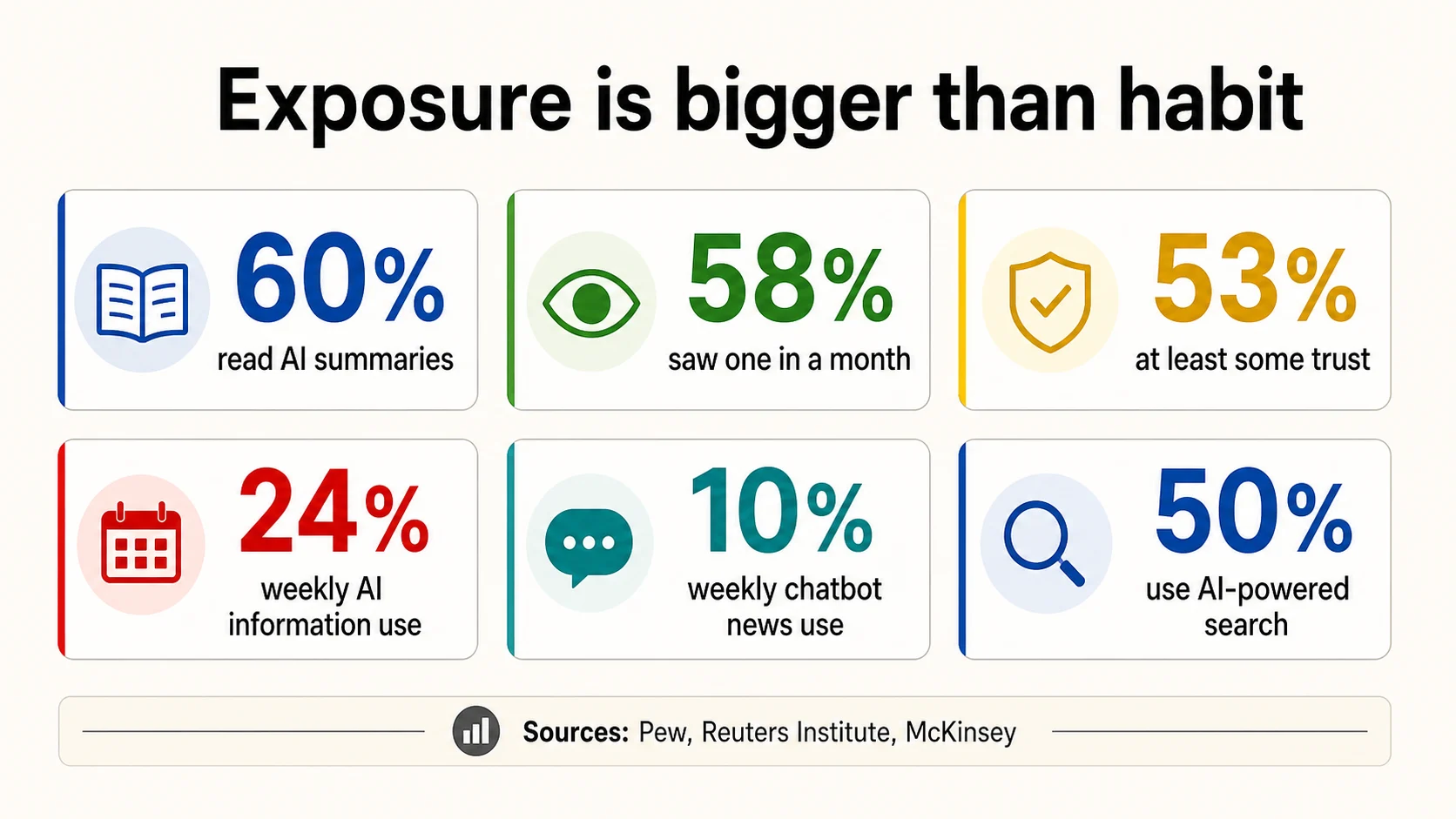
That is not the same as habitual AI-search use. A user can read an AI Overview because Google placed it in the results, even if they never choose ChatGPT Search, Perplexity, Brave, or Bing Copilot as a destination. Ofcom’s UK data makes the distinction plain: 53% of UK adults say they see AI summaries often, and “in most cases” they are not seeking them but finding them included by their search services (Ofcom).
Surveyed use is narrower and more dependent on wording. Reuters Institute’s 2025 research says weekly use of AI for getting information rose from 11% to 24%, a stronger signal for information-seeking than a generic “used AI” question (Reuters Institute). Its 2026 Digital News Report is narrower still: 10% of people use AI chatbots for news weekly, up from 7%, with 16% of under-35s doing so (Reuters Institute).
Commercial studies tend to use broader definitions. McKinsey’s August 2025 survey of 1,927 consumers says half of consumers use AI-powered search and 44% of those users call it their primary and preferred source of insight (McKinsey). Bain-Dynata says 80% of consumers rely on AI summaries or zero-click results at least 40% of the time (Bain). Those numbers are useful for brand and commerce planning, but they blend different forms of AI-mediated behavior and should not be mixed directly with Pew’s “ever read a summary” or Reuters’s “weekly AI chatbot use for news.”
AI Overviews And AI Mode Are Search-Result Metrics
Google’s AI-search features matter because they sit inside the world’s dominant search engine. Statcounter’s June 2026 baseline still shows Google at 91.27% of worldwide search-engine share, with Bing at 4.68% (Statcounter). That means AI Overviews and AI Mode can reshape search behavior even if standalone answer engines remain much smaller.
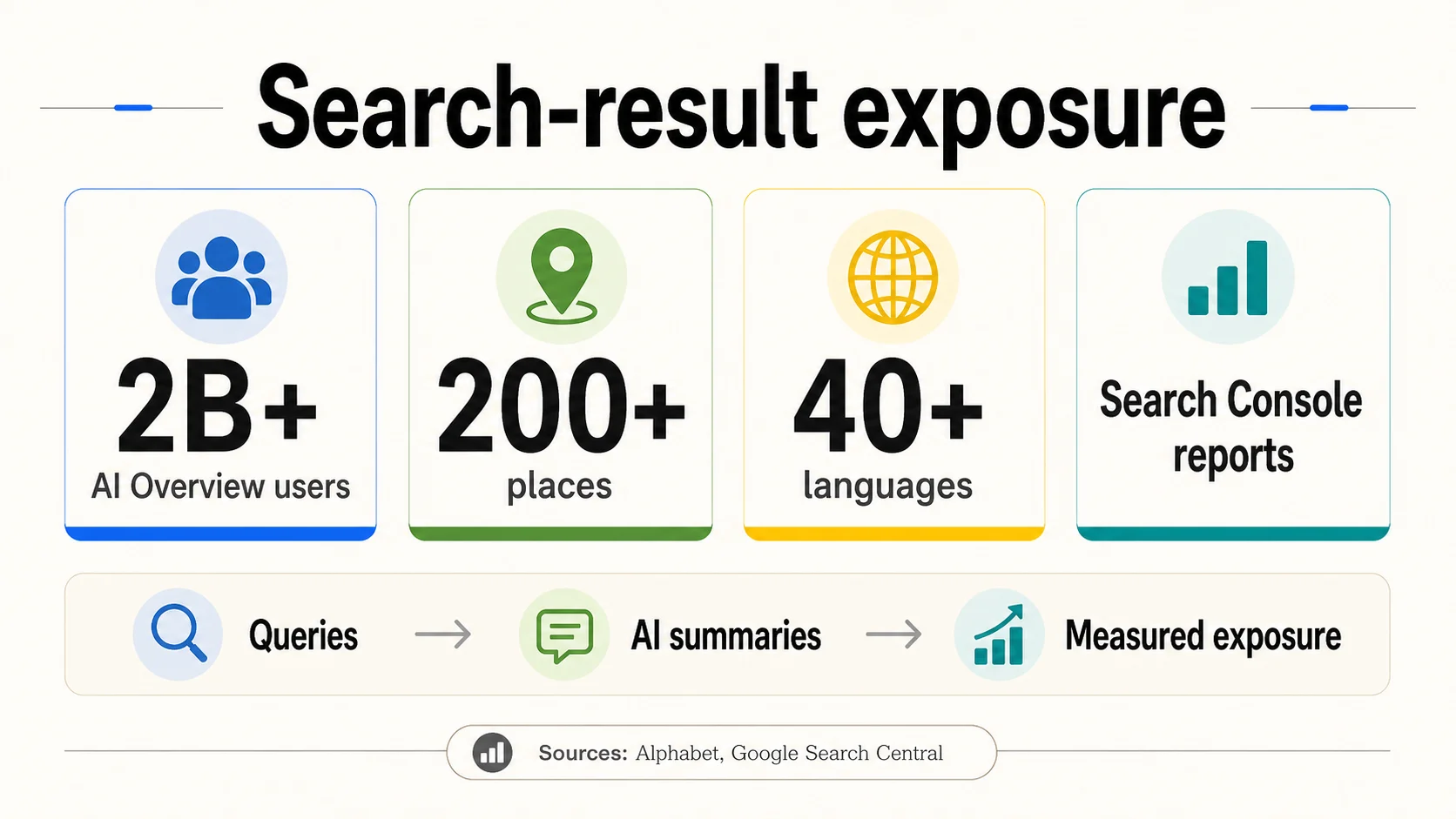
Official Google sources establish reach and mechanics. AI Overviews were available in more than 200 countries and territories and more than 40 languages by May 2025 (Google). Alphabet later said AI Overviews had over 2 billion monthly users (Alphabet). In Q1 2026 Google said AI Overviews were driving overall Search growth and AI Mode had strong global growth — a product-direction signal rather than a new disclosed user count (Alphabet Q1 2026).
Third-party prevalence estimates need more caution. Semrush’s 10M+ keyword study is strong for direction: since October 2024, AI Overview-triggering commercial queries rose from 8.15% to 18.57%, transactional queries from 1.98% to 13.94%, and navigational queries from 0.84% to 10.33% (Semrush). Ofcom’s UK summary says about 30% of searches show AI overviews in that market (Ofcom). Reuters Trends cited AI Overviews appearing at about 10% of U.S. results (Reuters Institute). These can all be true if the query sets, countries, dates, and devices differ.
Click effects also vary, but the direction is important. Ahrefs found AI Overview presence correlated with a 58% lower average CTR for the top-ranking page using December 2025 data, up from its earlier 34.5% estimate (Ahrefs). Pew’s browsing-panel analysis likewise found users were less likely to click links when AI summaries appeared (Pew). BrightEdge’s research says AI search referral traffic was growing, but still under 1% of referral traffic in its January-August 2025 dataset (BrightEdge).
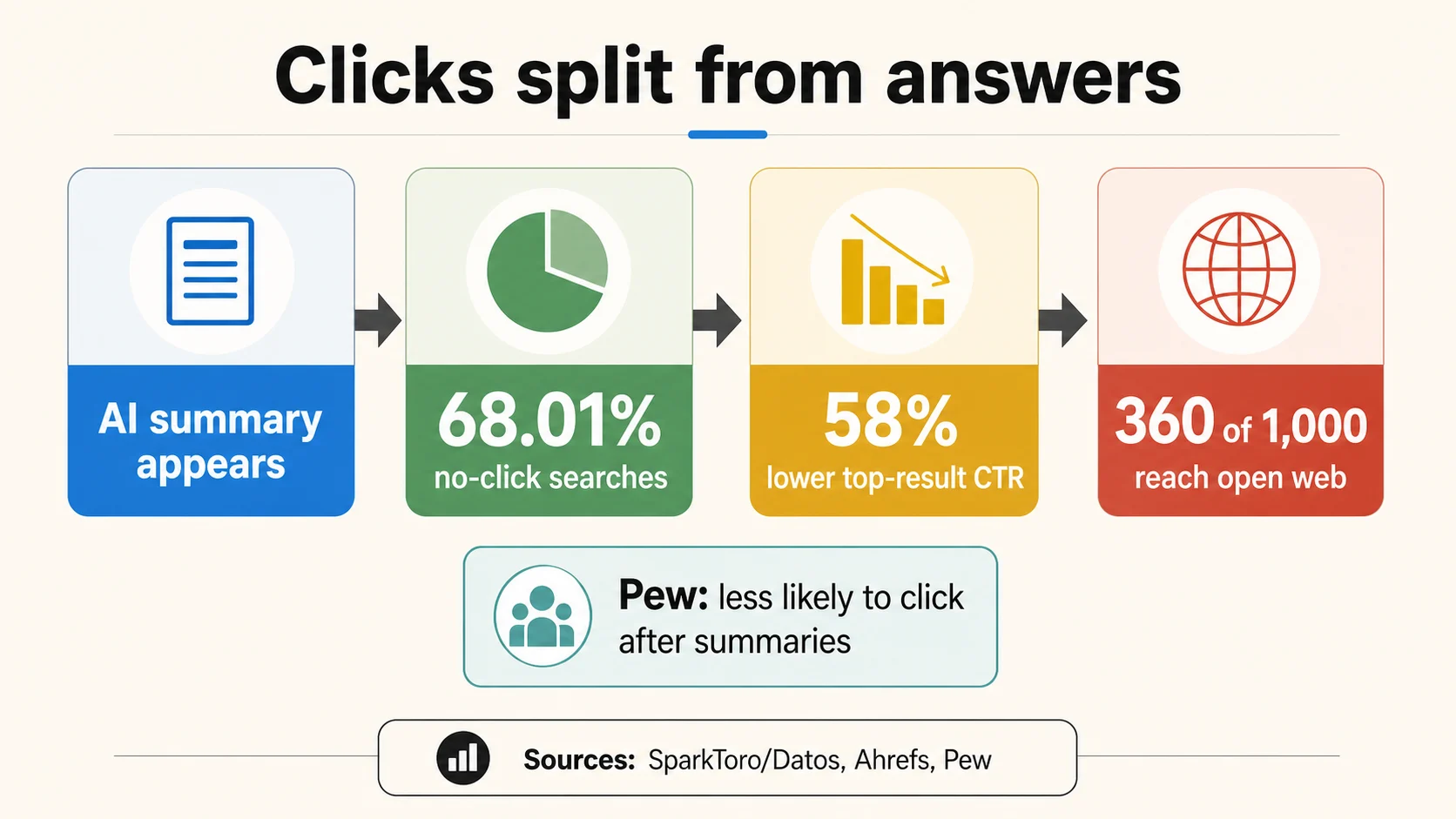
The clean reading is not “Google search is dead.” It is “ranking and clicks no longer tell the full story.” Google has added dedicated Search Console reporting for impressions in generative AI features (Google Search Central), and Microsoft added AI Performance reporting for citations in Copilot and Bing AI summaries (Bing Webmaster Tools). Search visibility is moving from a rank-and-click model toward an exposure, citation, and referral-quality model.
Referral Traffic: Fast Growth From A Small Base
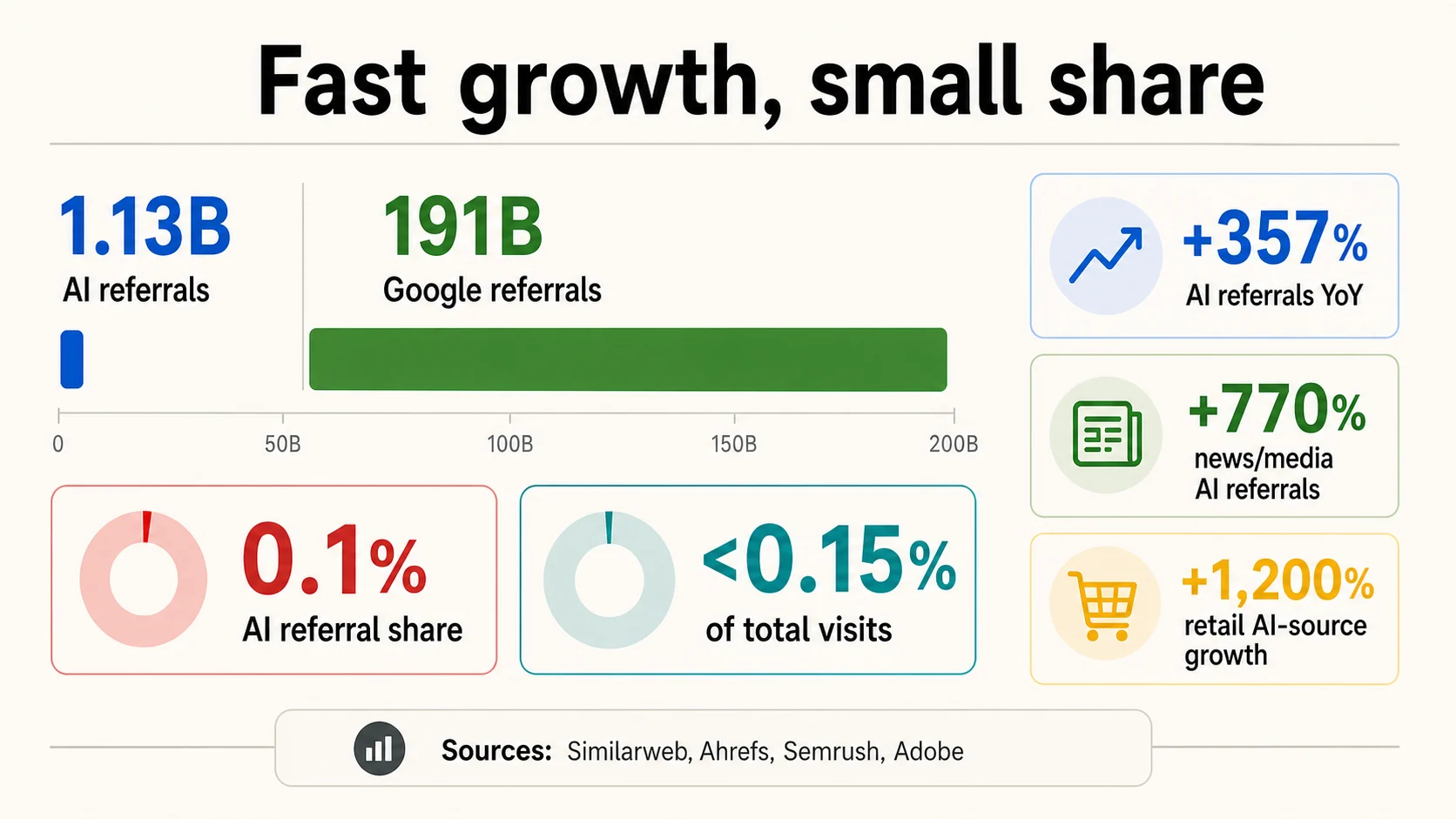
AI referrals look dramatic by growth rate and modest by share. Similarweb’s June 2025 estimate of 1.13 billion AI-platform referral visits is large in isolation, but the same source compares it with 191 billion Google Search referrals (Similarweb). Ahrefs’ panel puts AI at 0.1% of total referral traffic across roughly 35K websites, with Google sending 345x more than the three main AI assistants combined (Ahrefs). Semrush says AI traffic grew 66% in 2025 but was still below 0.15% of total web visits, while Google AI Mode traffic grew from 1,600 to 38.2 million visits between January and December 2025 — still 0.01% of total traffic (Semrush).
Monthly gen-AI referral visits — Oct 2024 to Sept 2025
Similarweb's AI-search trends write-up: monthly referrals from generative AI platforms climbed from roughly 60M to about 240M. Big growth from a base that is still a fraction of Google's 191B referral visits.
SimilarwebThat does not make AI referrals irrelevant. Similarweb says AI referrals were up 357% year over year in June 2025 and news/media AI referrals were up 770%, with ChatGPT accounting for more than 80% of AI referrals to the top 1,000 domains (Similarweb). Adobe measured U.S. retail traffic from generative AI sources up 1,200% from July 2024 to February 2025, with AI-referred retail visitors browsing 12% more pages and bouncing 23% less than non-AI sources (Adobe).
The quality signal may matter before the volume signal. Similarweb reports ChatGPT referrals to U.S. transactional sites converted at 7% versus 5% for Google, with AI-referred visitors spending 15 minutes on site versus 8 and viewing 12 pages per session versus 9 in its cited 2025 data (Similarweb). Referral share should therefore be used for website impact, not consumer adoption. A publisher receiving more ChatGPT or Perplexity referrals can still lose far more Google Search traffic; a SaaS site can see high-intent AI referrals while AI remains a tiny share of sessions.
Publishers Face A Search-Referral Problem, Not Just An AI-Referral Opportunity
Publishers feel the tension first because their economics depend on search and social referrals. Reuters Institute’s 2026 trends release says Chartbeat data across 2,500+ news sites showed Google Search traffic down 33% year over year and Google Discover down 21%, while media managers fear search referrals will fall 43% over the next three years (Oxford DPIR).
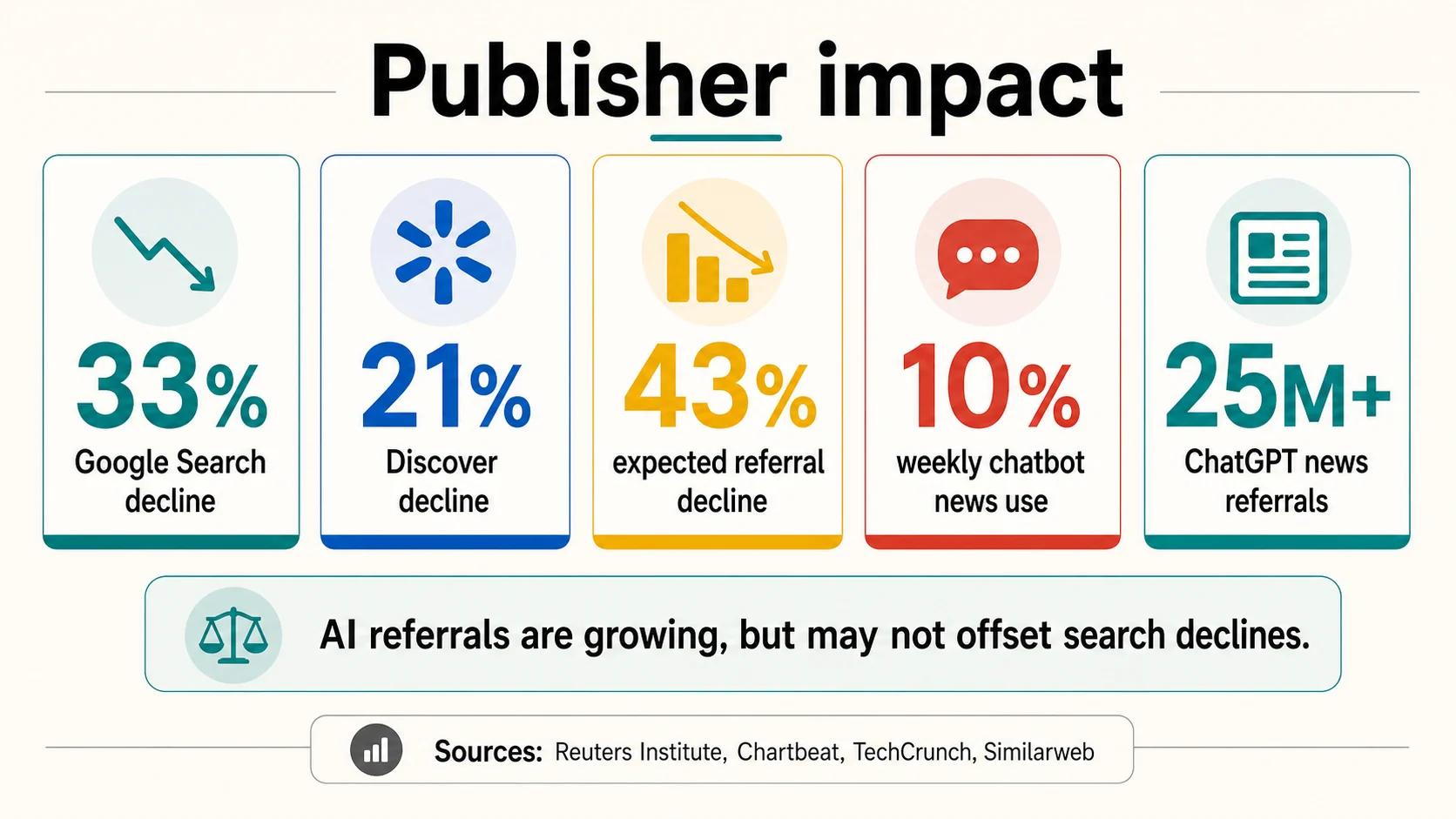
News-specific AI chatbot use is still small compared with search reach, but it is growing. Reuters Institute’s 2026 Digital News Report says 10% of people use AI chatbots for news weekly, up from 7%, and the chatbot news audience skews younger (Reuters Institute). TechCrunch, citing Similarweb, reported ChatGPT referrals to news sites grew from under 1 million in January-May 2024 to more than 25 million in 2025, but not enough to offset search declines (TechCrunch).
The conflict evidence is useful. Parse.ly’s earlier network analysis said it did not find traffic changes associated with AI Overviews and instead saw preexisting long-term trends (Parse.ly). That does not cancel Reuters/Chartbeat, Pew, Similarweb, or Ahrefs; it shows why publisher-impact claims should identify the dataset and date. Citation quality is another publisher issue: Columbia Journalism Review’s Tow Center compared eight AI search engines and found citation problems across news queries (CJR). For publishers, “being cited” is not just visibility; it is a trust, brand, and compensation question.
Market And Spend Context: Search Money Is Still Search Money
AI search is changing search monetization, but the current money still sits mostly in the broader search economy. IAB/PwC says U.S. digital ad revenue reached nearly $300 billion in 2025, up 13.9% year over year, and search revenue including AI search reached $114.2 billion, up 11% (IAB, IAB / PRNewswire). That is a search-ad baseline, not a pure AI-search revenue number.
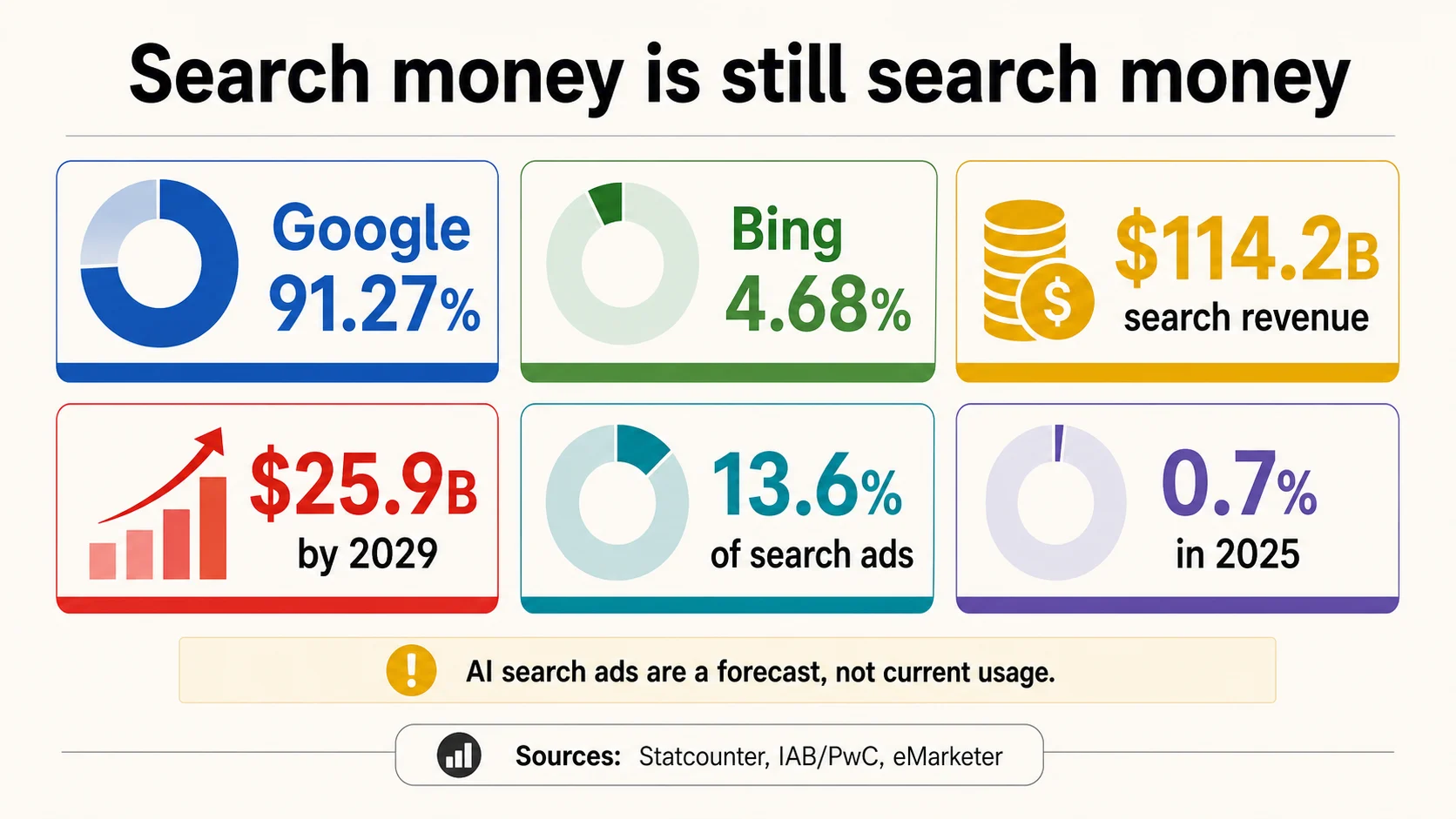
Analyst forecasts point to AI-search ads becoming meaningful, but they are forecasts. eMarketer expects U.S. AI-search ad spending to reach $25.9 billion in 2029, equal to 13.6% of all search ad spending, up from 0.7% in 2025 (eMarketer). eMarketer also forecasts Google’s share of U.S. search ad spending will fall below half in 2026 as retail media reshapes the mix (eMarketer).
U.S. AI-search ad spending as a share of all search ads
eMarketer forecast — AI-search ads rise from 0.7% of search ad spend in 2025 to a projected 13.6% ($25.9B) in 2029. Forecast context, not current usage.
The conventional search baseline remains huge. Statcounter puts Google above 91% of global search-engine share in June 2026 (Statcounter), and DataReportal says Google still accounts for close to 90% of search-engine referrals to third-party websites (DataReportal). Brave illustrates the scale gap from another angle: it handles more than 50 million user queries per day, with about one-third triggering an AI summary (Brave). That is a real answer-engine volume signal, but small relative to Google Search’s global baseline. The lesson is not to ignore Brave, Perplexity, ChatGPT Search, or Bing Copilot — it is to avoid sizing the whole category from one tool’s traffic.
Reading AI Search Metrics Without Mixing Denominators
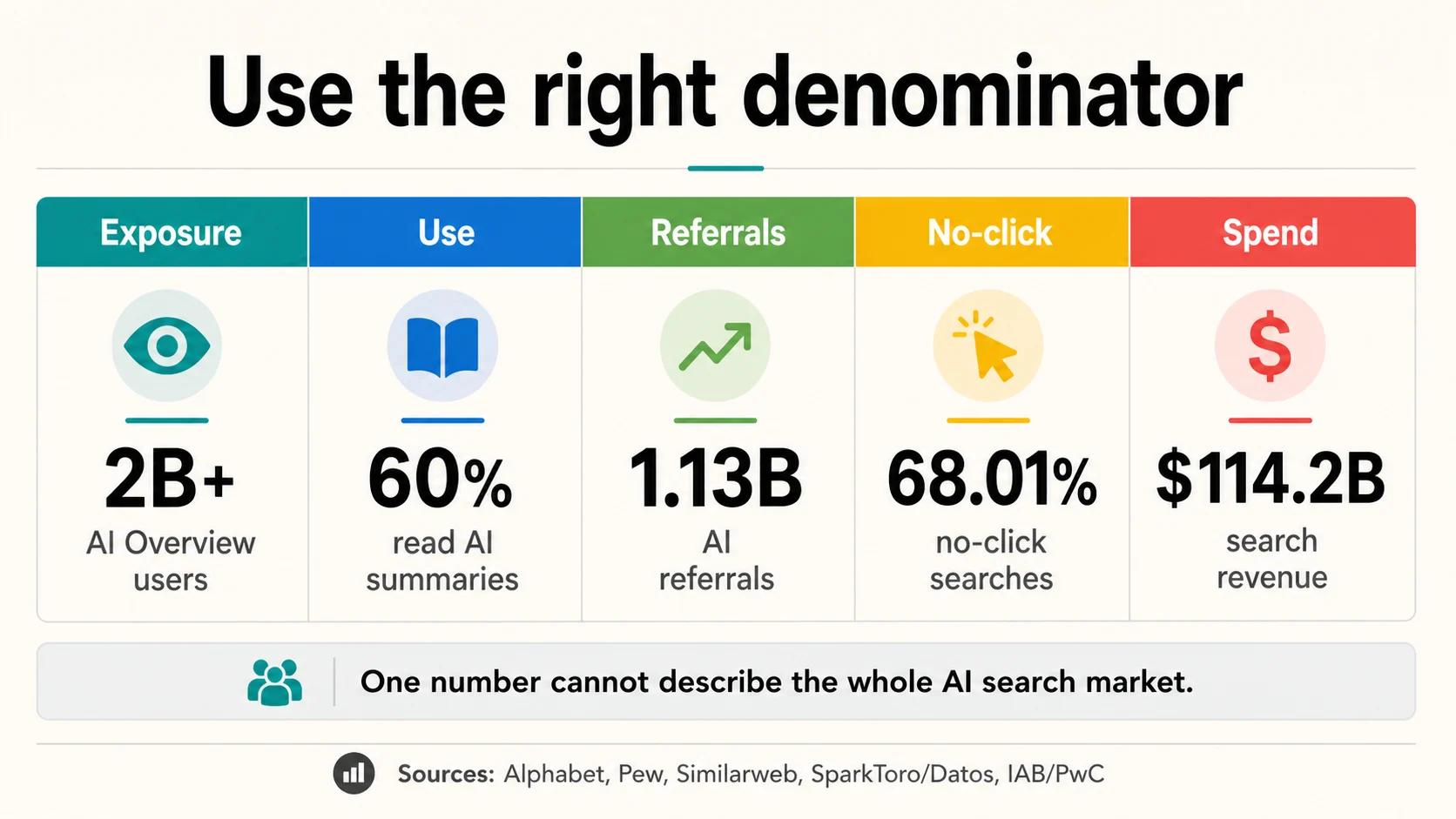
Each AI-search metric answers a specific question. The failure mode is stacking exposure, usage, referrals, no-click, and spend into one fake “AI-search adoption” number. Here is the clean mapping, with a domain-specific explorer of which metric fits which decision.
Which AI-search metric should you use?
Use it to understand how often users encounter generated answers inside a search experience — Semrush AI Overview triggers, Ofcom’s ~30% exposure, Pew’s summary exposure, Google’s 2B+ AI Overview reach.
Use it when a survey asks whether people use AI-powered search, AI tools for information, or chatbots for news — McKinsey’s half-of-consumers figure, Reuters’s 24% weekly info-seeking, Reuters’s 10% weekly chatbot news.
Use it to understand how much traffic, conversion quality, or publisher exposure comes from AI assistants and answer engines — Similarweb’s 1.13B referrals, Semrush’s under-0.15% share, Ahrefs’s 0.1% share, Adobe’s 1,200% retail growth.
Use it to understand what happens after a query. SparkToro/Datos shows zero-click was already high before AI Overviews, and its 2026 update shows it kept rising to 68.01%.
Use IAB and eMarketer to understand the economic baseline and forecast direction, not to count AI-search users. A large search-ad market explains why every platform cares about AI search.
Pick the question you are trying to answer. Each tab shows the right metric family, an anchor figure, and the trap to avoid.
Pew, Reuters, Similarweb, Ahrefs, SparkToro, IABDo not attribute every no-click search to AI: featured snippets, knowledge panels, maps, ads, weather, calculators, and user satisfaction all play roles. SparkToro/Datos’s 2024 baseline already found only 360 of every 1,000 EU Google searches and 374 of every 1,000 U.S. searches went to the open web, before AI Overviews became the default worry (SparkToro/Datos 2024).
What AI Search Means For Founders, Marketers, Publishers, And Ecommerce Teams
For founders, AI search is a distribution shift before it is a replacement market. Google’s AI Overview reach, ChatGPT Search availability, Bing AI citation reporting, Brave’s AI-summary query volume, and Perplexity’s cited-answer positioning all show that retrieval plus generation is becoming a default interface for information. The opportunity is not only building another answer box; it is building tools that earn trust, cite sources, route users to action, and produce measurable downstream demand.
Founders
A distribution shift, not a replacement
Retrieval plus generation is becoming a default interface. The edge is trust, source citation, action routing, and measurable downstream demand — not another answer box.
AlphabetSearch marketers
Rank tracking is no longer enough
Google says generative AI Search still depends on crawlable, indexed, people-first content, yet AI answers change clicks and referrals. Track organic clicks, AI exposure, AI citations, AI referrals, branded search, and conversion quality separately.
Google Search CentralPublishers
Does new AI traffic offset lost search?
Reuters/Chartbeat show a 33% Google Search decline and expected 43% referral decline for news; Similarweb and TechCrunch show ChatGPT referral growth. Both can be true — the question is net effect, citation accuracy, and licensing.
Oxford DPIREcommerce teams
AI is a research and comparison layer
Adobe found AI-source retail visitors browse more pages and bounce less; McKinsey says 70%+ of AI-powered search users ask top-of-funnel questions. Product pages, reviews, feeds, and third-party coverage become AI source material.
McKinseyFor search marketers, Google says generative AI Search still depends on crawlable, indexed, people-first content and core SEO practices (Google Search Central), while Ahrefs, Semrush, BrightEdge, Similarweb, and Pew all show AI answers can change clicks, referrals, and behavior. For ecommerce teams, Adobe measured generative AI referrals into retail, travel, and banking, and McKinsey says more than 70% of AI-powered search users ask top-of-funnel questions to learn about categories, brands, products, or services (McKinsey).
A 2026 Measurement Stack For AI Search
Start with exposure, then separate click behavior from referral source, then track quality, then keep source coverage visible. Google’s dedicated generative-AI reporting and Bing’s AI Performance dashboard both point to the same operational shift: teams need to know whether their content is shown or cited before they judge traffic outcomes (Google Search Central, Bing Webmaster Tools).
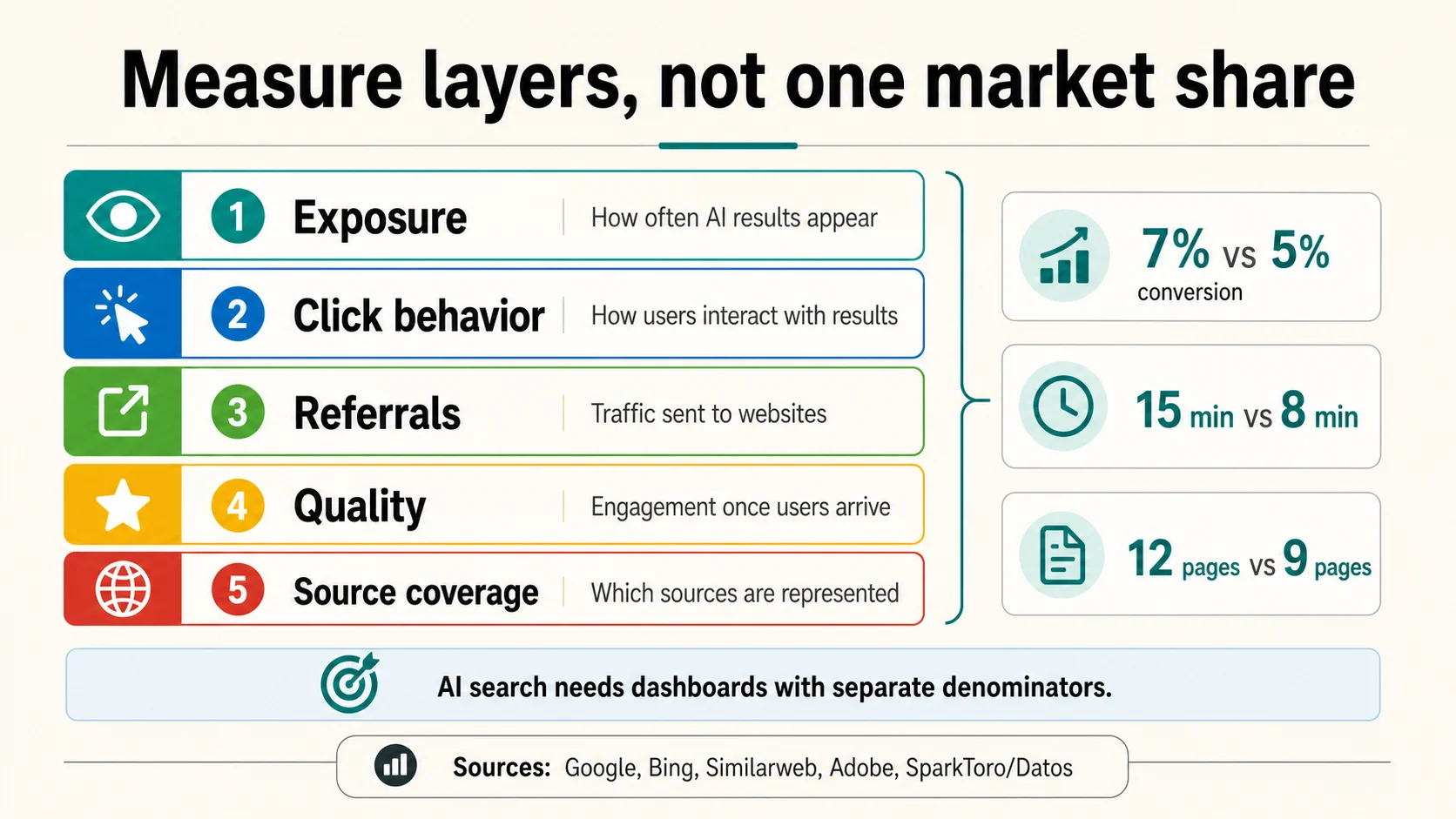
Exposure — is the brand shown or cited?
Track AI Overviews, AI Mode, Copilot answers, and citation presence via Search Console generative-AI reporting and Bing AI Performance, even when no click follows.
Click vs referral source — two different signals
SparkToro/Datos zero-click data explains whether sessions produce open-web clicks; Similarweb, Ahrefs, Semrush, Adobe, and BrightEdge explain which visits arrive from AI surfaces after a click.
Quality — value per AI-referred visit
Similarweb reports ChatGPT transactional referrals converting at 7% vs 5%, 15 min vs 8 on site, and 12 vs 9 pages per session. Weigh conversion rate and revenue per visit over raw session count.
Source coverage — is the web choosing you?
Google stresses crawlability and useful non-commodity content; McKinsey says AI-powered search draws from owned content, publishers, affiliates, UGC, and third parties, not only the brand site.
A falling organic CTR and a rising AI referral count can happen at the same time; they should be diagnosed as two related but different signals. AI referrals can be small by volume but commercially meaningful if they arrive later in the decision journey, which makes conversion rate, revenue per visit, assisted conversion, and branded-search lift more useful than raw session count.
The Practical Takeaway
AI search has crossed the visibility threshold. Google’s AI answers reach billions, Pew shows most U.S. adults have read AI search summaries, Ofcom shows AI overviews are common in UK search, Reuters shows AI information-seeking is rising, and McKinsey/Bain show consumers are using AI-mediated answers in decision journeys (Alphabet, Pew, Ofcom).
AI search has not crossed the replacement threshold. Google still dominates global search-engine share, organic search still sends far more traffic than AI assistants in Ahrefs, Semrush, BrightEdge, and Similarweb datasets, and AI referrals are still small even when they grow quickly (Statcounter, Ahrefs, Semrush).
Frequently Asked Questions
How many people use AI search in 2026?
There is no single number, because the metrics use different denominators. Google said its AI Overviews had more than 2 billion monthly users; Pew found 60% of U.S. adults have ever read AI summaries in search results; Reuters Institute found 24% of people use AI for getting information weekly; and McKinsey found about half of consumers use AI-powered search under a broader definition.
What share of Google searches end without a click?
SparkToro/Datos found 68.01% of Google searches ended without a click in the first four months of 2026. Zero-click behavior was already high before AI Overviews — its 2024 baseline found only 374 of every 1,000 U.S. searches and 360 of every 1,000 EU searches reached the open web — so no-click should not be attributed to AI alone.
How much traffic does AI search actually send to websites?
Similarweb estimated AI platforms generated more than 1.13 billion referral visits in June 2025, up 357% year over year, but Google Search generated 191 billion in the same comparison. Ahrefs put AI at 0.1% of total referral traffic, with Google sending 345x more than the three main AI assistants combined, and Semrush found AI was under 0.15% of total web visits.
Do Google AI Overviews reduce clicks to websites?
Ahrefs found that AI Overview presence correlated with a 58% lower average clickthrough rate for the top-ranking page using December 2025 data, up from its earlier 34.5% estimate, and Pew found Google users were less likely to click links when an AI summary appeared. These are correlations in specific datasets, not universal causal effects.
Why do AI search statistics disagree so much?
Because they measure different things: exposure (seeing an AI answer), usage (choosing to use AI), referrals (visits an AI sends a site), no-click behavior (searches with no click), citations, and ad spend. Studies also differ in country, date, device, sample, and definition, so figures like Ofcom’s ~30% AI-overview exposure and Reuters’s ~10% U.S. result prevalence can all be correct at once.
Is AI search replacing Google?
Not yet by the data. Statcounter puts Google at 91.27% of worldwide search-engine share in June 2026, and organic search still sends far more traffic than AI assistants in Ahrefs, Semrush, BrightEdge, and Similarweb datasets. AI referrals are growing fast from a small base, so AI search is a distribution shift rather than a completed replacement.
How big is the AI search advertising market?
eMarketer forecasts U.S. AI-search ad spending will reach $25.9 billion in 2029, or 13.6% of all search ad spending, up from 0.7% in 2025. For context, IAB/PwC reported U.S. search ad revenue, including AI search, reached $114.2 billion in 2025 inside a nearly $300 billion digital-ad market.
What should publishers and marketers actually track?
Track exposure (whether AI answers show or cite you, via Search Console generative-AI reports and Bing AI Performance), AI referrals and their conversion quality, organic CTR when AI summaries appear, and branded search and direct demand after AI exposure. Reuters/Chartbeat data showing a 33% Google Search decline for news sites alongside growing ChatGPT referrals shows why a single number is misleading.
Sources and Further Reading
Platform disclosures & documentation
Surveys & consumer research
Referrals, clicks & SEO measurement
Market share, ad spend & context