Perplexity Statistics
Last updated on July 6, 2026

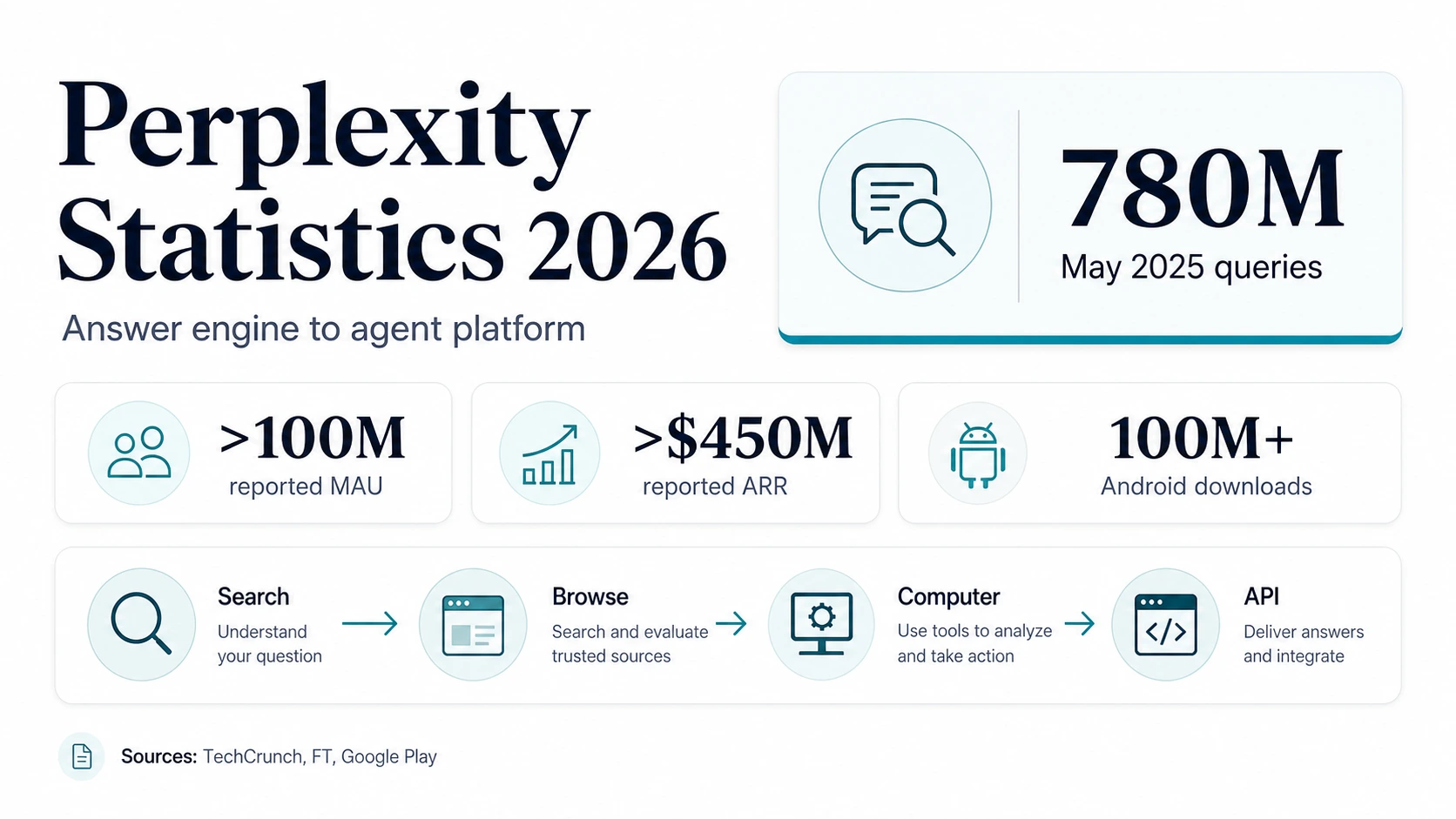
Perplexity’s public numbers now describe more than an AI search box. The company still calls the core product an answer engine, but the 2026 data stack spans search queries, app downloads, web-traffic estimates, a browser, a task-agent product, enterprise seats, API pricing, publisher revenue sharing, and private-company financing.
That makes Perplexity statistics useful and easy to misuse. A query count is not a user count. A website visit is not a retained customer. A Google Play download is not a paying subscriber. A reported valuation is not revenue. A publisher revenue-share program is not proof that publishers recover the traffic an answer engine may absorb. The cleanest reading in 2026 is layered: Perplexity has strong query and app-reach signals, meaningful reported business momentum, a fast-expanding product surface, and several missing denominators that still matter for operators.
Here is the clearest way to read Perplexity in 2026: queries and app installs show reach, reported ARR and valuation show private-company momentum, pricing and credits show how the business is packaged, and API docs show the developer surface. None of those alone proves paid conversion, retention, or exact market share.
The Perplexity Numbers Worth Knowing
The headline Perplexity numbers use different denominators, so read them as separate query, user, revenue, and app-reach signals rather than one figure.
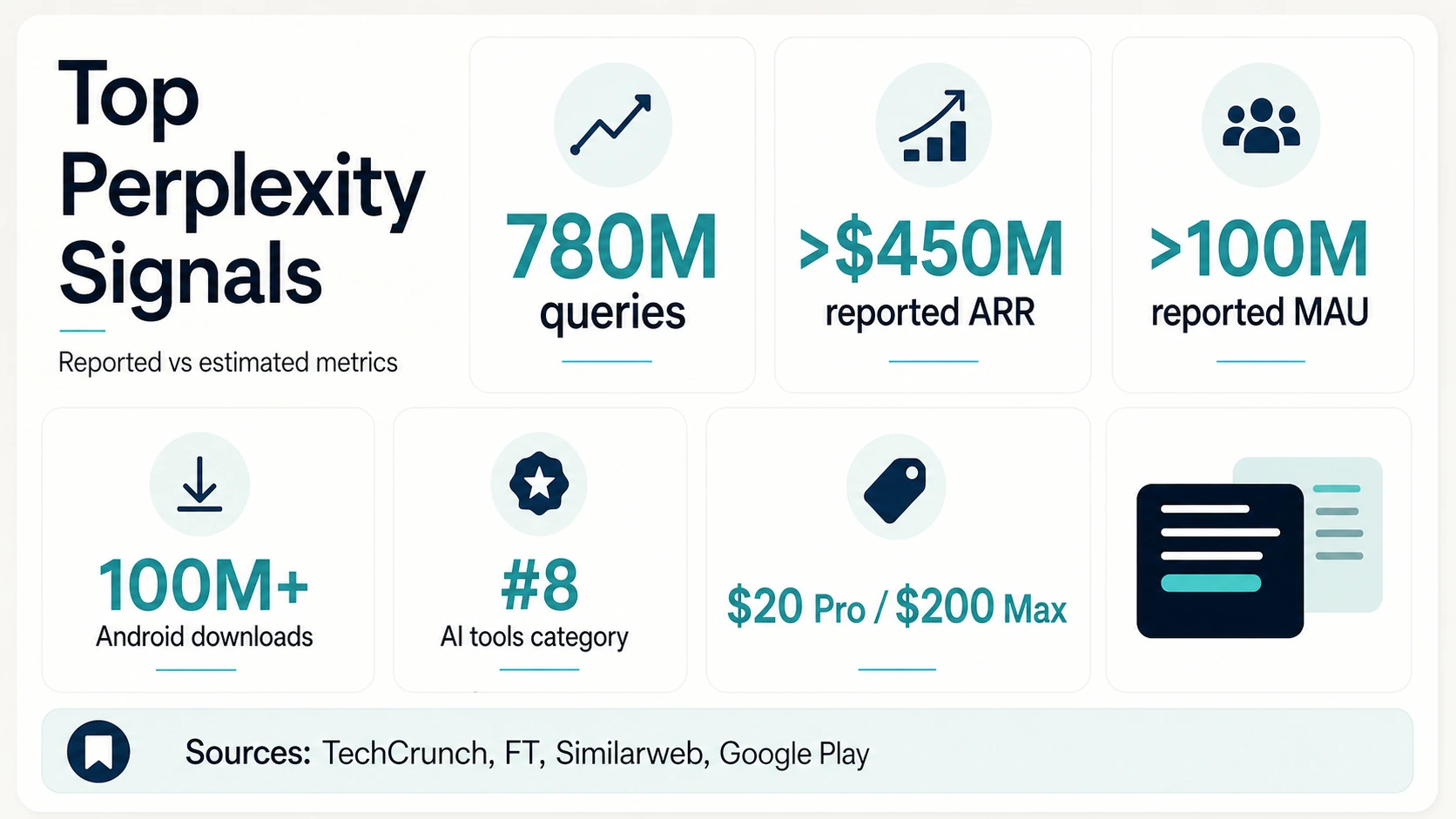
Reach & usage signals
Reported company economics & packaging
Read every number by its own denominator
Perplexity's headline figures answer different questions. Tap a metric to see what it measures — and what it does not prove.
Financial TimesReading Perplexity’s Numbers Across Systems
Perplexity needs a denominator map before any useful comparison. The 780 million May 2025 query figure measures requests. The FT-reported 100M+ monthly active users measures people across search and agent tools. Similarweb visits and Semrush visits measure web-traffic estimates. Google Play downloads measure Android install-band reach. Enterprise pricing measures list price. Computer credits measure consumption units for agentic work. None of those denominators replaces another.
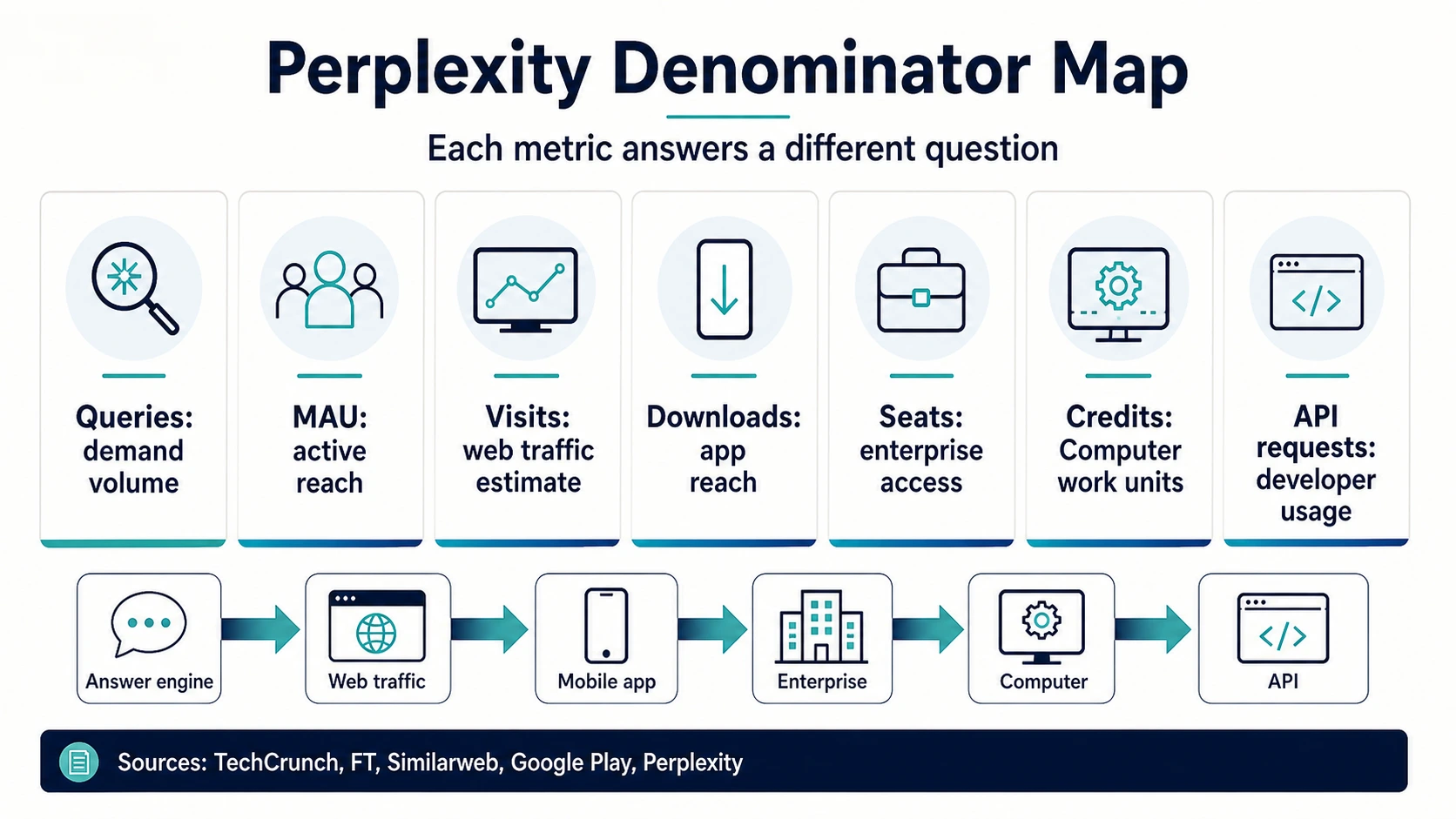
This distinction matters because Perplexity’s product strategy is broadening. The company can grow usage through the answer engine, mobile apps, Comet, Computer, enterprise workspaces, API calls, partner promotions, and publisher products. A single top-line metric can hide where the growth is coming from. A Max user running Computer tasks and a free mobile user asking occasional answers both belong somewhere in Perplexity’s reach story, but they are economically different.
For buyers, the most useful public facts are current product and pricing facts from official pages. The plan guide shows Free, Pro, Education Pro, Max, Enterprise Pro, Enterprise Max, and Sonar/API paths. The Enterprise FAQ says API usage is not included with Enterprise Pro or Enterprise Max. The API pricing docs show separate token, request, search, tool, and embedding prices. A business buyer should not treat one seat price as the whole cost of using Perplexity across app, agent, and API surfaces.
For investors, the private-company numbers need “reported” language. The Financial Times ARR report is stronger than a scraped database, but it is still not an audited filing. The PYMNTS valuation summary traces to private financing reports, not public-market documents. The right comparison is business momentum, not exact profitability, cash flow, or retained seat count.
What Perplexity Still Does Not Disclose
The missing numbers are as important as the published ones. Perplexity does not currently publish a clean split for free users, paid Pro subscribers, Max subscribers, Enterprise Pro seats, Enterprise Max seats, app-only users, Comet users, Computer users, API developers, or paying API organizations. That means the FT-reported 100M+ monthly active user figure is useful for reach, but not enough to calculate paid conversion or customer concentration.
A query count is not a user count.
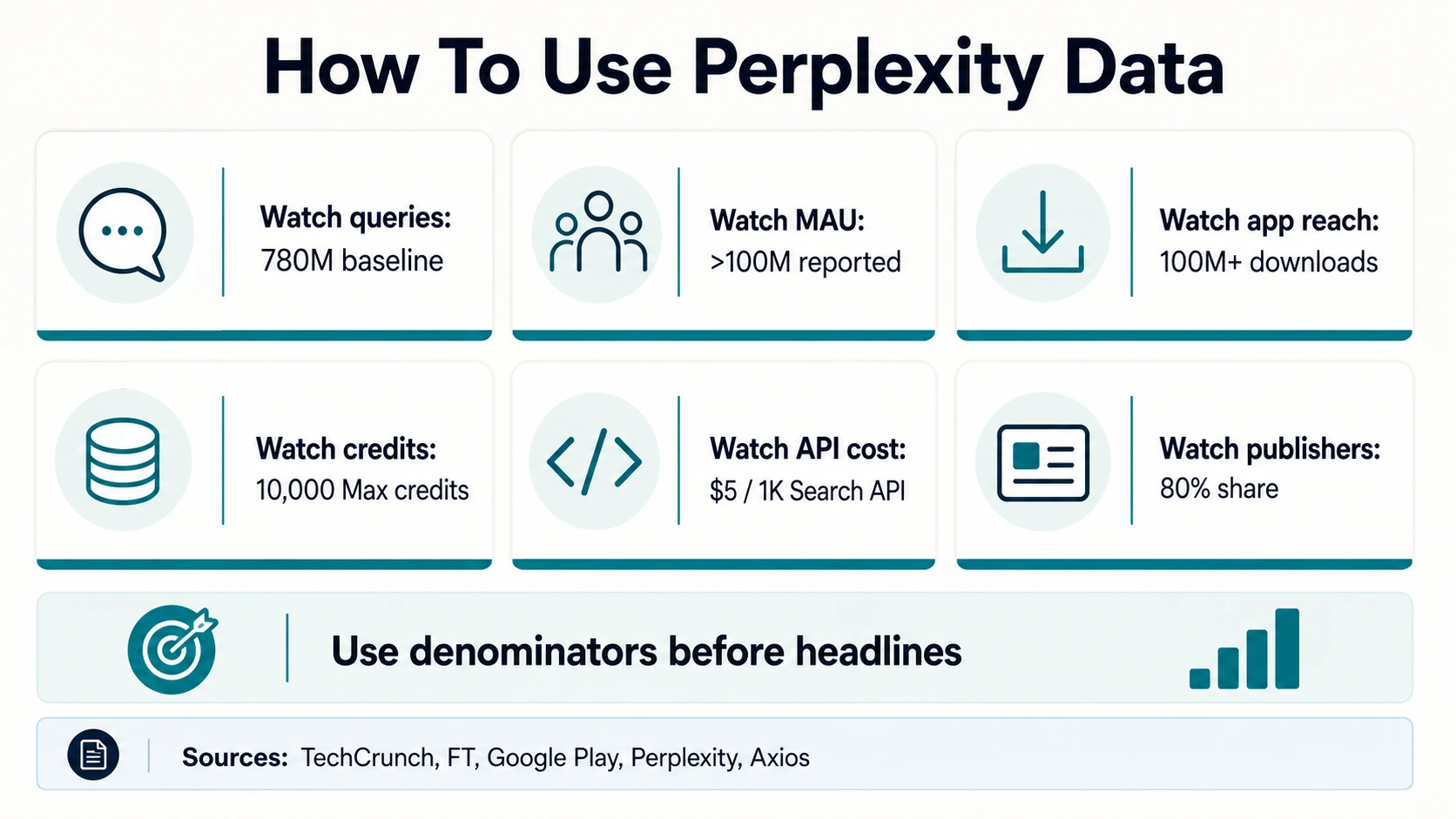
The 780M May 2025 figure counts requests received that month, not people, sessions per person, or a current 2026 total.
A download band is not active usage.
The 100M+ Android install band and 483K iOS ratings show trial and feedback volume, not weekly return, retained Pro plans, or moves to Max.
An enterprise-client count is not seats.
A tens-of-thousands client count can mean a small approved workspace or a large deployment; without seat counts, mix, and renewals it should stay separate from revenue math.
Computer credits exist, but usage is dark.
The credits page proves a consumption unit for multi-step tasks, but public sources show no total tasks, credits per task, success rate, or ARR contribution.
API pricing is packaging, not adoption.
The Sonar and Search API tables let you model a workload, but they do not reveal monthly API calls, active developers, API revenue, or retention.
This is not unusual for a private AI company. The practical point is that Perplexity has enough public data to show momentum, but not enough public data for exact market-share math. The honest version is stronger than a fake precise version: queries, visits, downloads, seats, credits, API requests, ARR, and valuation are all different measurement systems.
Adoption And Usage Signals
The query count is the cleanest usage signal because it came from Perplexity’s CEO and was reported by a major tech outlet. TechCrunch says Srinivas shared the 780M May 2025 figure onstage at Bloomberg’s Tech Summit and said growth was running above 20% month over month. The useful inference is that Perplexity had real answer-engine volume by mid-2025. The unsafe inference is a current 2026 query total created by compounding that growth rate for months.
The FT-reported 100M+ monthly active users is more current and broader. Because the Financial Times framed the user base as coming from search and agent tools, it supports a cross-surface adoption story. It does not reveal how many people use the web app, mobile apps, Comet, Computer, or enterprise products separately, or how many are paid, retained, or high-credit Computer users.
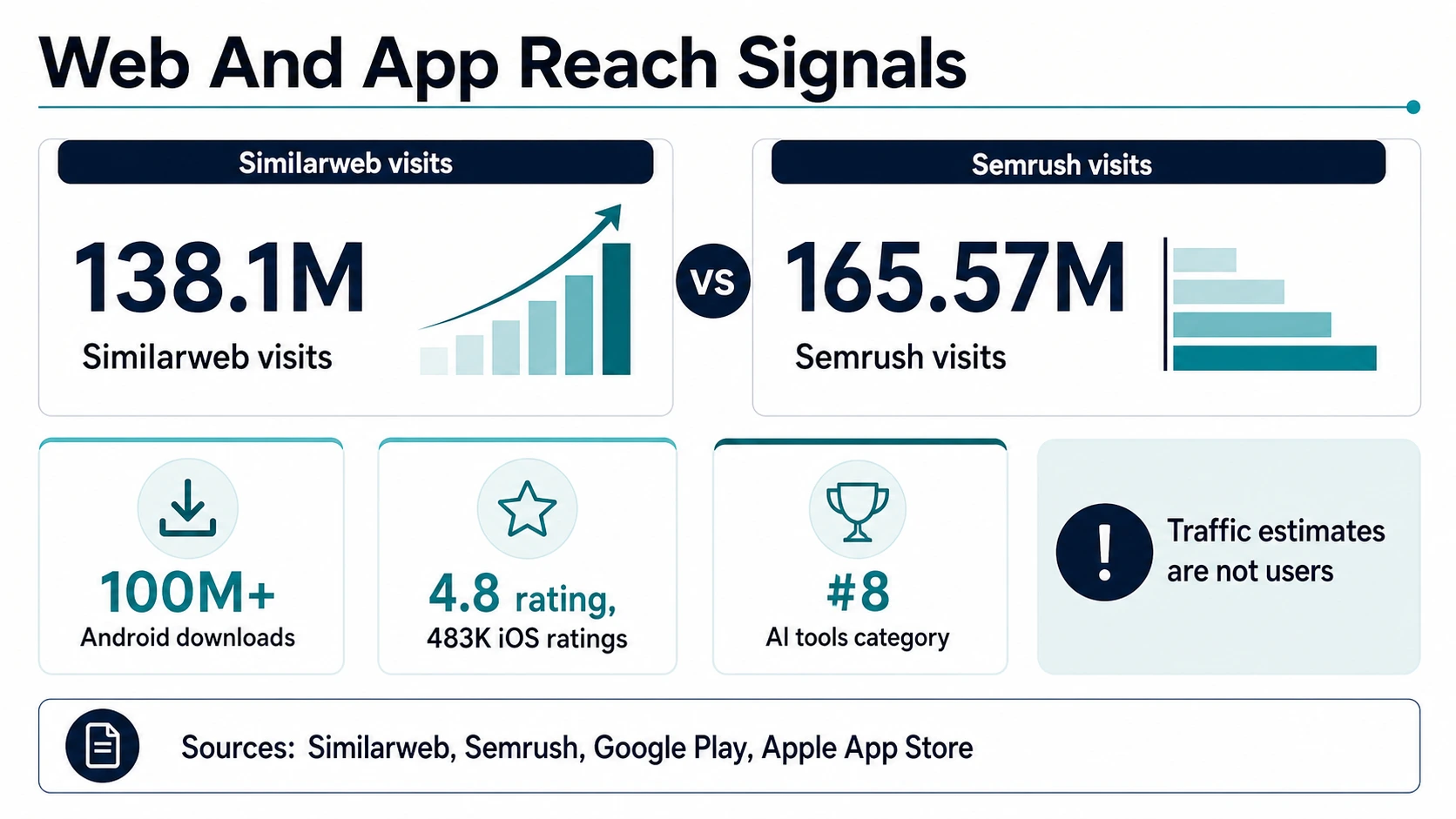
Traffic estimates fill in the web channel, with real uncertainty — and the two big panels disagree.
Both are useful for directional web demand. Neither measures the mobile app, API, embedded integrations, enterprise workspace activity, or Computer tasks inside connected tools.
The app-store picture is stronger for reach than for engagement. Google Play lists 100M+ Android downloads and roughly 2M reviews, a very large consumer distribution signal for a company founded in 2022. Apple’s App Store shows 483K ratings and a #15 Productivity placement on the current listing. But app-store data is early-funnel. It does not show monthly activity, paid-plan mix, churn after install, or how many users move from simple answers into Max, Enterprise, or API usage.
Perplexity also used telecom distribution to expand potential reach. Airtel said every one of its 360 million customers could receive a free 12-month Pro subscription, while Perplexity’s help center says the promo ended January 16, 2026. That was a serious distribution experiment in India. It should not be read as 360 million Perplexity users or 360 million paid subscribers.
Product Surface: Answer Engine, Comet, Computer, And Shopping
Perplexity’s core answer-engine promise is still visible in the app-store copy: the app gives answers backed by sources and citations, with Pro Search, follow-ups, voice, Discover, and a library of saved discoveries (Google Play, Apple App Store). That citation-first positioning is what made Perplexity stand apart from generic chatbots. It is also why publisher relationships and crawler trust matter more for Perplexity than they do for many closed-domain AI apps.
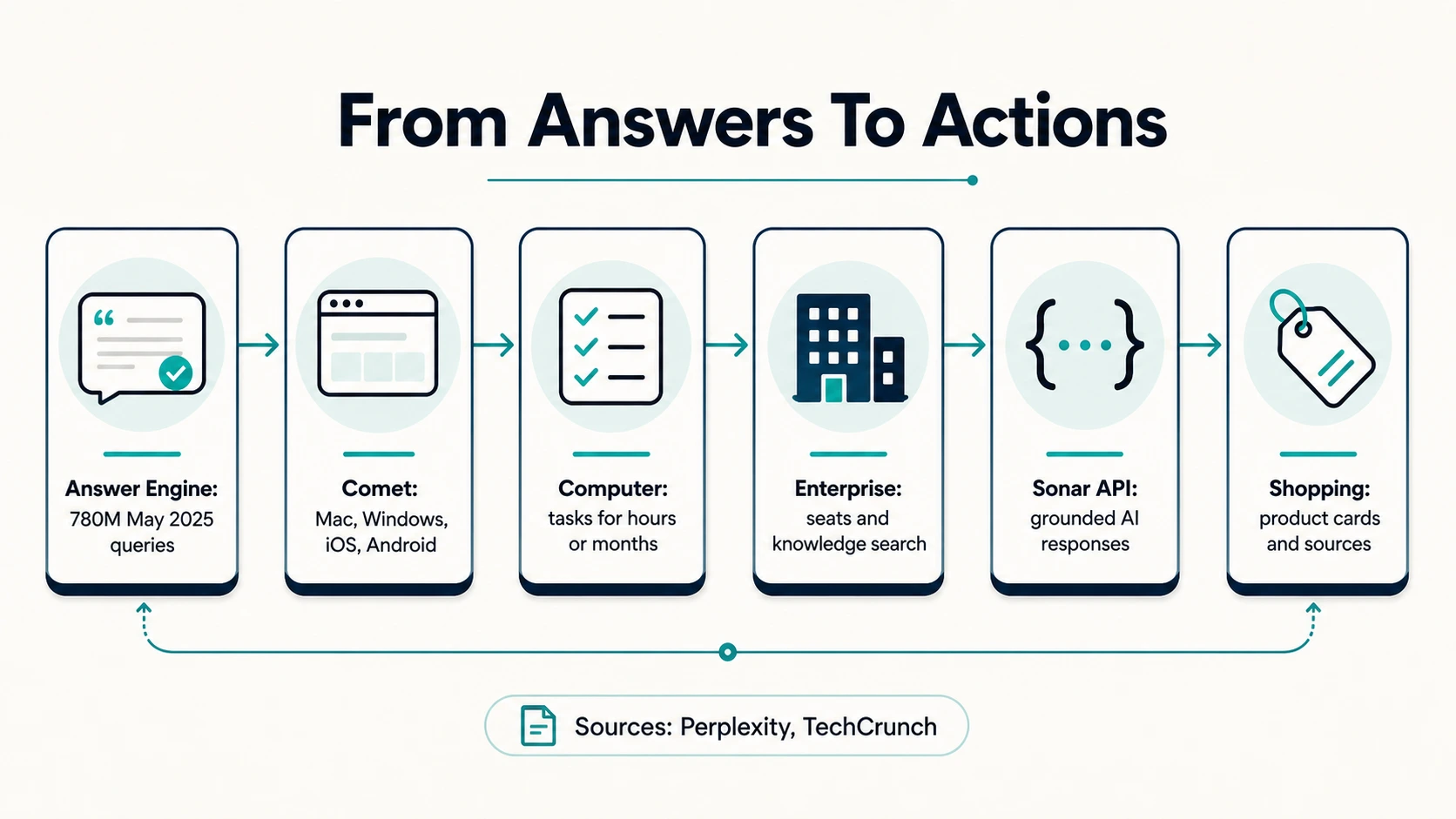
One brand, five product surfaces
The original wedge: cited answers with Pro Search, follow-ups, voice, and Discover. It received 780M queries in May 2025.
A browser that works for the user, available on Mac, Windows, iOS, and Android — moving the answer engine closer to daily web navigation.
A general-purpose agent that operates interfaces, builds workflows, and can run tasks for hours or months — available to Pro and Max subscribers, and it consumes credits.
Product cards with pricing, seller information, descriptions, pros and cons, reviews, and key features — turning answers into a decision surface for Pro users.
A web-grounded AI response API with streaming, tools, search options, OpenAI-compatible clients, native SDKs, and a zero-data-retention policy.
Perplexity is turning answer retrieval into browser navigation, task execution, enterprise knowledge, and developer infrastructure. Tap a surface to see what each is — and what it does not disclose.
PerplexityComet extends that answer engine into a browser. The official page says Comet is available for Mac, Windows, iOS, and Android, and frames it as a browser that works for the user. This is a distribution move — browsers sit closer to daily web navigation than a standalone chatbot tab — but public availability still does not reveal Comet’s active-user base.
Computer is the clearest sign that Perplexity wants to own work execution, not only answer retrieval. The official Computer page says it can browse, research, create, connect tools, personalize work, and run background tasks or continuous monitoring for hours or months. The credits page then explains why this matters commercially: Computer consumes credits, while ordinary Ask searches do not. The shopping surface shows the same pattern in a more consumer-focused way — TechCrunch reported that Perplexity’s shopping feature presented product cards with pricing, seller information, descriptions, pros and cons, reviews, and key features. The safe reading is product expansion; the unsafe reading is commerce GMV or transaction volume, which Perplexity does not disclose.
Pricing, Credits, Enterprise Packaging, And API Economics
The plan ladder is now one of Perplexity’s most revealing public datasets. The official Enterprise pricing page shows a consumer or individual tier at $20/month or $200/year, then Enterprise Pro at $40 per seat/month or $400/year, and Enterprise Max at $325 per seat/month or $3,250/year. The Enterprise FAQ confirms the Enterprise Pro and Enterprise Max prices and says organizations with 250+ users can contact Perplexity for white-glove support or discounts.
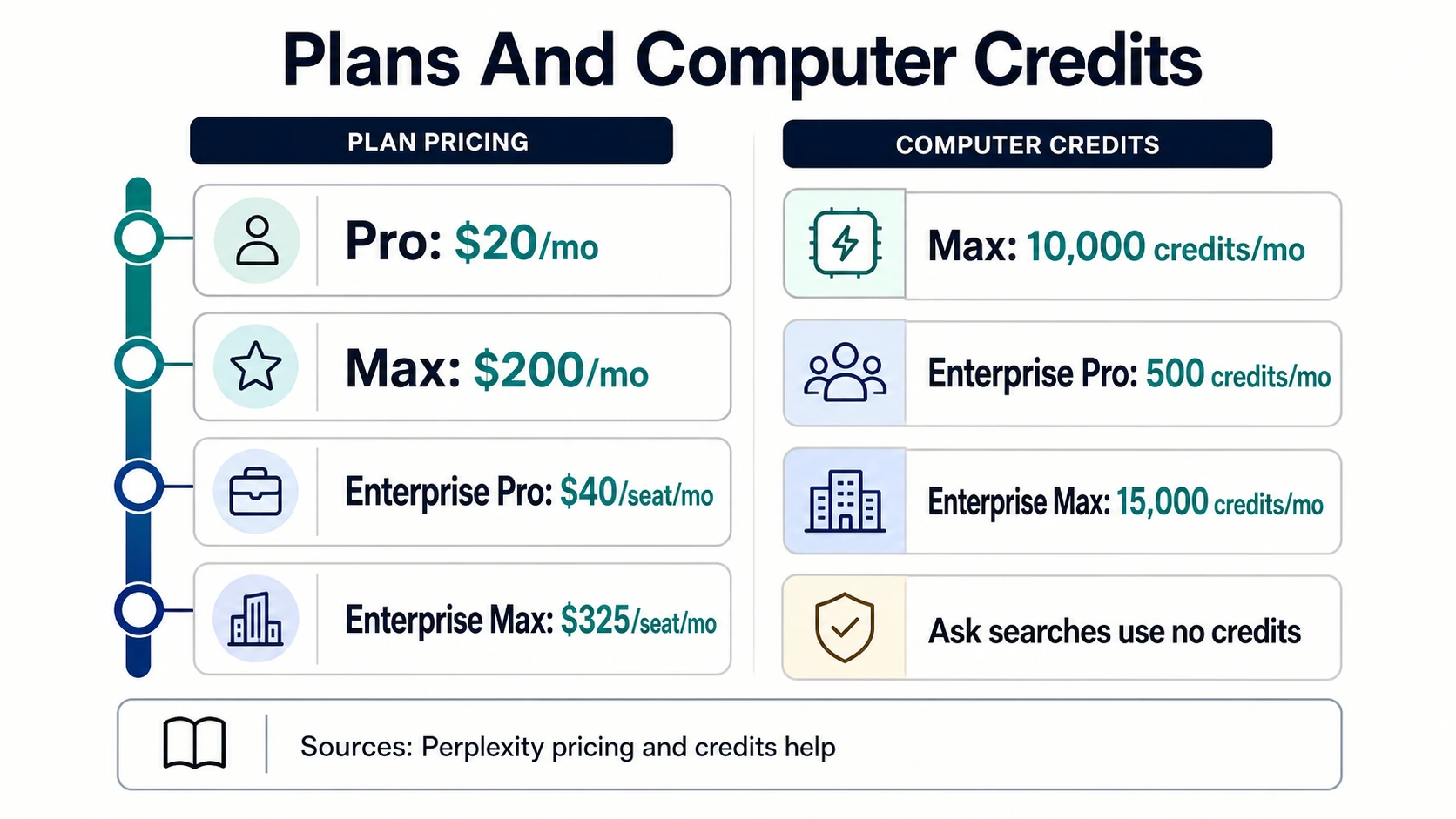
Credits add a consumption layer on top of subscription pricing. The credits help page says Ask searches do not consume credits — only Computer, the product that carries out multi-step work, does. Pro has no monthly credit allocation but can receive a one-time 4,000-credit bonus; Max starts with 10,000 monthly credits and a one-time 35,000-credit bonus; Enterprise Pro starts with 500 monthly credits; Enterprise Max starts with 15,000 monthly credits. Active tasks pause when credits run out and resume when credits reset or more are added. This is an important business-model signal: agentic work has a variable cost structure, so Perplexity is pricing some of that activity through credits.
Plan by surface, credits, and cost driver
A procurement review should map each use case to the right surface, not assume one price covers everything. Tap a plan to see its Computer credits and what it's built for.
PerplexityThe API platform is a separate developer business. The Sonar API docs say Sonar provides web-grounded AI responses with streaming, tools, search options, OpenAI-compatible client libraries, and native SDKs. The API pricing docs list Search API at $5 per 1,000 requests, plus token prices that vary by model and search-context size.
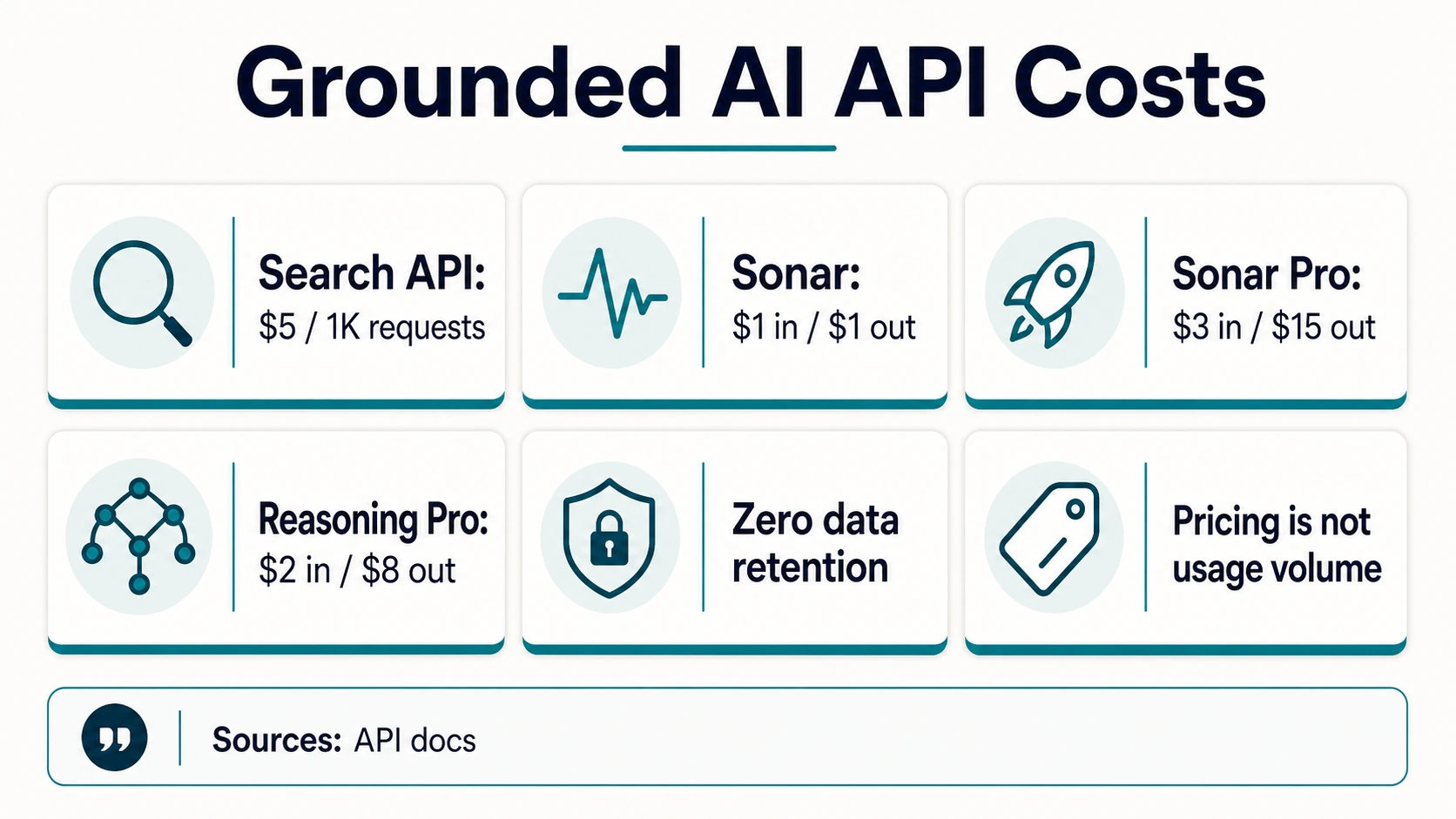
Sonar token pricing (per million tokens, input / output)
The API privacy page is notable because it gives a stricter promise for the Sonar API than a generic consumer privacy summary: no data retention, no training on customer data, and only billing metadata collected, alongside certifications such as SOC 2 Type II, a 2025 HIPAA gap assessment, and CAIQlite. The enterprise-buyer view is therefore a four-part calculation — identify the plan surface, the work type, the data posture, and the cost driver. Perplexity publishes enough official pages to make those distinctions, but not enough to turn them into customer-wide usage totals.
Company Economics: Funding, Valuation, ARR, And Investors
Perplexity’s company story accelerated quickly. PYMNTS reported in September 2025 that Perplexity secured $200 million at a $20 billion valuation, citing The Information and other accounts. The same report says Perplexity had raised funds about once every two months over the prior year, with total funding above $1 billion, and that the valuation had moved from $14 billion to $18 billion to $20 billion across nearby rounds.
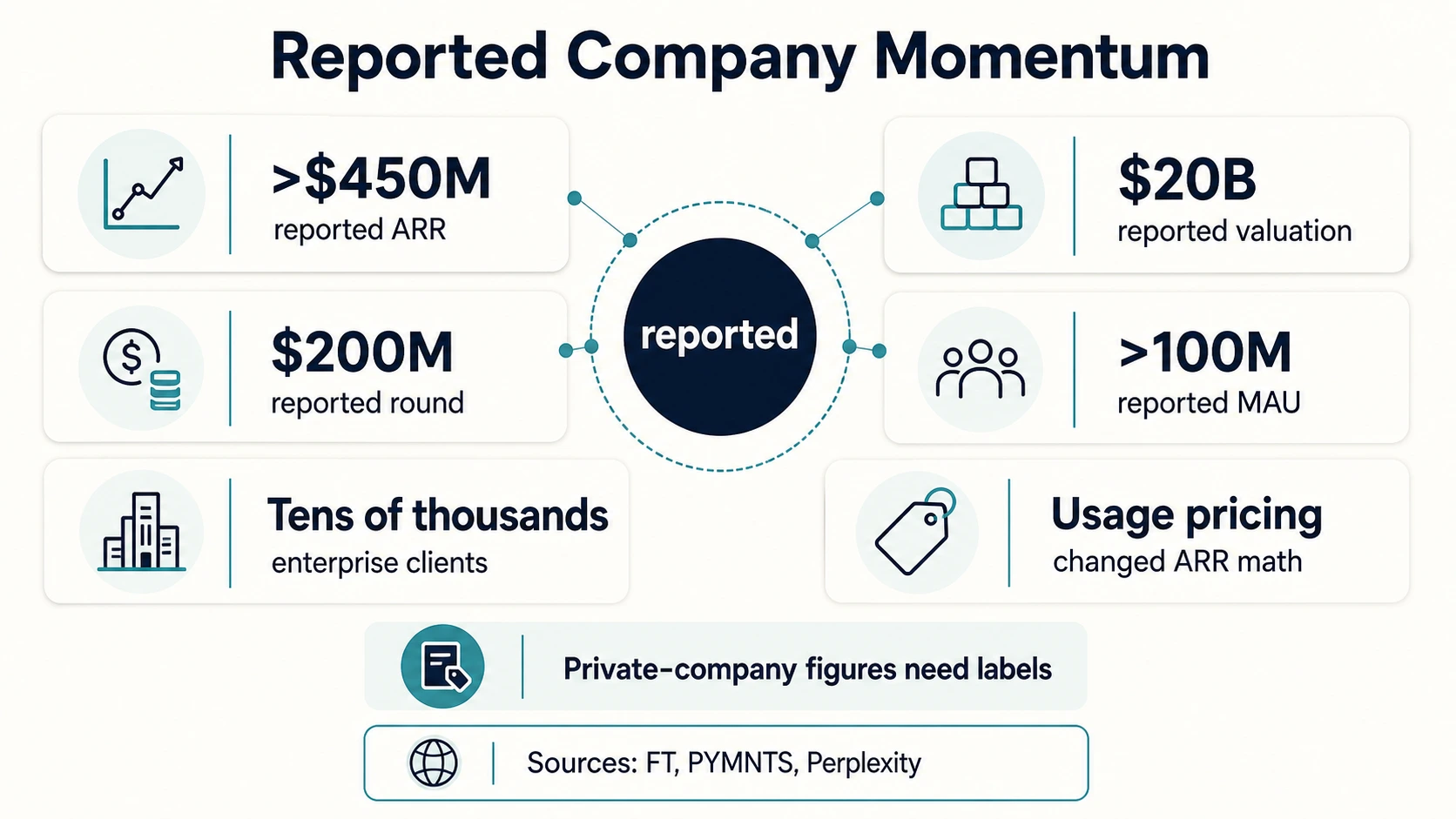
The Financial Times report adds the revenue layer: estimated ARR above $450 million in March 2026, up after the February launch of Computer and the shift toward usage-based pricing. It also notes that Perplexity had grown from $16 million to $305 million ARR over two years before the new pricing system.
Reported ARR — three FT data points
Each point is a Financial Times-reported ARR estimate on a linear axis: ~$16M and $305M over the two years before the repricing, then above $450M in March 2026. Reported private-company estimates, not audited revenue.
Financial TimesReported annual recurring revenue (estimated, USD millions)
ARR is a reported private-company estimate, not audited revenue. Sources: Financial Times reporting on the earlier trajectory and the March 2026 figure.
Those numbers are a strong business-momentum signal. They are not a profitability signal, especially because the same report describes Perplexity as lossmaking and paying model providers and inference costs. The economics are tied to product architecture: if Perplexity can route different tasks to efficient models and charge separately for heavy Computer work, it can potentially improve gross margins versus a flat subscription that absorbs every expensive request. That is why Computer credits, API pricing, and the FT usage-pricing discussion should be read together.
Business Insider’s profile context reinforces the investor story. A Business Insider report notes that Srinivas cofounded Perplexity after working at Google DeepMind and OpenAI and that the startup attracted funding from SoftBank, Nvidia, and Jeff Bezos. Perplexity’s brand is therefore doing two jobs at once: selling a consumer answer product and persuading investors that an answer engine plus agent layer can become a large platform business.
Publishers, Ads, And Open-Web Risk
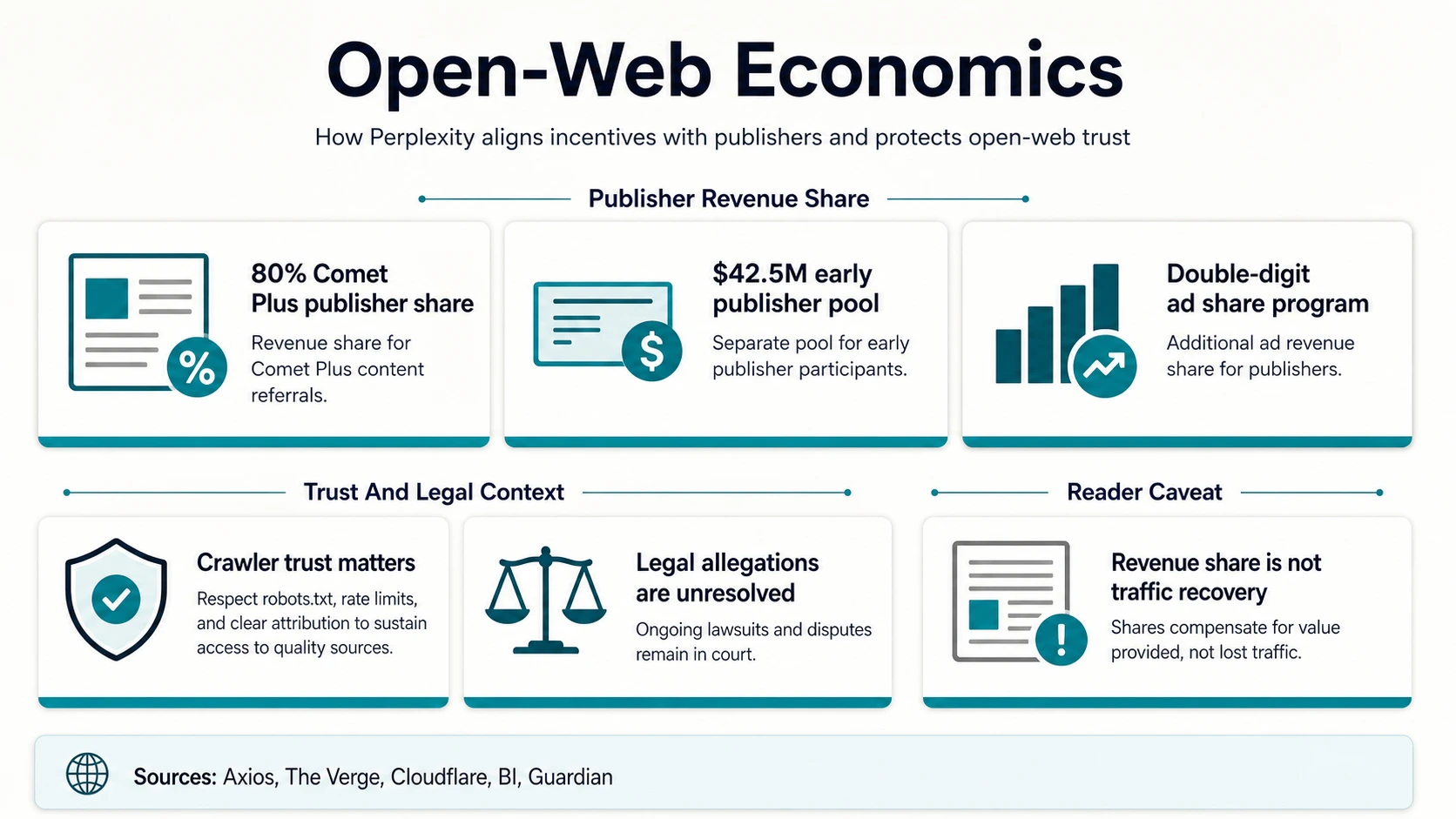
Perplexity’s cited-answer model depends on the open web, so publisher economics are not a side issue. In July 2024, The Verge reported that Perplexity’s Publishers’ Program included Time, Der Spiegel, Fortune, Entrepreneur, The Texas Tribune, and Automattic, with a multiyear double-digit ad-revenue share, per-source payments, free Enterprise Pro access, and developer tools. The same report makes the tradeoff clear: Perplexity was planning ads around related questions, but it had little or no ad revenue at that point.
Publisher revenue share
80% of Comet Plus subscription revenue
Comet Plus would give participating publishers 80% of subscription revenue — a concrete number, but not proof that referral losses are offset.
AxiosEarly pool
$42.5M to reward early publishers
Perplexity allocated a $42.5 million pool for early Comet Plus publishers. That is program design, not lifetime payouts or partner-level economics.
AxiosCrawler trust
Undeclared-crawler allegation
Cloudflare alleged in 2025 that Perplexity used undeclared crawlers to access sites that tried to block AI scraping — a trust variable, not a usage number.
CloudflareLegal risk
Reddit, NYT, and CNN suits
Reddit sued Perplexity and scraping firms; The New York Times and CNN filed copyright suits. These change the risk profile, not the adoption numbers.
The GuardianComet Plus extended the publisher strategy. Axios reported that Comet Plus would give participating publishers 80% of subscription revenue and that Perplexity allocated a $42.5 million pool to reward early publishers. That is a much more concrete publisher-economics number than vague partnership language. It still does not prove how much each publisher receives, whether referral losses are offset, or whether legal disputes end.
Legal and crawler risk remain part of the picture. Cloudflare alleged in 2025 that Perplexity used undeclared crawlers to evade no-crawl directives. Business Insider reported that Reddit sued Perplexity and several data-scraping firms, The Guardian reported that The New York Times sued Perplexity, and Bloomberg Law reported that CNN later filed a similar suit. Those disputes do not erase the adoption numbers, but for a product built on citations, web answers, browser agents, and publisher relationships, legal and crawler norms are business-model variables.
Market Context: Perplexity Is Not All Of AI Search
Perplexity is important in AI search, but broad AI-search growth is not Perplexity usage. Similarweb’s top AI Chatbots and Tools ranking put perplexity.ai at #8 worldwide in May 2026, behind much larger surfaces such as ChatGPT, Gemini, Claude, DeepSeek, and Grok. That shows Perplexity is a visible AI platform, not the category leader by web traffic.
The Google comparison is even more sobering. SparkToro, discussing Datos data, wrote that Google had more than 290× the number of search users as Perplexity in May and that Perplexity users generated about 15 events per searcher per month versus about 200 for Google search users (SparkToro).
By 2026, AI tools had become more common, but referral volume was still not a Google replacement. SparkToro’s 2026 click research notes that more than 20% of Americans use an AI tool 10 or more times per month and that AI tools send less than 1% of traffic out. Similarweb’s generative-AI report says AI referral traffic is becoming more intent-rich while still relatively small compared with traditional acquisition channels (Similarweb Gen AI stats). Publisher traffic data points the same way: Digiday reported Similarweb data showing AI referral traffic to news and media sites from non-Google AI platforms grew from 35.3 million global visits in May 2025 to 35.9 million in June, driven primarily by ChatGPT, followed by Perplexity. That makes Perplexity relevant for publishers and AEO teams, but not a volume replacement for Google Search.
What This Means For Founders, Search Teams, And Operators
For AI founders, Perplexity shows that a product can start with a narrow wedge and expand into a platform if the wedge controls a high-frequency workflow. The original wedge was cited answers. The 2026 system includes Comet, Computer, Enterprise Pro and Enterprise Max, and Sonar API. The strategic point is not that every surface has disclosed huge usage — it is that Perplexity is trying to turn answer retrieval into work execution, browser navigation, enterprise knowledge search, and developer infrastructure.
Search-marketer view
Treat Perplexity as one citation surface
Arrivals from Perplexity may be high-intent, but AI tools still send less than 1% of traffic out. Perplexity visibility should sit next to SEO, PR, community, review, and content work, not replace it.
SparkToroEnterprise-operator view
Map each use case to a surface
Enterprise Pro is per-seat; Enterprise Max costs much more and adds credits; API is billed separately with zero retention. A procurement review should not assume one privacy or pricing promise covers everything.
PerplexityInvestor view
Read the mix, not one number
The signal is not just a $20B valuation — it is the mix of reported ARR, usage-based credits, enterprise clients, app reach, and API monetization, against rising compute costs.
Financial TimesBuilder view
Cost depends on the workload
A team embedding cited answers cares about Sonar request fees and context size; a retrieval team cares about the Search API and embeddings; a sensitive-data team cares first about zero retention.
Perplexity APIWhat To Watch Through The Rest Of 2026
Four numbers would sharpen the Perplexity picture. First, a cleaner official active-user disclosure with channel splits — the FT-reported 100M+ MAU is useful, but web, mobile, Comet, Computer, enterprise, and API splits would be far more so. Second, Computer usage: Computer is the product that most clearly changes Perplexity from answers to tasks, and credits make that usage measurable inside billing. Third, publisher economics — future disclosures around actual payouts and participating publishers would matter for the entire answer-engine category. Fourth, enterprise trust, where enterprise security and API privacy sit against the crawler and copyright disputes.
Frequently Asked Questions
How many queries does Perplexity get?
Perplexity received 780 million queries in May 2025, according to CEO Aravind Srinivas in remarks reported by TechCrunch, with growth then running above 20% month over month. That is monthly query volume, not a user count, and it should not be compounded into a current 2026 total.
How much revenue does Perplexity make?
The Financial Times reported Perplexity's estimated annual recurring revenue rose above $450 million in March 2026, up from about $305 million before its shift to usage-based pricing. That is reported ARR, not audited revenue, and the same reporting describes Perplexity as lossmaking.
What is Perplexity worth in 2026?
PYMNTS, citing The Information and other accounts, reported that Perplexity secured $200 million at a $20 billion valuation in September 2025, after earlier nearby rounds valued it at $14 billion and $18 billion. That is a reported private valuation, not a public-market capitalization.
How many users does Perplexity have?
The Financial Times reported Perplexity had more than 100 million monthly active users across search and agent tools. That is a cross-surface reach figure, not a web-only count, and it does not reveal how many users are paid, retained, or on Comet, Computer, or enterprise plans.
How much does Perplexity cost?
Perplexity lists consumer Pro at $20/month, consumer Max at $200/month, Enterprise Pro at $40 per seat/month, and Enterprise Max at $325 per seat/month on its official pricing and help pages. The Sonar Search API is billed separately at $5 per 1,000 requests plus token costs.
Why do Perplexity traffic estimates differ so much?
Similarweb estimated 138.1 million visits to perplexity.ai on its latest panel while Semrush estimated 165.57 million visits for May 2026 — a gap of about 27 million. The two use different measurement methods, and both cover only website traffic, not the mobile app, API, or Computer tasks.
How does Perplexity pay publishers?
Axios reported that Comet Plus would give participating publishers 80% of subscription revenue and start with a $42.5 million early pool, while The Verge reported an earlier Publishers' Program with a multiyear double-digit ad-revenue share. Those are program-design numbers, not proof of lifetime payouts or recovered referral traffic.
Is Perplexity bigger than Google search?
No. SparkToro, citing Datos data, reported that Google had more than 290 times the number of search users as Perplexity in May, and that AI tools send less than 1% of traffic out. Perplexity ranked #8 on Similarweb's AI Chatbots and Tools list for May 2026, behind ChatGPT, Gemini, and Claude.
Sources and Further Reading
Reported company economics & funding
Official product, pricing, credits & API
Reach, traffic & app-store signals
Publishers, open-web trust & market context