Dify Statistics
Last updated on July 15, 2026

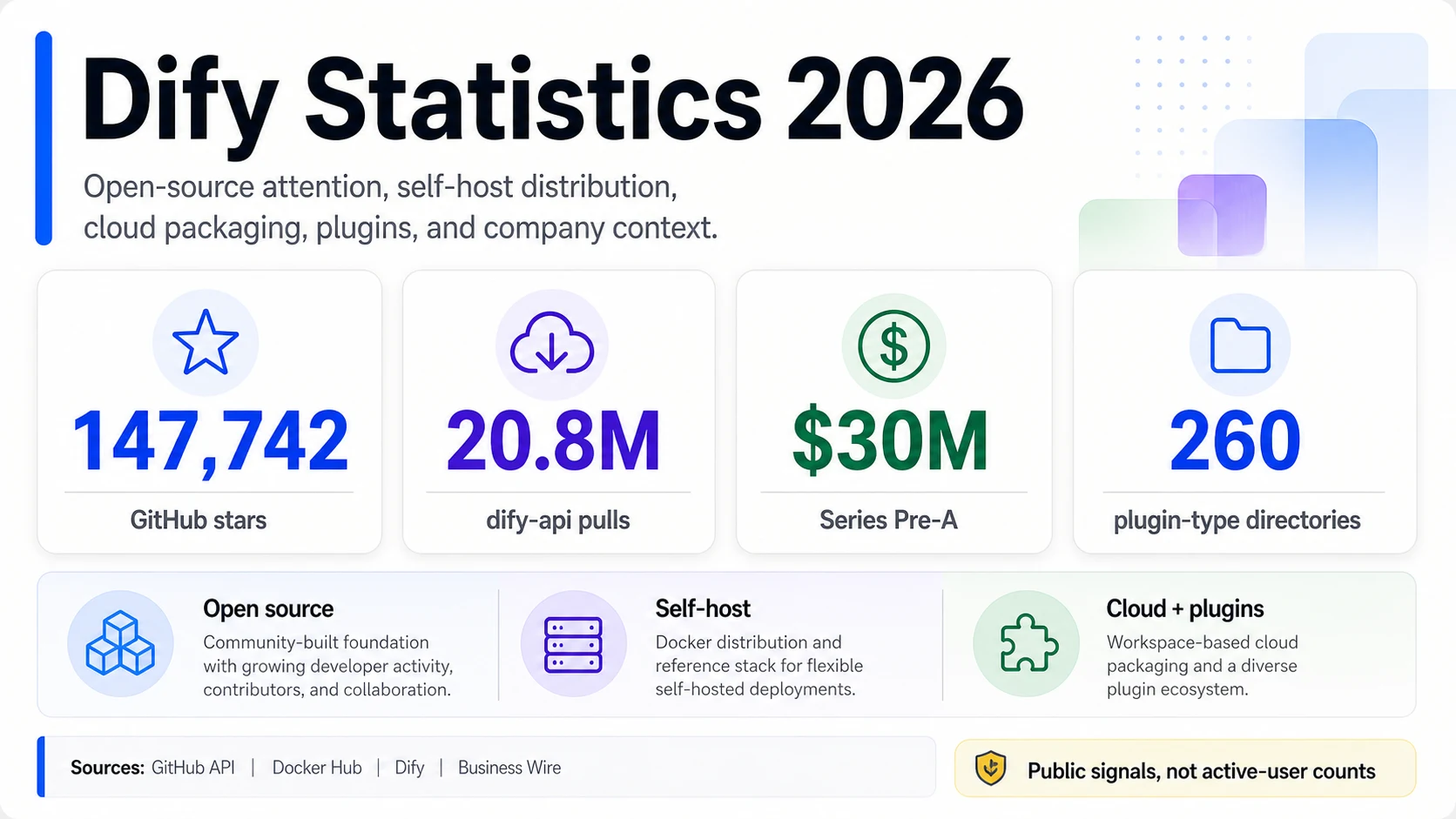
Dify’s public footprint in 2026 is easiest to misread if every large number gets treated as “users.” The open-source project is clearly large: the langgenius/dify repository had 147,742 GitHub stars, 23,264 forks, and about 1,375 contributors in the July 5, 2026 GitHub API snapshot. Those are strong open-source attention and participation signals.
The harder question is what those numbers prove. GitHub stars do not measure Dify Cloud users. Docker pulls do not equal active self-hosted deployments. A plugin repository is not the same as plugin adoption. Pricing pages do not reveal revenue. Funding is company momentum, not customer count. The useful way to read Dify in 2026 is as a layered platform: open-source project, self-hosted distribution, hosted workspace product, plugin and model-provider ecosystem, and LangGenius company context.
Where Dify Stands In 2026
The headline Dify numbers use different denominators, so read them as separate open-source, distribution, pricing, and company signals rather than one figure.
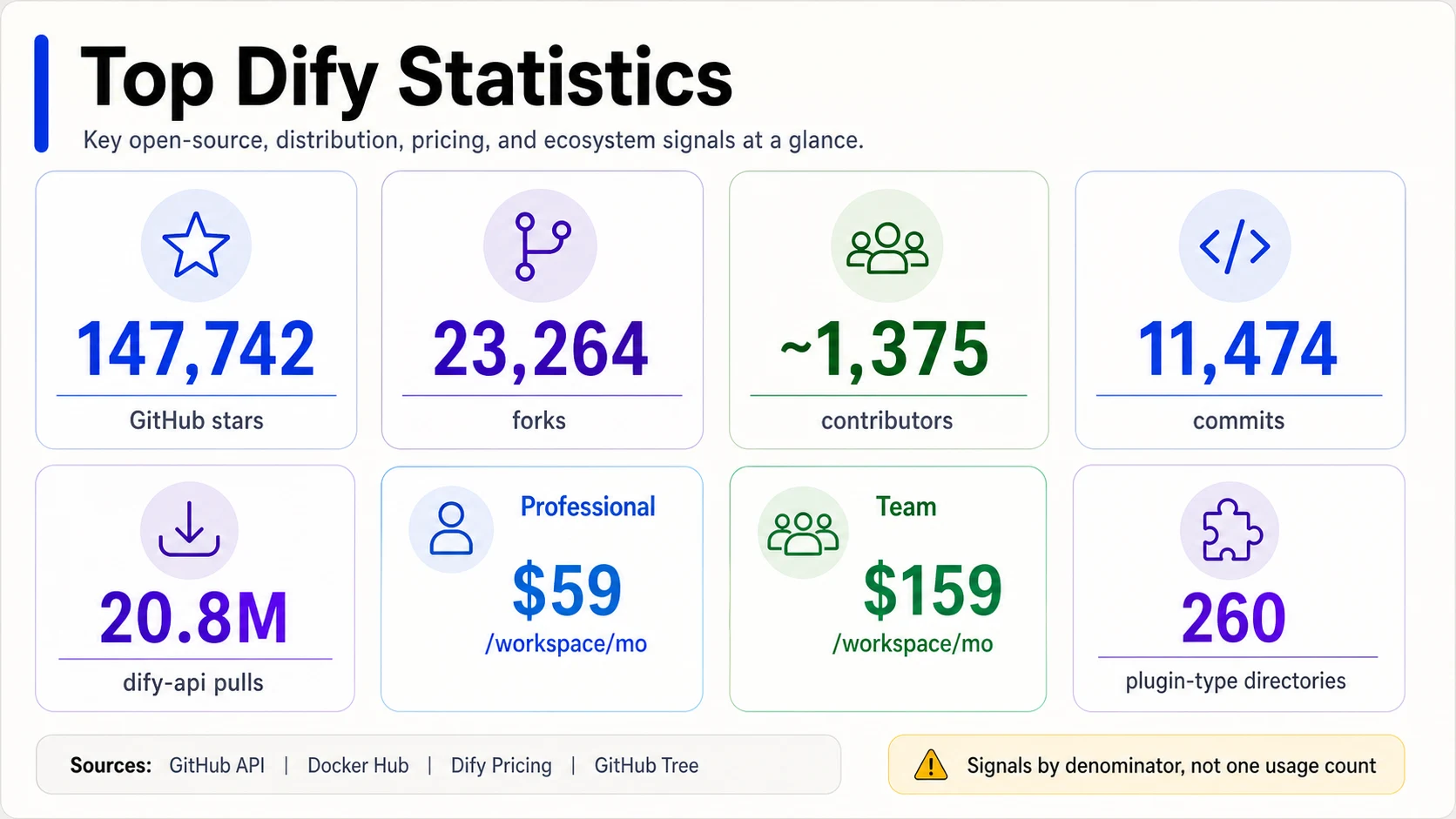
Open-source footprint (July 5, 2026 snapshot)
Distribution, pricing & company context
Read every number by its own denominator
Dify's headline figures answer different questions. Tap a metric to see what it measures — and what it does not prove.
GitHub APIStars Are Not Users: Reading Dify’s Numbers
Dify has a stronger public data trail than many private AI application-platform companies, but the trail is uneven. The open-source layer is visible through GitHub, release pages, contributor graphs, and Docker Hub. The hosted-product layer is visible through pricing, billing docs, model-provider docs, and workspace integrations. The company layer is visible through Dify’s funding announcement, Business Wire, and compliance announcements.
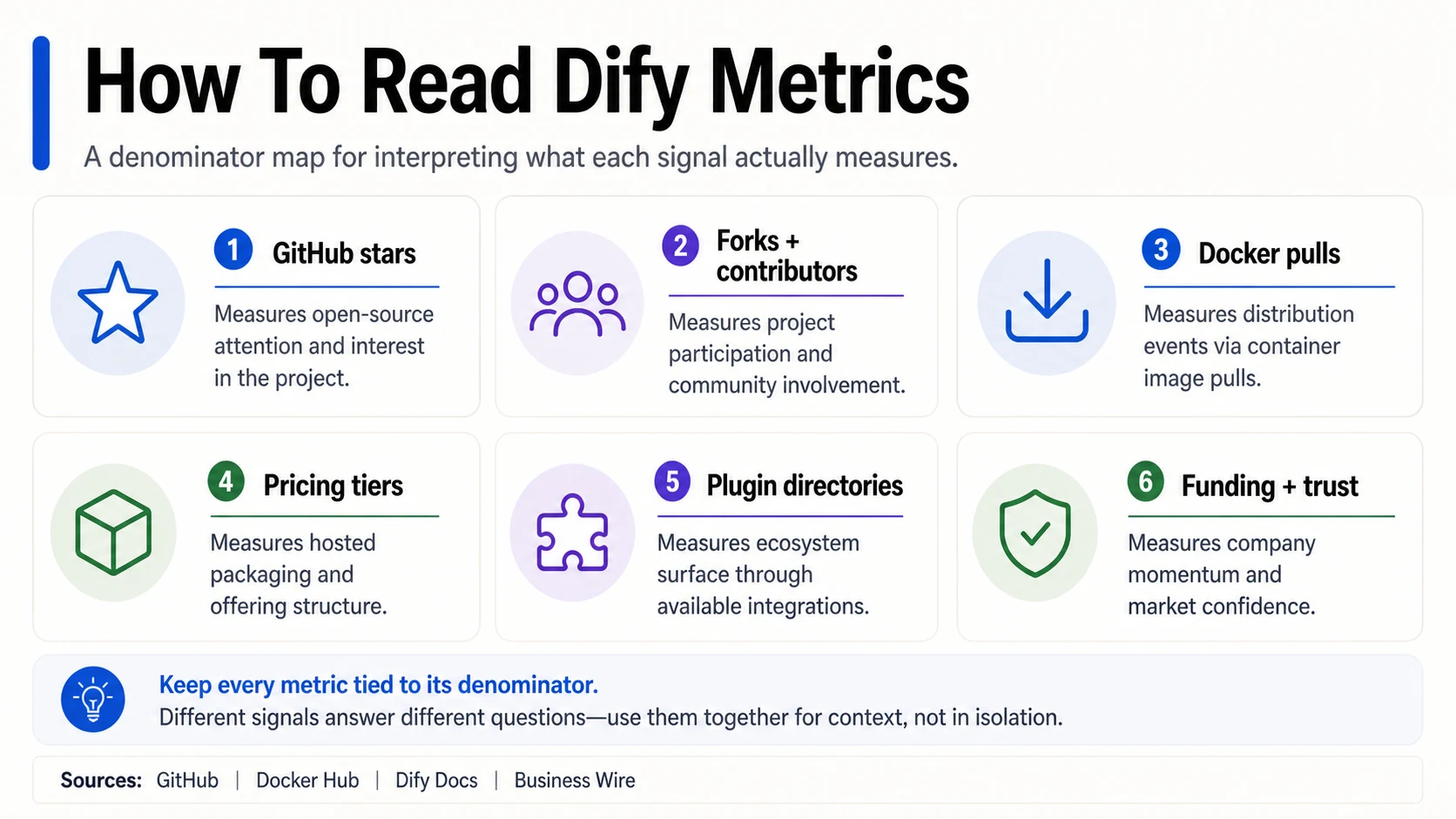
Those layers answer different questions. GitHub stars answer, “How much public developer attention does the project have?” Forks answer, “How many GitHub accounts copied the repository?” Contributors answer, “How broad is participation in the open-source project?” Docker pulls answer, “How often have official images been pulled?” Pricing answers, “How does Dify package the hosted product?” Funding answers, “What kind of investor and company momentum has been disclosed?”
None of those numbers answers, “How many active Dify Cloud users are there?” They also do not answer paid-customer count, monthly active workspaces, active self-hosted installations, revenue, retention, churn, net revenue retention, or customer deployment depth. That absence is not unusual for a private company with an open-source product, but it changes how each statistic should be used.
Open-Source Footprint: Stars, Forks, Contributors, Commits, And Releases
Dify’s open-source footprint is the strongest public part of its data story. The main langgenius/dify repository is not a small side project: the July 5, 2026 GitHub API snapshot showed 147,742 stars, 23,264 forks, 816 watchers/subscribers, and a latest push timestamp on the same day. The GitHub page rounded that to 148k stars and 23.3k forks.
The historical slope matters. Dify’s official milestone post says the project crossed 100,000 GitHub stars on June 5, 2025, and that Dify had been open-sourced on May 15, 2023. By July 5, 2026, the project had grown to about 147.7k stars in the API snapshot — roughly 47,700 stars above that official milestone.
GitHub stars — from open-source launch to 148k
Three anchored points on a linear axis: 0 stars at the May 2023 open-source launch, the official 100,000-star milestone in June 2025, and 147,742 in the July 2026 API snapshot.
Dify & GitHub API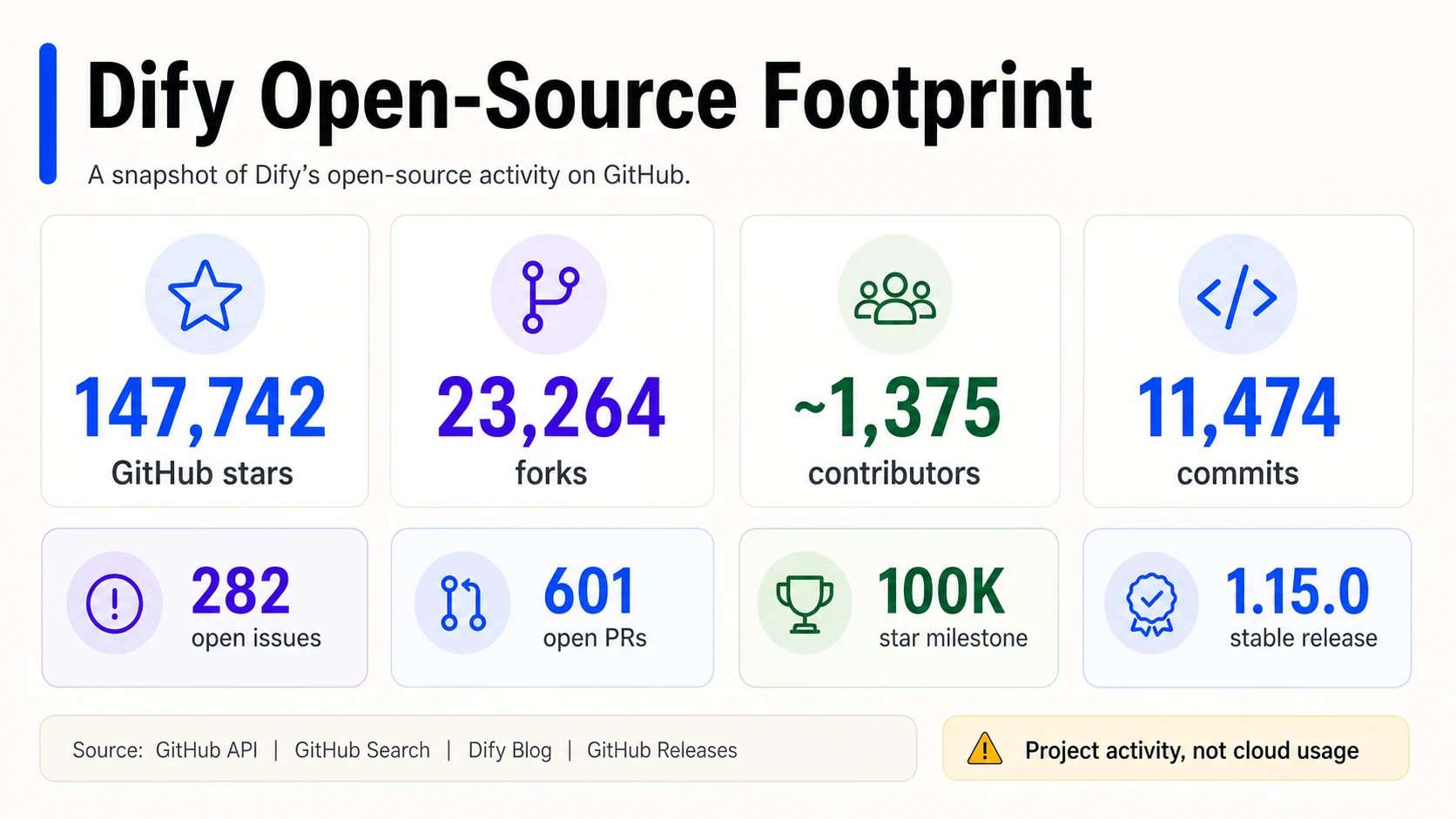
Participation is also visible. The contributors endpoint pagination indicated roughly 1,375 contributors, and the commits endpoint indicated 11,474 commits, matching the web UI. These are signs of a busy open-source project, but they still measure project activity rather than production usage.
The issue and pull-request backlog needs careful interpretation. The repository API reported 883 open issues and PRs combined. A separated GitHub search returned 282 open issues and 601 open pull requests, plus 17,922 closed issues and 14,598 closed PRs. A large backlog can indicate active community engagement, heavy development, product complexity, or maintenance pressure — it should not be simplified into either “healthy” or “unhealthy” without looking at labels, age, and close rate.
Release state is easier to read. Dify 1.15.0 was the latest stable release in the July 5 snapshot, published on June 25, 2026, and the release page also shows 2026 releases such as 1.13.0, 1.14.0, and their patch versions. Dify 1.15.0 introduced difyctl, a command-line client for running Dify apps and workflows from terminal, scripts, and CI pipelines. That is a product-surface expansion from web console to developer automation.
Self-Hosting And Docker Distribution Signals
Dify’s self-hosting story is visible from two directions: official docs and official Docker images. The GitHub README says the easiest way to start the server is through Docker Compose, and the dedicated self-host docs show the quick start for Docker Compose. The docs tell users to clone the repository, enter the docker directory, copy the environment file, and run the compose command.
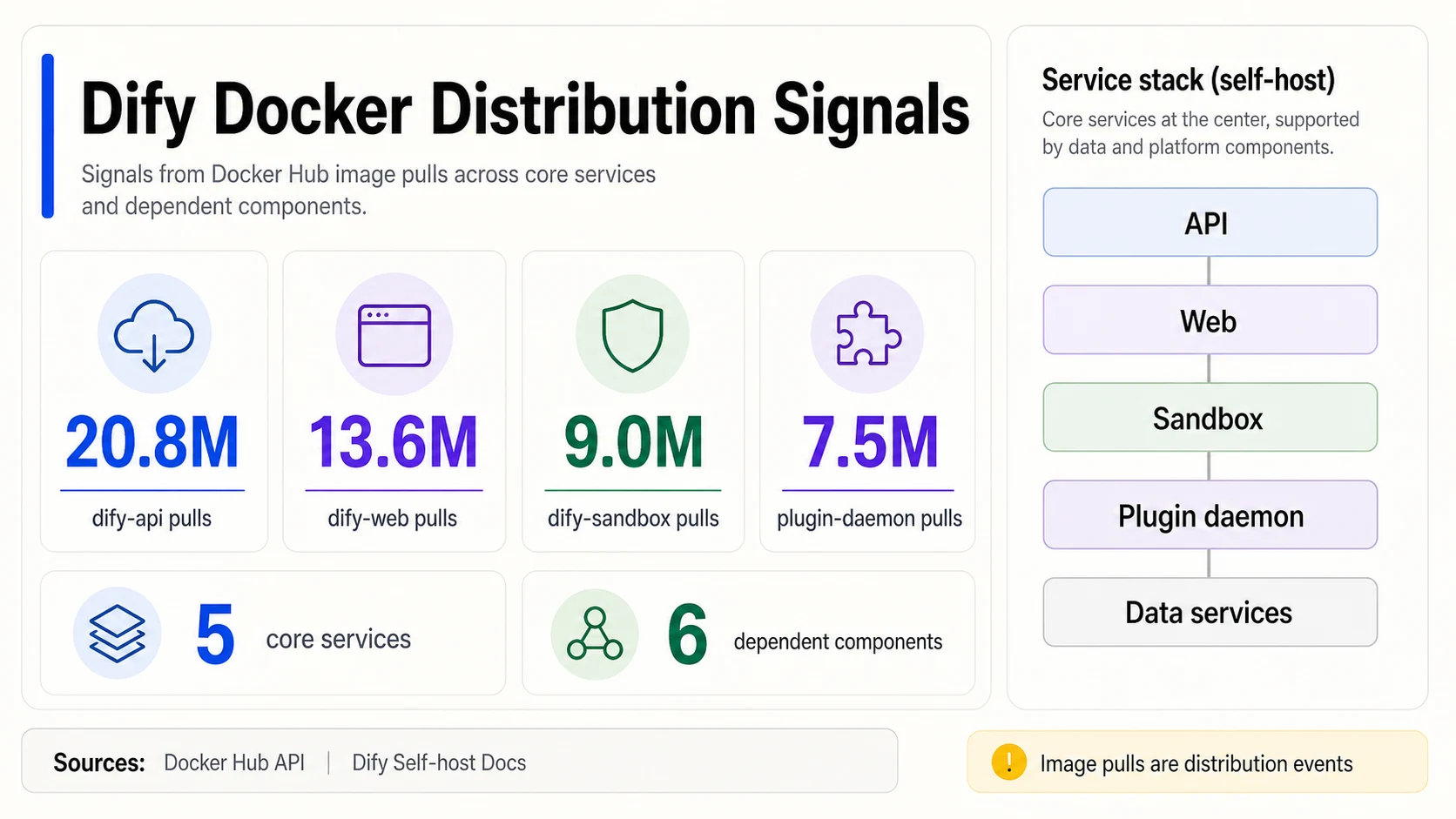
The same quick-start docs say the stack starts 5 core services and 6 dependent components: core services such as API, background job service, scheduler, web, and plugin daemon, plus components such as Weaviate, PostgreSQL, Redis, Nginx, SSRF proxy, and sandbox. That architecture matters for metrics — a single working environment can pull several images, and those images can be pulled again during upgrades, CI jobs, cache misses, failed deployments, and test runs.
The mistake is to sum those four counts and call the result deployments. If dify-api, dify-web, dify-sandbox, and dify-plugin-daemon are all part of the same Dify deployment pattern, then adding pull counts across services double-counts or quadruple-counts deployment-related activity. Docker pulls also include automated rebuilds, retries, cache warming, and version churn. Use them for distribution heat, not active instances.
The environment variable docs describe public console API URLs, backend API URLs, web app URLs, trigger URLs, file URLs, OAuth callback needs, collaboration mode, database settings, queue settings, background-job settings, and vector store profiles. These are real deployment surfaces that make Dify relevant for teams that want control over data, model keys, integrations, and infrastructure. The self-hosting signal is therefore strong but indirect: Docker Hub proves distribution activity around official images, and the docs prove Dify supports self-hosted operational deployment — neither proves how many active self-hosted installations exist today.
Dify Cloud, Pricing, And Workspace Packaging
Dify Cloud has a clearer public packaging surface than most open-source AI app platforms. The official pricing page lists Sandbox as free, Professional at $59 per workspace/month, Team at $159 per workspace/month, and Enterprise through contact and sales flows. Dify also says annual billing saves 17%, and notes that subscription prices exclude applicable taxes.
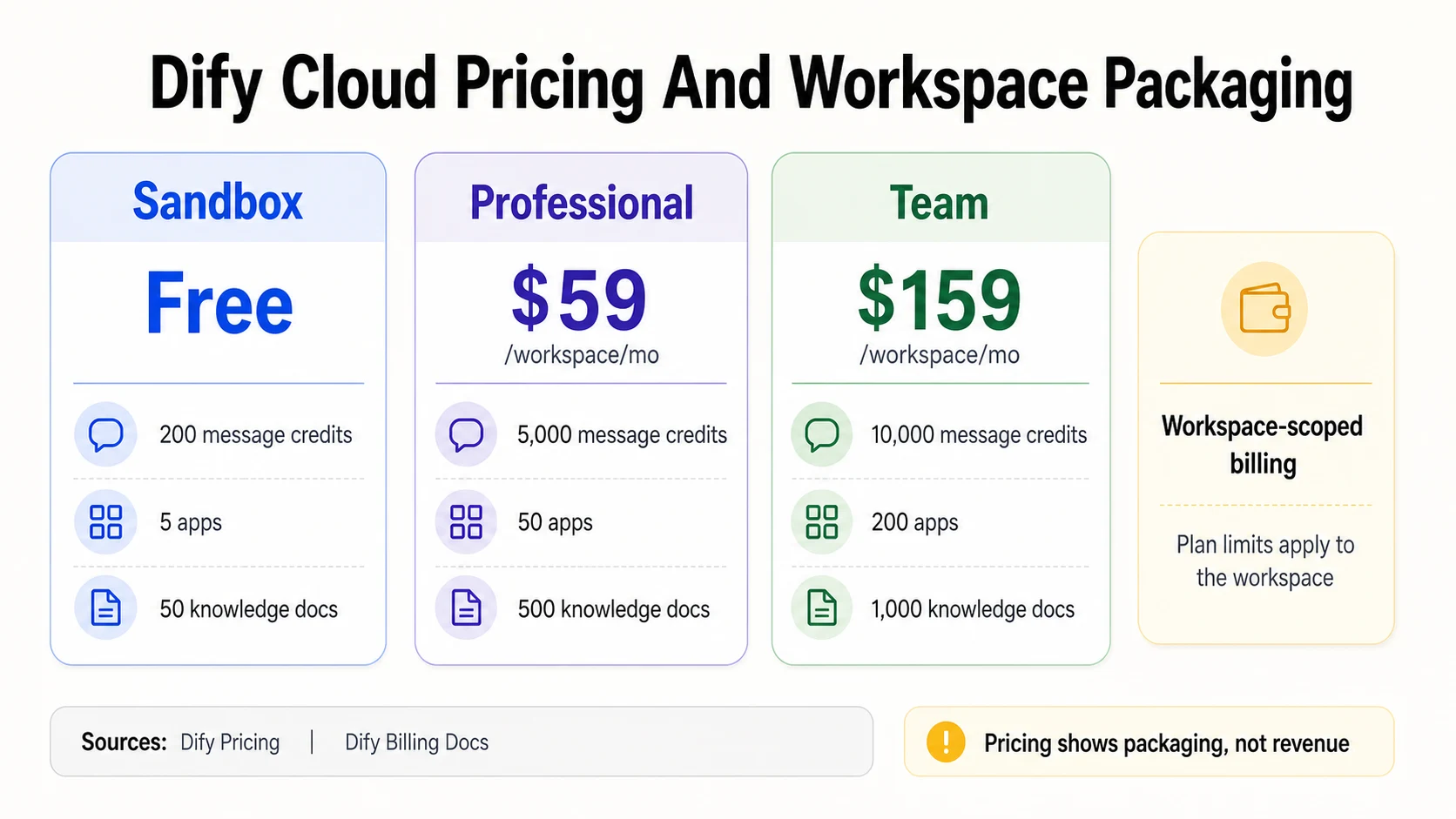
The billing docs make the unit explicit: billing is workspace-scoped. A subscription sets the team-member limit, feature access, and usage quotas for the entire workspace. That matters because Dify is not pricing simply by individual user seat — it is packaging a workspace with credits, apps, knowledge limits, storage, request limits, trigger events, workflow behavior, logs, and API access.
The Dify Cloud pricing ladder
Tap a tier to see how Dify packages message credits, team members, apps, and knowledge limits per workspace. Prices are per workspace/month; Enterprise is contact/sales.
Dify PricingThese plan limits are valuable for buyers because they show the shape of Dify Cloud’s product. They also show why pricing should not be used to infer revenue. A workspace can use different models, bring-your-own-key provider keys, Dify credits, different app volumes, and different workflow patterns. Discounting, annual billing, education pricing, enterprise contracts, and self-hosting all complicate any revenue inference. The public page gives enough detail to compare Dify’s hosted product with self-hosting, but it does not disclose active workspaces, paid customers, ARR, retention, or customer concentration.
Product Surface: Apps, Workflows, Agents, Knowledge, APIs, Logs, And CLI
Dify’s product surface is broader than a chatbot UI. The homepage says Dify offers agentic workflows, RAG pipelines, integrations, and observability in one place, and the GitHub README describes Dify as an open-source LLM app development platform with workflow, model support, Prompt IDE, RAG pipeline, agent capabilities, LLMOps, and backend-as-a-service APIs.
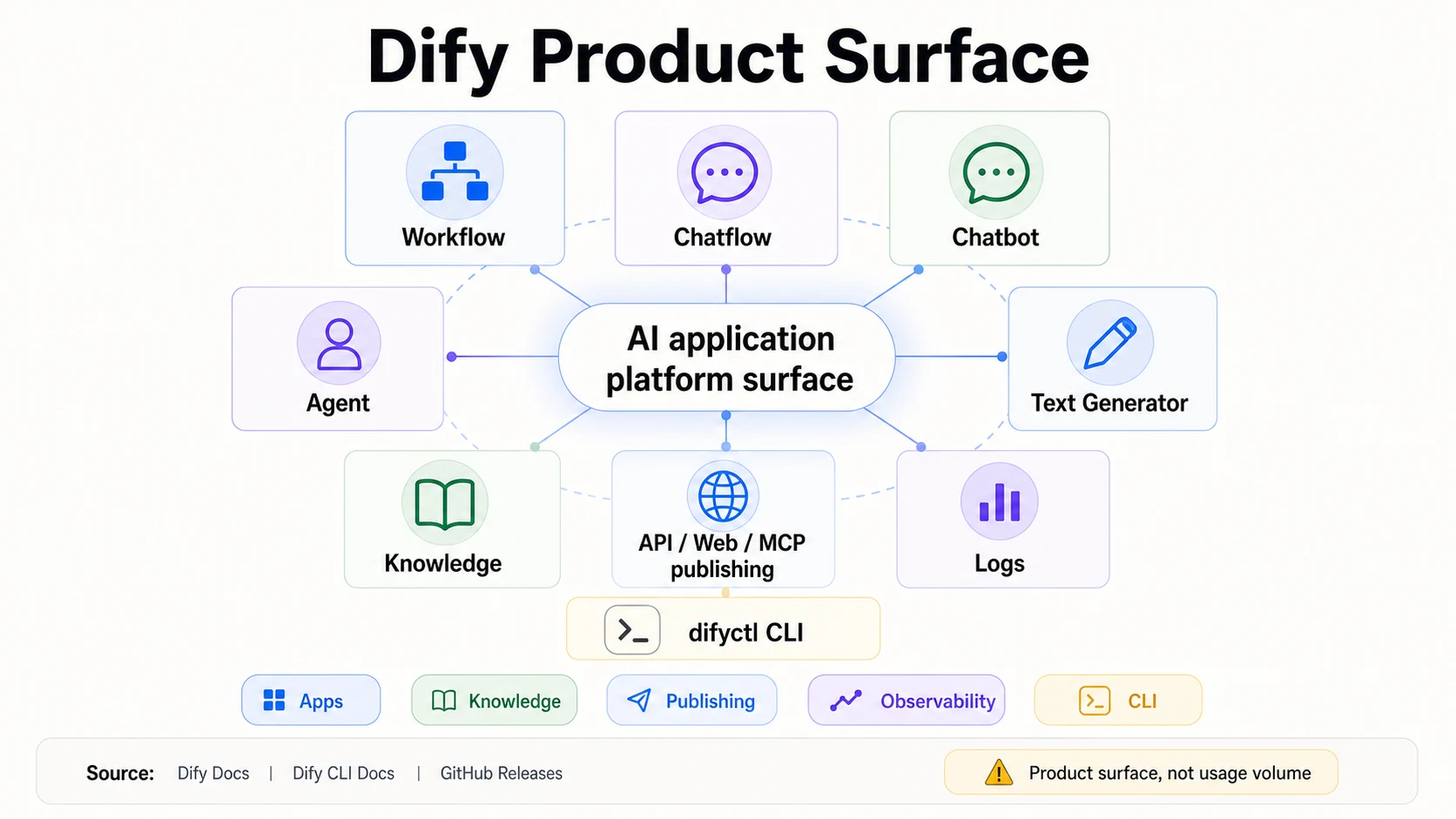
The docs make the app model more precise. Dify’s key-concepts page says the product is made for agentic app building, and that published apps can be accessed through API, web, or as an MCP server. It says the two main app types are Workflow and Chatflow, with Chatbot, Agent, and Text Generator as additional basic app types, and that those app types run on the same workflow engine underneath.
Workflow & Chatflow
Workflow apps handle single-turn tasks starting from a user input or trigger; Chatflow adds conversation state, custom variables, memory, and streaming multi-turn output.
Agents with autonomous tool use
The Agent docs describe chat-style apps that reason through a task and use tools autonomously, keeping up to 500 messages or 2,000 tokens of conversation history.
Knowledge & RAG
Knowledge docs cover quick create, knowledge pipelines, external knowledge bases, retrieval testing, metadata, and app integration, including connecting existing retrieval systems by API.
Publishing, APIs & logs
Apps publish via API, web, or MCP server; completion-messages and chat-messages APIs are documented, and conversation logs give visibility into every interaction.
CLI execution
Dify 1.15.0 introduced difyctl, running apps and workflows from terminal, scripts, and CI pipelines — moving Dify closer to batch operations and system integration.
The Agent docs describe agents as chat-style apps where the model can reason through a task, decide what to do next, and use tools autonomously, and state that agents keep up to 500 messages or 2,000 tokens of conversation history before older messages are removed. Knowledge and RAG are also central: Dify’s knowledge docs describe quick create, knowledge pipelines, external knowledge bases, content management, retrieval testing, metadata, and app integration. The logs docs say conversation logs provide visibility into every interaction, helping teams debug issues and understand user behavior patterns.
The safest product conclusion is that Dify is an AI application platform, not only an agent demo or a RAG UI. It covers app creation, workflow orchestration, model selection, knowledge, APIs, logs, plugins, self-hosting, and CLI invocation. None of that proves usage by itself, but it explains why the open-source and Docker metrics are meaningful.
Plugin, Model Provider, And Integration Ecosystem
Dify’s ecosystem story changed materially with plugins. The official dify-official-plugins README says that starting with Dify v1.0.0 in February 2025, models and tools were migrated into plugins and stored in the official plugin repository, and those official plugins are uploaded to the Dify Marketplace and maintained by the official Dify team.
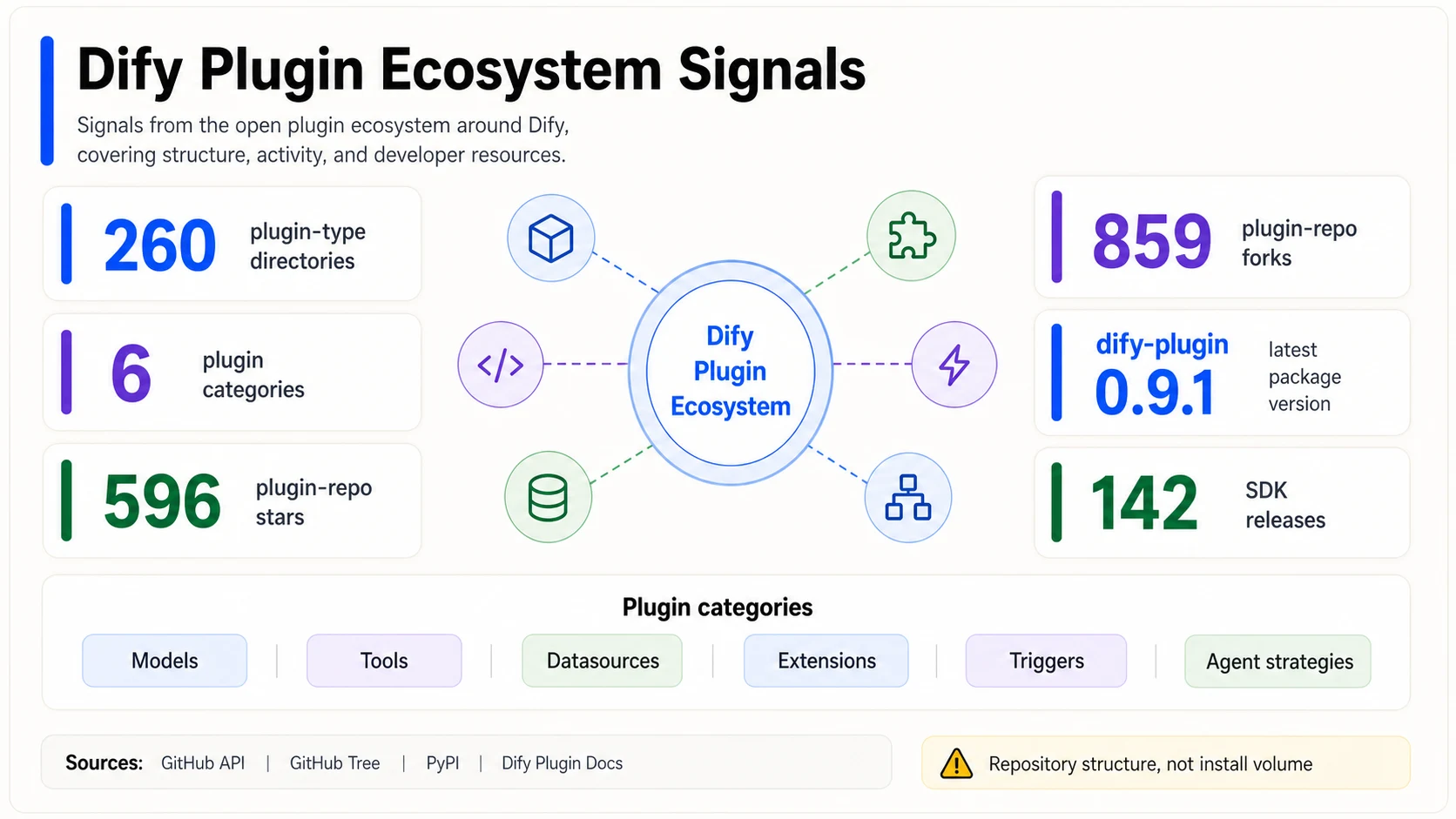
A July 5, 2026 GitHub tree snapshot of langgenius/dify-official-plugins found 260 top-level plugin-type directories under models, tools, datasources, extensions, triggers, and agent strategies. The official dify-official-plugins repository itself had 596 stars, 859 forks, and 44 open issues in the API snapshot. Dify’s plugin launch post frames the system as a mix of official plugins, partner solutions, and verified community contributions, and says Marketplace plugins undergo code review, run in isolation with defined permissions, and include data-handling declarations.
Inside the official plugin repository
Provider and model directories such as Anthropic, Azure OpenAI, Bedrock, and DeepSeek, with roughly 495 directories nested under models in the recursive tree.
The largest category, with roughly 659 directories nested under tools in the recursive repository tree — a map of implementation surface, not an exact plugin count.
Data-source directories such as Google Drive, Notion, GitHub, and SharePoint, with roughly 70 directories nested under datasources.
Extension plugins that hook into the platform, with roughly 31 directories nested under extensions in the recursive tree.
Trigger plugins that start workflows from external events, with roughly 212 directories nested under triggers.
The smallest category, with roughly 7 directories nested under agent strategies — reasoning patterns agents can adopt.
260 top-level plugin-type directories span six categories. Tap a category to see what it holds — this is repository structure, not marketplace install volume.
GitHub TreeThat 260 count should be used carefully. The recursive repository tree also had many nested folders, and those nested counts are not exact plugin counts — they are a map of implementation surface. The plugin tooling layer is smaller but active: the official dify-plugin-sdks repository had 143 stars, 140 forks, and 73 open issues; PyPI dify-plugin was at version 0.9.1 with 142 releases and a latest upload on June 17, 2026; and the npm package dify-client was at version 3.1.0.
This ecosystem surface matters because Dify is competing to be the orchestration layer between teams, models, data, tools, and apps. But ecosystem surface is not adoption. A plugin directory does not prove an active install. A package version does not prove downloads. A model-provider page does not prove model usage volume. Use these numbers to show platform breadth, then keep the usage gap visible.
Company Context: Funding, Valuation, And Enterprise Readiness
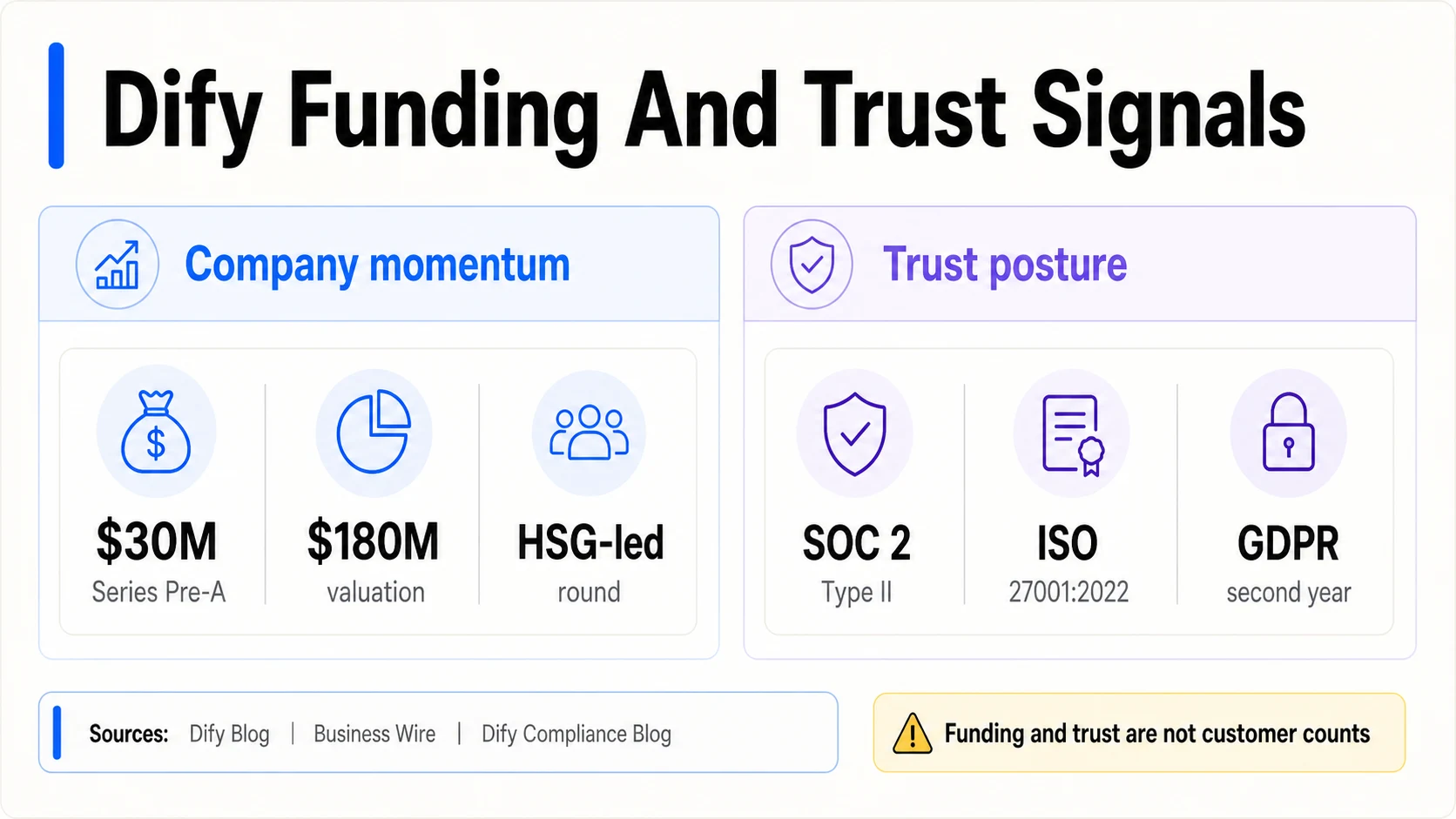
Dify’s company context became clearer in March 2026. Dify’s own blog says it raised a $30 million Series Pre-A led by HSG, with participation from GL Ventures, Alt-Alpha Capital, 5Y Capital, Mizuho Leaguer Investment, and NYX Ventures, and says returning investor 5Y Capital doubled down.
Company momentum
$30M Series Pre-A
Led by HSG with participation from GL Ventures, Alt-Alpha Capital, 5Y Capital, Mizuho Leaguer Investment, and NYX Ventures, announced March 10, 2026.
Dify BlogReported valuation
$180M valuation
Business Wire reported the same round at a $180 million valuation, describing Dify as an open-source platform for production-grade AI applications and agentic workflows.
Business WireTrust posture
SOC 2 · ISO 27001 · GDPR
Dify says it completed SOC 2 Type II, ISO 27001:2022, and GDPR compliance for the second consecutive year, with audits covering data security and development security.
Dify BlogPublic trust surface
Trust Center
Dify operates a public Trust Center, though the compliance announcement is the clearer public source for the specific audit details.
DifyThe company signal should stay in its lane. A $30M Series Pre-A is not revenue. A $180M valuation is not ARR. Investor participation is not customer count. The funding does show that Dify has investor-backed momentum around the enterprise agentic-workflow category, but it does not fill the missing denominators around active users, paid workspaces, self-hosted deployments, or retention.
Security and compliance add another enterprise-readiness layer. Dify says it completed SOC 2 Type II, ISO 27001:2022, and GDPR compliance for the second consecutive year, with audits covering personnel management, vendor onboarding, data security, system operations, and development security. Compliance is meaningful for buyers evaluating hosted or enterprise AI infrastructure, but it does not prove the number of enterprises using Dify. It proves that Dify is investing in the trust surface enterprises usually require before procurement can scale.
Market Context: AI App Builders And Agentic Workflows
Broader AI adoption explains why Dify’s category matters, but it should not be turned into Dify-specific adoption. The Stack Overflow 2025 Developer Survey says 84% of respondents use or plan to use AI tools in development, and that 51% of professional developers use AI tools daily. That is developer-AI category context, not Dify share.
GitHub’s Octoverse 2025 frames AI, agents, and typed languages as major shifts in software development. Dify’s open-source attention lives inside that broader GitHub ecosystem, but GitHub’s platform-level metrics do not prove Dify usage. The Stanford AI Index 2026 is useful for the same reason: it shows a broader AI adoption and measurement environment, and its framing around rapid generative AI adoption supports cautious language around agentic platforms. McKinsey’s State of AI notes that agent scaling is still uneven by function.
The key category takeaway is that Dify sits in a market where AI app building is moving from prompts and chat interfaces toward workflows, agents, model routing, knowledge retrieval, tools, APIs, and observability. Dify’s own docs line up with that shift through workflows and chatflows, agents, knowledge, integrations, and API publishing.
What This Means For Operators And AI Builders
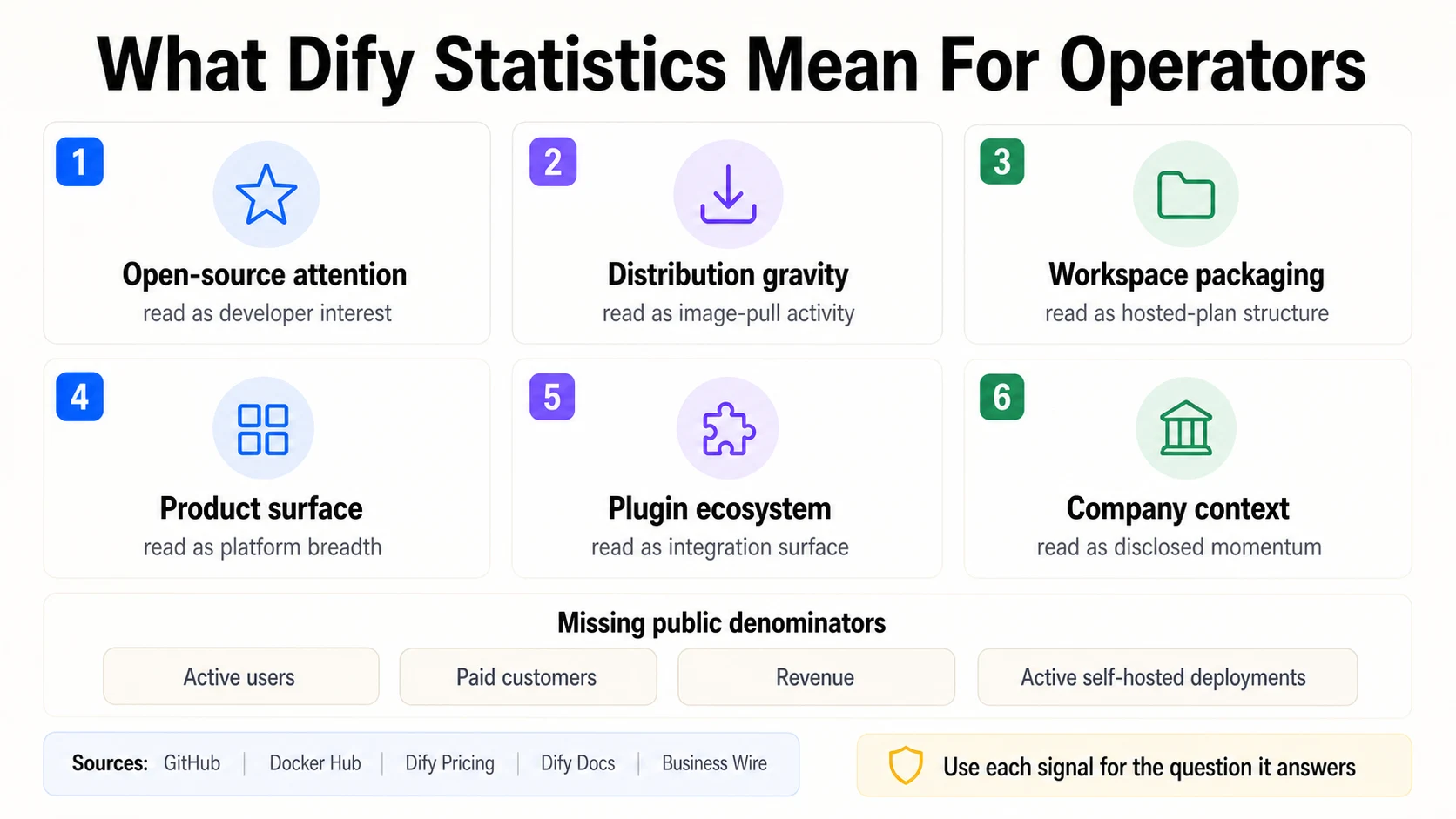
For operators, the most important Dify statistic is not one number. It is the gap between visible open-source momentum and invisible production usage.
Open-source view
Momentum, not usage
147,742 GitHub stars, 23,264 forks, and roughly 1,375 contributors show Dify is a major open-source project — they do not show how many teams rely on Dify in production.
GitHub APIInfrastructure view
Distribution, not installs
20.8M dify-api pulls and the rest of the official image set show wide distribution. The safe buyer question is whether the team can operate the stack, secrets, model keys, plugins, and upgrade path.
Docker HubProduct-leader view
Packaging, not ARR
The difference between Sandbox, Professional, Team, and Enterprise tells buyers how Dify thinks about workspaces, credits, members, apps, and limits — without pretending to know revenue.
Dify PricingBuilder view
A platform, not a chatbot
Dify combines Workflow and Chatflow, Agents, Knowledge, model providers, integrations, logs, APIs, and CLI execution — more like an application platform than a single-purpose chatbot builder.
Dify DocsFor GTM teams, Dify’s company context should be used carefully. The $30M Series Pre-A, $180M valuation, and SOC 2 / ISO 27001 / GDPR posture support the idea that Dify is serious about enterprise workflows. They do not reveal conversion, average contract value, or churn.
A star count shows attention, not usage.
The 147,742 stars measure public developer attention, not active Dify Cloud users or production deployments.
Docker pulls show distribution, not installs.
Pulls include rebuilds, retries, CI jobs, and upgrades, and adding them across four images double-counts the same deployment pattern.
Pricing shows packaging, not revenue.
The $59 and $159 workspace tiers reveal how Dify packages the product, but not ARR, paid workspaces, or retention.
Plugin directories show breadth, not adoption.
The 260 top-level directories map ecosystem surface in source control, not marketplace install or usage volume.
Funding shows momentum, not customers.
The $30M raise and $180M valuation are company signals, not revenue, customer count, or active self-hosted deployments.
The strongest operator takeaway is that Dify has public evidence of momentum at several layers: open-source attention, release velocity, Docker distribution, hosted pricing, plugin architecture, security and compliance posture, and venture backing. The missing public data is equally important: exact active users, paid customers, revenue, retained cohorts, active self-hosted deployments, and customer distribution are not available in a clean current public dataset.
What To Watch Through The Rest Of 2026
The first number to watch is GitHub velocity. If stars, forks, contributors, releases, and closed PRs keep rising, the open-source project remains active; if releases slow or the backlog grows without resolution, the same public metrics could start to mean maintenance pressure rather than momentum. The second is Docker distribution by image — pull counts should remain pull counts, but changes in update cadence and tags can indicate active packaging.
GitHub velocity
Stars, forks, contributors, releases, and closed PRs — rising numbers mean an active project; a growing unresolved backlog would suggest maintenance pressure.
Docker distribution by image
The official image set around dify-api, dify-web, dify-sandbox, and dify-plugin-daemon is a better self-hosting signal than third-party tutorials.
Cloud packaging changes
Changes to Professional and Team limits, message credits, app counts, storage, trigger events, API limits, or Enterprise language would signal where Dify is monetizing.
Plugin ecosystem maturity
The official plugin repo and Marketplace should be watched for clearer public counts, install data, verification tiers, and partner plugins.
Company transparency
A future disclosure of revenue, paid workspaces, enterprise customers, retention, or active deployments would materially change the data picture.
The current 260 top-level plugin-type directories show breadth in source control, but marketplace install and usage data would be a much stronger adoption signal. Dify has disclosed $30M in Series Pre-A funding and Business Wire reports a $180M valuation. A future disclosure of revenue, paid workspaces, enterprise customers, retention, or active deployments would materially change the data picture.
Frequently Asked Questions
How many GitHub stars does Dify have in 2026?
The langgenius/dify repository had 147,742 GitHub stars in the July 5, 2026 GitHub API snapshot, with the GitHub web page rounding to 148k. GitHub stars measure public developer attention, not Dify Cloud users or active deployments.
How many times has Dify been pulled on Docker Hub?
In the July 5, 2026 Docker Hub snapshot, the official dify-api image had 20,791,293 pulls, dify-web had 13,558,273, dify-sandbox had 9,024,278, and dify-plugin-daemon had 7,473,771. These are pull counts, not active installations, and they should not be summed into a deployment total because the images belong to the same self-host stack.
How much does Dify Cloud cost?
Dify Cloud lists Sandbox as free, Professional at $59 per workspace/month, and Team at $159 per workspace/month, with Enterprise handled through contact and sales, according to the official pricing page. Billing is workspace-scoped, so a subscription sets the team-member limit, feature access, and usage quotas for the whole workspace.
How much funding has Dify raised and at what valuation?
Dify announced a $30 million Series Pre-A led by HSG on March 10, 2026, and Business Wire reported the same round at a $180 million valuation. A $30M raise and $180M valuation are company-momentum signals, not revenue or ARR.
Does Dify publish how many active users it has?
No. Dify does not publish active Dify Cloud users, paid workspaces, revenue, retention, or active self-hosted deployments. Its public statistics are open-source, distribution, pricing, plugin, and company metrics, each with its own denominator.
How many plugins does Dify have?
A July 5, 2026 GitHub tree snapshot of dify-official-plugins found 260 top-level plugin-type directories across models, tools, datasources, extensions, triggers, and agent strategies. That is repository structure in source control, not marketplace install volume or active plugin usage.
What is the latest Dify release?
Dify 1.15.0 was the latest stable release in the July 5, 2026 snapshot, published June 25, 2026, and it introduced difyctl, a command-line client for running Dify apps and workflows from the terminal, scripts, and CI pipelines. Recent 2026 releases also include 1.13.0 and 1.14.0 and their patch versions.
When was Dify open-sourced and when did it hit 100,000 stars?
Dify says it was open-sourced on May 15, 2023, and crossed 100,000 GitHub stars on June 5, 2025, according to its official milestone blog post. By the July 5, 2026 snapshot the project had grown to about 147,742 stars, roughly 47,700 above the milestone.
Sources and Further Reading
Open-source: GitHub & releases
Distribution & self-hosting
Cloud pricing, product & CLI docs
Plugins, funding & trust
Market research & context